Introduction
Reputation management tools are software platforms designed to help businesses monitor, protect, and improve how they are perceived online. These tools act like a digital watchman, scanning review sites, social media, and search engines to find out what people are saying about a brand. Instead of manually checking Google or Yelp every day, a business can use these tools to see all their reviews in one place. They also help companies ask happy customers for reviews automatically, which helps push down negative comments and makes the business look better to potential buyers.
In a world where most people read a review before buying a product, these tools are vital for survival. A single bad review left unanswered can turn away dozens of customers, while a steady stream of five-star ratings can significantly boost sales. These platforms provide a way to respond to feedback quickly, manage crisis situations, and analyze customer sentiment using artificial intelligence. When looking for a tool, you should evaluate its ability to pull data from many sources, the ease of its response dashboard, and how well it automates the process of generating new, positive feedback.
Key Real-World Use Cases
- Review Generation: Automatically sending a text or email to a customer after a purchase, asking them to share their experience on Google or Facebook.
- Negative Feedback Alerts: Receiving an instant notification the moment a one-star review is posted, allowing the manager to fix the problem before it goes viral.
- Social Listening: Tracking brand mentions on platforms like Twitter or Reddit even when the user doesn’t “tag” the official company account.
- Local SEO Improvement: Managing business listings (like address and phone number) across hundreds of directories to ensure the brand appears high in search results.
- Sentiment Analysis: Using AI to read thousands of reviews and tell the company if customers are generally happy with the product quality or unhappy with the shipping speed.
Best for
- Local Service Businesses: Plumbers, dentists, and lawyers who rely heavily on local Google reviews to get new clients.
- Multi-Location Brands: Retail chains or restaurant groups that need to manage the reputation of 50 or 100 different locations from one central office.
- E-commerce Stores: Online sellers who need to build trust quickly through verified buyer reviews.
Not ideal for
- Personal Brands with No Budget: If you are an individual just starting out, free Google Alerts might be enough to get you through the first few months.
- B2B Companies with 5-Year Contracts: If you only have three customers and work on long-term government contracts, public review management is likely not a priority.
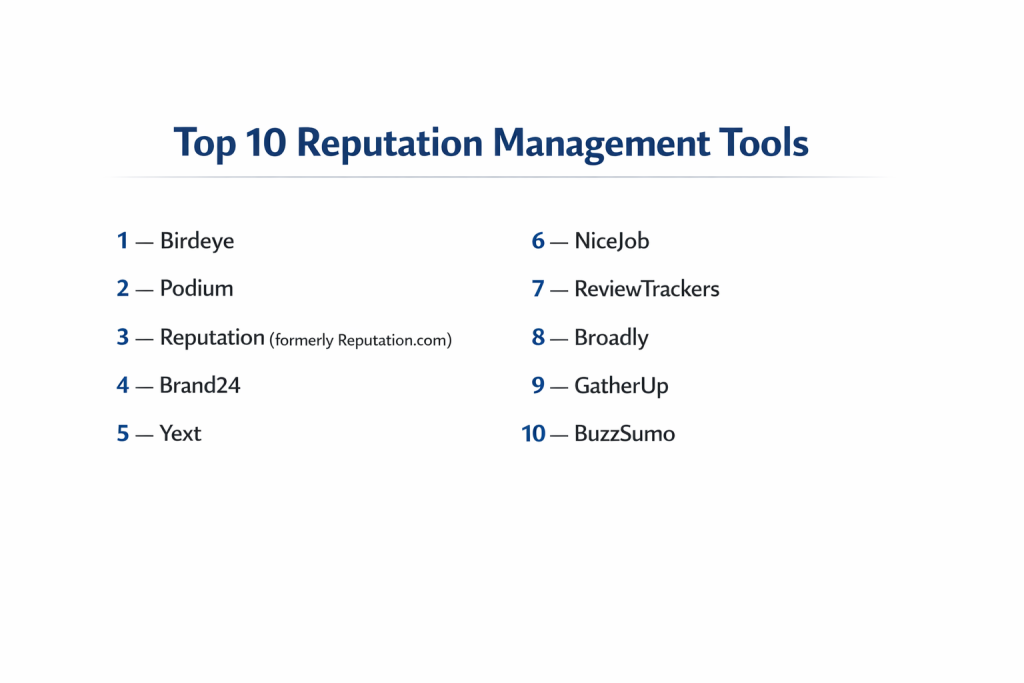
Top 10 Reputation Management Tools
1 — Birdeye
Birdeye is an all-in-one reputation and customer experience platform designed primarily for local businesses. It focuses on turning customer feedback into a marketing engine. It is famous for its ability to manage reviews, social media, and customer surveys in a single, high-powered dashboard that is easy for non-technical managers to use.
- Key features:
- Automated review requests via SMS, email, and QR codes.
- Centralized inbox to respond to Google, Facebook, and industry-specific reviews.
- Listing management to sync business info across 60+ sites.
- AI-powered social listening and sentiment insights.
- Built-in webchat to turn website visitors into leads.
- Automated social media posting and monitoring.
- Benchmarking tools to see how you compare to local competitors.
- Pros:
- Excellent at increasing the total number of positive reviews very quickly.
- The mobile app is robust, allowing owners to manage the brand from their phone.
- Cons:
- Can be expensive for very small businesses with only one location.
- The contract terms can sometimes be rigid for new users.
- Security & compliance: HIPAA, SOC 2 Type II, and GDPR compliant.
- Support & community: High-quality 24/7 support, dedicated account managers for larger teams, and a massive library of educational webinars.
2 — Podium
Podium is built around the idea that “leads are conversations.” It is a communication-first platform that uses text messaging to collect reviews and talk to customers. It is a favorite for home services, automotive dealerships, and retail shops that want a fast, modern way to interact with their community.
- Key features:
- Review management with a focus on mobile-first text requests.
- Unified inbox for text, email, and social media messages.
- Payments integration so customers can pay via a text link.
- Team collaboration tools to assign messages to specific employees.
- Bulk messaging for marketing promotions and updates.
- Automatic review invites sent immediately after a sale is closed.
- Detailed analytics on response times and employee performance.
- Pros:
- Extremely high open rates because it relies heavily on text messaging.
- Simplifies the entire customer journey from the first question to the final review.
- Cons:
- Not as strong in “deep” social media listening as enterprise tools.
- The costs can scale up quickly if you send a very high volume of messages.
- Security & compliance: SOC 2 Type II, PCI compliant for payments, and GDPR compliant.
- Support & community: Great onboarding experience and a helpful user community for local business owners.
3 — Reputation (formerly Reputation.com)
Reputation is the enterprise choice for giant companies. It specializes in “Reputation Experience Management” for brands with hundreds or thousands of locations. It is highly technical and provides deep data analysis that helps large corporations understand their brand health across the entire internet.
- Key features:
- Large-scale data harvesting from thousands of review and social sources.
- Advanced “Reputation Score” that benchmarks your brand against the industry.
- Managed services where their team helps respond to reviews for you.
- Deep NLP (Natural Language Processing) to find hidden customer trends.
- Directory and listing management for thousands of global locations.
- Integrated survey tools to gather feedback before it hits public sites.
- Crisis management modules for high-risk industries like healthcare.
- Pros:
- The most powerful reporting and data visualization in the industry.
- Built to handle the massive complexity of global, multi-location brands.
- Cons:
- Too complex and expensive for a typical small business.
- Takes a long time to fully set up and train the staff.
- Security & compliance: ISO 27001, SOC 2, HIPAA, and GDPR compliant.
- Support & community: Enterprise-grade support with strategic consulting services.
4 — Brand24
Brand24 is a specialized social listening and monitoring tool. Unlike Birdeye which focuses on “reviews,” Brand24 focuses on “mentions.” It finds every time someone says your name on the web, even if it is just a casual comment on a blog or a forum like Reddit.
- Key features:
- Mentions feed that updates in real-time across the web.
- Mentions analytics showing the “Influence Score” of people talking about you.
- Sentiment analysis to instantly flag if a mention is angry or happy.
- Alert system that pings your phone or Slack when a keyword is mentioned.
- Comparison tools to track your brand against three or more competitors.
- Hashtag tracking for marketing campaigns.
- Automated PDF reports for clients or stakeholders.
- Pros:
- Excellent for finding conversations that don’t happen on standard review sites.
- Very affordable and easy to set up for businesses of any size.
- Cons:
- It does not have tools to “ask” for reviews like Birdeye or Podium.
- Limited ability to manage local business listings.
- Security & compliance: GDPR compliant and uses standard encryption.
- Support & community: Very responsive customer support and a helpful blog for digital marketers.
5 — Yext
Yext is the king of “Digital Knowledge Management.” While it does have review features, its main job is making sure your business information is correct everywhere on the internet. It is the tool you use to make sure Siri, Alexa, Google, and Bing all have the right hours and address for your shop.
- Key features:
- Direct API integrations with hundreds of search engines and maps.
- Review monitoring and response for major platforms.
- “Yext Pages” to build search-optimized local landing pages.
- Knowledge Graph to manage all your business facts in one place.
- Voice search optimization for smart speakers.
- Duplicate listing suppression to remove confusing old addresses.
- Advanced analytics on how people find your business through search.
- Pros:
- The absolute best for controlling your “facts” across the web.
- Significantly helps with SEO and getting found in the “Local Pack” on Google.
- Cons:
- The review management features are not as deep as Birdeye.
- If you stop paying, your listings can sometimes revert to old, incorrect data.
- Security & compliance: SOC 2 Type II, HIPAA, and GDPR compliant.
- Support & community: Strong enterprise support and a large training platform called “Hitchhikers.”
6 — NiceJob
NiceJob is designed for small businesses that want to get more reviews without spending a lot of time on software. Its slogan is “Get the reputation you deserve.” It is simple, automated, and focuses on making the review-asking process as easy as possible for the customer.
- Key features:
- Automated review follow-up sequences (The “Smart Queue”).
- Photo sharing features to show off your work alongside reviews.
- “Stories” feature that turns reviews into social media posts automatically.
- Lead hub to track where your new customers are coming from.
- Simple integration with house-call and field-service software.
- SMS and email review invitations.
- No-contract, month-to-month pricing.
- Pros:
- Very high conversion rate for getting customers to actually leave a review.
- Extremely easy to use; you can set it up in under 30 minutes.
- Cons:
- Lacks the deep social listening of Brand24 or the enterprise scale of Reputation.
- Fewer integrations for very large, custom-built corporate systems.
- Security & compliance: Varies / GDPR compliant for standard data.
- Support & community: Friendly, fast support and a community of small business owners.
7 — ReviewTrackers
ReviewTrackers is a mid-market favorite that balances power with simplicity. It provides a very clean dashboard for companies with 10 to 500 locations to monitor reviews, manage local SEO, and analyze what customers are saying about specific locations.
- Key features:
- Aggregation of reviews from over 100 different sites.
- Mobile app for responding to reviews on the go.
- Local SEO tools to manage Google Business Profiles.
- Competitor monitoring to see their star ratings and review volume.
- Smart response templates to save time when answering common feedback.
- Employee performance tracking based on review mentions.
- Custom reporting for different levels of management.
- Pros:
- Very intuitive interface that doesn’t require much training.
- Strong focus on “customer intelligence”—understanding the “why” behind reviews.
- Cons:
- The review generation tools are good but not as “aggressive” as Birdeye.
- Pricing is middle-of-the-road; not the cheapest, but not the most expensive.
- Security & compliance: SOC 2 Type II and GDPR compliant.
- Support & community: Reliable support team and a great library of industry reports.
8 — Broadly
Broadly is a tool built for the “modern” small business. It focuses on the total customer experience, from the first lead to the final five-star review. It is very popular with auto shops, home services, and medical practices that want to look professional online.
- Key features:
- Unified inbox for webchat, text, and email.
- Automatic review requests after a job is completed.
- Team collaboration to make sure every customer gets a fast reply.
- Professional looking website templates optimized for reviews.
- Payments via text (Contactless payments).
- Integration with many field service management tools.
- Simple dashboard to see your overall star rating growth.
- Pros:
- Helps small businesses look much more high-tech and responsive.
- Excellent onboarding that helps you connect all your accounts correctly.
- Cons:
- Does not have the advanced social listening for “brand mentions.”
- More focused on service businesses than e-commerce or giant corporations.
- Security & compliance: SOC 2 and GDPR compliant.
- Support & community: High-touch support with dedicated “Customer Success Managers.”
9 — GatherUp
GatherUp (formerly GetFiveStars) is a tool built by SEO experts. It focuses heavily on “First-Party Reviews”—meaning the reviews you own on your own website. It is designed to help businesses get better search rankings through honest customer feedback.
- Key features:
- Automated “feedback first” process to catch unhappy customers privately.
- Review “Schema” to show star ratings directly in Google search results.
- Detailed reporting on “Net Promoter Score” (NPS).
- Integration with major CRMs and POS systems.
- Monitoring of 30+ third-party review sites.
- Ability to display reviews on your website in a beautiful “widget.”
- Video review requests to get video testimonials from fans.
- Pros:
- The best tool for businesses that care deeply about their website’s SEO.
- “Feedback first” approach protects your public reputation from minor mistakes.
- Cons:
- The interface is functional but not as “pretty” as Birdeye or Broadly.
- Requires a bit more setup to get the SEO benefits working correctly.
- Security & compliance: GDPR compliant and standard data encryption.
- Support & community: Very knowledgeable support team with deep SEO expertise.
10 — BuzzSumo
While BuzzSumo is often thought of as a content tool, its “Monitoring” feature is an elite reputation tool for PR teams and digital marketers. It helps you see who is talking about your brand in the news and across social media, focusing on “influence” and “reach.”
- Key features:
- Real-time brand alerts for news articles and blog posts.
- Identification of “top authors” who are writing about your industry.
- Backlink alerts to see who is linking to your website.
- Competitor alerts to see when your rivals get featured in the press.
- Trending alerts for keywords related to your brand.
- Chrome extension for quick lookups.
- Integration with Slack for instant team notifications.
- Pros:
- The best for tracking your reputation in the “media” and the news.
- Helps you find positive stories to share on your own social channels.
- Cons:
- It does not manage Google reviews or Yelp.
- It cannot send review requests to your customers.
- Security & compliance: GDPR compliant.
- Support & community: Large user community and excellent data-driven research blog.
Comparison Table
| Tool Name | Best For | Platform(s) Supported | Standout Feature | Rating |
| Birdeye | Local Businesses | Web, iOS, Android | All-in-one AI platform | 4.8/5 |
| Podium | Text-based Sales | Web, iOS, Android | Text-to-Pay & Inbox | 4.6/5 |
| Reputation | Large Enterprises | Web, iOS, Android | Reputation Score Analysis | 4.4/5 |
| Brand24 | Social Monitoring | Web, iOS, Android | Mentions Influence Score | 4.7/5 |
| Yext | Listing Accuracy | Web | Direct Search Engine APIs | 4.3/5 |
| NiceJob | Simplicity / Growth | Web, iOS, Android | Automated “Smart Queue” | 4.9/5 |
| ReviewTrackers | Mid-Market Brands | Web, iOS, Android | Customer Intelligence | 4.5/5 |
| Broadly | Service Providers | Web, iOS, Android | Contactless Payments | 4.7/5 |
| GatherUp | SEO / NPS Focus | Web | Star Rating Schema | 4.4/5 |
| BuzzSumo | PR / News Tracking | Web | Media Mention Alerts | 4.5/5 |
Evaluation & Scoring of Reputation Management Tools
| Criteria | Weight | Birdeye | NiceJob | Brand24 | Yext |
| Core Features | 25% | 10/10 | 8/10 | 7/10 | 9/10 |
| Ease of Use | 15% | 9/10 | 10/10 | 9/10 | 7/10 |
| Integrations | 15% | 9/10 | 8/10 | 8/10 | 10/10 |
| Security | 10% | 10/10 | 9/10 | 9/10 | 10/10 |
| Reliability | 10% | 9/10 | 10/10 | 10/10 | 9/10 |
| Support | 10% | 10/10 | 9/10 | 9/10 | 9/10 |
| Price / Value | 15% | 7/10 | 10/10 | 10/10 | 7/10 |
| Final Score | 100% | 9.1 | 8.9 | 8.4 | 8.5 |
Which Reputation Management Tool Is Right for You?
Solo Users vs SMB vs Mid-Market vs Enterprise
If you are a solo operator, NiceJob or Brand24 are the best because they are affordable and don’t take much time. Small and medium businesses (SMBs) will find the most success with Birdeye or Podium because they handle everything from reviews to payments. Large enterprises with hundreds of locations must go with Reputation or Yext to manage the massive scale of their data.
Budget-conscious vs Premium Solutions
If you are on a tight budget, Brand24 and NiceJob offer great value without a high monthly cost. If you have the budget for a premium solution, Birdeye is the most powerful choice for growing a local business. Remember, a tool that costs more but gets you 50% more reviews is often cheaper in the long run than a basic tool that does nothing.
Feature Depth vs Ease of Use
If you want a tool that you can set up once and forget, NiceJob is the winner. It is very simple. If you want “feature depth”—meaning you want to analyze sentiment, run social ads, and conduct surveys all in one place—Birdeye and Reputation are the more technical, deep-dive options.
Integration and Scalability Needs
If your business depends on a specific CRM like Salesforce or a service tool like ServiceTitan, make sure your reputation tool connects to it. Broadly and Podium have excellent integrations for service companies. For businesses that plan on opening many new locations soon, Yext is the best for scaling your listings quickly.
Security and Compliance Requirements
Healthcare providers must use a HIPAA-compliant tool like Birdeye, Podium, or Reputation to ensure patient privacy. Financial institutions or global firms that need strict data protection should look for SOC 2 Type II and ISO certifications, which are common in the higher-end enterprise tools.
Frequently Asked Questions (FAQs)
1. Can these tools delete bad reviews?
No tool can “delete” a review just because it is negative. However, they can help you flag reviews that violate platform rules (like fake or offensive ones) and help you bury bad reviews by getting more positive ones.
2. Is it legal to ask only happy customers for reviews?
This is called “review gating,” and platforms like Google and Yelp actually discourage it. It is better to ask all customers for feedback but use a tool like GatherUp to catch negative private feedback first.
3. How much do these tools usually cost?
Prices vary from $50 a month for simple monitoring to $500+ a month for all-in-one enterprise suites. Most local business tools fall in the $200–$400 range.
4. Do these tools work with Siri and Alexa?
Tools like Yext focus specifically on this. By ensuring your data is correct in their Knowledge Graph, you make it much more likely that voice assistants will recommend your business.
5. How long does it take to see results?
Most businesses see an increase in their star rating and review volume within the first 30 days of using an automated system like NiceJob or Birdeye.
6. Do I need to be a tech expert to use these?
No. Most tools like Podium and Broadly are designed for busy business owners. If you can send a text message or check an email, you can use these tools.
7. Can these tools help me find influencers?
Tools like Brand24 and BuzzSumo are great for this. They can tell you who is talking about your industry and how many followers they have.
8. What is “Sentiment Analysis”?
It is an AI feature that reads your reviews and tells you if customers are talking about your “price,” “service,” or “quality” in a positive or negative way.
9. Can I respond to all reviews from one place?
Yes, that is the main benefit of tools like ReviewTrackers or Birdeye. You don’t have to log into Google, Yelp, and Facebook separately.
10. Do I have to sign a long-term contract?
It depends. Tools like NiceJob are month-to-month, while larger platforms like Meltwater or Reputation usually require an annual commitment.
Conclusion
Managing your online reputation is no longer an optional task; it is a fundamental part of running a modern business. Whether you are a local plumber looking for your next 50 reviews or a global brand protecting a multi-million dollar image, there is a tool on this list that fits your specific needs.
The most important takeaway is that the “best” tool is the one that aligns with your primary goal. If you want more reviews, choose Birdeye or NiceJob. If you want to talk to customers via text, choose Podium. If you need to fix your business info across the web, choose Yext. By investing in your reputation today, you are building a foundation of trust that will pay for itself many times over in new customers and increased sales. Success online starts with what people say about you when you aren’t in the room—make sure it’s something good.