Introduction
Brand monitoring tools are specialized software solutions that track where and how your company is being discussed across the digital landscape. These tools scan social media platforms, news sites, blogs, forums, and review portals in real-time to capture mentions of your brand name, products, executives, or even your competitors. By centralizing these conversations into a single dashboard, businesses can move beyond guesswork and gain a data-driven understanding of their public perception.
The importance of brand monitoring cannot be overstated in a fast-moving digital economy. A single viral tweet or a negative news story can shift public sentiment in hours; monitoring tools provide the early warning system necessary for effective crisis management. Beyond crisis control, key real-world use cases include identifying influencers who already love your products, discovering “unlinked” brand mentions for SEO outreach, and monitoring competitor launches to stay ahead of the market. When evaluating tools, users should look for the depth of historical data, the accuracy of sentiment analysis (AI’s ability to tell if a mention is positive or negative), and the breadth of source coverage—especially across “dark” social or niche forums.
Best for: Social media managers, PR professionals, CMOs, and Customer Success teams. These tools are indispensable for B2C brands with high social volume, tech startups protecting their reputation, and global enterprises managing multi-regional public images.
Not ideal for: Small local businesses with very low digital footprints or businesses that rely purely on word-of-mouth with no online presence. In such cases, free alternatives like basic Google Alerts may suffice.
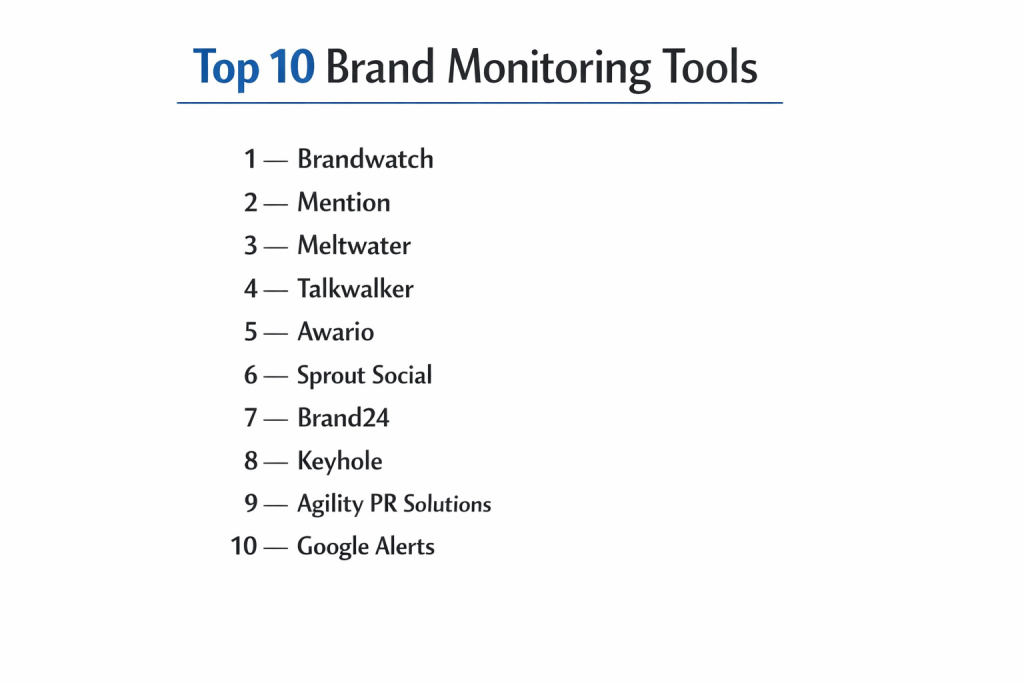
Top 10 Brand Monitoring Tools
1 — Brandwatch
Brandwatch is widely regarded as the enterprise leader in social intelligence. It is designed for deep-dive consumer research and global brands that need to analyze billions of conversations to drive product and marketing strategy.
- Key features
- Access to an archive of over a trillion historical conversations dating back to 2008.
- AI-powered “Iris” analyst that automatically identifies the cause behind data spikes.
- Highly customizable query builders using Boolean logic for precise filtering.
- Image recognition technology to find your brand logo in photos without text mentions.
- Integrated “Vizia” platform for real-time data visualization across office displays.
- Advanced sentiment analysis in dozens of languages.
- Competitor benchmarking and share-of-voice tracking.
- Pros
- The most powerful data cleaning and categorization engine in the industry.
- Unmatched historical data access for long-term trend analysis.
- Cons
- Extremely high price point that is prohibitive for small businesses.
- Steep learning curve; usually requires a dedicated analyst to manage.
- Security & compliance: SOC 2 Type II, ISO 27001, GDPR compliant, and SSO support.
- Support & community: Dedicated account managers, Brandwatch Academy training, and a global user community.
2 — Mention
Mention is a streamlined, real-time monitoring tool built for speed and ease of use. It is ideal for SMBs and agencies that need to react quickly to web and social conversations without the complexity of enterprise software.
- Key features
- Real-time alerts delivered via web, email, or mobile push notifications.
- “Pulse” alerts that notify you when a keyword starts trending.
- Social media management features allowing you to respond to mentions directly.
- Competitive analysis to track up to 10 competitors side-by-side.
- Influencer identification based on reach and engagement scores.
- Automated PDF reporting for stakeholders and clients.
- Boolean search available on higher-tier plans for refined monitoring.
- Pros
- Very user-friendly interface that requires almost zero onboarding.
- Excellent mobile app for monitoring your brand on the go.
- Cons
- Lower-tier plans have strict limits on the number of mentions tracked.
- Historical data is limited compared to enterprise-grade rivals.
- Security & compliance: GDPR compliant and secure data encryption.
- Support & community: Help center, email support, and a robust blog on brand management.
3 — Meltwater
Meltwater combines traditional media monitoring (PR) with modern social listening. It is a favorite for communications teams that need to track print, broadcast, and digital news alongside social media.
- Key features
- Monitoring of over 270,000 global news sources and all major social platforms.
- AI-driven sentiment and emotion analysis.
- “Impact” reports that correlate brand mentions with website traffic.
- Newsletter tool to distribute curated news mentions internally.
- Global database of journalists and influencers for outreach.
- Competitor “Share of Voice” analysis across all media types.
- Real-time dashboards with customizable widgets.
- Pros
- Best-in-class for tracking traditional news and broadcast media.
- Integrated PR and social listening reduces the need for multiple subscriptions.
- Cons
- Contract terms are often rigid and involve annual commitments.
- The platform can feel fragmented due to the high number of integrated tools.
- Security & compliance: ISO 27001, SOC 2 Type II, and GDPR compliant.
- Support & community: Meltwater Academy, 24/7 global support, and dedicated success managers.
4 — Talkwalker
Talkwalker is an enterprise-level platform known for its visual listening capabilities. It focuses on “Conversation Intelligence,” helping brands understand the “why” behind consumer behavior.
- Key features
- Visual listening that identifies logos, objects, and scenes in images and video.
- Global coverage across 187 countries and 187 languages.
- “Predictive Alerting” to spot potential crises before they go viral.
- Video recognition—one of the few tools that can find brand mentions in moving images.
- Automated reporting with AI-summarized insights.
- Deep integration with business intelligence tools like Tableau.
- Customer feedback loop integration (surveys, reviews, and social).
- Pros
- The leader in image and video recognition technology.
- Very fast data processing with almost no lag in mention discovery.
- Cons
- Premium features (like visual listening) come at a high additional cost.
- The setup process for complex queries can be time-consuming.
- Security & compliance: SOC 2 Type II, GDPR, and ISO 27001 compliant.
- Support & community: Global support teams, extensive technical documentation, and user webinars.
5 — Awario
Awario is a “bootstrapped” favorite that offers powerful, non-stop monitoring at an affordable price point. It is designed specifically for startups and solo entrepreneurs.
- Key features
- “Reach” filter that prioritizes mentions from the most influential accounts.
- Boolean search for advanced keyword combinations.
- “Awario Leads” tool that finds people asking for product recommendations in your niche.
- Sentiment analysis to track the “mood” of your mentions.
- Whitelabel reporting for agencies.
- Email and Slack integration for team notifications.
- Monitoring of niche forums like Reddit and Quora.
- Pros
- One of the most affordable tools without sacrificing core monitoring power.
- Does not rely on a single third-party data provider, ensuring high data “hit” rates.
- Cons
- Does not include traditional media (print/broadcast) monitoring.
- The user interface is functional but lacks the polish of more expensive rivals.
- Security & compliance: GDPR compliant and standard SSL encryption.
- Support & community: Direct email support and a helpful knowledge base.
6 — Sprout Social
While primarily a social media management tool, Sprout Social’s “Listening” module is world-class. it is perfect for teams that want their monitoring and their social posting to live in the same place.
- Key features
- Unified “Smart Inbox” to view all social mentions and messages.
- Advanced social listening for industry trends and competitor activity.
- Automated sentiment research for brand health tracking.
- Integration with Google Reviews, Yelp, and Facebook Reviews.
- High-level reporting on audience demographics and geography.
- Collaborative workflows for team-based response management.
- Mobile app with full monitoring and engagement capabilities.
- Pros
- The best user interface in the industry—extremely clean and modern.
- Seamlessly connects brand monitoring to actual social engagement.
- Cons
- The “Listening” module is a premium add-on to the core platform.
- Limited web-wide monitoring (it is heavily focused on social platforms).
- Security & compliance: SOC 2 Type II, GDPR, and SSO availability.
- Support & community: “Sprout Social Index” research, 24/7 support, and a massive community.
7 — Brand24
Brand24 is a popular mid-market tool that specializes in “Reputation Scores.” It is highly effective for measuring the impact of PR campaigns and digital marketing efforts.
- Key features
- “Influence Score” to help identify the most important voices talking about you.
- Sentiment analysis with automated grouping of positive/negative mentions.
- “Reputation Score” that provides a numerical value for your brand health.
- Slack integration for real-time team alerts.
- Podcast monitoring—a unique feature that scans audio transcripts.
- Exportable infographics for quick executive presentations.
- Mobile app for iOS and Android.
- Pros
- Excellent balance of price and feature depth for growing companies.
- The “Reputation Score” is a great KPI for reporting to management.
- Cons
- Some users find the sentiment analysis needs occasional manual correction.
- Coverage of high-volume keywords can be limited on the cheaper plans.
- Security & compliance: GDPR compliant and secure data processing.
- Support & community: Highly responsive chat support and a “Brand24 Academy.”
8 — Keyhole
Keyhole is a specialist in “Hashtag Tracking” and event monitoring. It is the go-to tool for brands that run frequent influencer campaigns or live events.
- Key features
- Real-time hashtag tracking across Twitter, Instagram, and TikTok.
- Influencer management and ROI tracking.
- “Profile Analytics” to monitor competitor growth and engagement.
- Automated “Influencer Discovery” tool.
- Sentiment analysis for specific marketing campaigns.
- Historical data available via “on-demand” snapshots.
- Quick-share dashboards for clients or partners.
- Pros
- Best-in-class for measuring the success of specific social campaigns.
- Very easy to identify which influencers are driving the most value.
- Cons
- Not a “full-web” monitoring tool; it focuses primarily on major social networks.
- Historical search can be expensive compared to real-time tracking.
- Security & compliance: GDPR compliant and secure API integrations.
- Support & community: Email support, live chat, and a focus on social media education.
9 — Agility PR Solutions
Agility PR is a specialized tool for communicators who prioritize “Earned Media” and journalist relations. It is more than a social tool; it is a full PR intelligence suite.
- Key features
- Monitoring of over 1.1 million journalists and influencers.
- Tracking of print, broadcast, online news, and social media.
- Automated “Briefings” sent to your inbox every morning.
- Crisis alerts for negative news mentions.
- Integrated press release distribution wire.
- “Media Value” calculation to see what your mentions would cost in ad spend.
- Relationship management (PRM) to track journalist interactions.
- Pros
- Unmatched for professional PR and media relations teams.
- Provides the “Ad Value Equivalent” metrics that many CEOs still demand.
- Cons
- The social media listening features are not as deep as Brandwatch.
- The interface can feel a bit “old school” compared to modern SaaS tools.
- Security & compliance: GDPR compliant and secure database management.
- Support & community: High-touch customer success and personalized onboarding.
10 — Google Alerts
While technically a free service rather than a “Pro” platform, Google Alerts remains a foundational tool for brand monitoring. It is the baseline for anyone who needs to know when their name appears on the indexed web.
- Key features
- Simple keyword-based monitoring for the entire Google search index.
- Custom frequency settings (As-it-happens, daily, or weekly).
- Filtering by region and language.
- Ability to limit results to “Best results” or “All results.”
- Delivery via email or RSS feed.
- Completely free of charge.
- Pros
- Zero cost and instant setup.
- Excellent for catching blog posts and news articles that smaller tools might miss.
- Cons
- No social media monitoring (it cannot see private profiles or real-time tweets).
- No analytics, sentiment analysis, or reporting features.
- Security & compliance: Backed by Google’s standard security infrastructure.
- Support & community: Peer-to-peer help forums and basic documentation.
Comparison Table
| Tool Name | Best For | Platform(s) Supported | Standout Feature | Rating |
| Brandwatch | Global Research | Web / API | 1 Trillion+ Data Archive | 4.8/5 |
| Mention | Fast SMB Reaction | Web / Mobile | Real-time “Pulse” Alerts | 4.5/5 |
| Meltwater | PR & Media Teams | Web / Mobile | Broadcast/News Integration | 4.4/5 |
| Talkwalker | Visual Monitoring | Web / API | Video/Logo Recognition | 4.6/5 |
| Awario | Startups / Solo | Web | Awario “Leads” Finder | 4.2/5 |
| Sprout Social | Social Engagement | Web / Mobile | Smart Inbox Integration | 4.7/5 |
| Brand24 | PR Reporting | Web / Mobile | Automated Reputation Score | 4.4/5 |
| Keyhole | Influencer Tracking | Web | TikTok/IG Hashtag Analytics | 4.3/5 |
| Agility PR | Traditional PR | Web | Ad Value Equivalent (AVE) | 4.2/5 |
| Google Alerts | Simple Web Alerts | Web / Email | Completely Free | N/A |
Evaluation & Scoring of Brand Monitoring Tools
We evaluated these tools across seven key metrics to provide a balanced view of their performance and ROI.
| Category | Weight | Evaluation Focus |
| Core Features | 25% | Breadth of data (Social, Web, News, Broadcast). |
| Ease of Use | 15% | Dashboard intuitiveness and setup speed. |
| Integrations | 15% | Native connectivity with Slack, CRM, and BI tools. |
| Security & Compliance | 10% | GDPR, SOC 2, and enterprise data governance. |
| Performance | 10% | Latency between a mention and the notification. |
| Support & Community | 10% | Quality of documentation and customer help. |
| Price / Value | 15% | ROI relative to the features provided. |
Which Brand Monitoring Tool Is Right for You?
Solo Users vs SMB vs Mid-Market vs Enterprise
If you are a Solo User or a hobbyist, Google Alerts paired with Awario provides sufficient coverage for almost no cost. SMBs and growing agencies will find the best value in Mention or Brand24, which offer professional analytics without five-figure annual contracts. Mid-Market companies with high social interaction should look at Sprout Social. For Enterprises, the choice usually comes down to Brandwatch (for data depth) or Meltwater (for PR and news breadth).
Budget-Conscious vs Premium Solutions
If budget is the primary driver, Awario offers the most “bang for your buck.” On the premium side, Talkwalker and Brandwatch are expensive but provide proprietary technologies like logo recognition and predictive crisis alerting that can save a company millions in potential brand damage.
Feature Depth vs Ease of Use
For those who want to “set it and forget it,” Mention is the easiest to maintain. If you have a dedicated data analyst who wants to build custom dashboards and complex Boolean queries, Brandwatch is the industry benchmark for feature depth.
Integration and Scalability Needs
If you already use a CRM like Salesforce or a BI tool like Tableau, ensure your monitoring tool has a robust API or native connector. Meltwater and Brandwatch excel at enterprise-level scalability, while Sprout Social is the best at integrating monitoring into a daily social media management workflow.
Security and Compliance Requirements
Companies in the financial, legal, or government sectors must prioritize SOC 2 Type II and ISO 27001 certifications. Most enterprise-grade tools (Meltwater, Brandwatch, Talkwalker) meet these standards, whereas smaller “budget” tools may only offer basic GDPR compliance.
Frequently Asked Questions (FAQs)
What is the difference between social listening and brand monitoring?
Brand monitoring is “micro”—tracking specific mentions of your name. Social listening is “macro”—analyzing the broader industry trends, customer moods, and competitor movements to inform strategy.
Can these tools monitor private social media profiles?
No. Due to privacy laws and API restrictions (like those from Meta), monitoring tools can only see public posts, comments on public pages, and mentions on public forums.
What is “Sentiment Analysis”?
This is an AI-driven process that categorizes a mention as positive, negative, or neutral. It helps you see the emotional tone of the conversation at a glance.
Why is “Boolean Search” important?
Boolean search (using AND, OR, NOT) allows you to filter out noise. For example, if your brand name is “Apple,” you need Boolean logic to exclude mentions of the fruit.
How do I track competitors with these tools?
You simply set up “Alerts” for your competitor’s brand names or product names. This allows you to see their customer complaints and marketing successes in real-time.
Do these tools track podcasts and videos?
Only premium tools like Brand24 (for podcasts) and Talkwalker (for video/logo recognition) can “hear” or “see” your brand in audio and video content.
How fast are the notifications?
Most professional tools provide “Real-Time” or “Near Real-Time” alerts, typically notifying you within minutes of a new mention appearing on the web.
Is it possible to monitor mentions in different languages?
Yes, most enterprise tools support monitoring in over 100 languages, allowing global brands to track sentiment in localized markets.
What is an “Unlinked Brand Mention”?
This is when someone talks about your brand on a blog or news site but doesn’t link to your website. PR and SEO teams use monitoring tools to find these and ask for a link.
Can I respond to mentions within the tool?
Some tools, like Sprout Social and Mention, allow for direct engagement. Others are strictly for “listening” and require you to visit the native platform to reply.
Conclusion
The “best” brand monitoring tool is rarely a universal winner; instead, it is the one that fills the specific gaps in your business strategy. If your primary concern is traditional media and PR, Meltwater is your best ally. If you are a social-first brand looking for deep consumer insights, Brandwatch remains the gold standard. For those just starting out, the simplicity of Mention or the affordability of Awario provides a perfect entry point.
When choosing a tool, remember that data is only useful if it is actionable. Look for a platform that doesn’t just give you a list of links, but provides the sentiment, influence scores, and reporting features necessary to prove the value of your brand’s reputation to the rest of your organization.