Introduction
Text-to-Speech (TTS) platforms are sophisticated software solutions that utilize artificial intelligence and neural network technology to convert written text into spoken audio. These platforms have moved far beyond the robotic, monotonous voices of the past, now offering “neural” voices that replicate human cadence, emotion, and regional accents with startling accuracy. By leveraging deep learning, TTS engines analyze the context of a sentence to determine proper intonation, making it difficult for the average listener to distinguish between a computer-generated voice and a human recording.
The importance of TTS technology in the modern digital landscape cannot be overstated. It serves as a cornerstone for accessibility, allowing visually impaired users to consume written content, and it empowers the “multitasking” generation to listen to articles or documents while on the move. Key real-world use cases include the automation of customer service through intelligent IVR systems, the creation of localized marketing content in dozens of languages, and the development of educational “audio-first” learning materials. When choosing a platform, users should evaluate the naturalness of the voices, the breadth of language support, the availability of an API for scaling, and the ability to fine-tune pronunciations.
Best for: Content creators, e-learning developers, customer success managers, and accessibility officers. It is essential for businesses looking to scale their audio production without the high costs of studio time and human voice talent.
Not ideal for: High-end theatrical productions or narrative films where the extreme emotional nuance and improvisational ability of a human actor are required to carry the story.
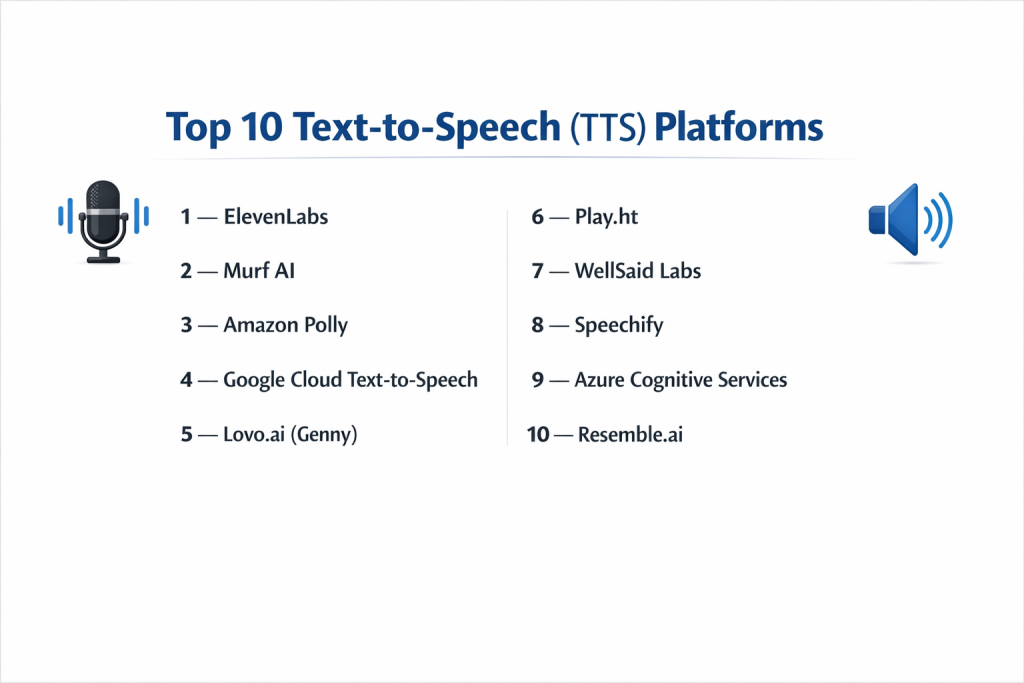
Top 10 Text-to-Speech (TTS) Platforms Tools
1 — ElevenLabs
ElevenLabs is widely considered the pioneer in high-fidelity neural speech synthesis. Its platform is designed for creators who prioritize emotional depth and lifelike realism in their audio content.
- Key features
- Advanced neural models that capture subtle human emotions.
- Instant voice cloning with as little as one minute of audio.
- Multilingual speech generation across 29+ languages.
- “Speech-to-Speech” engine for changing the voice of an existing recording.
- Projects tool for long-form content like audiobooks and narrations.
- Professional Voice Cloning for high-security enterprise needs.
- Robust API for real-time integration into third-party applications.
- Pros
- Unmatched realism; currently the benchmark for “non-robotic” AI speech.
- Extremely fast processing speeds for instant audio generation.
- Cons
- Higher price point compared to basic utility TTS tools.
- Limited granular control over specific phoneme editing.
- Security & compliance: GDPR compliant, SOC 2 (Varies), and advanced encryption.
- Support & community: Active Discord community, developer-centric documentation, and email support.
2 — Murf AI
Murf AI is a comprehensive creative suite that combines TTS with a built-in video editor. It is designed for marketing teams and educators who want to create narrated videos in a single workspace.
- Key features
- Over 120+ lifelike voices in 20+ languages.
- Ability to add images, videos, and music to voiceover projects.
- Grammar assistant to ensure scripts are perfect before rendering.
- Voice Changer feature for converting home recordings to professional AI voices.
- Team collaboration tools for shared project folders and permissions.
- High-quality WAV and MP3 export options.
- Pronunciation library for brand names and industry jargon.
- Pros
- Excellent “all-in-one” workflow for video-focused content creators.
- The interface is highly intuitive, requiring no technical background.
- Cons
- The video editor is basic compared to dedicated professional NLEs.
- Voice cloning is limited to higher-tier Enterprise plans.
- Security & compliance: GDPR, SSO, and secure data encryption at rest.
- Support & community: Priority support for Pro users, extensive FAQ, and webinars.
3 — Amazon Polly
Amazon Polly is a cloud-based service from AWS that turns text into lifelike speech. It is a favorite for developers who need to build scalable, low-cost voice applications within the AWS ecosystem.
- Key features
- Massive selection of “Standard” and “Neural” voices.
- Support for Speech Synthesis Markup Language (SSML) for deep control.
- Real-time streaming for conversational AI and bots.
- Pay-as-you-go pricing based on characters processed.
- Brand Voice feature for creating a unique, exclusive voice for a company.
- Speech Marks to synchronize speech with facial animations or text highlighting.
- Integration with AWS Lambda and other Amazon cloud services.
- Pros
- Highly cost-effective for massive-scale applications.
- Extremely reliable uptime and global infrastructure.
- Cons
- The interface is geared toward developers and can be intimidating for non-tech users.
- Creating “emotional” speech requires manual SSML tagging.
- Security & compliance: ISO, SOC, HIPAA, and GDPR compliant via AWS standards.
- Support & community: Enterprise-grade AWS support plans and a massive global developer community.
4 — Google Cloud Text-to-Speech
Powered by Google’s DeepMind WaveNet technology, this platform offers some of the most technologically advanced voices used in the Google Assistant.
- Key features
- Over 220+ voices across 40+ languages and variants.
- Neural2 voices which represent the latest in Google’s speech research.
- Custom Voice (Beta) to train a unique model for your brand.
- Linear 16, MP3, OGG, and Opus audio format support.
- Speed and pitch tuning via API or Cloud Console.
- Deep integration with Google Cloud’s AI and ML portfolio.
- Extensive support for SSML tags.
- Pros
- The WaveNet voices are incredibly smooth and consistent.
- Excellent global coverage, especially for non-English languages.
- Cons
- Setup is complex for users not already using Google Cloud Platform.
- Lacks a “creative” interface for manual narration editing.
- Security & compliance: HIPAA (Varies), SOC 2, ISO 27001, and GDPR.
- Support & community: Global technical support, Google Cloud community, and rich documentation.
5 — Lovo.ai (Genny)
Lovo.ai, via its Genny platform, is an AI voice generator and art creator designed for the “Creator Economy.” It excels in variety and emotional “acting” voices.
- Key features
- 500+ voices with 150+ different emotional tones.
- Built-in AI Image Generator to create visuals for your audio.
- Timeline-based editor for syncing multiple voices in a single scene.
- Pronunciation editor with phoneme-level control.
- 3rd-party music and sound effects library.
- Support for 100+ languages.
- Bulk production tools for high-volume creators.
- Pros
- Unrivaled variety of “character” voices for gaming and fiction.
- Very visual, user-friendly workspace.
- Cons
- Some voices are noticeably higher quality than others in the library.
- The “Pro” features have a steeper learning curve than basic TTS.
- Security & compliance: GDPR compliant and standard web security protocols.
- Support & community: Active Facebook community and email support.
6 — Play.ht
Play.ht is a powerful tool for web publishers and marketers. It specializes in converting blog posts into podcasts and provides high-quality voices for commercial use.
- Key features
- Large library of “Ultra-Realistic” neural voices.
- WordPress plugin for automatic blog-to-audio conversion.
- Ability to host and distribute podcasts directly to Spotify/iTunes.
- Custom audio players with lead-capture features.
- Multi-voice editor for creating “conversation” style audio.
- Support for 142 languages and dialects.
- High-fidelity 44.1kHz audio exports.
- Pros
- The best option for publishers looking to automate their audio presence.
- Voice quality is consistently high across the newer models.
- Cons
- The “Ultra-Realistic” voices consume credits faster than standard ones.
- The dashboard can feel slightly cluttered with many active projects.
- Security & compliance: SOC 2 Type II, GDPR, and secure API keys.
- Support & community: 24/7 live chat and an extensive knowledge base.
7 — WellSaid Labs
WellSaid Labs is an enterprise-grade platform that prioritizes consistent, professional audio for corporate training and internal comms.
- Key features
- Curated library of high-quality “Avatars” (voices).
- Ethical voice sourcing—voices are based on paid, real-life actors.
- WellSaid Studio for precise word-for-word editing.
- Team collaboration with shared projects and permissions.
- “Cues” to help guide the AI on how to say specific phrases.
- API access for high-volume corporate workflows.
- High-resolution WAV downloads.
- Pros
- Known for having the most “professional” and stable corporate tones.
- Strong commitment to ethical AI practices.
- Cons
- Does not offer “emotional” or “character” voices; strictly professional.
- Pricing is geared toward businesses rather than casual creators.
- Security & compliance: SOC 2 Type II, GDPR, and SSO support.
- Support & community: Dedicated account managers and professional onboarding.
8 — Speechify
Speechify is the leading accessibility-focused TTS tool, famous for its mobile app that allows users to “read” any document or book through high-quality AI voices.
- Key features
- OCR (Optical Character Recognition) to scan and read physical books.
- Chrome extension to read any webpage or Google Doc.
- High-profile celebrity voices (like Snoop Dogg and Gwyneth Paltrow).
- Up to 4.5x reading speed for power-users.
- Cross-platform syncing between mobile and desktop.
- Focused “Reading Mode” to eliminate distractions.
- Large library of 100+ languages.
- Pros
- The absolute best for personal productivity and students.
- Celebrity voices add a fun and engaging element to reading.
- Cons
- Commercial licensing is more limited than platforms like Murf or ElevenLabs.
- Not designed for complex video narration or “scene” building.
- Security & compliance: GDPR compliant and secure data handling.
- Support & community: Massive user base and high-quality mobile support.
9 — Azure Cognitive Services (Microsoft)
Microsoft Azure offers a sophisticated TTS service that is widely used in enterprise-level customer service and Windows integrations.
- Key features
- Neural TTS with over 400 voices and 140 languages/locales.
- “Style” support to make voices sound cheerful, empathetic, or whispering.
- Custom Neural Voice for building a signature brand voice.
- Viseme support for synchronizing lips in avatar animations.
- Integration with the wider Azure AI ecosystem.
- Local container support for edge computing and privacy.
- Fine-grained control over audio output parameters.
- Pros
- The best “Emotional Styling” controls for automated customer service.
- Enterprise-grade scalability and reliability.
- Cons
- Requires an Azure account and technical knowledge to implement.
- Pricing can be complex due to the cloud-resource model.
- Security & compliance: ISO, SOC, HIPAA, GDPR, and FedRAMP.
- Support & community: Global Azure support and deep technical documentation.
10 — Resemble.ai
Resemble.ai focuses on the “Generative” side of voice, offering advanced tools for developers who need to create dynamic, real-time voice experiences.
- Key features
- Instant voice cloning and cross-lingual cloning.
- “Resemble Fill” to edit speech by simply typing new words into a recording.
- Neural speech-to-speech for emotional transfer.
- Real-time API for gaming and customer support bots.
- Audio watermarking to protect your cloned voices.
- Support for high-quality lossless audio formats.
- Mobile SDK for iOS and Android integration.
- Pros
- The “Resemble Fill” feature is a game-changer for audio editing.
- Powerful developer tools for building voice-driven apps.
- Cons
- Can be overly technical for a simple marketing voiceover project.
- Higher entry cost for the more advanced generative features.
- Security & compliance: SOC 2, GDPR, and custom security agreements for enterprise.
- Support & community: Professional technical support and GitHub integrations.
Comparison Table
| Tool Name | Best For | Platform(s) Supported | Standout Feature | Rating |
| ElevenLabs | Lifelike Realism | Web / API | Best Emotional Depth | 4.9/5 |
| Murf AI | Marketing Videos | Web / Cloud | Built-in Video Editor | 4.8/5 |
| Amazon Polly | Scalable Devs | AWS Cloud / API | Pay-as-you-go Pricing | 4.5/5 |
| Google Cloud | Global Reach | Cloud / API | WaveNet Consistency | 4.6/5 |
| Lovo.ai | Creative Content | Web / Cloud | Character/Emotional Voices | 4.7/5 |
| Play.ht | Web Publishers | Web / WordPress | Blog-to-Audio Automation | 4.6/5 |
| WellSaid Labs | Corp. Training | Web / API | Ethical Professional Tone | 4.7/5 |
| Speechify | Personal Prod. | iOS / Android / Web | Celebrity Voices & OCR | 4.9/5 |
| Azure (MS) | Enterprise Bots | Azure Cloud / API | Advanced Emotional Styles | 4.5/5 |
| Resemble.ai | App Developers | Web / API / SDK | Resemble Fill (Edit Audio) | 4.4/5 |
Evaluation & Scoring of Text-to-Speech (TTS) Platforms
We evaluated the top platforms using a weighted scoring system to determine which tools offer the best value for different professional needs.
| Category | Weight | Evaluation Criteria |
| Core Features | 25% | Voice quality, language variety, and emotion controls. |
| Ease of Use | 15% | Intuitiveness of the UI and onboarding speed. |
| Integrations | 15% | API robustness and connectivity with 3rd-party apps. |
| Security & Compliance | 10% | Data privacy, GDPR status, and enterprise security. |
| Performance | 10% | Latency, rendering speed, and uptime reliability. |
| Support & Community | 10% | Quality of documentation and responsiveness. |
| Price / Value | 15% | Transparency and ROI for different user tiers. |
Which Text-to-Speech (TTS) Platforms Tool Is Right for You?
Small to Mid-Market vs. Enterprise
For Solo Users and SMBs, the focus should be on ease of use and creative flexibility. Tools like Murf AI and Lovo.ai provide an all-in-one environment that eliminates the need for extra software. Enterprises, on the other hand, should look for the reliability and “brand voice” capabilities of Amazon Polly, Azure, or WellSaid Labs. These platforms offer the security and scalability required for global deployments.
Budget and Value
If you are Budget-Conscious, Amazon Polly and Google Cloud TTS offer the best price-per-character, especially if you only need the audio without a fancy interface. If you are looking for the best Value for Creators, ElevenLabs provides a level of quality that reduces the need for human voice actors, potentially saving thousands in production costs.
Technical Depth vs. Simplicity
For those who want Simplicity, Speechify and Play.ht offer the most straightforward “paste-and-play” experience. However, if your project requires Technical Depth—such as real-time speech synthesis in a mobile game or custom voice cloning for a virtual assistant—Resemble.ai and Azure provide the developer-level control needed for these complex tasks.
Security and Compliance Requirements
If you work in a regulated industry like Healthcare or Finance, Microsoft Azure and AWS (Amazon Polly) are the safest bets due to their extensive list of compliance certifications. For companies concerned about the Ethics of AI, WellSaid Labs is a standout choice, as they ensure all their voice actors are properly compensated for their digital likeness.
Frequently Asked Questions (FAQs)
What is the difference between “Standard” and “Neural” voices?
Standard voices use older technology that pieces together recorded sounds, often resulting in a robotic tone. Neural voices use deep learning to predict the flow of speech, creating a much more natural, human-like sound.
Can I use these voices for commercial YouTube videos?
Yes, most paid plans on platforms like ElevenLabs, Murf, and Lovo include full commercial rights. However, free tiers usually restrict usage to personal or non-profit projects.
How does voice cloning work?
You upload a sample of a person’s voice (ranging from 1 minute to several hours). The AI analyzes the pitch, tone, and unique characteristics to create a digital “clone” that can then say any text you type.
Can I make the AI voice sound angry or happy?
Yes, several platforms offer “Emotion” or “Style” settings. Azure and Lovo are particularly strong in this area, allowing you to select specific emotional presets for the voice.
Is Text-to-Speech expensive?
It varies. Cloud providers like AWS charge fractions of a cent per 1,000 characters. Creative platforms like Murf usually range from $20 to $100 per month depending on features and usage limits.
Which TTS platform is best for languages other than English?Google Cloud and Azure generally have the widest support for global languages and regional dialects, while ElevenLabs is widely praised for its “Multilingual v2” model.
What is SSML?
Speech Synthesis Markup Language (SSML) is a way to “code” your text to tell the AI where to pause, which words to emphasize, and what pitch to use. It is widely used by developers in Amazon Polly and Azure.
Are AI voices detectable by listeners?
With the latest neural models from ElevenLabs and WellSaid Labs, it is becoming increasingly difficult for listeners to tell. In short-form content, most listeners will assume it is a human voice.
Can I use celebrity voices legally?
Tools like Speechify have official partnerships for certain celebrity voices. However, “cloning” a celebrity without their permission for a commercial project is a legal gray area and often a violation of platform terms of service.
How long does it take to generate audio?
For most platforms, it is nearly instantaneous. A one-page script usually takes less than 30 seconds to render into a high-quality audio file.
Conclusion
The selection of a Text-to-Speech platform is no longer a matter of finding a “voice” that sounds okay; it’s about finding a “partner” that fits your workflow. For pure, emotional realism, ElevenLabs is currently unparalleled. For those who need to build audio into a wider marketing strategy, Murf AI and Play.ht offer the most practical feature sets.
Ultimately, the best TTS platform is the one that removes friction from your production process. Whether you are an educator making content accessible with Speechify or an enterprise building a global brand voice with WellSaid Labs, the power of AI speech synthesis is a transformative tool for the digital age.