Introduction
Media monitoring tools are specialized software platforms that act as a digital “listening post” for businesses and brands. These tools scan the vast expanse of the internet—including news websites, social media platforms, blogs, forums, and even television or radio broadcasts—to find every mention of a specific company, product, or person. Instead of a person manually searching Google every hour to see what people are saying, these tools automate the process and bring all those conversations into one central dashboard. It is like having a global radar that alerts you the moment someone talks about your business anywhere in the world.
These tools are incredibly important because news and opinions travel instantly. A single viral tweet or a negative news article can change a company’s reputation in minutes. Media monitoring allows businesses to respond to crises immediately, join relevant conversations, and track how their marketing campaigns are performing. In the real world, companies use these tools to keep an eye on their competitors, find “influencers” to work with, and understand the general “mood” of their customers. When choosing a tool, you should look for its ability to track multiple languages, the speed of its alerts, the depth of its historical data, and how well it analyzes whether a mention is positive or negative.
Key Real-World Use Cases
- Crisis Management: Getting an instant alert when a negative story breaks so the PR team can respond before the news spreads too far.
- Competitor Tracking: Monitoring when a rival company launches a new product or gets mentioned in the press to stay ahead of market trends.
- Campaign Measurement: Tracking how many people talked about a specific hashtag or advertisement to see if a marketing budget was well-spent.
- Customer Service: Finding people who are complaining about a product on social media even if they didn’t “tag” the company directly.
- Market Research: Analyzing what features people are wishing for in a specific industry by listening to forum discussions and blog comments.
Best for
- Public Relations (PR) Professionals: Those who need to prove the value of their media outreach to clients or bosses.
- Brand Managers: People at mid-sized to large companies who need to protect their brand’s reputation across the globe.
- Marketing Agencies: Teams that manage multiple clients and need to generate detailed reports on media coverage.
Not ideal for
- Local Small Shops: A single-location dry cleaner or bakery likely doesn’t need to monitor global news and can stick to free alerts.
- Highly Private Organizations: Groups that do not have a public-facing brand or social media presence may find these tools unnecessary.
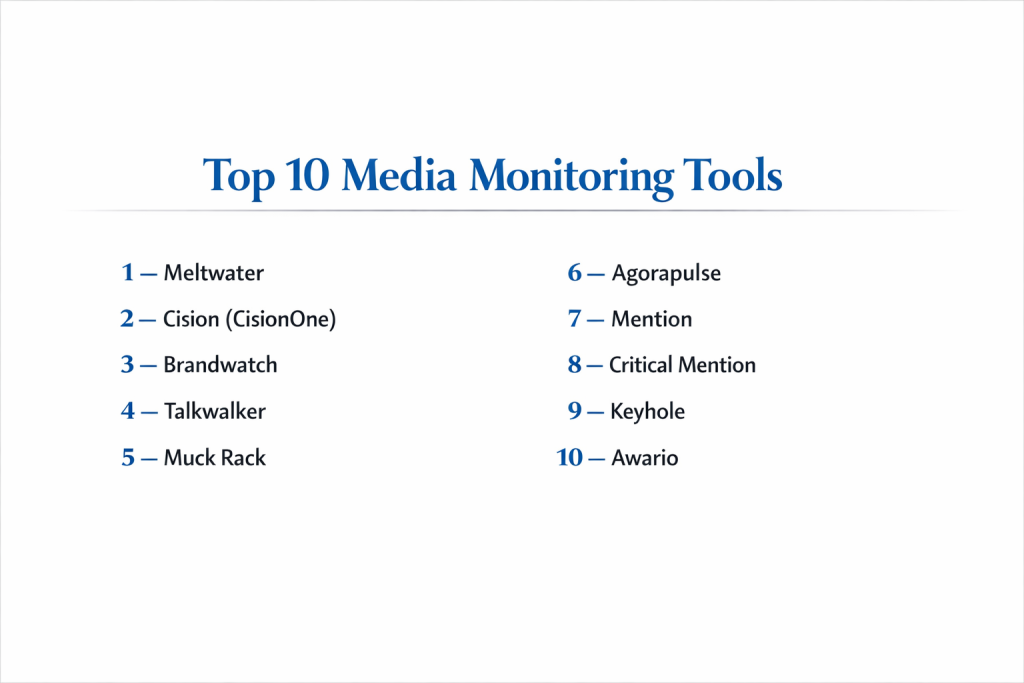
Top 10 Media Monitoring Tools
1 — Meltwater
Meltwater is a global leader in media intelligence, offering one of the most comprehensive databases in the industry. It is designed for large enterprises and PR agencies that need to track everything from a tiny local blog to major international television networks. It uses advanced artificial intelligence to help users make sense of millions of daily mentions.
- Key features:
- Real-time monitoring of over 300,000 online news sources.
- Social media listening across all major platforms including Twitter, Instagram, and Reddit.
- Broadcast monitoring for television and radio mentions using speech-to-text.
- Built-in influencer database to find and contact journalists.
- Advanced sentiment analysis to categorize mentions as positive, negative, or neutral.
- Customizable dashboards that show trends and share of voice compared to competitors.
- Automated reporting that can be sent directly to executive teams.
- Pros:
- Offers one of the largest data reaches in the world.
- Excellent for global companies that need to monitor multiple languages.
- Cons:
- The pricing is premium and usually requires a long-term contract.
- The interface is very powerful but can feel overwhelming for a beginner.
- Security & compliance: SOC 2 Type II, GDPR compliant, and ISO 27001 certified.
- Support & community: High-touch support with dedicated account managers and an extensive “Meltwater Academy” for training.
2 — Cision (CisionOne)
Cision is a powerhouse in the PR world, famous for its massive database of journalists and its ability to distribute press releases. Its monitoring tool, CisionOne, is built for professionals who want to see exactly how their media outreach is turning into actual news coverage.
- Key features:
- Integration with PR Newswire for distributing and then tracking news.
- Impact tracking that shows how many people actually read a specific article.
- Detailed journalist profiles and contact information.
- Real-time “Flash Alerts” for critical brand mentions.
- Image recognition technology to find logos in social media photos.
- Attribution technology that links media mentions to website traffic.
- Comprehensive print and broadcast monitoring capabilities.
- Pros:
- The best tool for connecting “outbound” PR work with “inbound” monitoring.
- Very strong reporting that demonstrates the financial value of media coverage.
- Cons:
- Can be very expensive for small teams or solo practitioners.
- Some users find the software to be slower than newer, cloud-native tools.
- Security & compliance: SOC 2, GDPR, and CCPA compliant.
- Support & community: Large-scale enterprise support and a wide network of PR industry experts.
3 — Brandwatch
Brandwatch is widely considered the best tool for deep social media listening. It focuses heavily on data science and consumer research, making it the favorite of market researchers who want to understand why people are talking about certain topics.
- Key features:
- Access to an archive of social media conversations going back years.
- AI-powered “Signal” alerts that detect unusual spikes in conversation.
- Image analysis to see where your brand logo appears in the wild.
- Consumer research panels to dig deeper into specific demographics.
- Highly flexible “Query Builder” for finding very specific topics.
- Integration with social media management tools for responding to posts.
- Advanced data visualization tools for complex reports.
- Pros:
- The most powerful tool for analyzing trends and “why” people feel a certain way.
- Handles massive amounts of data without slowing down.
- Cons:
- It has a steep learning curve because of its technical depth.
- Not as focused on traditional “print” news as Meltwater or Cision.
- Security & compliance: ISO 27001, GDPR, and SOC 2 compliant.
- Support & community: Excellent technical support and a very active community of data analysts.
4 — Talkwalker
Talkwalker is a robust social listening and analytics company that is famous for its “Visual Listening” technology. It is designed for brands that want to track their reputation across all media types in a single, fast interface.
- Key features:
- Video recognition that finds logos inside moving videos.
- Real-time tracking of over 150 million web sources.
- “Conversation Clusters” that visually map how a story is spreading.
- Integration with business tools like Salesforce and Hootsuite.
- Global coverage in 187 languages.
- Built-in tools for identifying and vetting influencers.
- Automated alerts for potential brand crises.
- Pros:
- Very fast search results and real-time updates.
- The visual mapping of conversations is unique and helpful.
- Cons:
- The pricing structure can be confusing with different “add-ons.”
- Reporting features can take some time to customize perfectly.
- Security & compliance: SOC 2 Type II and GDPR compliant.
- Support & community: Strong customer success team and a library of industry-specific case studies.
5 — Muck Rack
Muck Rack is a modern, user-friendly platform that is rapidly becoming the favorite for digital PR teams. It focuses on the relationship between journalists and brands, making it very easy to see who is writing what in real-time.
- Key features:
- Automatic updating of journalist profiles (no more “dead” emails).
- “Who Shared My Link” tool to see which journalists tweeted your article.
- Alerts for when a journalist is looking for a source on a specific topic.
- Simple, clean dashboards that are easy to share with clients.
- Ability to build and export media lists in seconds.
- Tracking of “unlinked mentions” where your brand is named but not linked.
- Collaborative tools for teams to avoid emailing the same journalist twice.
- Pros:
- Known as the most “intuitive” and modern-feeling tool on this list.
- Excellent for building relationships with the press, not just tracking them.
- Cons:
- Does not have the massive “broadcast” (TV/Radio) depth of Meltwater.
- Focused more on the “PR” side than “consumer research.”
- Security & compliance: SOC 2 and GDPR compliant.
- Support & community: Highly rated customer support and very popular among digital journalists.
6 — Agorapulse
Agorapulse is primarily a social media management tool, but its built-in monitoring features make it a top choice for small to mid-sized businesses. It is designed for people who want to manage their posts and listen to their audience in the same app.
- Key features:
- Social “Inbox” that catches all mentions and direct messages.
- Monitoring of specific keywords and hashtags across Twitter and Instagram.
- Ability to “label” and “assign” mentions to different team members.
- Simple ROI reports to see how social engagement is growing.
- Built-in “CRM” features to track your history with specific users.
- Automated moderation to hide spam or toxic comments.
- Shared calendar for planning content alongside monitoring.
- Pros:
- Very affordable for smaller companies compared to enterprise tools.
- Extremely easy to use; you can learn it in an afternoon.
- Cons:
- It does not monitor traditional news websites or TV/Radio.
- Monitoring is limited to social media platforms.
- Security & compliance: GDPR compliant with standard data encryption.
- Support & community: Very friendly support team and a helpful Facebook group for users.
7 — Mention
Mention is a tool built for speed and simplicity. It is designed for small businesses and agencies that want to stay on top of their web and social mentions without spending thousands of dollars every month.
- Key features:
- “Pulse” alerts that tell you when your brand is trending.
- Ability to monitor millions of sources including forums and blogs.
- Competitive analysis to see how your brand stacks up.
- Daily summary emails that highlight the most important mentions.
- Simple “Boolean” search to filter out noise.
- Integration with Slack to get alerts in your team’s chat.
- Basic social media publishing and engagement tools.
- Pros:
- One of the most affordable “all-around” monitoring tools.
- Very clean interface that focuses only on what is important.
- Cons:
- The data isn’t as deep as the enterprise tools for large global firms.
- Sentiment analysis can sometimes be less accurate on the lower-cost plans.
- Security & compliance: GDPR compliant.
- Support & community: Good email support and a very clear “help center” with articles.
8 — Critical Mention
Critical Mention is the specialist for broadcast monitoring. If your brand is frequently mentioned on local or national TV news, this is the tool you use to find those clips, edit them, and share them instantly.
- Key features:
- Real-time search of television and radio broadcasts.
- Instant video editing to create “clips” of your mentions.
- Word-for-word transcripts of news broadcasts.
- Tracking of online news and social media alongside broadcast.
- Global TV coverage including North America, Europe, and Asia.
- Audience reach metrics for TV and radio segments.
- Heat maps showing where in the country you are being discussed.
- Pros:
- The fastest and most reliable tool for television and radio tracking.
- Makes it very easy to show your boss a video clip of the company on the news.
- Cons:
- The user interface looks a bit older and more “industrial.”
- Not as strong for deep social media “sentiment” research.
- Security & compliance: SOC 2 and GDPR compliant.
- Support & community: 24/7 support is available, which is vital for news cycles.
9 — Keyhole
Keyhole is a specialized tool that focuses on hashtag tracking and influencer marketing. It is designed for social media managers who are running specific campaigns and need to see the “real-time” impact of those campaigns.
- Key features:
- Real-time hashtag tracking and analytics.
- Influencer “Impact” scores to see who is actually driving sales.
- Historical data for Twitter and Instagram.
- Event tracking to see how much “buzz” a conference or launch is creating.
- Competitive benchmarking to see your competitor’s social strategy.
- Automated reports that look beautiful and are ready for clients.
- Sentiment analysis for specific campaigns.
- Pros:
- The best tool for tracking specific marketing “events” and hashtags.
- Very easy to identify who the most influential people are in a conversation.
- Cons:
- Limited monitoring of traditional news or offline media.
- Can get expensive if you need to track many different hashtags.
- Security & compliance: GDPR compliant.
- Support & community: Good online guides and responsive email-based support.
10 — Awario
Awario is a newer tool that is gaining popularity among startups because it is very powerful but priced for people who are just starting out. It focuses on finding conversations on social media and the web to help companies find new leads.
- Key features:
- “Reach” metric to show you how many people saw a mention.
- Real-time monitoring of the entire web.
- “Leads” module that finds people asking for recommendations in your industry.
- Comparison feature to track multiple brands side-by-side.
- Boolean search for very precise filtering.
- No limit on the number of mentions you can collect on most plans.
- Language and location filters to narrow your search.
- Pros:
- Incredible value for the price; great for small business budgets.
- The “Leads” feature actually helps you find new customers, not just monitor them.
- Cons:
- It does not have the deep “Broadcast” or “Print” data of enterprise tools.
- Reporting is a bit more basic than Meltwater or Brandwatch.
- Security & compliance: GDPR compliant.
- Support & community: Helpful blog and direct email support for all users.
Comparison Table
| Tool Name | Best For | Platform(s) Supported | Standout Feature | Rating |
| Meltwater | Global Enterprises | Web, Mobile | AI-driven Global Database | 4.5/5 |
| Cision | PR Professionals | Web, Mobile | Press Release Distribution | 4.3/5 |
| Brandwatch | Market Research | Web, Mobile | Deep Consumer Insights | 4.6/5 |
| Talkwalker | Visual Brands | Web, Mobile | Video & Image Recognition | 4.4/5 |
| Muck Rack | Modern Digital PR | Web | Real-time Journalist Profiles | 4.8/5 |
| Agorapulse | SMB Social Teams | Web, Mobile | Social Inbox Management | 4.5/5 |
| Mention | Small Agencies | Web, Mobile | Pulse Trending Alerts | 4.2/5 |
| Critical Mention | TV/Radio Tracking | Web | Instant Broadcast Clipping | 4.0/5 |
| Keyhole | Campaign Managers | Web | Hashtag & Event Tracking | 4.3/5 |
| Awario | Startups / Solo | Web | Sales Lead Generation | 4.1/5 |
Evaluation & Scoring of Media Monitoring Tools
| Criteria | Weight | Meltwater | Brandwatch | Muck Rack | Awario |
| Core Features | 25% | 10/10 | 9/10 | 9/10 | 7/10 |
| Ease of Use | 15% | 7/10 | 6/10 | 10/10 | 9/10 |
| Integrations | 15% | 9/10 | 10/10 | 8/10 | 7/10 |
| Security | 10% | 10/10 | 10/10 | 10/10 | 9/10 |
| Reliability | 10% | 10/10 | 10/10 | 9/10 | 8/10 |
| Support | 10% | 10/10 | 9/10 | 10/10 | 8/10 |
| Price / Value | 15% | 6/10 | 7/10 | 8/10 | 10/10 |
| Final Score | 100% | 8.8 | 8.6 | 9.2 | 8.1 |
Which Media Monitoring Tool Is Right for You?
Solo Users vs SMB vs Mid-Market vs Enterprise
If you are a solo entrepreneur or a very small business, Awario or Mention are perfect because they give you the essential alerts without a huge price tag. Mid-market companies that focus on social media should look at Agorapulse or Keyhole. Large global enterprises that need to protect a multi-billion dollar reputation should invest in Meltwater, Cision, or Brandwatch to ensure no conversation is missed.
Budget-conscious vs Premium Solutions
For those on a tight budget, Awario offers the most “mentions” for your money. If you are looking for a premium solution where the software does the hard work of analysis for you, Meltwater and Talkwalker are worth the investment. They save you hundreds of hours of manual work, which often justifies the higher cost.
Feature Depth vs Ease of Use
If you want a tool that “just works” and is a joy to use, Muck Rack is the winner. It feels like modern software. If you need “feature depth”—meaning you want to write complex code-like queries to find very specific data—Brandwatch is the most powerful tool, even if it takes longer to learn.
Integration and Scalability Needs
If your marketing team already uses Salesforce or Slack, you need a tool that can send alerts directly to those apps. Brandwatch and Meltwater have the strongest enterprise integrations. If you plan to scale from monitoring one brand to fifty, you need an enterprise tool that allows for multiple “workspaces.”
Security and Compliance Requirements
Companies in finance, government, or healthcare need to be very careful about where their data is stored. Meltwater and Cision are the gold standards here, with multiple high-level security certifications. Always ensure the tool you pick is fully GDPR compliant if you have any customers in Europe.
Frequently Asked Questions (FAQs)
1. What is the difference between “Social Listening” and “Media Monitoring”?
Media Monitoring is the broad term that includes news, TV, and blogs. Social Listening is a part of that, focusing specifically on conversations happening on platforms like Twitter, Facebook, and TikTok.
2. Can these tools see private Facebook profiles?
No. Due to privacy laws and platform rules, no legal monitoring tool can see what people post on their private accounts or in private groups. They only track “public” data.
3. How do these tools know if a mention is “negative”?
They use “Sentiment Analysis,” which is a type of AI that looks for keywords like “broken,” “bad,” or “terrible” to label the post. It is not 100% perfect but gives a good general idea.
4. How much do these tools cost?
Prices vary wildly. Simple tools can start at $29 per month, while enterprise platforms can cost $1,000 to $5,000 per month or more depending on how much data you need.
5. Do I need to be a PR expert to use them?
Not necessarily. Tools like Awario and Mention are built for everyone. However, the enterprise tools like Brandwatch are best used by people with some data or PR background.
6. Can I monitor my competitors too?
Yes! This is one of the best ways to use these tools. You can set up “alerts” for your competitors’ names to see their news and what their customers are saying.
7. What is “Share of Voice”?
This is a metric that shows what percentage of the total conversation in your industry is about your brand compared to your competitors.
8. Can these tools track my logo if there is no text?
Yes, high-end tools like Talkwalker and Brandwatch have “Image Recognition” that can find your logo even if the person didn’t type your company name.
9. Can I get alerts on my phone?
Most of these tools have mobile apps or can send you an “Instant Alert” via email or Slack the moment a mention is found.
10. Do these tools cover global news?
The enterprise tools (Meltwater, Cision, Talkwalker) cover the entire world in hundreds of languages. Smaller tools may be more focused on English-speaking web and social media.
Conclusion
Choosing the right media monitoring tool is about finding the “ears” that best fit your business. If you are a modern digital brand that lives on social media, a tool like Brandwatch or Muck Rack will provide the most value. If you are a traditional company that still gets mentioned on the evening news and in newspapers, the deep archives of Meltwater or Critical Mention are indispensable.
Ultimately, the goal of these tools is to move from being “reactive” to “proactive.” Instead of waiting to hear about a problem from a customer, you can see it developing in real-time and fix it. The “best” tool is the one that gives you clear, actionable information without burying you in too much noise. By picking the right partner from this list, you can ensure that your brand’s reputation is always protected and that you never miss a chance to connect with your audience.