Introduction
Account-Based Marketing (ABM) platforms are specialized B2B marketing technologies designed to help companies identify, track, and engage specific high-value accounts rather than casting a wide net for individual leads. In the traditional “inbound” model, marketing aims for quantity; in ABM, the focus is on quality and strategic alignment with sales. These platforms act as a central hub where data from CRMs, website interactions, and third-party intent providers merge to create a single view of a target account. By using these tools, businesses can orchestrate personalized advertising, email, and web experiences tailored to the specific needs of a collective buying committee within a company.
The importance of ABM platforms has surged as B2B buying cycles become more complex, often involving 6 to 10 stakeholders. Real-world use cases include a software firm targeting 50 specific Fortune 500 companies with custom advertisements or a manufacturing company using intent data to identify when a dormant account starts researching a competitor. When evaluating these tools, users should look for robust “account-to-lead” matching, the depth of their proprietary data (intent signals), the ease of sales and marketing alignment, and the ability to measure “account engagement” rather than just “clicks.”
Best for: B2B marketing managers, sales development leaders, and revenue operations (RevOps) teams in mid-market and enterprise organizations. It is essential for companies with high average contract values (ACV) and long, multi-stakeholder sales cycles.
Not ideal for: B2C companies, small businesses selling low-cost products, or organizations that rely on high-volume, transactional sales where individual leads are the primary driver of revenue.
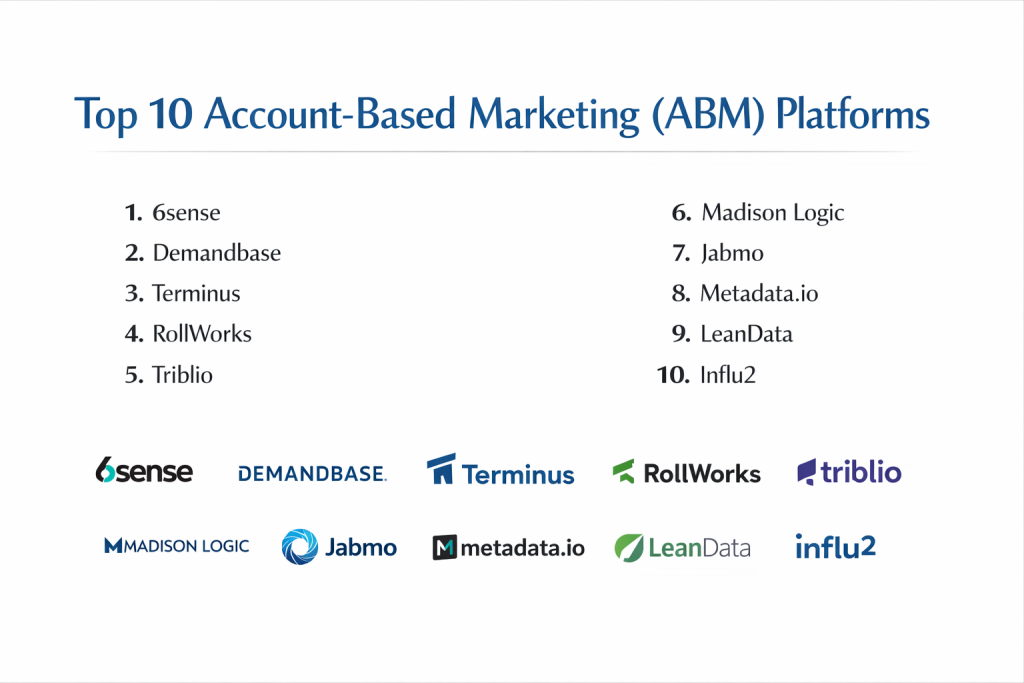
Top 10 Account-Based Marketing (ABM) Platforms
1 — 6sense
6sense is an enterprise-grade Revenue AI platform that focuses heavily on the “Dark Funnel”—the anonymous research buyers do before they ever fill out a form. It uses advanced machine learning to predict when an account is in-market to buy.
- Key features
- Intent data that identifies anonymous research behavior on third-party sites.
- Predictive modeling that segments accounts by their current buying stage.
- Dynamic audience orchestration for automated cross-channel campaigns.
- Account-based advertising with specialized B2B targeting.
- Sales Intelligence tools that provide “next-best-action” alerts to reps.
- Sophisticated lead-to-account matching and data cleansing.
- Comprehensive revenue attribution to prove marketing ROI.
- Pros
- Exceptional predictive accuracy; it tells you who to call and when.
- One of the strongest data sets for identifying anonymous intent.
- Cons
- The platform is highly complex and usually requires a dedicated administrator.
- Pricing is at the highest end of the market spectrum.
- Security & compliance: SOC 2 Type II, GDPR compliant, CCPA compliant, and ISO 27001.
- Support & community: “6sense RevCity” community, extensive certification programs, and dedicated customer success managers.
2 — Demandbase
Demandbase is a pioneer in the ABM space and offers a “One” platform approach that combines ABM, B2B data, and sales intelligence. It is designed to be the complete ecosystem for any B2B go-to-market team.
- Key features
- Combined ABM and Sales Intelligence in a single interface.
- Account-based advertising with access to a massive B2B DSP.
- Personalization tools for tailoring website content to specific accounts.
- “Technographic” data to see what software your target accounts are using.
- Self-service data management and account list building.
- Advanced measurement of “Pipeline Predict” and “Engagement Minutes.”
- Deep integrations with Salesforce, HubSpot, and Microsoft Dynamics.
- Pros
- Excellent at consolidating multiple tools (Intent, Advertising, Data) into one.
- Very strong account-to-lead matching algorithms.
- Cons
- The user interface can feel cluttered due to the vast amount of data.
- Implementation can be a lengthy process for large organizations.
- Security & compliance: SOC 2 Type II, GDPR, CCPA, and HIPAA ready.
- Support & community: Demandbase Academy, extensive technical documentation, and an active user community.
3 — Terminus
Terminus is designed to help marketers execute “account-based everything.” It is particularly well-known for its ad-targeting capabilities and its ability to coordinate campaigns across email signatures, chat, and web.
- Key features
- Multi-channel orchestration across display ads, LinkedIn, and email.
- “Terminus Email Experiences” for banner ads in employee email signatures.
- Integrated chat feature specifically for recognized target accounts.
- Account-based analytics that measure the “progression” of a deal.
- Intent data powered by Bombora for identifying in-market accounts.
- Website personalization that changes headers based on the visitor’s company.
- Revenue attribution that connects marketing touchpoints to closed-won deals.
- Pros
- Very strong focus on “ad-targeting” precision and brand awareness.
- Great for teams that want to start with advertising and expand into full ABM.
- Cons
- Lacks some of the advanced predictive AI found in 6sense.
- Reporting can be less granular than some other enterprise-level tools.
- Security & compliance: SOC 2 Type II, GDPR compliant, and uses secure SSO.
- Support & community: Terminus “Cloud” support, dedicated CSMs, and regular webinars.
4 — RollWorks
RollWorks (a division of NextRoll) is an ABM platform that makes the technology accessible to the mid-market. It provides a more streamlined, affordable way for companies to start running account-based ads and sales outreach.
- Key features
- Account Discovery tool to find new accounts that match your ICP.
- Automated sales sequences that sync with your CRM.
- Targeted display advertising with high-quality B2B firmographic filters.
- Integration with LinkedIn Matched Audiences for specialized social ads.
- “Journey Stage” tracking to see how accounts move through the funnel.
- Bi-directional CRM sync with Salesforce and HubSpot.
- Account-level reporting on engagement and advertising spend.
- Pros
- More user-friendly and faster to deploy than enterprise platforms.
- Competitive pricing makes it a great choice for growing SMBs and mid-market teams.
- Cons
- Advertising-heavy; it lacks the deep “content personalization” of others.
- Intent data options are slightly more limited than 6sense or Demandbase.
- Security & compliance: GDPR, CCPA compliant, and SOC 2 Type II.
- Support & community: Extensive “Learning Center,” email/chat support, and onboarding services.
5 — Triblio
Triblio (by IDG) is a platform that excels at “Orchestration.” It allows marketers to trigger specific actions (like an ad or an email) based on where an account is in the buying journey and what they have clicked on.
- Key features
- Account-based advertising integrated with web personalization.
- Sales activation tools that alert reps when their accounts are on the site.
- Dynamic content overlays that change based on company firmographics.
- Multi-channel orchestration (Ads, Web, Sales, Email).
- Proprietary “IDG” intent data from global technology publications.
- Detailed account analytics and pipeline impact reporting.
- Lead-to-account matching using advanced data science.
- Pros
- Very strong at the “Web Personalization” layer of the ABM stack.
- Access to high-quality intent data from the IDG media network.
- Cons
- The interface feels a bit more technical and less “modern” than others.
- Requires a fair amount of content production to fuel the personalization engine.
- Security & compliance: GDPR compliant and SOC 2 Type II.
- Support & community: High-touch customer support and dedicated strategic consulting.
6 — Madison Logic
Madison Logic is an enterprise ABM platform that focuses on “Global” scale and multi-channel lead generation. It is widely used by massive tech companies that need to run account-based programs across different regions and languages.
- Key features
- “ML Data Cloud” for identifying high-propensity accounts globally.
- Integrated Content Syndication to generate leads from target accounts.
- Global display advertising with localized language support.
- Journey acceleration tools that move accounts through the funnel faster.
- Deep measurement of “Account Engagement Score.”
- Integrations with Marketo, Oracle Eloqua, and Salesforce.
- Multi-channel reporting across ads, social, and content syndication.
- Pros
- One of the best options for global companies running large-scale programs.
- Strong emphasis on “Content Syndication” as a way to get actual leads.
- Cons
- Can feel like a “managed service” more than a self-service software platform.
- Pricing is geared toward high-spend enterprise marketing budgets.
- Security & compliance: GDPR, CCPA, ISO 27001, and SOC 2 Type II.
- Support & community: Expert managed services and dedicated global account teams.
7 — Jabmo
Jabmo is a specialized ABM platform designed for manufacturers, life sciences, and other “non-tech” B2B industries. It is built to handle the unique challenges of long, complex industrial buying cycles.
- Key features
- IP-based account identification specifically tuned for industrial networks.
- Global omnichannel advertising (LinkedIn, Display, Facebook, Instagram).
- Website personalization tailored for industrial product categories.
- Email marketing integration to sync with account-based ads.
- Sales alerts for manufacturing reps to follow up on account activity.
- Compliance-friendly tracking (Privacy-first architecture).
- Simplified reporting that focuses on account-level engagement.
- Pros
- Specialized for industries that aren’t typical “SaaS” or tech companies.
- Very privacy-conscious; great for highly regulated sectors.
- Cons
- Smaller feature set compared to the “all-in-one” giants like 6sense.
- Limited integrations with niche software outside the major CRMs.
- Security & compliance: GDPR (EU-based), CCPA, and secure data encryption.
- Support & community: Strong European presence and industry-specific consulting.
8 — Metadata.io
Metadata.io is an “ABM Orchestration” platform that focuses on the automation of paid social and search ads. It is designed for demand generation teams who want the AI to handle the tedious work of campaign management.
- Key features
- Autonomous campaign execution; the AI creates and tests thousands of ad variations.
- B2B audience builder using firmographic, technographic, and intent data.
- Automatic “Lead-to-Account” mapping for attribution.
- Integration with LinkedIn, Facebook, Google, and Quora ads.
- Revenue attribution that tracks spend directly to CRM opportunities.
- Experiments platform for A/B testing audiences and creatives at scale.
- Automated audience syncing with Salesforce and HubSpot.
- Pros
- Incredible time-saver for teams running high-volume paid social ads.
- Focuses on “Pipeline Generated” rather than “Leads” or “Clicks.”
- Cons
- Focused primarily on “Paid Media” rather than the full ABM lifecycle.
- The “black box” nature of AI automation can be scary for some marketers.
- Security & compliance: SOC 2 Type II and GDPR compliant.
- Support & community: Dedicated customer success and a very modern, responsive support team.
9 — LeanData
LeanData is not a traditional “marketing” platform in the sense of ads or content, but it is the “Engine” of many ABM programs. It specializes in Lead-to-Account (L2A) matching and routing, which is the foundation of any ABM strategy.
- Key features
- Industry-leading Lead-to-Account matching fuzzy logic.
- Visual flow builder for complex lead and account routing.
- “Book-It” feature for instant meeting scheduling for target accounts.
- Automated data orchestration within the Salesforce CRM.
- Attribution modeling that connects every touchpoint to a specific account.
- Territory management tools for sales alignment.
- Real-time alerts for sales reps when a target account engages.
- Pros
- The “Gold Standard” for making sure leads actually get matched to accounts.
- Essential for large sales teams where lead ownership is a major problem.
- Cons
- It does not provide intent data or run advertising campaigns.
- Primarily designed for Salesforce; limited utility on other platforms.
- Security & compliance: SOC 2 Type II, GDPR, and HIPAA compliant.
- Support & community: “LeanData University,” strong user community, and expert support.
10 — Influ2
Influ2 is a “Person-Based Marketing” platform that takes ABM to the most granular level possible. Instead of just targeting a “Company,” it allows you to target the specific individuals (by name and title) within that company.
- Key features
- Person-based advertising on LinkedIn, Facebook, and Display.
- Tracking of specific individuals who click on your ads.
- Integration with sales outreach tools like Outreach and Salesloft.
- Analytics that show you exactly who (by name) is engaging with your brand.
- Audience builder based on specific job titles and company names.
- Sales alerts triggered when a “Decision Maker” clicks an ad.
- CRM sync to show ad engagement on the contact record.
- Pros
- Provides a level of transparency (who clicked) that other platforms don’t.
- Excellent for “one-to-one” ABM strategies for high-value deals.
- Cons
- Very narrow focus; not meant for “one-to-many” broad awareness.
- Privacy regulations in some regions make person-based tracking more difficult.
- Security & compliance: GDPR, CCPA compliant, and SOC 2 Type II.
- Support & community: Dedicated success managers and help with ad creative strategy.
Comparison Table
| Tool Name | Best For | Platform(s) Supported | Standout Feature | Rating |
| 6sense | Enterprise Predictive | Web / CRM | “Dark Funnel” Intent AI | 4.7/5 |
| Demandbase | All-in-One Ecosystem | Web / CRM | Consolidated B2B Data | 4.6/5 |
| Terminus | Multi-channel Ads | Web / Email | Email Signature Ads | 4.5/5 |
| RollWorks | Mid-Market ABM | Web / CRM | Easy Sales/Marketing Sync | 4.4/5 |
| Triblio | Web Personalization | Web / CRM | IDG-Proprietary Intent | 4.3/5 |
| Madison Logic | Global Scale Tech | Web / CRM | Content Syndication Ads | 4.2/5 |
| Jabmo | Industrial/Mfg | Web / CRM | IP-based Mfg Targeting | 4.1/5 |
| Metadata.io | Paid Media Automation | Web / Social | AI-Executed Ad Testing | 4.6/5 |
| LeanData | Lead-to-Account Routing | Salesforce | Visual Routing Logic | 4.8/5 |
| Influ2 | Person-Based Marketing | Social / Display | “Who Clicked” Transparency | 4.4/5 |
Evaluation & Scoring of ABM Platforms
Choosing an ABM platform is a significant investment. We have evaluated the top players based on the following weighted criteria to help you determine which fits your operational style.
| Evaluation Category | Weight | Evaluation Highlights |
| Core Features | 25% | Presence of intent data, ad DSP, and personalization. |
| Ease of Use | 15% | Intuitiveness of the UI and campaign setup speed. |
| Integrations | 15% | Strength of CRM (Salesforce/HubSpot) bi-directional sync. |
| Security & Compliance | 10% | GDPR, SOC 2, and data privacy protections. |
| Performance | 10% | Reliability of data matching and ad delivery uptime. |
| Support & Community | 10% | Access to strategic consulting and educational resources. |
| Price / Value | 15% | Cost of platform relative to the revenue impact potential. |
Which ABM Platform Is Right for You?
Solo Users vs SMB vs Mid-Market vs Enterprise
If you are a solo marketer or a very small team, a full-scale ABM platform might be too much. You are better off using the ABM features built into your CRM (like HubSpot’s ABM tools). For mid-market companies (50–500 employees), RollWorks or Metadata.io provide the best “bang for your buck.” Large enterprises with hundreds of marketers and multiple products should look at 6sense or Demandbase, as they offer the governance and scale needed for complex global programs.
Budget-Conscious vs Premium Solutions
If you have a limited budget, RollWorks and Influ2 often provide more flexible entry-level pricing. They allow you to prove the value of ABM before moving to a larger system. On the premium side, 6sense and Madison Logic are significant investments. These platforms are designed for companies where a single “Closed Won” deal could be worth $500,000 or more, making the platform’s high cost easy to justify.
Feature Depth vs Ease of Use
If you want a tool that you can set up and start running ads in a week, Metadata.io or Terminus are your best bets. They are built for action. If you need “feature depth”—meaning you want to analyze every single anonymous web visit and predict with 90% accuracy which accounts will buy in the next 90 days—you will need the power and complexity of 6sense.
Integration and Scalability Needs
For companies that prioritize a clean Salesforce database above all else, LeanData is a mandatory addition to any other ABM tool you buy. Regarding scalability, Demandbase is excellent for companies that are growing through acquisitions, as it can consolidate multiple data sources and CRM instances into one unified view of your accounts.
Security and Compliance Requirements
If you are doing business in the European Union, you must prioritize GDPR compliance. Jabmo and 6sense have very strong reputations for privacy-first tracking. For organizations in highly regulated sectors like Finance or Healthcare, ensure the platform provides a full SOC 2 Type II audit report to satisfy your IT security team.
Frequently Asked Questions (FAQs)
What is the difference between ABM and Lead Generation?
Lead Generation focuses on getting as many individuals as possible to fill out a form. ABM focuses on engaging the right people within specific target accounts that have been pre-approved by the sales team.
Do I need a CRM to use an ABM platform?
While not strictly “required” for some ad-only features, a CRM (like Salesforce or HubSpot) is essential for 90% of what these platforms do. The real power comes from syncing marketing data with your sales records.
What is “Intent Data”?
Intent data is information collected from across the web that suggests a company is researching a specific topic. For example, if ten people at “Company X” are reading articles about “Cybersecurity Software,” the platform flags them as having high intent.
How much do ABM platforms cost?
Small-to-mid-market solutions usually start around $25,000–$40,000 per year. Enterprise-grade platforms like 6sense or Demandbase often cost $75,000–$150,000+ per year, depending on the number of accounts and features.
Can ABM platforms help my sales team?
Absolutely. Most platforms provide “Sales Intelligence” dashboards or Slack/Email alerts that tell a rep, “Hey, your top prospect just visited the pricing page for 20 minutes. You should call them now.”
Will these tools help me with LinkedIn Ads?
Yes. Most of these platforms have direct integrations with LinkedIn, allowing you to sync your target account lists directly to LinkedIn’s Campaign Manager for better targeting.
What is “Lead-to-Account Matching”?
It is the technology that takes a new lead (e.g., john@apple.com) and automatically connects it to the existing account record for “Apple Inc.” This is much harder than it sounds and is a core feature of ABM tools.
How long does it take to see results from ABM?
Because ABM is usually used for complex B2B sales, results (closed revenue) can take 6–12 months. However, you can see “leading indicators” like increased engagement and pipeline growth within the first 90 days.
Can I run ABM without a platform?
Yes, you can do it manually with spreadsheets and manual ad targeting, but it is very difficult to scale. A platform automates the data syncing and “account-level” reporting that is impossible to do by hand.
What is the “Dark Funnel”?
The Dark Funnel refers to all the places where buyers research your brand anonymously (social media, third-party review sites, podcasts) where you can’t normally track them with traditional cookies or forms.
Conclusion
The shift toward Account-Based Marketing is more than just a trend; it is a response to the way modern B2B buyers operate. We have reviewed a diverse range of tools, from the AI-driven predictive power of 6sense and Demandbase to the specialized automation of Metadata.io and the foundational routing of LeanData. Each of these platforms offers a different way to solve the same core problem: how to align marketing and sales to win the highest-value accounts.
When choosing your ABM platform, remember that the technology is only as good as the strategy behind it. The “best” tool won’t help you if your sales and marketing teams aren’t aligned on who your “Ideal Customer Profile” (ICP) is. Start by defining your target list, understanding your buyers’ journey, and then selecting the tool that provides the specific features (whether that’s ads, intent, or personalization) that your strategy requires. ABM is a marathon, not a sprint, and having the right platform is like having the best possible pair of shoes for the race.