Introduction
Conversation Intelligence (CI) platforms are sophisticated software solutions that use Artificial Intelligence (AI) and Natural Language Processing (NLP) to record, transcribe, and analyze customer-facing interactions. Whether it is a sales discovery call, a customer support ticket, or a video conference, these tools go beyond simple recording. They “listen” for sentiment, detect competitor mentions, identify buyer objections, and track how much time a representative spends talking versus listening. By turning unstructured voice and video data into searchable, actionable insights, CI platforms bridge the gap between what happens on a call and the data stored in a CRM.
The importance of CI platforms in 2026 cannot be overstated. In an era where every customer interaction is a data point, businesses can no longer afford to leave “the voice of the customer” trapped in unreviewed recordings. CI provides a “manager in every meeting,” allowing leaders to coach teams at scale, identify why deals are being won or lost, and ensure compliance in regulated industries. Real-world use cases include accelerating the onboarding of new sales reps by letting them listen to “best-in-class” call libraries, reducing customer churn by spotting early warning signs of frustration, and automating the tedious task of manual note-taking.
When choosing a platform, users should evaluate transcription accuracy (especially with industry jargon), the depth of CRM integration, real-time coaching capabilities, and the robustness of automated security features like PII (Personally Identifiable Information) redaction.
Best for: Revenue teams (Sales, Account Management, Customer Success) in mid-market and enterprise companies that manage high volumes of virtual meetings. It is also essential for sales enablement managers looking to automate coaching and QA.
Not ideal for: Small businesses with minimal call volume or companies that primarily interact with customers via physical, in-person retail environments where digital recording is impractical.
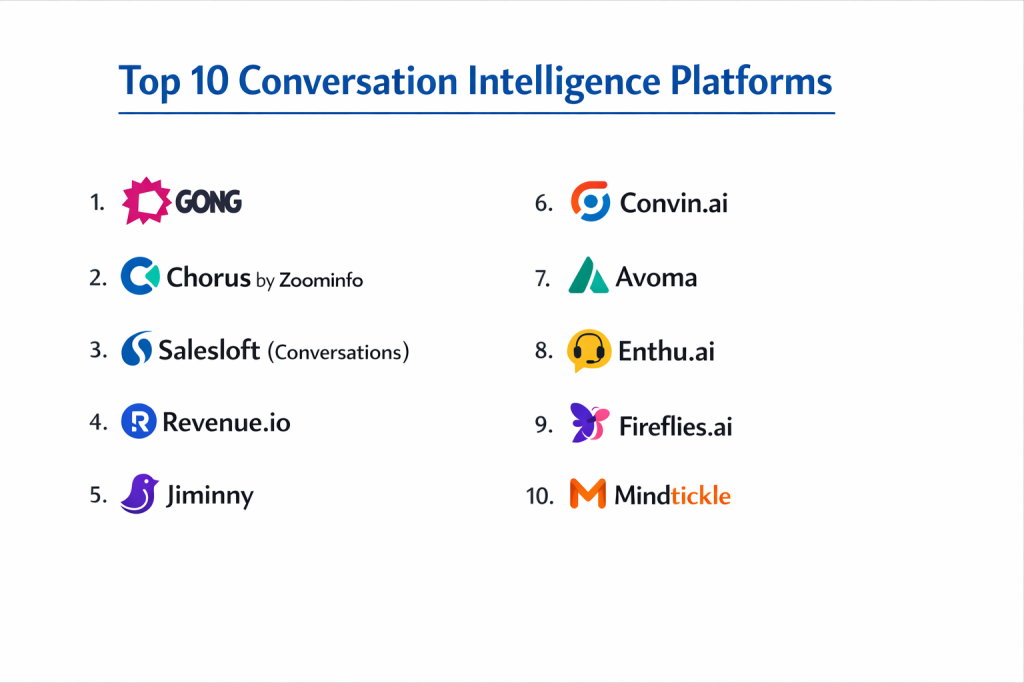
Top 10 Conversation Intelligence Platforms
1 — Gong
Gong is widely considered the pioneer of the Revenue Intelligence category. It captures all customer interactions across phone, email, and web conferencing to provide a “360-degree view” of deals and market trends.
- Key features
- Proprietary AI engine that identifies deal risks and “cold” accounts.
- Automated call transcription with high accuracy across 70+ languages.
- “Trackers” that flag specific keywords, competitors, or feature requests.
- Deal execution boards that visualize every touchpoint in a sales cycle.
- Coaching scorecards that compare rep performance against top earners.
- Smart summaries that highlight action items and next steps automatically.
- Pros
- Best-in-class user interface that is highly intuitive for sales reps.
- Extremely powerful “Deal Intelligence” that predicts win probability based on real activity.
- Cons
- Premium pricing makes it one of the most expensive options on the market.
- Can feel overwhelming for smaller teams that only need basic transcription.
- Security & compliance: SOC 2 Type II, ISO 27001, GDPR, HIPAA, and PCI DSS compliant.
- Support & community: Extensive “Gong Academy,” 24/7 support, and a massive community of revenue professionals.
2 — Chorus by ZoomInfo
Chorus (acquired by ZoomInfo) focuses on high-growth sales teams. It leverages ZoomInfo’s massive database of B2B insights to add context to every conversation, making it a favorite for outbound-heavy organizations.
- Key features
- Native integration with ZoomInfo’s database for deep prospect context.
- Real-time transcription and highlight clips for easy sharing.
- Momentum signals that track the “velocity” of a deal.
- Competitive intelligence dashboards that show how often rivals are mentioned.
- Automated CRM sync that pushes transcripts and summaries to Salesforce or HubSpot.
- Skill-based coaching recommendations based on conversation metrics.
- Pros
- Unmatched data enrichment—know exactly who you are talking to during the call.
- Excellent at identifying specific “buying signals” in complex enterprise deals.
- Cons
- Most effective when bundled with other ZoomInfo products, which adds cost.
- Transcription accuracy can occasionally struggle with heavy background noise.
- Security & compliance: SOC 2, GDPR, CCPA, and advanced encryption at rest.
- Support & community: Dedicated account managers for enterprise clients and robust online documentation.
3 — Salesloft (Conversations)
Salesloft is a leading sales engagement platform that includes a native CI tool called “Conversations.” It is designed for teams that want their sales cadences and call coaching to live in one unified workflow.
- Key features
- Integrated “Rhythm” workflow that surfaces coaching tasks as action items.
- AI-assisted scorecards that pre-populate manager feedback.
- Detailed talk-time analytics (Talk vs. Listen ratio, filler word usage).
- Integration with major dialers and video conferencing tools.
- Snippet sharing that allows reps to send “highlight reels” to prospects.
- Trend reporting on pricing objections and competitor mentions.
- Pros
- Eliminates the “tab fatigue” of switching between a dialer and a CI tool.
- Seamlessly connects outbound activity with conversation outcomes.
- Cons
- Less “deal-specific” intelligence compared to Gong.
- The CI features are primarily an add-on to the core Salesloft platform.
- Security & compliance: SOC 2 Type II, GDPR, and ISO 27001.
- Support & community: “Salesloft University” and a high-touch customer success model.
4 — Revenue.io
Revenue.io is unique because it was built specifically for the Salesforce ecosystem. It provides real-time “Agent Assist” during live calls, guiding reps through objections as they happen.
- Key features
- Real-time “Battle Cards” that pop up when a competitor is mentioned.
- Live sentiment analysis that alerts managers to join a “heated” call.
- 100% native Salesforce integration (no data syncing lag).
- Dynamic playbooks that change based on what the prospect says.
- Automated call logging and note-taking directly into CRM fields.
- High-fidelity transcription with automated PII redaction.
- Pros
- The best choice for organizations that live and breathe in Salesforce.
- Real-time guidance actually helps reps save deals during the call.
- Cons
- Limited utility for teams that do not use Salesforce.
- The interface can feel a bit “utilitarian” compared to modern SaaS rivals.
- Security & compliance: SOC 2 Type II, GDPR, HIPAA, and TCPA compliance tools.
- Support & community: Strong technical support and specialized Salesforce consulting.
5 — Jiminny
Jiminny is a UK-based platform that has gained global popularity for its simplicity and focus on coaching. It is designed to be the most “human-centric” tool in the category.
- Key features
- Simple “Recording,” “Insights,” and “Listener” seat types for flexible pricing.
- AI-powered deal insights and risk alerts for managers.
- Global language support with high accuracy for European accents.
- One-click “shout-outs” to celebrate winning moments across Slack.
- Collaborative note-taking where multiple team members can tag a live call.
- Integration with niche CRMs like Bullhorn and Pipedrive.
- Pros
- Very fast implementation; teams can get up and running in a few days.
- More affordable for mid-market teams than the “Big Three” (Gong/Chorus/Salesloft).
- Cons
- Lacks the deep “Forecasting” modules found in enterprise platforms.
- The analytics dashboards are less customizable than Gong’s.
- Security & compliance: SOC 2 Type II, GDPR, CCPA, and HIPAA.
- Support & community: Known for highly responsive customer support and a friendly community.
6 — Convin.ai
Convin.ai stands out for its focus on 100% automated QA (Quality Assurance) and auditing. It is particularly strong in the fintech and banking sectors where compliance is a daily requirement.
- Key features
- Automated auditing of 100% of calls (eliminating manual random sampling).
- Real-time “Agent Assist” voicebots that guide agents through complex queries.
- Fraud detection and identity verification via voice response.
- Automated CSAT (Customer Satisfaction) scoring based on sentiment.
- Detailed “Ramp-up” tracking for new hires.
- Support for 20+ languages and regional dialects.
- Pros
- Reduces manual QA hours by up to 80% through total automation.
- Extremely strong compliance and fraud-prevention features.
- Cons
- Higher learning curve for the automated auditing setup.
- The “human-like” voicebots might feel too “automated” for high-touch sales.
- Security & compliance: SOC 2, GDPR, and localized data hosting (U.S. and Ireland).
- Support & community: Focuses on enterprise deployment with dedicated implementation engineers.
7 — Avoma
Avoma is an all-in-one “Meeting Lifecycle” assistant. It covers everything from scheduling the meeting to transcribing it and syncing it to the CRM, making it a favorite for SMBs and startups.
- Key features
- Integrated meeting scheduler and lead routing.
- Collaborative note-taking with time-stamped links to the recording.
- AI-generated summaries categorized by “Pain Points,” “Features,” and “Next Steps.”
- Revenue intelligence features that track deal health.
- Performance dashboards showing “Interrupting” and “Talk-to-Listen” ratios.
- Ability to share “Snippets” and playlists with external customers.
- Pros
- Excellent value for money; offers a “Startup” tier that is very accessible.
- Simple, clean interface that minimizes distraction during meetings.
- Cons
- Some technical glitches reported with complex Zoom integrations.
- The interface can feel a bit “busy” as they add more scheduling features.
- Security & compliance: SOC 2 Type II, GDPR, and HIPAA.
- Support & community: Comprehensive “Knowledge Base” and helpful onboarding for small teams.
8 — Enthu.ai
Enthu.ai is a specialized CI tool for contact centers and high-volume calling teams. It focuses on simplifying the QA process for managers who need to oversee hundreds of agents.
- Key features
- “Auto-QA” that scores every call based on customizable criteria.
- Agent performance leaderboards and mood tracking.
- Simplistic interface designed for non-technical managers.
- Rapid conversion speeds for audio-to-text.
- Targeted coaching modules that let managers leave voice comments on call moments.
- Seamless integration with popular cloud telephony providers.
- Pros
- One of the most user-friendly tools for contact center environments.
- Very affordable pricing model compared to enterprise sales platforms.
- Cons
- Lacks the deep “Deal Intelligence” and CRM automation of Gong.
- Not ideal for complex B2B sales cycles with multiple stakeholders.
- Security & compliance: Varies / Standard encryption and privacy protocols.
- Support & community: Known for taking user feedback seriously and releasing regular updates.
9 — Fireflies.ai
Fireflies.ai is a viral favorite for internal meetings and small teams. It is an “AI Notetaker” that joins your calendar meetings as a participant and provides searchable transcripts.
- Key features
- “Ask Fred”—a GPT-powered assistant that answers questions about your meeting.
- Smart search for tasks, action items, and participant sentiment.
- “Topic Trackers” to identify when specific keywords are mentioned.
- Integrations with 50+ apps including Slack, Trello, and Notion.
- Soundbites feature for creating short, shareable clips.
- Global language support for 30+ languages.
- Pros
- Extremely easy to set up; just invite the bot to your calendar.
- Great for “Internal Knowledge Management”—never forget a meeting detail again.
- Cons
- Accuracy can vary with heavy accents or technical jargon.
- Some users find the presence of a “Bot” participant in the meeting distracting.
- Security & compliance: SOC 2 Type 2, GDPR, and customizable privacy settings.
- Support & community: Large user base and extensive self-service documentation.
10 — Mindtickle
Mindtickle is a Sales Readiness platform that integrates CI as a core component of sales training and onboarding. It is designed for large enterprises that want to link conversation data directly to rep “readiness” scores.
- Key features
- Gamified coaching with quizzes and leaderboards based on call performance.
- AI-powered “Call Scorecards” integrated with training modules.
- Certification paths for reps based on their ability to handle objections.
- Detailed analytics on knowledge gaps across the sales floor.
- Mobile-first design for field sales teams to review coaching on the go.
- Direct CRM integration to correlate training with actual revenue.
- Pros
- The best tool for turning “insights” into “action” through training.
- Highly engaging for reps due to gamification and competition.
- Cons
- Steep learning curve for administrators setting up the platform.
- Can be expensive as it is a full “Readiness” suite, not just a CI tool.
- Security & compliance: SOC 2 Type II, ISO 27001, and HIPAA compliant.
- Support & community: Enterprise-grade support with a focus on strategic partnership.
Comparison Table
| Tool Name | Best For | Platform(s) Supported | Standout Feature | Rating |
| Gong | Enterprise Revenue Teams | Web / Cloud | Deal Intelligence AI | 4.8/5 |
| Chorus | ZoomInfo Users | Web / Cloud | ZoomInfo Data Enrichment | 4.6/5 |
| Salesloft | Unified Sales Engagement | Web / Cloud | Integrated “Rhythm” Workflow | 4.5/5 |
| Revenue.io | Salesforce Heavy Teams | Web / Salesforce | Real-time Agent Assist | 4.7/5 |
| Jiminny | Mid-Market / European | Web / Cloud | High-Touch Coaching | 4.5/5 |
| Convin.ai | Fintech / Compliance | Web / Cloud | 100% Automated QA | 4.4/5 |
| Avoma | SMBs / Startups | Web / Cloud | End-to-End Meeting Lifecycle | 4.5/5 |
| Enthu.ai | Contact Centers | Web / Cloud | Agent Mood Tracking | 4.2/5 |
| Fireflies.ai | Internal Productivity | Web / Mobile | GPT-powered “Ask Fred” | 4.4/5 |
| Mindtickle | Sales Training / Readiness | Web / Mobile | Gamified Coaching | 4.3/5 |
Evaluation & Scoring of Conversation Intelligence Platforms
To provide an objective overview, we have evaluated the top players based on the following weighted criteria:
| Evaluation Criteria | Weight | Evaluation Highlights |
| Core Features | 25% | Focuses on transcription accuracy, sentiment analysis, and deal intelligence. |
| Ease of Use | 15% | Measures the learning curve and UI intuitiveness for daily sales reps. |
| Integrations | 15% | Evaluates native connections with CRM, Dialers, and Video platforms. |
| Security & Compliance | 10% | Assesses SOC 2, HIPAA, GDPR, and PII redaction capabilities. |
| Performance | 10% | Considers transcription speed and software reliability (uptime). |
| Support & Community | 10% | Quality of onboarding, documentation, and user forums. |
| Price / Value | 15% | Balances the cost of seats against the ROI and feature depth. |
Which Conversation Intelligence Platform Is Right for You?
Solo Users vs SMB vs Mid-Market vs Enterprise
If you are a solo consultant or a very small team, Fireflies.ai or Avoma are the most logical choices. They offer a “low-friction” setup and affordable pricing that provides immediate value without requiring an IT team. For mid-market companies (50–500 employees), Jiminny and Chorus offer a great balance of coaching power and price. For global enterprises, Gong and Mindtickle are the gold standards, as they offer the complex governance and deep analytical layers required by large revenue organizations.
Budget-Conscious vs Premium Solutions
If budget is the primary driver, Enthu.ai and Fireflies.ai are hard to beat. They focus on the core utility of transcription and basic insights at a fraction of the cost of enterprise tools. However, if you are looking for a platform that will actively help you “save” deals and forecast revenue more accurately, the premium price tag of Gong or Revenue.io is often justified by the massive ROI generated from increased win rates.
Feature Depth vs Ease of Use
There is often a trade-off between how much a tool can do and how easy it is to use. Gong has managed to bridge this gap brilliantly, though it still requires a dedicated admin for the best results. Avoma and Fireflies.ai are the champions of ease of use—they simply “work” in the background. If you need deep feature depth in a specific area like Compliance, then Convin.ai is your best bet, even if it takes a bit more effort to configure the initial “Auto-QA” parameters.
Integration and Scalability Needs
For companies already committed to a specific ecosystem, the choice is often simplified. Revenue.io is the clear winner for Salesforce users, while Salesloft is best for teams already using their engagement software. If you use a wide variety of tools and need “Swiss Army Knife” connectivity, Fireflies.ai integrates with nearly everything in the modern SaaS stack.
Security and Compliance Requirements
In industries like Healthcare (HIPAA) or Finance (SOC 2 / PCI), security isn’t just a feature—it’s a legal requirement. Convin.ai and Gong lead the pack here with automated PII redaction (masking sensitive data like credit card numbers in transcripts) and localized data storage to comply with GDPR.
Frequently Asked Questions (FAQs)
How accurate is the transcription in these platforms?
Most top-tier platforms like Gong and Chorus achieve 85% to 95% accuracy. However, accuracy can drop with heavy background noise, multiple people talking at once, or highly technical jargon that isn’t in the AI’s vocabulary.
Is it legal to record calls without permission?
Legality varies by region (e.g., “One-party consent” vs. “Two-party consent” states). Most CI tools include automated features to play a recording disclaimer or ask for consent to stay compliant with local laws.
Do these tools work with Zoom and Microsoft Teams?
Yes, almost all platforms listed integrate natively with major video conferencing tools. They usually join the meeting as a “silent participant” or record via a background API.
Can CI tools actually help me close more deals?
Yes. By identifying “win patterns” (e.g., top reps talk 45% of the time while low performers talk 70%), managers can coach their teams to replicate the behaviors that lead to successful outcomes.
How long does it take to implement a CI platform?
For simple tools like Fireflies, it takes minutes. For enterprise platforms like Gong or Mindtickle, implementation can take 2 to 4 weeks to ensure CRM data is syncing correctly and reps are trained.
Do these tools support languages other than English?
Yes. Gong, Jiminny, and Convin.ai are particularly strong in multi-language support, covering 20 to 70+ languages including Spanish, French, German, and Hindi.
Will my data be secure?
Reputable CI platforms use enterprise-grade encryption and are SOC 2 Type II compliant. Look for features like “PII Redaction” which automatically scrubs sensitive information from transcripts.
Can I use these tools for customer support, not just sales?
Absolutely. Many companies use CI (especially Convin.ai and Enthu.ai) to monitor support call quality, track common customer complaints, and reduce average handle time (AHT).
What is the difference between Conversation Intelligence and Call Recording?
Call recording simply stores the audio file. Conversation intelligence transcribes the audio, analyzes the content with AI, identifies sentiment, and integrates that data into your business workflows.
Do I need a special phone system to use these?
Most CI tools work with your existing “Softphones,” VOIP providers, or Video conferencing apps. You rarely need to change your underlying phone hardware.
Conclusion
The market for Conversation Intelligence has matured rapidly into a diverse ecosystem of tools tailored for every business size and need. Whether you are a startup looking to capture meeting notes with Fireflies.ai, a mid-market team focused on coaching with Jiminny, or a global enterprise driving revenue growth with Gong, there is a platform built for you.
When making your final choice, remember that the most successful CI deployments are those that focus on Adoption. The most powerful features in the world won’t help if your team finds the tool intrusive or difficult to use. Prioritize a platform that integrates seamlessly into your current workflow (like Revenue.io for Salesforce or Salesloft for engagement) and provides clear, actionable coaching insights rather than just more data. Ultimately, the “best” tool is the one that helps your team listen better and sell smarter.