Introduction
Customer Support Chatbots are AI-driven software applications designed to simulate human conversation and resolve user inquiries without direct agent intervention. These tools leverage Natural Language Processing (NLP) and Machine Learning (ML) to understand intent, provide instant answers from knowledge bases, and perform automated tasks like tracking orders or resetting passwords. In an era where customers expect 24/7 availability, these chatbots serve as the first line of defense, filtering high-volume, repetitive questions so that human teams can focus on complex, high-empathy interactions.
The importance of these platforms lies in their ability to scale support operations infinitely without a proportional increase in headcount. Key real-world use cases include automating e-commerce returns, providing technical troubleshooting for SaaS users, and gathering lead information during off-hours. When choosing a tool in this category, users should evaluate NLP accuracy, seamless human handoff triggers, integration depth with existing CRMs, and the ease of training the AI model. A successful chatbot shouldn’t just deflect tickets; it should resolve them while maintaining a brand-consistent voice.
Best for: Customer Support Leads, Experience Officers (CXO), and E-commerce founders across SMBs and large enterprises. They are particularly vital in high-traffic industries like Retail, Travel, FinTech, and Software-as-a-Service (SaaS).
Not ideal for: High-stakes boutique services where every interaction requires deep emotional intelligence or specialized legal/medical consulting where automated advice could lead to significant liability.
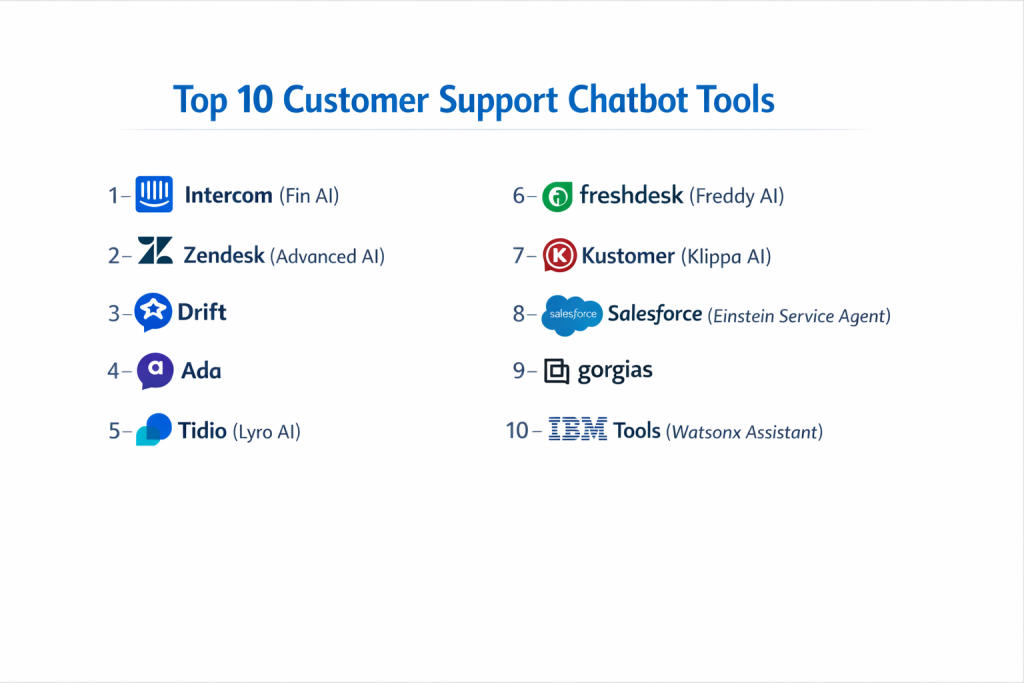
Top 10 Customer Support Chatbots Tools
1 — Intercom (Fin AI)
Intercom has shifted from a simple messaging widget to an AI-first “Customer Service Platform.” Its latest bot, Fin, is powered by OpenAI’s technology to provide conversational answers based strictly on a company’s support content.
- Key features:
- Fin AI Bot: Resolves inquiries instantly by synthesizing information from your help center.
- Omnichannel Support: Operates across email, WhatsApp, SMS, and in-app chat.
- Workflow Builder: A visual, no-code environment for mapping out complex bot paths.
- Custom Bots: Proactively engages visitors based on behavior or specific user attributes.
- Resolution Dashboard: Detailed reporting on which queries the bot solved versus abandoned.
- Pros:
- Natural Conversations: Fin sounds significantly more human than traditional rule-based bots.
- Integrated Ecosystem: Combines the bot, help center, and agent inbox into one unified workspace.
- Cons:
- Pricing Model: Charges per resolution, which can lead to unpredictable costs for high-volume businesses.
- Complexity: Setting up advanced workflows requires a learning curve for new administrators.
- Security & compliance: SOC 2 Type II, HIPAA, and GDPR compliant. Features 256-bit encryption and SSO support.
- Support & community: Extensive Intercom Academy, a massive “Intercom Community” forum, and dedicated enterprise success managers.
2 — Zendesk (Advanced AI)
Zendesk is a titan in the helpdesk world, offering AI agents that are pre-trained on billions of real customer service interactions. It is designed for businesses that need a bot that understands “customer service intent” out of the box.
- Key features:
- Intent Detection: Automatically categorizes user issues (e.g., “refund,” “shipping”) to provide relevant answers.
- Macro Suggestions: Suggests responses to agents based on previous successful bot interactions.
- Content Cues: Uses AI to identify gaps in your knowledge base where the bot is failing.
- Flow Builder: Simplifies the creation of automated conversation trees without coding.
- Advanced Encryption: High-level data protection for enterprise-level support.
- Pros:
- Pre-trained Models: Requires less manual “teaching” than general AI bots because it already understands support lingo.
- Vast Integration Marketplace: Connects with virtually every major business tool (Shopify, Jira, Slack).
- Cons:
- UI/UX: The administrative backend can feel cluttered and overwhelming for small teams.
- Cost of Entry: Advanced AI features are often locked behind higher-tier “Suite” plans.
- Security & compliance: ISO 27001, SOC 2, HIPAA, and GDPR compliant. Includes robust audit logs and PII masking.
- Support & community: Large global user groups, “Zendesk Relate” events, and a comprehensive developer portal.
3 — Drift
Drift focuses on “Conversational Service,” aiming to bridge the gap between marketing, sales, and support. It is highly optimized for B2B companies looking to provide a personalized experience for VIP accounts.
- Key features:
- Conversational AI: Learns from your website content to answer technical questions accurately.
- VIP Identification: Recognizes high-value customers and immediately alerts a human account manager.
- Meeting Scheduler: The bot can book demos or support calls directly in an agent’s calendar.
- Video Messaging: Allows the bot to drop personalized video greetings into the chat.
- A/B Testing: Compare different bot greetings to see which leads to higher engagement.
- Pros:
- B2B Powerhouse: Excellent at identifying who is on your site and routing them to the right team.
- Lead Generation: One of the few support bots that excels at converting a support query into a sales lead.
- Cons:
- Premium Pricing: Targeted toward the mid-market and enterprise; not budget-friendly for small startups.
- Support Focus: Can sometimes feel more like a sales tool than a pure customer support platform.
- Security & compliance: SOC 2 Type II certified, GDPR compliant, and Privacy Shield certified.
- Support & community: “Drift Insider” platform for training, plus high-touch customer success for all premium accounts.
4 — Ada
Ada is a specialized AI platform built for automated brand interactions. It focuses heavily on “Resolution-as-a-Service,” designed to handle millions of inquiries for global brands.
- Key features:
- Multilingual Support: Automatically detects and speaks over 100 languages.
- Proactive Messaging: Reaches out to users during common friction points in the customer journey.
- No-Code Platform: Allows non-technical CX managers to build and manage the AI.
- Integration Hub: Deep hooks into Shopify, Salesforce, and Oracle.
- Predictive Suggestions: Guesses what the user might need next based on current page context.
- Pros:
- Scale: Handles massive traffic spikes without latency, perfect for airlines or major retailers.
- Focus on Resolution: The tool is philosophically built to resolve issues, not just answer questions.
- Cons:
- Setup Time: To get the best results, significant time must be spent mapping out complex integrations.
- Niche Tool: It is a standalone bot platform, meaning you still need a separate ticketing system.
- Security & compliance: HIPAA, PCI DSS Level 1, SOC 2, and GDPR compliant.
- Support & community: Dedicated transformation teams to help enterprises transition to AI-first support.
5 — Tidio (Lyro AI)
Tidio is the go-to solution for SMBs and Shopify store owners. Its newest AI, Lyro, is a conversational bot that small teams can set up in minutes to handle 70% of common questions.
- Key features:
- Lyro AI: Uses Claude (Anthropic) or GPT models to talk naturally with customers.
- Salesforce/Shopify Sync: Pulls order data to answer “Where is my order?” automatically.
- Live Visitor List: Shows you who is on your site in real-time so the bot can trigger.
- Visual Builder: Drag-and-drop nodes for creating simple automation paths.
- Email Integration: Manage both chat and email support from a single Tidio dashboard.
- Pros:
- Value: One of the most affordable ways to get high-end conversational AI for a small business.
- Simplicity: You can literally go live with an AI bot in under 15 minutes.
- Cons:
- Enterprise Limits: Lacks the advanced routing and reporting needed for teams of 500+ agents.
- Customization: Fewer options to fine-tune the AI’s internal “brain” compared to Ada or Zendesk.
- Security & compliance: GDPR compliant and uses standard SSL/TLS encryption. SOC 2 varies by plan.
- Support & community: Very responsive live chat support and an extensive library of templates.
6 — Freshdesk (Freddy AI)
Part of the Freshworks suite, Freddy AI provides “Omnibot” capabilities that assist both the customer (via self-service) and the agent (via automated suggestions).
- Key features:
- Solution Suggester: Matches user queries to help-center articles automatically.
- Thank You Detector: Recognizes when a user says “thanks” and prevents the bot from reopening a ticket.
- Dynamic Workflows: Changes the bot’s behavior based on the time of day or agent availability.
- Auto-Triage: Categorizes and prioritizes tickets before they ever reach an agent.
- Social Bot: Extends chatbot capabilities to Twitter (X) and Facebook Messenger.
- Pros:
- Agent Productivity: Excellent features that help human agents work faster through “Agent Assist.”
- Ease of Use: Consistent, modern interface that is easier to navigate than Zendesk.
- Cons:
- Integration Lag: Some third-party integrations aren’t as deep as those found in the Salesforce ecosystem.
- Bot Credits: Pricing is often tied to “sessions,” which can be tricky to forecast.
- Security & compliance: ISO 27001, SOC 2, HIPAA, and GDPR compliant. Robust data residency options.
- Support & community: Freshworks Academy and a global network of implementation partners.
7 — Kustomer (Klippa AI)
Kustomer is a CRM-based support platform that was briefly owned by Meta. It focuses on a “customer-centric” view, meaning the bot has access to the user’s entire purchase and interaction history.
- Key features:
- CRM Data Access: The bot can see every past interaction a user has had across all channels.
- Timeline View: A visual history of the customer journey used to inform bot responses.
- Intelligent Routing: Moves the conversation to the best agent if the bot cannot resolve it.
- Sentiment Analysis: Detects if a user is angry and escalates the chat immediately.
- Custom Objects: Allows the bot to interact with specialized data like “Subscription Type” or “Loyalty Level.”
- Pros:
- Context King: Because it is a CRM first, the bot is smarter about who it is talking to.
- Social Integration: Best-in-class integration with Instagram and WhatsApp.
- Cons:
- Pricing: Higher starting price point, making it less ideal for micro-businesses.
- Niche Ecosystem: Best used if you move your entire support operation to Kustomer.
- Security & compliance: SOC 2 Type II, HIPAA, and GDPR compliant. Offers high-level encryption.
- Support & community: Personalized onboarding and a focus on high-growth D2C (Direct to Consumer) brands.
8 — Salesforce (Einstein Service Agent)
For companies already running on Salesforce, Einstein is the logical choice. It is a deeply integrated AI that can perform actual business processes, not just talk.
- Key features:
- Autonomous Action: The bot can trigger workflows in the CRM, like processing a refund or updating a lead.
- Data Cloud Sync: Uses your company’s entire data ecosystem to provide personalized answers.
- Multimodal AI: Can process images and text to understand support issues.
- Trust Layer: Features built-in PII masking to ensure sensitive data never leaves the secure environment.
- Omni-Channel Flow: A powerful builder that manages bot logic across web, app, and phone.
- Pros:
- Process Automation: The only bot that can truly “work” inside your complex business systems.
- Scalability: Built for the world’s largest companies with infinite scalability.
- Cons:
- Extreme Complexity: Requires a certified Salesforce Administrator to set up and maintain.
- High Cost: The total cost of ownership is significant when including licensing and setup.
- Security & compliance: The industry gold standard; SOC 1/2/3, ISO, HIPAA, PCI DSS, and GDPR.
- Support & community: The “Trailhead” learning platform is the best in the software industry.
9 — Gorgias
Gorgias is the leading support platform for e-commerce, specifically built for Shopify, BigCommerce, and Magento users. Its bot is laser-focused on reducing the “Where is my order?” (WISMO) tickets.
- Key features:
- Shopify Integration: Deep sync that allows the bot to modify orders or issue discounts.
- Social Media Automation: Automatically responds to comments and DMs on Instagram and Facebook.
- Quick Response Macros: One-click automated answers that the bot can deploy.
- Intent Detection: Recognizes when a customer wants to cancel an order and acts accordingly.
- Self-Service Portal: A specialized widget where customers can track their own packages.
- Pros:
- E-commerce Specialist: If you run an online store, the bot’s logic is already tuned for your specific needs.
- Revenue Tracking: Shows you exactly how much money the bot saved or generated through chat.
- Cons:
- Niche: Not a great fit for SaaS or B2B companies; it is strictly an e-commerce tool.
- Platform Dependent: Most powerful when used exclusively with Shopify.
- Security & compliance: GDPR compliant and SOC 2 Type II certified. Secure Shopify API handling.
- Support & community: Strong community of e-commerce founders and excellent live chat support.
10 — IBM Tools (Watsonx Assistant)
IBM Watsonx Assistant is an enterprise-grade AI builder. It is for companies that want to build a highly custom, conversational agent that can be deployed on any cloud or on-premise.
- Key features:
- NLP Excellence: Historically one of the most accurate Natural Language Processing engines.
- Low-Code Interface: A “skills-based” builder that simplifies complex AI training.
- Search Integration: Crawls your website and documents to find answers the bot wasn’t explicitly taught.
- Deployment Flexibility: Can be hosted on IBM Cloud, AWS, Azure, or locally (On-Prem).
- Advanced Debugging: Tools that show exactly “why” the bot gave a certain answer.
- Pros:
- Data Privacy: Ideal for banks or government agencies that cannot use standard “black-box” AI.
- Customization: Almost no limit to how you can train or brand the assistant.
- Cons:
- Interface: The platform can feel “academic” and less user-friendly than modern SaaS bots.
- Resource Intensive: Requires a dedicated AI specialist to reach its full potential.
- Security & compliance: FedRAMP, HIPAA, SOC 2, ISO 27001, and GDPR compliant.
- Support & community: Professional services from IBM and an extensive global developer network.
Comparison Table
| Tool Name | Best For | Platform(s) Supported | Standout Feature | Rating |
| Intercom | SaaS & Apps | Web, Mobile, WhatsApp | Fin AI Conversationalist | 4.7/5 |
| Zendesk | Enterprise Helpdesk | Omnichannel | Pre-trained Intent Models | 4.6/5 |
| Drift | B2B Lead Gen | Web, Mobile | VIP Account Routing | 4.4/5 |
| Ada | Global Brands | Omnichannel | 100+ Language Support | 4.5/5 |
| Tidio | Shopify SMBs | Web, Mobile | Lyro AI (Affordable) | 4.5/5 |
| Freshdesk | Agent Productivity | Web, Mobile, Social | Agent-Assist AI | 4.3/5 |
| Kustomer | D2C Brands | Omnichannel | CRM Timeline View | 4.4/5 |
| Salesforce | Large Enterprise | Omnichannel | Einstein Process Automation | 4.2/5 |
| Gorgias | E-commerce | Shopify, Social | “Where is my order?” Bot | 4.8/5 |
| IBM Watsonx | Specialized/High Sec | Cloud & On-Prem | On-Premise Deployment | 4.1/5 |
Evaluation & Scoring of Customer Support Chatbots
| Category | Weight | Evaluation Criteria |
| Core Features | 25% | NLP accuracy, intent detection, and resolution capabilities. |
| Ease of Use | 15% | No-code setup, visual builder quality, and admin UI. |
| Integrations | 15% | Depth of connection with CRMs, Shopify, and social channels. |
| Security | 10% | SOC 2, GDPR, HIPAA, and data residency options. |
| Performance | 10% | Uptime, bot response speed, and mobile responsiveness. |
| Support | 10% | Documentation, onboarding, and community resources. |
| Price / Value | 15% | Transparency and scalability of the pricing model. |
Which Customer Support Chatbot Is Right for You?
Solo Users vs. SMB vs. Mid-Market vs. Enterprise
For Solo Users and small Shopify owners, Tidio or Gorgias are the gold standard. They are built for speed and require very little technical setup. Mid-Market companies often find the best balance in Intercom or Freshdesk, which offer powerful automation without the massive overhead of a legacy CRM. Global Enterprises should look toward Zendesk, Salesforce, or Ada, as these platforms provide the governance, security, and complex routing needed for thousands of agents and millions of customers.
Budget-Conscious vs. Premium Solutions
If you are Budget-Conscious, Tidio offers a high-performing AI (Lyro) with a predictable pricing structure. If you are looking for a Premium Solution where results matter more than cost, Ada and Intercom provide the most advanced Generative AI capabilities that feel truly human, justifying their higher price points through high deflection rates.
Feature Depth vs. Ease of Use
If you prioritize Ease of Use, Tidio and Gorgias are the winners. You can literally be live in minutes. If you require Feature Depth—specifically the ability for the bot to perform complex tasks like verifying a warranty or updating a shipping address—Salesforce and Ada provide the deepest integration capabilities.
Integration and Scalability Needs
For teams that need to Scale and already live in their CRM, Salesforce and Zendesk are the logical choices. Their marketplaces allow you to add features as your company grows. If your main goal is to scale across multiple languages, Ada is the undisputed leader in automated translation.
Security and Compliance Requirements
Companies in Finance or Government must be cautious. IBM Watsonx is often the top choice because it allows for on-premise hosting, ensuring data never leaves the building. For Healthcare, ensure you are on a plan that specifically includes a BAA (Business Associate Agreement), which is commonly offered by Zendesk, Intercom, and Salesforce.
Frequently Asked Questions (FAQs)
1. What is the difference between a rule-based bot and an AI bot?
Rule-based bots follow a strict “if-this-then-that” flowchart. AI bots use Natural Language Processing to understand the meaning behind a user’s words, allowing them to answer questions that weren’t explicitly programmed into a flow.
2. Will a chatbot make my customer service feel cold?
Not if implemented correctly. Modern bots (like Fin or Lyro) use Generative AI to sound helpful and polite. The key is to always provide an “Escape Hatch” where a user can talk to a human if they get frustrated.
3. Do I need to know how to code to set up a support chatbot?
Most modern SaaS bots (Intercom, Tidio, Appcues) are “No-Code,” meaning you use a visual drag-and-drop builder to set them up. Only enterprise tools like IBM Watson or Salesforce Einstein might require developer assistance.
4. How do chatbots reduce support costs?
They handle the “Low Value, High Volume” queries (like “What is your return policy?”) for pennies. This reduces the number of human agents you need to hire and lowers the cost-per-ticket significantly.
5. Can a chatbot handle returns and refunds?
Yes, if the bot is integrated with your e-commerce platform (like Shopify). Tools like Gorgias and Salesforce can verify an order and trigger a refund process automatically.
6. Are chatbots GDPR compliant?
The top 10 listed here are all GDPR compliant. However, you must ensure your privacy policy discloses the use of a chatbot and that you have a data processing agreement (DPA) with the provider.
7. How do I “train” a chatbot?
Most modern AI bots train by “reading” your existing help-center articles, website pages, and past support tickets. You simply provide the URL or document, and the AI learns the content.
8. What is “Human Handoff”?
This is the process where a bot realizes it cannot answer a question and seamlessly transfers the conversation to a live human agent, usually passing along the full transcript so the customer doesn’t have to repeat themselves.
9. Can chatbots work on social media?
Yes. Most platforms (Freshdesk, Gorgias, Kustomer) can be deployed on Facebook Messenger, Instagram DMs, and WhatsApp, allowing you to manage all social support in one place.
10. What is the biggest mistake when launching a chatbot?
Launching a bot that pretends to be a human. Customers value transparency; they are happy to talk to a bot if it solves their problem quickly, but they feel cheated if they think they are being “tricked.”
Conclusion
The era of the “frustrating chatbot” is coming to an end. With the rise of Generative AI, customer support bots have transformed from simple FAQ-repeaters into intelligent assistants capable of resolving complex issues in seconds.
Choosing the “best” tool depends entirely on your ecosystem. If you are a Shopify store, Gorgias or Tidio will give you the fastest ROI. If you are a SaaS company, Intercom provides a world-class conversational experience. And for the Global Enterprise, Zendesk and Salesforce offer the scale and security required for millions of interactions.
Ultimately, a chatbot should not be viewed as a way to “hide” from your customers, but as a way to respect their time by providing instant, accurate answers 24 hours a day.