Introduction
SSL/TLS Certificate Authorities (CA) tooling refers to the specialized software and platforms used to issue, manage, and automate digital certificates. These certificates are the backbone of internet security, enabling encrypted communication between a web browser and a server. Without this tooling, the “green padlock” (or modern equivalent) in your browser wouldn’t exist, leaving sensitive data like passwords and credit card numbers vulnerable to interception. These tools act as the “notaries” of the digital world, verifying that a website or service is truly who they claim to be.
The importance of this category cannot be overstated. As the web moves toward 100% encryption, managing these certificates manually has become impossible for modern businesses. A single expired certificate can bring down a global banking app or an e-commerce giant, causing millions in lost revenue. CA tooling automates the lifecycle of these certificates—from request and validation to installation and renewal—ensuring that security remains seamless and uninterrupted.
Key Real-World Use Cases
- Public Web Security: Securing customer-facing websites to prevent “Not Secure” warnings and improve SEO rankings.
- Machine-to-Machine Communication: Protecting internal traffic between microservices in a cloud-native environment.
- IoT Device Authentication: Ensuring that only authorized “smart” devices can connect to a company’s backend servers.
- Enterprise Email Security: Utilizing S/MIME certificates to sign and encrypt corporate communications.
What to Look For (Evaluation Criteria)
When choosing a tool, you should prioritize Automation Capabilities, specifically support for protocols like ACME (Automated Certificate Management Environment). Validation Speed is also vital—how fast can the tool issue a certificate after you request it? Look for Lifecycle Management features that provide a central dashboard for tracking expiration dates across your entire infrastructure. Finally, ensure the tool offers Strong Integration with your existing stack, whether you use AWS, Azure, or on-premise Linux servers.
Best for:
- DevOps and Site Reliability Engineers (SREs): Who need to automate security without slowing down deployment pipelines.
- Cybersecurity Managers: Who require a centralized “source of truth” for all digital certificates across an organization.
- E-commerce and Financial Institutions: Industries where uptime and trust are directly tied to revenue.
- Enterprise IT Departments: Organizations managing thousands of internal and external endpoints.
Not ideal for:
- Static Site Hobbyists: If you are running a basic personal blog on a platform like GitHub Pages or https://www.google.com/search?q=WordPress.com, these services usually handle SSL for you automatically.
- Local-Only Development: Developers working strictly on
localhostmay find full CA tooling to be overkill, preferring simple self-signed certificates or local tools likemkcert.
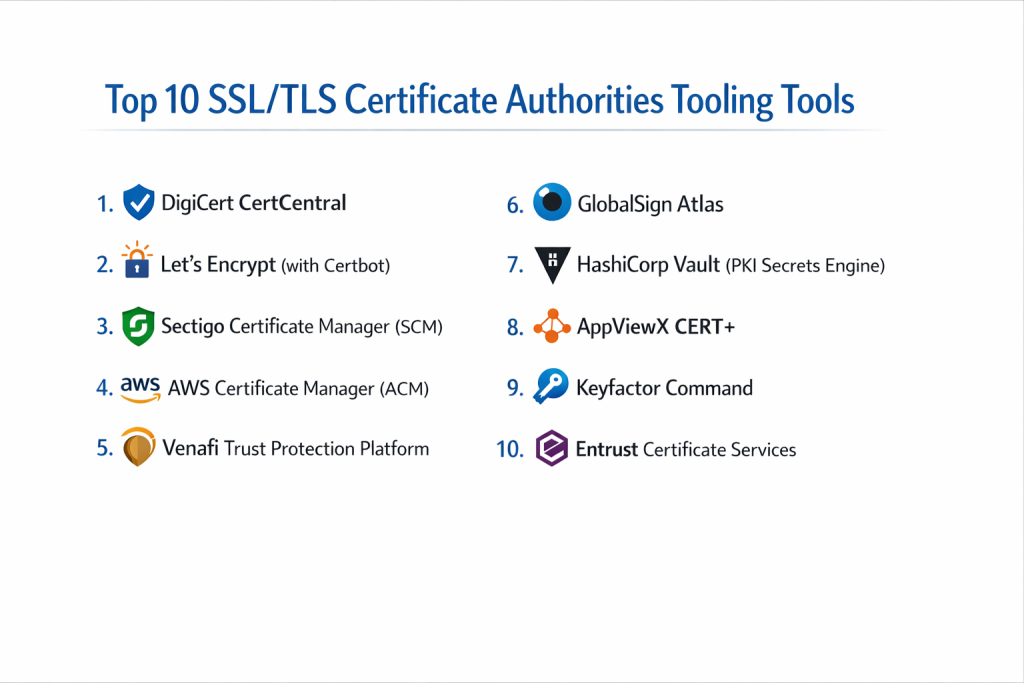
Top 10 SSL/TLS Certificate Authorities Tooling Tools
1 — DigiCert CertCentral
DigiCert is widely considered the gold standard for enterprise-level certificate management. CertCentral is their flagship platform, designed to give large organizations total visibility and control over their entire certificate inventory, regardless of the issuer.
- Key features:
- Discovery tool to find every certificate on your network (even those not issued by DigiCert).
- Automated renewal and installation via specialized sensors and agents.
- Support for all certificate types: DV, OV, EV, and Wildcard.
- Granular role-based access control (RBAC) for large teams.
- API-first architecture for integration into CI/CD pipelines.
- Pros:
- Unmatched reliability and industry-leading trust in all browsers and operating systems.
- The discovery feature is excellent for cleaning up “rogue” certificates hidden in the network.
- Cons:
- Significantly more expensive than open-source or mid-market alternatives.
- The sheer number of features can be overwhelming for smaller businesses.
- Security & compliance: SOC 2 Type II, HIPAA, GDPR, PCI DSS, and ISO 27001.
- Support & community: 24/7/365 premium support with dedicated account managers for enterprise clients.
2 — Let’s Encrypt (with Certbot)
Let’s Encrypt is a non-profit Certificate Authority that changed the web by providing free SSL/TLS certificates. While Let’s Encrypt is the issuer, Certbot is the primary tooling used to manage those certificates, making it the most popular choice for developers globally.
- Key features:
- Completely free Domain Validated (DV) certificates.
- Automatic renewal via the ACME protocol.
- Certbot client provides easy CLI-based management for Linux servers.
- Massive ecosystem of plugins for Nginx, Apache, and other web servers.
- Transparent, public audit logs for all issued certificates.
- Pros:
- Eliminates the cost of basic web security entirely.
- Automation is exceptionally robust; once set up, it rarely requires manual intervention.
- Cons:
- Does not offer Organization Validated (OV) or Extended Validation (EV) certificates.
- No dedicated phone or live-chat support; you rely on community forums.
- Security & compliance: GDPR compliant, audited annually by WebTrust.
- Support & community: Massive community forum and extensive documentation used by millions of developers.
3 — Sectigo Certificate Manager (SCM)
Sectigo is one of the largest CAs in the world, and SCM is their cloud-based platform designed to manage the end-to-end lifecycle of all digital certificates, including those used for users, devices, and servers.
- Key features:
- Single pane of glass for public and private CA management.
- Automation for Apache, IIS, and F5 systems.
- Integration with popular MDM (Mobile Device Management) platforms.
- S/MIME certificate automation for secure email communication.
- Comprehensive reporting and alerting for pending expirations.
- Pros:
- Excellent for hybrid environments that use both public and private certificates.
- Very strong integration with Windows environments and Active Directory.
- Cons:
- The user interface can feel a bit dated compared to modern SaaS platforms.
- Provisioning speeds can sometimes lag behind more agile cloud-native tools.
- Security & compliance: SOC 2, HIPAA, GDPR, and WebTrust certified.
- Support & community: 24/7 technical support and a global network of partners.
4 — AWS Certificate Manager (ACM)
For organizations built on Amazon Web Services, ACM is the default choice. It simplifies the process of provisioning, managing, and deploying public and private SSL/TLS certificates for use with AWS services like Elastic Load Balancers and CloudFront.
- Key features:
- One-click deployment to AWS resources.
- Free public certificates for use with AWS-hosted websites.
- Automatic renewal of certificates managed within the AWS ecosystem.
- Private CA option for internal microservices.
- Integration with AWS CloudWatch for monitoring and logs.
- Pros:
- Deeply integrated; you never have to manually upload a certificate file to a load balancer.
- No additional cost for public certificates used on AWS.
- Cons:
- Strong vendor lock-in; you cannot export public ACM certificates for use on external servers.
- Does not support Extended Validation (EV) certificates.
- Security & compliance: HIPAA, PCI DSS, SOC 1/2/3, and FedRAMP compliant.
- Support & community: Backed by AWS’s massive documentation and paid support tiers.
5 — Venafi Trust Protection Platform
Venafi is a specialized machine identity management platform. Unlike a standard CA, Venafi acts as a sophisticated orchestration layer that manages certificates across multiple CAs, including DigiCert, Sectigo, and Let’s Encrypt.
- Key features:
- Full visibility into every certificate, key, and machine identity in the enterprise.
- Automated “one-click” remediation for compromised or expired certificates.
- Policy enforcement to ensure all teams follow security standards.
- Integration with Kubernetes and service meshes (Istio, Linkerd).
- Secure key storage and management.
- Pros:
- The absolute best tool for “Certificate Agility” (switching CAs quickly if one is compromised).
- Essential for high-security environments like banking and defense.
- Cons:
- The highest price point on this list.
- Significant implementation time and complexity.
- Security & compliance: FIPS 140-2, SOC 2, GDPR, and ISO 27001.
- Support & community: Top-tier enterprise support and professional service offerings.
6 — GlobalSign Atlas
GlobalSign’s Atlas is a high-speed, cloud-based issuance engine designed for automation at scale. It is particularly effective for organizations that need to issue certificates for thousands of employees or IoT devices in a short window.
- Key features:
- Massive throughput for high-volume certificate issuance.
- Restful API for custom application integrations.
- Automated deployment for Windows via ACME and Active Directory.
- Cloud-based portal for easy certificate lifecycle tracking.
- Support for WiFi and VPN authentication certificates.
- Pros:
- One of the fastest issuance engines in the industry.
- Excellent for large-scale internal security and device identity.
- Cons:
- The API documentation can be complex for junior developers.
- Account setup and vetting process can be rigorous and time-consuming.
- Security & compliance: WebTrust, ISO 27001, and SOC 2.
- Support & community: Multi-language support and dedicated regional offices.
7 — HashiCorp Vault (PKI Secrets Engine)
HashiCorp Vault is a well-known secrets management tool, but its PKI (Public Key Infrastructure) engine is a powerful way for developers to generate and manage dynamic, short-lived certificates.
- Key features:
- Programmatic generation of certificates via API or CLI.
- Support for short-lived certificates (minutes or hours) to reduce risk.
- Acts as an intermediary CA, chaining up to a trusted root.
- Role-based generation (issue certs for specific domains only).
- Automatic revocation and CRL (Certificate Revocation List) management.
- Pros:
- Perfect for “Zero Trust” architectures where identities change frequently.
- Integrates natively with modern DevOps tools like Terraform and Nomad.
- Cons:
- Vault itself requires significant expertise to manage and secure.
- Not a public CA; certificates aren’t trusted by browsers by default.
- Security & compliance: FIPS 140-2, SOC 2, and GDPR.
- Support & community: Massive open-source community and professional enterprise support options.
8 — AppViewX CERT+
AppViewX is a modular platform focusing on certificate lifecycle automation and network orchestration. It is designed to bridge the gap between security teams and infrastructure teams, providing a visual way to manage certificates.
- Key features:
- Visual workflow automation (drag-and-drop) for certificate tasks.
- Multi-CA support (DigiCert, Sectigo, Microsoft CA, etc.).
- Automated discovery and vulnerability scanning for SSL/TLS.
- Integration with ITSM tools like ServiceNow.
- Self-service portal for developers to request certificates.
- Pros:
- The visual workflow builder makes complex automation easy to understand.
- Great for organizations that need to strictly audit who requested what and when.
- Cons:
- Can be resource-heavy to run the platform on-premise.
- Initial configuration of the discovery sensors can be tricky.
- Security & compliance: SOC 2 Type II and GDPR compliant.
- Support & community: Strong customer success program and detailed training modules.
9 — Keyfactor Command
Keyfactor is a leader in machine identity management. Their Command platform focuses specifically on “crypto-agility”—the ability of an organization to respond to changes in the cryptographic landscape, such as the move to post-quantum cryptography.
- Key features:
- Continuous monitoring of all keys and certificates.
- Orchestrated renewal across cloud, on-prem, and IoT.
- “Any-to-any” CA connectivity.
- Detailed compliance auditing and reporting.
- Secure storage of private keys in hardware security modules (HSMs).
- Pros:
- High focus on future-proofing security against new threats.
- The user interface is modern, clean, and very fast.
- Cons:
- Primarily targeted at large enterprises; price is prohibitive for small teams.
- Support for some older legacy systems may require custom development.
- Security & compliance: FIPS 140-2 Level 3, SOC 2, and WebTrust.
- Support & community: High-touch support and an active “identity” research wing.
10 — Entrust Certificate Services
Entrust is a legacy security giant that has modernized its certificate management platform to compete in the cloud era. They are a preferred choice for government and high-compliance sectors due to their long history in physical and digital identity.
- Key features:
- Centralized dashboard for public and private SSL management.
- Enterprise-wide discovery and expiration monitoring.
- Support for code signing and document signing certificates.
- Integration with major cloud platforms and load balancers.
- Automated renewal via agents.
- Pros:
- Strong reputation for compliance and security in high-stakes environments.
- Excellent consolidated billing and management for multiple TLDs.
- Cons:
- Provisioning workflows can be more rigid than cloud-native competitors.
- The website and management portal can be confusing to navigate initially.
- Security & compliance: ISO 27001, SOC 2, HIPAA, and WebTrust.
- Support & community: Extensive library of whitepapers and 24/7 technical support.
Comparison Table
| Tool Name | Best For | Platform(s) Supported | Standout Feature | Rating |
| DigiCert | Enterprise Trust | Universal | Network-wide Discovery | 4.8/5 |
| Let’s Encrypt | Free Automation | Linux / Cloud | ACME Protocol | 4.7/5 |
| Sectigo | Hybrid Environments | Windows / Cloud | S/MIME Automation | 4.4/5 |
| AWS ACM | AWS Users | AWS Ecosystem | Seamless Deployment | 4.6/5 |
| Venafi | Complex Security | Multi-Cloud | Identity Orchestration | 4.9/5 |
| GlobalSign | IoT / High Volume | Cloud / On-Prem | High-Speed Issuance | 4.3/5 |
| HashiCorp Vault | Dynamic Microservices | Containerized | Ephemeral Certificates | 4.5/5 |
| AppViewX | Visual Automation | Universal | Workflow Drag-and-Drop | 4.2/5 |
| Keyfactor | Future-Proofing | Cloud / IoT | Post-Quantum Readiness | 4.6/5 |
| Entrust | Government / Legal | Universal | Identity Heritage | 4.1/5 |
Evaluation & Scoring of SSL/TLS Certificate Authorities Tooling
The following scores represent a balanced look at how these tools serve a modern, security-conscious organization.
| Evaluation Category | Weight | DigiCert | Let’s Encrypt | Venafi | AWS ACM |
| Core Features | 25% | 9.5 | 7.0 | 10.0 | 8.0 |
| Ease of Use | 15% | 8.5 | 9.0 | 7.0 | 9.5 |
| Integrations | 15% | 9.0 | 9.5 | 9.5 | 10.0 |
| Security/Compliance | 10% | 10.0 | 8.5 | 10.0 | 9.5 |
| Performance | 10% | 9.5 | 9.0 | 9.0 | 10.0 |
| Support/Community | 10% | 10.0 | 9.5 | 9.0 | 8.5 |
| Price / Value | 15% | 7.0 | 10.0 | 6.5 | 9.0 |
| TOTAL SCORE | 100% | 8.9 | 8.6 | 8.8 | 9.1 |
Which SSL/TLS Certificate Authorities Tooling Tool Is Right for You?
Small to Mid-Market vs. Enterprise
For solo users and small businesses, Let’s Encrypt with Certbot is the undisputed winner. It’s free, automated, and supported by every major hosting provider. Mid-market companies starting to feel the pain of manual management should look at AWS ACM (if they are on AWS) or DigiCert’s entry-level CertCentral tiers. Enterprises with thousands of machines and multiple CAs need an orchestration layer like Venafi or Keyfactor to prevent outages and enforce security policies.
Budget and Value
If your budget is zero, Let’s Encrypt is your only choice for public trust. For those seeking the best value in a managed platform, AWS ACM offers incredible value because it doesn’t charge for the public certificates themselves—you only pay for the private CA if you need one. Sectigo often provides competitive volume pricing for organizations that need a wide variety of certificate types (DV, OV, EV) under one contract.
Technical Depth vs. Simplicity
If you want Simplicity, AWS ACM and Cloudflare’s managed SSL are the easiest to use—often requiring just a single click. If you need Technical Depth—such as short-lived, ephemeral certificates for thousands of Docker containers—HashiCorp Vault or Venafi provide the granular control and API surface area that power users require.
Security and Compliance Requirements
For industries like healthcare, finance, or government, DigiCert and Entrust have the longest track records of compliance. They provide the “high assurance” certificates (OV and EV) that are often required by legal frameworks to prove the identity of the organization owning the website. If you are building a modern “Zero Trust” network, the dynamic capabilities of HashiCorp Vault are unmatched.
Frequently Asked Questions (FAQs)
What is the difference between a CA and CA tooling?
A Certificate Authority (CA) like DigiCert is the entity that issues the certificate. Tooling like CertCentral or Venafi is the software that helps you request, track, and install those certificates automatically.
Why is SSL/TLS automation important?
Manual management leads to human error. If you forget to renew a certificate, your website will show a “Not Secure” warning, which destroys user trust and causes immediate downtime.
Can I use Let’s Encrypt for my enterprise?
Yes, but remember that Let’s Encrypt only provides Domain Validated (DV) certificates. It cannot verify the legal existence of your company (OV/EV), which some enterprise partners may require.
What is a “Wildcard” certificate?
A wildcard certificate secures your main domain and an unlimited number of subdomains (e.g., *.example.com). This is a huge time-saver for companies with many sub-services.
What is the ACME protocol?
ACME (Automated Certificate Management Environment) is a communication protocol that allows a web server to talk directly to a CA to request and install certificates without any human help.
Does SSL improve my SEO?
Yes. Google and other search engines prioritize encrypted websites. Using SSL/TLS tooling to ensure your certificates never expire is a key part of maintaining your search ranking.
Is AWS ACM better than DigiCert?
It depends on where your servers are. If everything you own is on AWS, ACM is better due to its integration. If you have servers in your own data center, DigiCert is better because it is platform-agnostic.
What is an EV certificate?
Extended Validation (EV) is the highest level of validation. It requires the CA to perform a deep check of your legal business status. It’s primarily used by banks and high-trust e-commerce sites.
How often should I renew my certificates?
Public certificates currently have a maximum life of 398 days. However, security experts recommend using tooling to renew them every 90 days or even more frequently to minimize risk.
Can SSL certificates be stolen?
The certificate itself is public, but the “Private Key” must be kept secret. Good CA tooling helps secure these private keys in an HSM or an encrypted vault to prevent theft.
Conclusion
Managing the security of the modern web is no longer a task for spreadsheets and calendar reminders. The explosion of microservices, IoT devices, and cloud-native applications has made SSL/TLS Certificate Authorities Tooling a mandatory part of the enterprise security stack. Whether you are a solo developer relying on the automation of Let’s Encrypt or a global bank orchestrating identities with Venafi, the goal remains the same: 100% uptime and 100% encryption.
When choosing your tool, remember that the “best” choice is the one that fits your current infrastructure while scaling for the future. Prioritize automation, visibility, and ease of renewal. By taking the human element out of certificate management, you don’t just secure your data—you protect your brand’s reputation and ensure your services remain accessible to the world.