Introduction
Therapy practice management tools are all-in-one software platforms designed to streamline the clinical and administrative operations of mental health professionals, physical therapists, and speech-language pathologists. These systems act as the digital backbone of a modern practice, integrating electronic health records (EHR), automated appointment scheduling, HIPAA-compliant telehealth, and complex insurance billing into a single interface. By centralizing these workflows, therapists can reduce the time spent on manual paperwork and focus more on delivering high-quality patient care.
The importance of these tools has surged with the rise of hybrid care models. Key real-world use cases include automated patient intake to reduce waiting room friction, AI-powered clinical documentation to combat burnout, integrated insurance claim filing for faster reimbursements, and secure client portals that empower patients to manage their own health journey. When evaluating these tools, users should look for ease of navigation, mobile accessibility, depth of clinical templates, and robust security certifications that protect sensitive health data.
Best for: Solo practitioners, small group practices, and large multi-disciplinary clinics across mental health, physical therapy, occupational therapy, and speech-language pathology.
Not ideal for: General business consultants or life coaches who do not require medical-grade documentation or HIPAA-compliant insurance billing, as the complexity of these tools may exceed their basic needs.
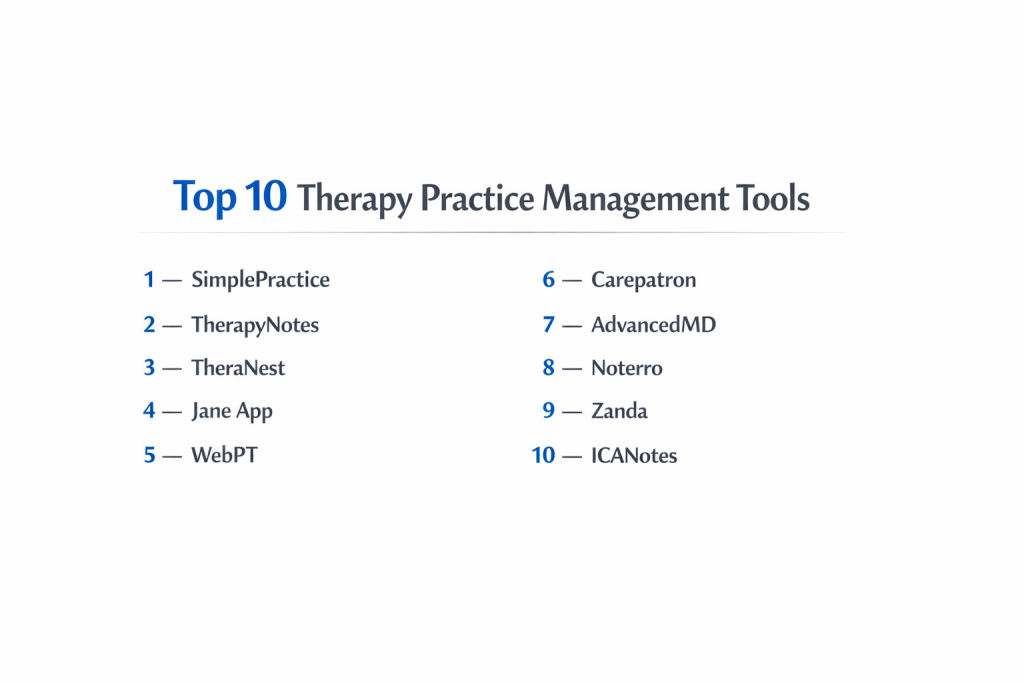
Top 10 Therapy Practice Management Tools
1 — SimplePractice
SimplePractice is widely regarded as the most user-friendly all-in-one platform for solo and small group practices. It excels at creating a seamless, paperless experience for both the clinician and the client.
- Key features:
- Fully Paperless Intake: Clients sign all consent forms and fill out history via a secure portal before the first session.
- Integrated Telehealth: Built-in HIPAA-compliant video conferencing with screen-sharing and whiteboard features.
- AI Note Taker: A modern addition that assists in drafting progress notes from session recordings or highlights.
- Autopay Billing: Automatically charges client credit cards and sends invoices at the end of each session.
- Insurance Claim Filing: One-click submission to thousands of payers with real-time status tracking.
- Pros:
- Exceptionally clean and intuitive user interface that requires almost no training.
- The mobile app allows for full practice management on the go.
- Cons:
- Pricing has increased significantly over the years, making it one of the more expensive options for solo users.
- Customer support is primarily chat and email-based, with no direct phone line for immediate help.
- Security & compliance: HIPAA and HITRUST certified; features data encryption at rest and in transit, plus regular SOC 2 audits.
- Support & community: Extensive self-service “Help Center,” a vibrant Facebook community, and “SimplePractice Learning” for continuing education.
2 — TherapyNotes
TherapyNotes is a powerhouse in the behavioral health space, known for its robust documentation tools and “compliance-first” design. It is highly favored by clinicians who prioritize structured note-taking.
- Key features:
- Specialized Note Templates: Built-in templates for SOAP, DAP, and initial evaluations specific to mental health.
- Appointment Reminders: Automated text, email, and phone reminders to drastically reduce no-shows.
- To-Do List Dashboard: A unique feature that flags missing signatures, late notes, and pending claims.
- Integrated Outcome Measures: Easy deployment of assessments like PHQ-9 and GAD-7 to track patient progress.
- Customized Client Portal: Allows clients to request appointments and view billing statements securely.
- Pros:
- The “To-Do” list ensures that practitioners never miss a compliance or billing deadline.
- Highly reliable and stable platform with exceptional data integrity records.
- Cons:
- The interface feels a bit dated and “industrial” compared to modern competitors.
- Telehealth features sometimes feel like an add-on rather than a natively integrated core experience.
- Security & compliance: HIPAA compliant with a signed Business Associate Agreement (BAA); utilizes bank-level encryption and audit logs.
- Support & community: Renowned for offering unlimited phone support with live agents, which is rare in the industry.
3 — TheraNest
TheraNest is a versatile platform that balances affordability with a strong feature set, making it a top choice for small clinics and non-profit organizations.
- Key features:
- Group Therapy Support: One of the best systems for managing multiple participants in a single session with individualized notes.
- Flexible Billing: Supports insurance, private pay, and sliding scale fee structures easily.
- Wiley Treatment Planners: Optional integration for evidence-based treatment planning and goal setting.
- Secure Messaging: HIPAA-compliant chat between the therapist and the client within the portal.
- Customizable Forms: Drag-and-drop builder for intake and consent paperwork.
- Pros:
- Tiered pricing based on active client count makes it very affordable for part-time therapists.
- Strong multi-provider features that make it easy to manage a growing group practice.
- Cons:
- The mobile application is limited in functionality compared to the desktop version.
- Some advanced reporting features can be difficult to configure without a learning curve.
- Security & compliance: HIPAA compliant; features multi-factor authentication (MFA) and data redundancy across multiple servers.
- Support & community: Offers a structured knowledge base, email support, and scheduled phone support sessions.
4 — Jane App
Originally from the allied health world, Jane App has become a favorite for multi-disciplinary clinics that include both mental health and physical therapy services.
- Key features:
- Beautiful Online Booking: A highly customizable and aesthetically pleasing booking page for clients.
- Charting Flexibility: Allows for “sketching” on anatomical diagrams, ideal for physical and occupational therapy.
- Integrated Payments: Jane Payments offers seamless credit card processing with transparent flat-rate fees.
- Return-to-Clinic Prompts: Automated reminders to invite clients back who haven’t booked in a while.
- Inventory Management: Tracks retail sales for supplements or therapeutic equipment.
- Pros:
- The most visually attractive and customizable client-facing interface on the market.
- Outstanding 99.99% uptime and overall system performance.
- Cons:
- Insurance billing for US-based practices is not as robust as systems like TherapyNotes.
- The “all-in-one” nature means it may lack some hyper-specific mental health documentation depth.
- Security & compliance: HIPAA, PIPEDA (Canada), and GDPR (Europe) compliant; features SSO and advanced audit logs.
- Support & community: Known for “Jane University” (training) and a community that feels like a partnership rather than a vendor relationship.
5 — WebPT
WebPT is the undisputed leader for outpatient rehab therapy (PT, OT, and SLP). It is built for high-volume clinics that need to maintain strict compliance with insurance payers like Medicare.
- Key features:
- Compliant Documentation: Built-in alerts ensure notes meet Medicare and commercial insurance standards.
- Outcome Tracking: Integrated tools to measure functional progress and patient performance over time.
- Revenue Cycle Management (RCM): Advanced billing services that handle the entire insurance lifecycle.
- Scheduler and Reminders: Optimized for high-frequency appointments typical in rehab therapy.
- Home Exercise Programs (HEP): Built-in tools to assign and track patient exercises between visits.
- Pros:
- The most specialized tool for rehab professionals, ensuring no “clinical gaps” in documentation.
- Scalable for enterprise-level operations with dozens of locations.
- Cons:
- Very high price point, which may be prohibitive for solo practitioners.
- The software is extremely dense and requires significant training to master.
- Security & compliance: HIPAA and SOC 2 Type II compliant; features enterprise-grade security protocols.
- Support & community: Professional onboarding and a dedicated success team for larger organizations.
6 — Carepatron
Carepatron is a modern, community-driven platform that has gained massive traction by offering a powerful “forever free” tier for those just starting out.
- Key features:
- AI Medical Scribe: Converts session transcripts into structured clinical notes automatically.
- Client Portal: A sleek, mobile-responsive portal for scheduling, forms, and payments.
- Telehealth Integration: One-click HIPAA-compliant video calls included in the platform.
- Workflow Automation: Task management and reminders for both staff and patients.
- Global Availability: Specifically designed to be used by therapists in multiple countries with local currency support.
- Pros:
- The “Forever Free” plan is the best value in the industry for new practitioners.
- Modern, minimalist design that is very easy for clients to navigate.
- Cons:
- Insurance billing features are less advanced than legacy US-based platforms.
- Fewer third-party integrations compared to the “big three” (SimplePractice, TherapyNotes, TheraNest).
- Security & compliance: HIPAA and GDPR compliant; uses 256-bit AES encryption for all data.
- Support & community: Fast-growing library of templates and a responsive digital support team.
7 — AdvancedMD
AdvancedMD is a comprehensive enterprise-level solution designed for large, multi-specialty healthcare organizations that include a mental health division.
- Key features:
- Advanced RCM: Industrial-strength revenue cycle management for complex billing departments.
- Clinical Intelligence: AI-driven analytics that provide insights into practice performance and patient health trends.
- Patient Marketing: Built-in tools for reputation management and patient satisfaction surveys.
- E-Prescribing: Full integration with pharmacies for medication management.
- Customizable Dashboards: Real-time data visualization for clinic managers and executives.
- Pros:
- Truly infinite scalability; you will never “outgrow” this system.
- Deep clinical depth for multidisciplinary practices that need to share data across specialties.
- Cons:
- Far too complex and expensive for a typical solo therapy practice.
- Implementation can take months and often requires a dedicated IT specialist.
- Security & compliance: Meets the highest federal standards, including HIPAA and ONC certification.
- Support & community: Enterprise-level account management and 24/7 technical support.
8 — Noterro
Noterro is an agile, all-in-one platform popular among massage therapists, physical therapists, and hands-on bodywork practitioners.
- Key features:
- SOAP Note Builder: Fast, click-based note-taking that is ideal for physical modalities.
- Integrated Charting: Allows practitioners to draw directly on clinical diagrams to show points of pain or treatment.
- Automated Waitlist: Automatically notifies clients when a slot opens up in the schedule.
- Multi-Location Support: Easily manage separate schedules and finances for different clinic sites.
- Invoicing and Receipts: Simple tools for private-pay billing and insurance receipts.
- Pros:
- Highly optimized for “hands-on” therapy rather than just “talk” therapy.
- Very affordable pricing with a straightforward, transparent structure.
- Cons:
- Lacks the deep insurance adjudication features needed for high-volume mental health practices.
- Minimal telehealth capabilities compared to video-first platforms.
- Security & compliance: HIPAA and PIPEDA compliant; features secure data hosting and encrypted backups.
- Support & community: Friendly, responsive support and a helpful “Getting Started” guide.
9 — Zanda
Zanda is a rising star in the therapy management space, focusing on extreme simplicity and a “mobile-first” philosophy for practitioners who are always on the move.
- Key features:
- One-Click Calendar: Highly responsive drag-and-drop scheduling that works flawlessly on smartphones.
- Secure Document Storage: Encrypted vault for patient files, IDs, and external medical records.
- SMS-First Communication: Prioritizes secure texting for appointment changes and reminders.
- Basic Telehealth: Simple, no-download video links for virtual sessions.
- Automated Invoicing: Generates and sends invoices the moment a session is marked complete.
- Pros:
- The best interface for practitioners who do most of their work from a tablet or phone.
- Minimalist feature set means there is zero bloat or confusing menus.
- Cons:
- Not suitable for complex group practices that need deep administrative hierarchies.
- Lacks advanced clinical assessments and outcome measure libraries.
- Security & compliance: HIPAA compliant; utilizes modern cloud security standards and MFA.
- Support & community: High-touch email support and a focus on direct user feedback for new features.
10 — ICANotes
ICANotes is a specialized EHR designed specifically for psychiatrists and psychiatric nurse practitioners who need detailed medication management tools.
- Key features:
- Point-and-Click Note Engine: Generates narrative-style notes by clicking buttons rather than typing.
- E-Prescribing (EPCS): Full support for electronic prescriptions, including controlled substances.
- Integrated Lab Results: View and manage lab orders and results directly within the chart.
- Mental Status Exam: Structured templates for quick and accurate psychiatric evaluations.
- Billing for Psychiatry: Built-in support for psychiatry-specific CPT codes.
- Pros:
- Dramatically reduces the time needed for complex psychiatric charting.
- The most “medication-aware” platform on this list.
- Cons:
- The interface is noticeably outdated and can feel clunky compared to modern apps.
- Higher learning curve for the “point-and-click” logic.
- Security & compliance: HIPAA compliant and ONC-certified; high-level data encryption for prescriptions.
- Support & community: Offers live training and a dedicated support team familiar with psychiatric workflows.
Comparison Table
| Tool Name | Best For | Platform(s) Supported | Standout Feature | Rating |
| SimplePractice | Solo & Small Group | Web, iOS, Android | Paperless Client Intake | 4.8 / 5 |
| TherapyNotes | Compliance-First | Web | Automated To-Do List | 4.7 / 5 |
| TheraNest | Non-Profits / Groups | Web, iOS, Android | Group Session Notes | 4.5 / 5 |
| Jane App | Multi-Disciplinary | Web (Mobile Responsive) | Beautiful Online Booking | 4.9 / 5 |
| WebPT | Physical Therapy | Web | Medicare Compliance Alerts | 4.2 / 5 |
| Carepatron | Value / New Starters | Web, iOS, Android | Forever Free Tier | 4.8 / 5 |
| AdvancedMD | Enterprise Clinics | Web, Desktop App | Industrial Revenue Cycle | 4.1 / 5 |
| Noterro | Hands-on Bodywork | Web (Mobile Responsive) | Waitlist Automation | 4.8 / 5 |
| Zanda | Mobile-First Solo | Web, iOS, Android | Drag-and-Drop Calendar | N/A |
| ICANotes | Psychiatry | Web, Desktop App | Point-and-Click Narrative | 4.3 / 5 |
Evaluation & Scoring of Therapy Practice Management Tools
To help you make an objective decision, we have evaluated these platforms against a weighted scoring rubric based on current industry standards.
| Category | Weight | Evaluation Criteria |
| Core Features | 25% | Scheduling, notes, billing, and telehealth functionality. |
| Ease of Use | 15% | Intuitiveness of the interface and speed of the mobile app. |
| Integrations | 15% | Ability to connect with labs, pharmacies, and external calendars. |
| Security & Compliance | 10% | HIPAA/GDPR certifications, BAA availability, and encryption levels. |
| Performance | 10% | System uptime, loading speeds, and database reliability. |
| Support & Community | 10% | Availability of phone support, training videos, and peer forums. |
| Price / Value | 15% | Fairness of the pricing tiers relative to the features provided. |
Which Therapy Practice Management Tool Is Right for You?
Choosing the right tool is a strategic decision that will define your daily workflow for years. Here is how to navigate the choice:
Solo Users vs SMB vs Mid-Market vs Enterprise
If you are a solo practitioner, priority should be placed on SimplePractice or Carepatron for their ease of setup. For small group practices (SMB), TherapyNotes and TheraNest offer the best permission-based hierarchies. Mid-market clinics with multiple specialties will find Jane App or WebPT most adaptable, while Enterprise organizations should exclusively look at AdvancedMD or NextGen for their data-scaling capabilities.
Budget-conscious vs Premium Solutions
If you are just starting and have a tight budget, Carepatron is the clear winner with its free tier. For those who want a premium, “do-it-all” experience and are willing to pay for it, SimplePractice provides the most polished end-to-end service.
Feature Depth vs Ease of Use
If you hate technology and want something that “just works,” Jane App or Zanda are the most intuitive. However, if you require extreme feature depth—such as electronic prescribing for controlled substances or complex Medicare auditing—you should opt for specialized tools like ICANotes or WebPT.
Integration and Scalability Needs
For practices planning to grow rapidly, scalability is key. TheraNest makes it easy to add providers with its tiered pricing, while AdvancedMD offers the most robust API integrations for custom workflows.
Security and Compliance Requirements
Every tool on this list is HIPAA compliant, but if you operate internationally, ensure you select a tool like Jane App or Carepatron that specifically supports GDPR (Europe) or PIPEDA (Canada) to stay on the right side of global privacy laws.
Frequently Asked Questions (FAQs)
1. Is “Practice Management” the same as an “EMR”?
An EMR (Electronic Medical Record) is focused on clinical charting. Practice Management includes the “business” side, like billing and scheduling. Most tools today are “all-in-one” systems that handle both.
2. Do I really need a HIPAA-compliant tool?
Yes. Using standard email, Google Docs, or non-secure video for therapy is a violation of federal law and puts your license and your clients’ privacy at risk.
3. Can I migrate my data from my old system?
Most modern platforms (like SimplePractice and TherapyNotes) offer free or low-cost data migration for client lists, though clinical notes often have to be uploaded as PDFs.
4. How much do these tools typically cost?
Solo plans usually range from $40 to $100 per month. Group plans usually charge a base fee plus $30 to $60 per additional clinician.
5. Do my clients have to download an app to use the portal?
In most cases, no. Portals are usually “web-based,” meaning clients can access them from any browser on their phone or computer without downloading software.
6. Can I bill insurance directly through these platforms?
Yes, most of the top-tier tools have a “clearinghouse” integration that allows you to submit claims and track reimbursements within the software.
7. Is telehealth included in the monthly price?
It varies. Some tools include it for free, while others charge an additional $10 to $20 per month for the secure video feature.
8. What happens to my data if I cancel my subscription?
Under HIPAA, you are the “data owner.” Most vendors allow you to export your client records and notes as a ZIP file before you close your account.
9. Can I use these tools if I only see clients in person?
Absolutely. While they excel at telehealth, their primary value is in organizing your schedule, billing, and clinical documentation regardless of how you see clients.
10. Do these tools offer a free trial?
Yes, almost all of them offer a 14-day or 30-day free trial. It is highly recommended to try at least two before committing to one.
Conclusion
Finding the “perfect” therapy practice management tool is less about finding the most popular software and more about finding the one that matches your specific clinical niche and business size. Whether you prioritize the clinical depth of TherapyNotes, the aesthetic polish of Jane App, or the specialized psychiatric tools of ICANotes, the right platform will fundamentally transform your practice from a source of administrative stress into a streamlined, patient-centered machine.
The “best” tool is the one that stays out of your way so you can focus on the healing work that matters most.