Introduction
A Pathology Laboratory Information System (LIS) is a specialized software category designed to manage and optimize the complex workflows of medical laboratories. Unlike general clinical software, a pathology LIS is built to handle the unique journey of a specimen—from initial collection and barcoding to processing, pathologist review, and final reporting. These systems act as the digital backbone of the lab, integrating with diagnostic analyzers and digital pathology scanners to ensure that every slide and sample is tracked with 100% accuracy. By automating repetitive tasks and enforcing standardized protocols, a modern LIS transforms a laboratory into a high-efficiency diagnostic engine.
The importance of a robust LIS cannot be overstated in an era of personalized medicine and rising cancer rates. It is the primary tool used to prevent “specimen mix-ups,” reduce manual transcription errors, and ensure compliance with strict regulatory bodies like CLIA, CAP, and HIPAA. Key real-world use cases include anatomic pathology (histology/cytology) tracking, molecular and genetic testing orchestration, automated billing and revenue cycle management, and digital pathology slide integration. When choosing a system, evaluators must prioritize HL7/FHIR interoperability, user-defined workflow flexibility, machine interfacing capabilities, and advanced reporting analytics.
Best for: Pathologists, lab managers, and hospital IT directors in private diagnostic labs, large hospital pathology departments, and multi-location reference laboratories. It is essential for teams looking to scale their testing volume while maintaining high diagnostic accuracy.
Not ideal for: General practitioners or small dental offices that only perform “point-of-care” testing (like rapid flu tests) and do not process physical tissue specimens or complex blood panels. For these users, a basic Electronic Health Record (EHR) module is often sufficient.
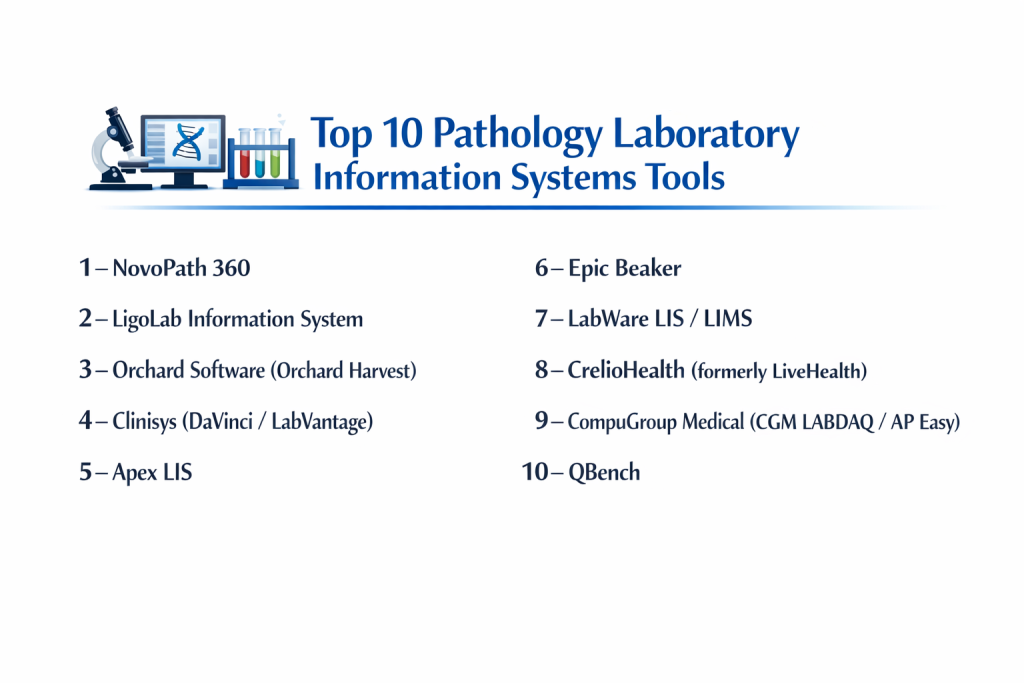
Top 10 Pathology Laboratory Information Systems Tools
1 — NovoPath 360
NovoPath 360 is a cloud-native (SaaS) platform engineered specifically for anatomic, molecular, and veterinary pathology. It is widely recognized for its “modern-first” approach, focusing on speed and pathologist-friendly interfaces.
- Key features:
- Cloud-Native Architecture: No on-premise servers required; updates are pushed automatically.
- Anatomic Pathology Focus: Deep workflows for grossing, histology, and cytology.
- Integrated Molecular Module: Handles complex NGS (Next-Generation Sequencing) workflows.
- Digital Pathology Readiness: Agnostic viewer integration for digital slide review.
- Advanced Reporting: High-quality, image-rich diagnostic reports that can be customized for referring physicians.
- Pros:
- Exceptionally fast sign-out times thanks to an intuitive, “one-click” workflow.
- Strong emphasis on implementation playbooks that reduce the “go-live” time.
- Cons:
- The high level of specialization means it may lack some general “clinical chemistry” features found in hybrid LIMS/LIS.
- Pricing is geared toward professional labs, which may be high for tiny startups.
- Security & compliance: HIPAA, SOC 2 Type II, data encryption at rest/transit, and full audit logs.
- Support & community: NovoU training platform, dedicated implementation managers, and 24/7 technical support.
2 — LigoLab Information System
LigoLab is an all-in-one platform that uniquely integrates the LIS with an advanced Revenue Cycle Management (RCM) system. It is designed for pathology groups that want to manage their operations and billing under a single roof.
- Key features:
- Integrated RCM: Real-time billing validation during the accessioning process.
- Dynamic Workflow Engine: Allows labs to create custom rules for different types of specimens.
- Client Connectivity: Advanced portals for referring physicians to track orders in real-time.
- Specimen Tracking: End-to-end barcoding and location tracking throughout the lab.
- Molecular & Toxicology Modules: Native support for high-complexity testing.
- Pros:
- Eliminates the need for a separate billing software, reducing data silos.
- Highly configurable; can scale from a single-pathologist lab to a national reference center.
- Cons:
- The interface can be overwhelming due to the sheer amount of data visible.
- Initial configuration and “discovery” phases are intensive and require dedicated lab resources.
- Security & compliance: HIPAA compliant, encryption, and multi-layered access control.
- Support & community: Extensive onboarding training and a responsive customer success team.
3 — Orchard Software (Orchard Harvest)
Orchard is a powerhouse in the LIS market, particularly known for its modular design and its ability to handle “outreach” programs where labs serve multiple external clients.
- Key features:
- Modular Design: Choose modules for anatomic pathology, molecular, or microbiology.
- Orchard Outreach: Robust tools for managing orders and results from external clinics.
- Quality Control (QC): Advanced tools for tracking analyzer performance and QC charts.
- Configurable Worklists: Staff can see exactly what is on their “bench” in real-time.
- Comprehensive Interfacing: Supports over 1,000 different analyzer models.
- Pros:
- One of the most reliable and stable systems with a massive install base.
- Excellent at handling the logistical complexity of high-volume outreach labs.
- Cons:
- The legacy “feel” of some modules can make it feel dated compared to cloud-native tools.
- Implementation can feel like “assembling IKEA furniture in the dark” due to complex settings.
- Security & compliance: HIPAA compliant, supports SSO (Single Sign-On), and secure data archiving.
- Support & community: Strong user group network and comprehensive onsite training options.
4 — Clinisys (DaVinci/LabVantage)
Clinisys is a global leader that provides enterprise-scale LIS solutions, particularly for hospital systems and public health labs that require massive data throughput and multi-site management.
- Key features:
- Enterprise Multi-Site Support: Manage dozens of hospitals from a single database.
- Anatomic Pathology (DaVinci): Specialized workflow for histology and case management.
- Public Health Tracking: Tools for disease surveillance and epidemiological reporting.
- Advanced Interoperability: Deep integration with major hospital EHRs like Epic and Cerner.
- Specimen Management: Highly sophisticated storage and archival tracking.
- Pros:
- Built for scale; it almost never “slows down,” even with millions of records.
- Extremely robust for regulatory environments like public health and academia.
- Cons:
- Customization can be slow and often requires Clinisys professional services.
- Reporting tools are powerful but have a very steep learning curve for non-IT staff.
- Security & compliance: ISO 27001, HIPAA, GDPR, and SOC 2 compliant.
- Support & community: Enterprise-grade SLAs, global support centers, and dedicated account managers.
5 — Apex LIS
Apex Healthware offers a cloud-based LIS that targets small-to-mid-sized labs and startups. It is known for its affordability and rapid deployment.
- Key features:
- Rapid Setup: Can often be installed and configured in as little as a day.
- CLIA Compliance Suite: Built-in tools to help labs pass their regulatory inspections.
- Integrated Billing: Simple invoicing and billing modules for smaller practices.
- Phone App: Mobile access for patients to register and see results.
- Analyzer Interfacing: Pre-built interfaces for common analyzers in toxicology and pathology.
- Pros:
- One of the most affordable options on the market for new labs.
- Low technical barrier to entry; very easy for lab techs to learn.
- Cons:
- Lacks the advanced “predictive AI” and complex workflow logic of enterprise tools.
- Not ideal for high-volume reference labs with massive multi-site needs.
- Security & compliance: HIPAA compliant with secure cloud hosting.
- Support & community: Strong web-based training and 24/7 technical support included in subscriptions.
6 — Epic Beaker
Epic Beaker is the laboratory module for the Epic EHR. For hospitals already using Epic, Beaker is often the default choice due to its “single patient record” philosophy.
- Key features:
- Native EHR Integration: The lab record is part of the hospital’s main medical record.
- Physician Visibility: Doctors see lab progress and results directly in their main chart.
- Anatomic Pathology Module: Integrated workflows for surgical pathology.
- Case Synchronization: Automatically links pathology reports to surgery schedules.
- Predictive Analytics: Uses the broader Epic data pool for clinical insights.
- Pros:
- Zero “integration lag”—the lab and hospital are always in sync.
- High security as it follows the hospital’s enterprise-wide security protocols.
- Cons:
- Only available to organizations already using the Epic EHR.
- Can be rigid; making “lab-specific” workflow changes often requires hospital-wide approval.
- Security & compliance: HIPAA, HITRUST, and SOC 2 Type II compliant.
- Support & community: Massive “UserWeb” community and world-class enterprise support.
7 — LabWare LIS/LIMS
LabWare is a powerhouse “hybrid” system. It blends the patient-centric features of an LIS with the sample-centric power of a LIMS, making it a favorite for research labs and complex diagnostics.
- Key features:
- Unified Platform: One system for clinical diagnostics and R&D research.
- Automation Engine: High-level automation for sample prep and instrument loading.
- Compliance Documentation: Built-in document management for SOPs and training.
- Highly Configurable: Use of “Visual Workflows” to design the user interface.
- Global Scalability: Support for multiple languages and regulatory frameworks.
- Pros:
- The most powerful system on the list in terms of “raw configuration.”
- Excellent for labs that do both patient testing and pharmaceutical research.
- Cons:
- Very complex; typically requires a full-time “LabWare Administrator” on staff.
- Interface can feel dated and “spreadsheet-heavy” in certain modules.
- Security & compliance: HIPAA, GDPR, ISO 9001, and 21 CFR Part 11 compliant.
- Support & community: Global training centers and an extensive partner network for customization.
8 — CrelioHealth (formerly LiveHealth)
CrelioHealth is a cloud-based LIMS/LIS focusing on digital patient engagement and automated reporting, particularly popular in the mid-market and diagnostic chain segments.
- Key features:
- Digital Patient Engagement: WhatsApp/SMS notifications and online payment.
- Machine Interfacing: Real-time data capture from 250+ analyzers.
- Mobile App for Phlebotomists: Manage home collection and GPS tracking.
- Dynamic Report Templates: Create visually appealing PDF reports with QR codes.
- Analytics Dashboard: Real-time visibility into business and clinical KPIs.
- Pros:
- Exceptional patient experience features that modernize the lab’s “front office.”
- Rapid, cloud-only deployment with lower upfront infrastructure costs.
- Cons:
- Less depth in advanced anatomic pathology (histology) than NovoPath.
- Some enterprise users find the “SaaS-only” model restrictive for complex on-site networking.
- Security & compliance: HIPAA compliant, data encryption, and SSL-secured communication.
- Support & community: 24/7 online support and comprehensive digital documentation.
9 — CompuGroup Medical (CGM LABDAQ / AP Easy)
CGM offers a portfolio of LIS solutions, including the popular LABDAQ for clinical labs and AP Easy for anatomic pathology. It is a “steady hand” in the industry with decades of experience.
- Key features:
- AP Easy Cloud: A simplified, cloud-based version specifically for anatomic pathology.
- Inventory Management: Integrated tracking of reagents and lab supplies.
- Automated Data Backups: Secure, redundant storage to prevent data loss.
- User Access Control: Fine-grained permissions for different lab roles.
- Compliance Manager: Tools to streamline audit preparation and quality logs.
- Pros:
- Very reliable and predictable software with a strong reputation for “getting the job done.”
- Broad feature set that covers both clinical chemistry and pathology.
- Cons:
- The separation between LABDAQ and AP Easy can feel like using two different systems.
- Not as “cutting-edge” in terms of digital pathology/AI integration as newer players.
- Security & compliance: HIPAA compliant and follows NIST cybersecurity frameworks.
- Support & community: Established training programs and a large, experienced support team.
10 — QBench
QBench is a modern, developer-friendly LIMS that has made significant inroads into the diagnostic space due to its incredible flexibility and API-first design.
- Key features:
- API-First Architecture: Easy to connect to any other software or custom tool.
- No-Code Configuration: Lab managers can change workflows without hiring a programmer.
- Customer Portal: Modern interface for clients to place orders and view results.
- Batch Processing: Tools for managing high-volume sample batches efficiently.
- Electronic Lab Notebook (ELN): Integrated notes for research-heavy diagnostic labs.
- Pros:
- The most “modern-feeling” software on the list from a user-interface perspective.
- Best-in-class for labs that need to integrate custom-built apps or specialty hardware.
- Cons:
- Does not have as many “pre-built” pathology-specific templates as NovoPath or Orchard.
- Implementation requires a team that is comfortable with modern software concepts.
- Security & compliance: HIPAA compliant, SOC 2 Type II, and data encryption.
- Support & community: High-quality digital documentation and responsive developer support.
Comparison Table
| Tool Name | Best For | Platform(s) Supported | Standout Feature | Rating |
| NovoPath 360 | Anatomic Pathology | Cloud / SaaS | Diagnostic Speed & AI Readiness | 4.8 / 5 |
| LigoLab | Labs with Billing | Cloud / Windows | Integrated RCM (Billing) | 4.7 / 5 |
| Orchard Software | High-Volume Outreach | Windows / Cloud | Advanced Outreach Management | 4.6 / 5 |
| Clinisys | Large Enterprise Labs | Windows / Web | Global Multi-Site Support | 4.5 / 5 |
| Apex LIS | Small Labs / Startups | Cloud / Web | Rapid “1-Day” Deployment | N/A |
| Epic Beaker | Epic-Based Hospitals | Integrated EHR | Unified Single Patient Record | 4.9 / 5 |
| LabWare | R&D + Diagnostics | Windows / Web | Clinical/Research Hybridity | 4.6 / 5 |
| CrelioHealth | Diagnostic Chains | Cloud / Mobile | Patient Engagement & Apps | 4.7 / 5 |
| CGM LABDAQ | Mid-Market General | Windows / Cloud | Decades of Proven Stability | 4.4 / 5 |
| QBench | Agile / Tech-Heavy | Cloud / API | No-Code Workflow Design | 4.5 / 5 |
Evaluation & Scoring of Pathology Laboratory Information Systems
| Category | Weight | Score | Evaluation Details |
| Core Features | 25% | 9.7 / 10 | Most systems have mastered basic accessioning; differentiators are in Molecular/AP. |
| Ease of Use | 15% | 8.0 / 10 | Pathology is complex; SaaS tools score higher, but enterprise tools can be dense. |
| Integrations | 15% | 9.2 / 10 | HL7 is standard; modern tools lead with FHIR and API-first connectivity. |
| Security & Compliance | 10% | 9.9 / 10 | Extremely high across the board due to HIPAA/GDPR requirements. |
| Performance | 10% | 9.4 / 10 | Uptime is critical; Cloud-native systems provide better redundancy. |
| Support & Community | 10% | 8.6 / 10 | Large vendors have better groups; small vendors provide more personal service. |
| Price / Value | 15% | 8.1 / 10 | Higher ROI for integrated billing systems (like LigoLab) and low-maintenance SaaS. |
Which Pathology Laboratory Information Systems Tool Is Right for You?
Solo Users vs SMB vs Mid-Market vs Enterprise
If you are a Solo Pathologist starting a small practice, Apex LIS or AP Easy (by CGM) are the clear winners due to their low cost and quick setup. SMB and Mid-Market labs (10–50 employees) should look at NovoPath or CrelioHealth for a balance of modern features and manageable complexity. Enterprise systems (Hospital networks) are best served by Clinisys, Orchard, or Epic Beaker, which provide the administrative “heavy lifting” required to manage thousands of users and millions of results.
Budget-conscious vs Premium Solutions
For the budget-conscious, Apex LIS offers a “pay-as-you-grow” model that minimizes initial capital outlay. If you have the budget for a Premium solution, NovoPath 360 or LigoLab are the high-performance Ferraris of the industry. While they cost more upfront, their ability to speed up pathologist sign-outs and automate the billing cycle usually leads to a much higher long-term ROI.
Feature Depth vs Ease of Use
If your priority is Ease of Use for a staff that isn’t tech-savvy, CrelioHealth and NovoPath lead with clean, modern web interfaces. If you require absolute Feature Depth—such as managing a hybrid lab that does both clinical diagnostic work and veterinary research—LabWare or Clinisys are the only tools with enough configuration depth to handle those disparate workflows in one database.
Integration and Scalability Needs
If you plan on expanding from one location to ten within three years, Scalability is your top priority. Cloud-native tools like QBench or LigoLab allow you to spin up new sites and connect new instruments almost instantly. For labs that must integrate deeply with a hospital’s pre-existing software, Epic Beaker or Orchard provide the most mature interface libraries.
Security and Compliance Requirements
Every tool on this list is built to keep you compliant. However, if you are looking to achieve the prestigious College of American Pathologists (CAP) accreditation, look for systems with built-in “Compliance Suites” like Orchard or NovoPath. These tools have specific dashboards that track the exact data your inspector will ask for, such as staff training logs and instrument maintenance records.
Frequently Asked Questions (FAQs)
1. What is the difference between an LIS and a LIMS?
An LIS (Laboratory Information System) is patient-centric and used in clinical settings. A LIMS (Laboratory Information Management System) is sample-centric and traditionally used in research, manufacturing, or environmental labs. Modern pathology tools often blend both.
2. Can an LIS help me with my CAP inspection?
Yes. A good LIS will track Quality Control (QC) data, staff competencies, and specimen turnaround times (TAT), allowing you to generate “inspection-ready” reports at the touch of a button.
3. Does the LIS handle the billing for the tests?
Some systems, like LigoLab, have native billing modules. Others integrate with third-party Revenue Cycle Management (RCM) software through an HL7 interface.
4. What is “Accessioning” in an LIS?
Accessioning is the process of receiving a specimen, assigning it a unique ID (barcode), and entering the patient and test data into the system. This is the most critical step for ensuring specimen safety.
5. How does Digital Pathology integrate with the LIS?
Modern LIS platforms can “talk” to digital scanners (like Leica or Philips). When a pathologist opens a case in the LIS, the digital slide image automatically pops up in a viewer for them to diagnose on-screen.
6. Do I need to buy my own servers?
Not necessarily. “SaaS” or “Cloud” systems (like NovoPath or QBench) host the data for you. “On-premise” systems (traditional versions of Orchard or Clinisys) require you to maintain your own server room.
7. Can an LIS reduce my Turnaround Time (TAT)?
Yes. By automating the movement of data and alerting pathologists when a case is ready for sign-out, an LIS can cut days off the time it takes for a patient to get their results.
8. Is HL7 integration difficult?
It used to be. Today, most LIS vendors have “Standard Interface Libraries” for major EHRs and analyzers, making the connection process much faster than in the past.
9. What is a “Zero-Footprint” viewer?
It is a technology that allows you to view images or data in a standard web browser (like Chrome) without needing to install any software or plugins on your computer.
10. How long does a typical LIS implementation take?
For small labs using SaaS, it can be 2–4 weeks. For large hospitals with complex integrations, it can take 6–12 months.
Conclusion
Choosing the right Pathology Laboratory Information System is one of the most consequential decisions a lab director can make. Whether you opt for the anatomic pathology precision of NovoPath 360, the billing-integrated power of LigoLab, or the enterprise reliability of Clinisys, the goal remains the same: ensuring every patient receives a fast, accurate diagnosis.
The “best” system is the one that fits your specific testing menu and staff capabilities. By focusing on a tool that prioritizes specimen safety, diagnostic speed, and seamless integration, you aren’t just buying software—you are building the foundation for the future of your laboratory.