Introduction
A Radiology Information System (RIS) is the administrative and operational backbone of a radiology department. It is specialized software that manages the entire non-clinical workflow of medical imaging, from the moment an exam is ordered to the moment the final report is billed and archived. Think of it as the central nervous system that handles patient scheduling, resource management, order tracking, report distribution, and revenue cycle functions, allowing radiologists and technologists to focus on the actual imaging and diagnosis.
The importance of a robust RIS cannot be overstated. It streamlines complex workflows in high-volume imaging centers, reduces patient wait times through efficient scheduling, minimizes errors in order entry and patient identification, ensures critical results are communicated promptly, and optimizes the use of expensive imaging equipment and staff. In short, a modern RIS is essential for operational efficiency, patient safety, regulatory compliance, and financial health in radiology.
Key real-world uses include a front-desk scheduler booking a patient for an MRI, a technologist checking in a patient and confirming the correct exam protocol, a radiologist receiving a prioritized worklist of studies to read, an administrator tracking report turnaround times, and a billing specialist generating claims from completed procedures.
When choosing a RIS, you should look for strong scheduling capabilities (especially for multi-modality, multi-site operations), seamless integration with your Picture Archiving and Communication System (PACS) and other hospital systems (like the EHR), robust reporting and analytics tools, compliance features for mammography (MQSA) or other specialties, and intuitive interfaces for all user roles (schedulers, technologists, radiologists, administrators).
Best for: These systems are essential for radiologists, radiology administrators, chief technology officers (CTOs), technologists, schedulers, and billing staff. They benefit hospital radiology departments, outpatient imaging centers, teleradiology companies, multi-specialty clinics with imaging services, and group radiology practices.
Not ideal for: A small clinic that occasionally sends patients out for imaging and only needs to receive reports (an EHR with document management may suffice). A solo practitioner in a non-radiology specialty does not need a RIS. Organizations that only need to view and store images require a PACS, not necessarily the full workflow management of a RIS.
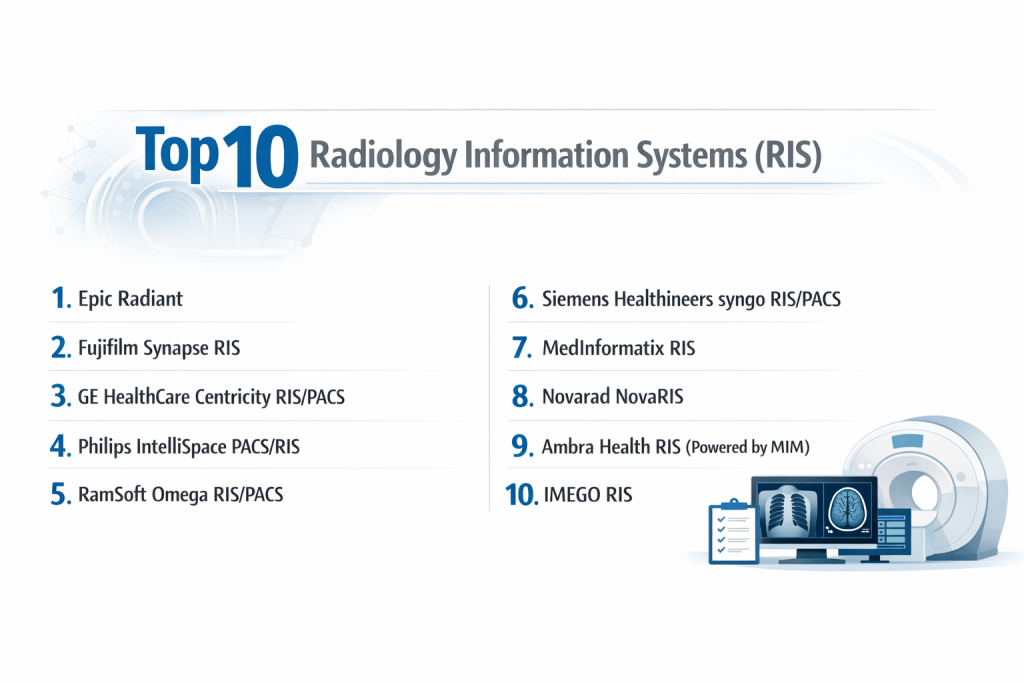
Top 10 Radiology Information Systems (RIS)
Here is a detailed look at ten of the most capable and widely-used RIS platforms in medical imaging today.
1 — Epic Radiant
Epic Radiant is the radiology module fully integrated within the Epic electronic health record (EHR) ecosystem. It is the dominant choice for large health systems and academic medical centers that use Epic as their enterprise EHR.
Key features:
- Native EHR Integration: Seamlessly shares a single patient record with inpatient, outpatient, and emergency department teams, eliminating data silos.
- Unified Physician Worklist: Radiologists have one worklist within Epic that includes imaging studies alongside other clinical tasks (notes, orders, in-basket).
- Order Transmittal & Protocoling: Enables automated order validation, protocol selection by radiologists, and communication back to the ordering provider—all within the same system.
- Integrated Reporting with Speech Recognition: Supports embedded speech-to-text for report dictation and signing directly in the workflow.
- MyChart for Patients: Allows patients to view imaging reports, preparation instructions, and schedule appointments via the MyChart patient portal.
- Enterprise Analytics: Leverages Epic’s Cogito data warehouse for deep operational and financial reporting specific to radiology.
Pros:
- Seamless Clinical Workflow: Radiologists and referring providers work in the same system, streamlining communication and providing full clinical context.
- Single Source of Truth: Eliminates duplicate data entry and ensures consistent patient information across all care settings.
- Powerful Enterprise Scalability: Built to handle the immense volume and complexity of large, multi-facility health systems.
Cons:
- Extremely High Cost & Complexity: Only feasible for organizations already invested in or committing to the full Epic EHR ecosystem.
- “All-or-Nothing” Approach: Difficult to implement as a standalone RIS; it comes as part of the total Epic package.
- Less Flexibility for Outpatient-Only Centers: Its enterprise focus can be over-engineered for a freestanding imaging center.
Security & compliance: Inherits Epic’s enterprise-grade security infrastructure. Fully HIPAA compliant, with robust access controls, audit trails, and data encryption. Hosted in Epic’s secure data centers or on-premise.
Support & community: Supported through Epic’s implementation and ongoing support model. Part of the massive Epic user community, with access to the “UserWeb” forum and specialized Radiant-focused training and conferences.
2 — Fujifilm Synapse RIS
Fujifilm Synapse RIS is part of the comprehensive Synapse suite, which tightly integrates RIS, PACS, and cardiology PACS (CVIS). It is known for its strong workflow orchestration and vendor-neutral archiving (VNA) capabilities.
Key features:
- Unified RIS/PACS Database: Built on a single, unified database, ensuring seamless data flow between scheduling, image acquisition, and reporting.
- Advanced Workflow Orchestrator: A rules-based engine that automates task routing, prioritization, and notification based on modality, urgency, radiologist subspecialty, etc.
- Integrated Vendor-Neutral Archive (VNA): Can serve as a central archive for images from any vendor’s modality, future-proofing the imaging IT infrastructure.
- Enterprise Workflow for Multi-Site: Manages complex workflows across multiple hospitals, imaging centers, and reading rooms as a single entity.
- Comprehensive Business Analytics: Provides dashboards and reports for key metrics like equipment utilization, report turnaround times, and revenue.
- Teleradiology-Ready: Includes tools to efficiently distribute studies to remote radiologists and integrate their reports back into the system.
Pros:
- Exceptional Workflow Automation: Its orchestration tools significantly reduce manual steps and optimize radiologist and technologist productivity.
- True Unified Architecture: The shared RIS/PACS database eliminates interface headaches and promotes data integrity.
- Strong Enterprise & Multi-Site Focus: Well-suited for large IDNs and radiology practices managing distributed operations.
Cons:
- Can Be Complex to Configure: Maximizing the workflow engine requires careful planning and setup, often needing professional services.
- Vendor Ecosystem: While open, there is a natural affinity to leverage the full Fujifilm Synapse suite (PACS, VNA).
- Cost: Positioned as a premium, enterprise-scale solution with associated investment.
Security & compliance: Enterprise-level security with data encryption, audit trails, and HIPAA compliance. Supports secure external communications for teleradiology.
Support & community: Backed by Fujifilm’s global service organization. Has an established user community with regional groups and an annual user meeting.
3 — GE HealthCare Centricity RIS/PACS
GE HealthCare Centricity is a long-established, integrated RIS/PACS platform. It is widely used in medium to large hospital systems and offers stability, deep functionality, and strong modality integration.
Key features:
- Proven Integrated Platform: Combines RIS and PACS in a single, mature product with a long history of deployment in demanding environments.
- Advanced Scheduling & Resource Management: Powerful tools for managing complex schedules across multiple modalities, rooms, and technologists.
- Clinical Protocols & Decision Support: Supports the creation and enforcement of imaging protocols and can integrate clinical decision support (CDS) for appropriate use criteria (AUC).
- Interoperability with GE Modalities: Often features optimized integration with GE imaging equipment (CT, MRI, X-Ray), though it is not exclusive.
- Enterprise Reading Workflow: Facilitates worklist management and reporting for large, sub-specialized radiology groups.
- Compliance Tools: Includes features to support compliance with MQSA for mammography tracking and reporting.
Pros:
- Reliability & Stability: A mature, battle-tested platform known for its reliability in high-volume settings.
- Deep Scheduling & Operational Tools: Excellent for managing the complex logistics of a busy hospital radiology department.
- Strong Vendor Support & Roadmap: Backed by a major global healthcare technology company with extensive service resources.
Cons:
- Legacy Interface Challenges: Some components of the user interface can feel dated and less intuitive compared to newer, web-native platforms.
- Cost & Complexity: As an enterprise solution, it requires significant investment in software, services, and often hardware.
- Customization Can Be Cumbersome: Making significant workflow changes can sometimes require vendor assistance.
Security & compliance: Meets all healthcare security standards, including HIPAA. GE provides tools for data encryption, access management, and audit logging.
Support & community: Supported by GE HealthCare’s extensive service network. Has a large, long-standing user base with formal user groups.
4 — Philips IntelliSpace PACS/RIS
Philips IntelliSpace PACS/RIS is an integrated platform that emphasizes advanced visualization, quantitative analysis, and radiologist efficiency tools within the workflow.
Key features:
- Integrated Advanced Visualization: Brings powerful 3D post-processing, cardiac analysis, and oncology tools directly into the radiologist’s reading workflow.
- Universal Worklist: Aggregates studies from multiple sources (different PACS, VNAs) into a single, prioritized worklist for the radiologist.
- Hanging Protocol & Personalization: Highly customizable hanging protocols and user preferences that travel with the radiologist across different workstations.
- Speech Recognition & Reporting: Deeply integrated speech-to-text solutions for efficient reporting.
- Enterprise Intelligence: Analytics and monitoring tools to track department performance, bottlenecks, and key performance indicators (KPIs).
- Teleradiology & Collaboration: Built-in tools for secure remote access and peer collaboration on cases.
Pros:
- Radiologist-Centric Design: Focuses on tools that speed up reading and reporting, especially for complex studies requiring advanced visualization.
- Strong in Specialty Quantitative Analysis: Excellent for cardiology, neurology, and oncology where measurements and tracking are key.
- Scalable Enterprise Platform: Can be deployed across large health systems with consistent performance.
Cons:
- Premium Pricing: Positioned at the higher end of the market, reflecting its advanced feature set.
- Focus on Visualization: While the RIS is robust, the platform’s standout features are often more on the PACS/visualization side.
- Implementation Scope: A full deployment of the integrated suite is a major IT project.
Security & compliance: Built on a secure, scalable enterprise architecture compliant with HIPAA and other global regulations. Offers data encryption and detailed audit capabilities.
Support & community: Supported by Philips’ global healthcare IT services team. Has an active user community and hosts dedicated user events.
5 — RamSoft Omega RIS/PACS
RamSoft Omega is a cloud-native, software-as-a-service (SaaS) RIS/PACS platform. It is particularly popular with outpatient imaging centers, teleradiology companies, and smaller hospitals seeking a modern, all-in-one solution with low IT overhead.
Key features:
- True Cloud-Native SaaS: No on-premise servers required; accessible from any web browser. Includes automatic updates and backups.
- All-in-One Integrated Suite: Combines RIS, PACS, voice recognition, billing interface, and patient portal in a single subscription.
- Zero-Footprint Universal Viewer: A web-based diagnostic viewer that requires no plugins, allowing access to full imaging studies from any device.
- Built for Teleradiology: The cloud architecture is inherently designed for remote reading and multi-site practice management.
- Predictable Subscription Pricing: Monthly or annual per-study or per-modality subscription, converting capital expenditure to operational expense.
- Rapid Deployment: Can be implemented in a matter of weeks, not months or years.
Pros:
- Low IT Burden & Upfront Cost: Eliminates the need for expensive servers, IT staff, and long implementation cycles.
- Ideal for Distributed & Outpatient Models: Perfect for imaging centers, teleradiology, and multi-location groups.
- Always Current: Automatic updates ensure you always have the latest features and security patches without downtime.
Cons:
- Internet Dependency: Requires a reliable, high-speed internet connection for all operations.
- Less Customization Depth: As a multi-tenant SaaS, deep, low-level customization of the core platform may be limited compared to on-premise systems.
- Long-Term Cost: While upfront costs are low, the recurring subscription can exceed the cost of an owned system over a long period.
Security & compliance: Hosted on secure, HIPAA-compliant cloud infrastructure (like AWS or Azure). RamSoft manages all security, encryption, and compliance at the infrastructure level, typically providing SOC 2 reports.
Support & community: Support is integral to the subscription. RamSoft hosts an annual user conference and fosters a community among its largely outpatient-focused clientele.
6 — Siemens Healthineers syngo RIS/PACS
Siemens Healthineers syngo is an integrated imaging IT platform that emphasizes workflow efficiency, clinical collaboration, and connectivity within the Siemens ecosystem and beyond.
Key features:
- Seamless Modality Integration (Teamplay): Strong connectivity and workflow integration with Siemens imaging modalities, enabling “one-click” exam sending and protocol management.
- syngo Virtual Cockpit: A customizable, role-based dashboard that provides real-time operational overviews of department status, equipment utilization, and worklists.
- Advanced Visualization Ready: Designed to easily connect with Siemens’ advanced 3D visualization applications (syngo.via) for complex reading tasks.
- Collaboration & Communication Tools: Includes tools for conferencing, peer review, and communication with referring physicians.
- Enterprise Scalability: Can be deployed across multiple hospitals and sites within a health network.
- Data-Driven Insights: Offers analytics packages to monitor workflow efficiency and clinical performance.
Pros:
- Optimized for Siemens Modality Workflow: Offers a very smooth experience for departments heavily invested in Siemens CT, MRI, etc.
- Operational Visibility: The Virtual Cockpit provides excellent real-time management tools for administrators and leads.
- Strong Clinical Tools: Good integration of reading, reporting, and advanced visualization in a cohesive environment.
Cons:
- Best Experience with Siemens Ecosystem: While interoperable, its most seamless workflows are often with other Siemens products.
- Complexity of Suite: The full syngo suite encompasses many components, which can make the overall system complex to manage.
- Enterprise-Level Investment: Represents a significant capital investment typical of major OEM platforms.
Security & compliance: Built to meet stringent healthcare security standards, including HIPAA and GDPR. Provides comprehensive audit trails and data protection features.
Support & community: Backed by Siemens Healthineers’ global service network. Has a large user base with access to user forums and training resources.
7 — MedInformatix RIS
MedInformatix offers a comprehensive RIS that is often paired with its practice management (PM) and EHR systems. It has a strong presence in large radiology groups and outpatient imaging centers in the U.S.
Key features:
- Integrated Revenue Cycle Management: Deep integration between RIS and medical billing, with tools for claims scrubbing, denial management, and financial reporting.
- Multi-Modality, Multi-Site Scheduling: Advanced scheduling engine capable of managing complex networks of imaging centers with different equipment and hours.
- Radiologist Dashboard & Workflow: Customizable radiologist worklists, macros, and reporting tools designed to maximize reading efficiency.
- Patient Portal & Engagement: Includes tools for online scheduling, prep instructions, and report delivery to patients.
- Interoperability & HL7 Integration: Strong focus on connecting with hospital EHRs, referring physician offices, and national networks like CommonWell.
- Compliance & Registry Reporting: Features to support compliance with MQSA, ACR registries, and other regulatory requirements.
Pros:
- Financial & Operational Focus: Excellent for radiology groups that want tight control over billing and practice revenue performance.
- Scalable for Large Groups: Proven in large, high-volume radiology practice environments.
- Strong U.S. Outpatient Market Fit: Understands the specific billing, scheduling, and regulatory needs of American imaging centers.
Cons:
- Primarily U.S.-Focused: Its features and support are optimized for the U.S. healthcare market.
- Interface Modernity: Some users find the interface functional but not as modern as some newer, web-native competitors.
- Can Be Module-Heavy: The full suite (RIS, PM, EHR) can be perceived as having many moving parts to implement and learn.
Security & compliance: HIPAA compliant with robust user access controls and audit logging. Can be deployed on-premise or in a private cloud.
Support & community: Provides direct customer support and implementation services. Hosts an annual user conference for its client base.
8 — Novarad NovaRIS
Novarad’s NovaRIS is part of its integrated enterprise imaging solution, known for innovation in areas like 3D printing, AI orchestration, and a unique patient identification technology (CryptoChart).
Key features:
- Integrated Enterprise Imaging Platform: Combines RIS, PACS, and specialty modules (like cardiology) on a single database.
- CryptoChart Patient Identification: Uses a visual patient identifier (a unique image/code) to drastically reduce wrong-patient errors at the modality.
- AI Orchestration & Integration: A built-in AI orchestrator that can manage and run multiple third-party AI algorithms on studies and present results within the workflow.
- True 3D Printing Integration: Unique tools for creating and managing 3D printable models directly from imaging studies for surgical planning.
- Zero-Footprint, Anywhere Access: Web-based access for reading, reporting, and administration from any device.
- Cloud-Native Options: Offers both on-premise and cloud-hosted deployment models.
Pros:
- Innovative Patient Safety Feature: CryptoChart is a significant differentiator in preventing a critical error.
- Forward-Looking on AI & 3D: Embraces emerging technologies like AI and 3D printing as core capabilities.
- Unified & Modern Platform: Offers a cohesive, web-based experience across its modules.
Cons:
- Smaller Market Share: Less ubiquitous than the giant OEMs, which may be a consideration for very large health systems.
- Learning New Paradigms: Features like CryptoChart require a change in technologist workflow that needs adoption.
- Ecosystem: While interoperable, its deepest integrations are within its own NovaPACS and specialty modules.
Security & compliance: HIPAA compliant with data encryption and secure access controls. The CryptoChart system adds an extra layer of patient identity verification.
Support & community: Novarad provides direct support and is known for close collaboration with its clients. Hosts user group meetings to share innovations.
9 — Ambra Health RIS (Powered by MIM)
Ambra Health provides a modern, cloud-based platform focused on medical image management and sharing. Its RIS capabilities are optimized for imaging centers, clinical trials, and healthcare networks that prioritize data exchange.
Key features:
- Cloud-First Image Management & RIS: Core platform is a cloud-native VNA and image exchange, with integrated RIS scheduling and workflow.
- Strong Emphasis on Interoperability: Excellent connectivity for sharing images and reports with referring physicians, patients, and other health systems via secure cloud links.
- Clinical Trial & Research Support: Robust tools for managing imaging in clinical trials, including de-identification (anonymization) and centralized review.
- Patient-Centric Image Access: Easy for patients to access and share their own imaging studies via a portal or mobile app.
- API-First Architecture: Designed for easy integration with EHRs, patient portals, and other health IT systems via modern APIs.
- Diagnostic Viewer & Basic Reporting: Includes a zero-footprint viewer and tools for report creation and distribution.
Pros:
- Superior Image Sharing & Exchange: Arguably best-in-class for securely moving images between organizations and to patients.
- Ideal for Networks & Referral-Based Business: Perfect for imaging centers that live on referrals and need to distribute results efficiently.
- Modern, Scalable Cloud Platform: Agile, scalable infrastructure with predictable SaaS pricing.
Cons:
- RIS Depth vs. Specialists: Its RIS may not have the extreme depth of scheduling or billing features found in systems built for large, complex hospital departments.
- Focus on Data Movement: Its greatest strength is in managing and sharing image data; traditional RIS workflow automation might be less extensive.
- Evolving RIS Feature Set: The RIS component is robust but may be developing compared to its mature image management core.
Security & compliance: A cloud-native platform built on HIPAA-compliant infrastructure with HITRUST CSF certification, a rigorous security framework. Specializes in secure, audited data exchange.
Support & community: Provides customer success management. Its community includes many academic medical centers and innovative imaging networks.
10 — IMEGO RIS
IMEGO RIS is a flexible, web-based system often chosen by small to medium-sized imaging centers and hospitals. It emphasizes configurability, user-friendly design, and strong customer support.
Key features:
- Fully Web-Based & Configurable: Accessible from any browser, with tools allowing administrators to modify screens, fields, and certain workflows without coding.
- Integrated PACS & Reporting: Often sold as a combined RIS/PACS package with an integrated diagnostic viewer and reporting tools.
- Streamlined Scheduling & Patient Flow: Focuses on efficient front-office operations with tools for patient check-in, tracking, and communication.
- Billing & Claims Management: Includes interfaces and tools to connect with billing companies or in-house billing software.
- Mobile-Friendly: Responsive design allows key functions to be performed on tablets and smartphones.
- Affordable Pricing Model: Often positioned as a cost-effective alternative to larger enterprise systems.
Pros:
- Ease of Use & Quick Implementation: Known for being relatively straightforward to learn and deploy.
- Good Value for Mid-Size Operations: Provides a comprehensive feature set at a competitive price point.
- Responsive Support: Frequently praised for accessible and helpful customer support.
Cons:
- Limited Enterprise Scalability: May not be designed for the absolute largest, most complex multi-hospital health systems.
- Brand Recognition: Less widely known on a national scale compared to the industry giants.
- Advanced Workflow Automation: While configurable, it may lack the deep, rules-based orchestration engines of some premium platforms.
Security & compliance: HIPAA compliant as a web-based application. Security practices are managed by the vendor for cloud deployments or must be implemented by the client for on-premise.
Support & community: Support is a key selling point, provided directly by the company. Has a loyal user base, particularly in the community hospital and imaging center market.
Comparison Table
| Tool Name | Best For | Platform(s) Supported | Standout Feature | Rating |
|---|---|---|---|---|
| Epic Radiant | Large Health Systems using Epic EHR | Integrated into Epic EHR | Seamless EHR integration & unified workflow | 4.7/5 |
| Fujifilm Synapse RIS | Enterprise Health Systems wanting workflow automation | Client-server, Web | Unified RIS/PACS DB & advanced workflow orchestrator | 4.5/5 |
| GE Centricity RIS/PACS | Medium-Large Hospitals wanting stability & depth | Client-server | Proven, reliable integrated platform & strong scheduling | 4.3/5 |
| Philips IntelliSpace | Hospitals prioritizing radiologist tools & visualization | Client-server, Web | Integrated advanced visualization & universal worklist | 4.4/5 |
| RamSoft Omega | Outpatient Centers & Teleradiology (Cloud SaaS) | 100% Cloud Web Browser | All-in-one cloud SaaS with low IT overhead | 4.2/5 |
| Siemens syngo | Hospitals invested in Siemens modality workflow | Client-server | syngo Virtual Cockpit & seamless modality integration | 4.3/5 |
| MedInformatix RIS | Large Radiology Groups & Outpatient Centers (US) | Client-server, Web | Deep RCM integration & multi-site scheduling | 4.1/5 |
| Novarad NovaRIS | Innovative practices wanting AI, 3D, patient safety | Web, Cloud options | CryptoChart ID & AI/3D printing integration | 4.0/5 |
| Ambra Health RIS | Imaging Networks & Centers focused on data exchange | 100% Cloud Web Browser | Superior cloud image sharing & interoperability | 4.2/5 |
| IMEGO RIS | Small-Medium Imaging Centers & Hospitals | 100% Web Browser | User-friendly, configurable, & cost-effective | 3.9/5 |
Evaluation & Scoring of Radiology Information Systems (RIS)
To find the right system, weigh its performance in these key areas based on your department’s priorities.
| Evaluation Category | Weight | What to Look For | Top Performer Example |
|---|---|---|---|
| Core Features | 25% | Scheduling complexity, worklist management, reporting tools, billing integration, compliance (MQSA). | GE Centricity, MedInformatix |
| Ease of Use | 15% | Intuitive interfaces for schedulers, technologists, and radiologists; minimal training required. | RamSoft Omega, IMEGO |
| Integrations & Ecosystem | 15% | PACS integration depth, EHR/EMR interfaces (HL7/FHIR), modality connectivity, teleradiology readiness. | Epic Radiant, Fujifilm Synapse |
| Security & Compliance | 10% | HIPAA compliance, audit trails, data encryption, access controls, secure external sharing. | All Major Vendors, Ambra (HITRUST) |
| Performance & Reliability | 10% | System uptime, speed with high volumes, worklist responsiveness, scalability. | Epic Radiant, Fujifilm Synapse |
| Support & Community | 10% | Quality of implementation help, training, responsive support, active user community. | Epic, GE, Siemens |
| Price / Value | 15% | Total cost (software, hardware, services) vs. features and ROI in efficiency gains. | RamSoft (SaaS), IMEGO |
Which Radiology Information System (RIS) Is Right for You?
Your choice depends on your practice setting, scale, integration needs, and budget.
- Freestanding Imaging Center / Outpatient Clinic: You need efficiency and cost control. RamSoft Omega (SaaS) is ideal for modern, low-IT models. MedInformatix offers strong billing integration. IMEGO provides great value and ease of use.
- Hospital Radiology Department (Community/Mid-Size): You need reliability and depth. GE Centricity and Siemens syngo are trusted, mature platforms. Fujifilm Synapse offers superior workflow automation.
- Large Health System / Academic Medical Center: You need enterprise scale and EHR unity. Epic Radiant is the dominant choice if you use Epic. Fujifilm Synapse and Philips IntelliSpace are powerful, best-of-breed alternatives.
- Teleradiology Company / Multi-Site Group Practice: You need cloud access and centralized management. RamSoft Omega is built for this. Ambra Health excels at secure image distribution across a network.
- Innovative / Specialty Practice: You focus on new tech. Novarad offers unique AI and 3D tools. Philips IntelliSpace leads in integrated advanced visualization.
Budget-conscious vs. premium solutions: IMEGO and RamSoft’s subscription model offer lower upfront costs. GE, Siemens, Philips represent significant capital investments. Epic is in a tier of its own for total cost, tied to the EHR.
Feature depth vs. ease of use: Epic and Fujifilm offer immense depth but require significant configuration. RamSoft and IMEGO prioritize a streamlined, user-friendly experience that gets you operational quickly.
Integration and scalability needs: If seamless EHR integration is non-negotiable, choose your EHR’s native module (Epic Radiant, **Cerner PowerChart). For scaling a distributed cloud operation, RamSoft or Ambra are strong. For complex multi-site workflow orchestration, Fujifilm Synapse excels.
Security and compliance requirements: All certified vendors meet HIPAA. For ultra-secure cloud data exchange, look for HITRUST certification (Ambra). For environments with high wrong-patient risk, Novarad’s CryptoChart is a unique safeguard.
Frequently Asked Questions (FAQs)
1. What’s the difference between a RIS and a PACS?
A RIS manages the administrative workflow (scheduling, patient tracking, reporting, billing). A PACS manages the images (storage, retrieval, display, distribution). They are complementary systems, and modern solutions often integrate both.
2. Do we need a separate RIS if our EHR has imaging orders?
Yes, for a dedicated radiology department. An EHR handles the order, but a RIS manages the specialized radiology workflow: technologist schematics, protocoling, modality worklists, radiologist reading worklists, and complex reporting specific to imaging.
3. Can a RIS help with MIPS or other value-based reporting?
Absolutely. A modern RIS can track and report on quality measures relevant to radiology (e.g., appropriate use, turnaround times for critical results, dose index monitoring), which can be submitted for MIPS.
4. How important is cloud-based vs. on-premise?
Cloud-based (SaaS) reduces upfront hardware costs and IT burden, offers easier remote access, and includes automatic updates. On-premise offers more direct control and customization but requires significant capital and IT staff. The trend is strongly toward cloud.
5. What is “worklist” management and why is it critical?
The worklist is the radiologist’s task queue. A good RIS prioritizes studies (by stat status, modality, subspecialty), tracks progress, and ensures nothing gets lost. It’s the core tool for radiologist productivity and patient safety.
6. How do we handle interfacing a RIS with our hospital’s EHR?
This is done via HL7 or FHIR interfaces. It’s a complex but standard part of implementation. Choose a RIS vendor with a strong track record of building stable interfaces with major EHRs like Epic, Cerner, and Meditech.
7. What about speech recognition for reporting?
Most modern RIS either have built-in speech recognition or integrate tightly with major third-party speech solutions (like Nuance Dragon). This integration is crucial for report turnaround time.
8. Can a RIS help prevent wrong-patient errors?
Yes. Features like barcode/RFID patient ID checks at the modality, biometrics, or unique technologies like Novarad’s CryptoChart are designed specifically to reduce this critical risk.
9. What is the typical cost range for a RIS?
It varies from tens of thousands for a basic SaaS subscription for a small center to multi-million dollar enterprise licenses for large hospitals. Remember to budget 1.5-2x the software cost for implementation, training, and interfaces.
10. What’s the biggest mistake when choosing a RIS?
Choosing based on a feature list alone without considering the daily user experience for technologists and radiologists, or underestimating the importance and cost of integration with your existing PACS and EHR.
Conclusion
Selecting the right Radiology Information System is a strategic decision that impacts the efficiency, safety, and financial viability of your imaging services for a decade or more. The market offers tailored solutions, from the seamless, all-encompassing integration of Epic Radiant for massive health systems to the agile, cloud-native simplicity of RamSoft Omega for outpatient centers.
The critical insight is that the “best” RIS is the one that aligns with your operational reality. A system perfect for a high-volume hospital would overwhelm a small clinic, while a lightweight system would crumble under the complexity of an academic medical center.
Focus on your core needs: Is it deep EHR integration? Streamlining a multi-site teleradiology operation? Maximizing radiologist reading speed with advanced tools? Or simply getting a reliable, affordable system running with minimal fuss? By prioritizing these operational truths over generic checklists, you can implement a RIS that becomes an invisible engine of efficiency, allowing your team to focus on what matters most—providing excellent patient care through precise and timely imaging.