Introduction
Remote Patient Monitoring (RPM) platforms are digital health solutions that allow healthcare providers to monitor patients’ physiological data outside of traditional clinical settings. By using connected devices such as blood pressure cuffs, glucometers, pulse oximeters, and weight scales, these platforms transmit real-time data from a patient’s home directly to their medical team. This technology creates a continuous stream of clinical insights, moving healthcare from a reactive “sick-care” model to a proactive, data-driven approach. The core value of an RPM platform lies in its ability to alert clinicians to abnormal readings before they escalate into emergencies, thereby reducing hospital readmissions and improving the quality of life for those with chronic conditions.
The importance of RPM has surged alongside the rise of value-based care and the aging global population. Key real-world use cases include chronic disease management (hypertension, diabetes, COPD), post-surgical recovery tracking, and high-risk pregnancy monitoring. When evaluating RPM platforms, users should look for cellular connectivity (which bypasses the need for patient Wi-Fi), seamless Electronic Health Record (EHR) integration, automated billing and CPT code tracking, and FDA-cleared hardware. A platform is only as good as its ability to turn raw data into actionable clinical decisions without overwhelming the staff with “alert fatigue.”
Best for: Chronic care management teams, primary care physicians, cardiologists, and large hospital systems looking to reduce readmission rates. It is particularly beneficial for organizations managing “at-risk” populations under Medicare or Medicare Advantage plans.
Not ideal for: Acute emergency care where immediate physical intervention is required, or for very small practices that lack the administrative staff to review daily patient data alerts. In those cases, traditional telehealth or basic patient portals may be sufficient.
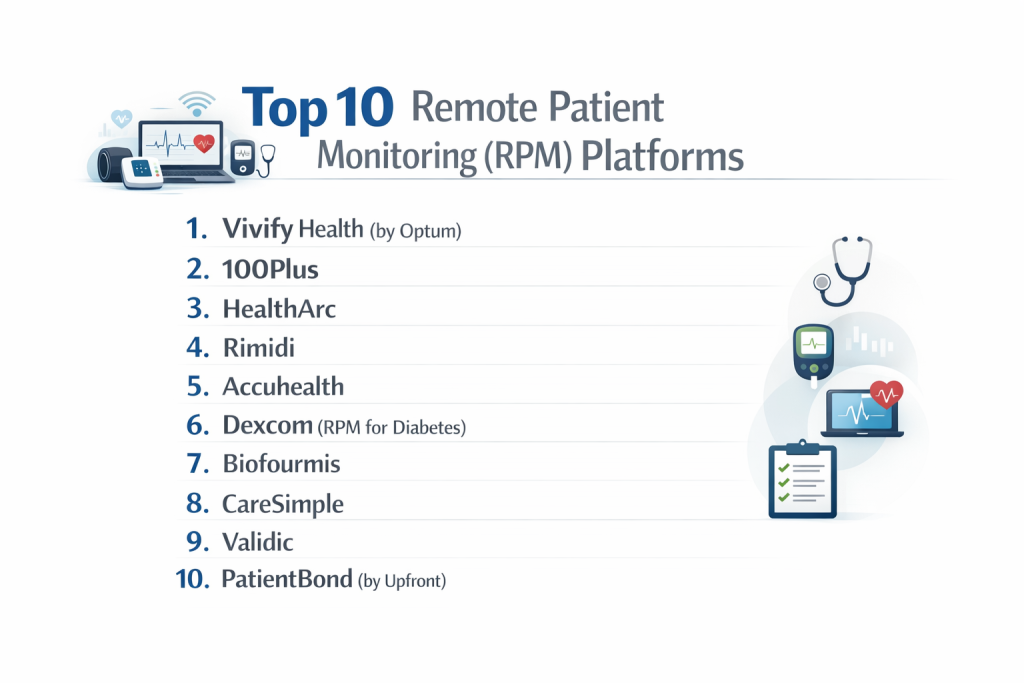
Top 10 Remote Patient Monitoring (RPM) Platforms Tools
1 — Vivify Health (by Optum)
Vivify Health is an enterprise-grade RPM and care management platform designed to scale across large health systems. It offers a highly customizable experience ranging from simple text-based monitoring to complex, device-integrated clinical pathways.
- Key features:
- Vivify +Plus: A full-service kit including a managed tablet and integrated Bluetooth peripherals.
- Vivify +Go: A bring-your-own-device (BYOD) mobile app for lower-risk patient populations.
- Clinical Pathways: Pre-built, evidence-based protocols for over 90 different conditions.
- Virtual Visits: Integrated high-definition video conferencing for immediate follow-ups.
- EHR Interoperability: Deep, bi-directional integration with Epic, Cerner, and other major systems.
- Pros:
- Exceptionally robust for large-scale institutional deployments.
- High patient engagement rates due to the intuitive, tablet-based “concierge” experience.
- Cons:
- Significant upfront cost for the managed tablet kits.
- Can be overly complex for a small, single-provider practice.
- Security & compliance: HIPAA compliant, HITRUST CSF Certified, SOC 2 Type II, and data encryption at rest/transit.
- Support & community: Dedicated clinical success managers, 24/7 technical support, and comprehensive onsite training.
2 — 100Plus
100Plus is a “turnkey” RPM solution that focuses heavily on the Medicare market. Its standout feature is the use of cellular-enabled devices that work straight out of the box without any setup required from the patient.
- Key features:
- Cellular Connectivity: Devices use a built-in SIM card to transmit data, requiring no Wi-Fi or Bluetooth pairing.
- Ava AI: An artificial intelligence assistant that outreaches to patients to encourage testing adherence.
- Automated Billing: Automatically tracks time spent on patient care to generate CPT code reports (99453, 99454, 99457).
- No-Cost Setup: Offers a model with no upfront costs for eligible practices.
- Shipping & Logistics: Handles all device shipping, returns, and refurbishing for the practice.
- Pros:
- Ideal for elderly populations who may struggle with smartphones or home internet.
- Dramatically reduces the administrative burden of device management for the clinic.
- Cons:
- Less flexibility in choosing hardware; you are generally limited to their specific device catalog.
- AI engagement can sometimes feel repetitive for very high-functioning patients.
- Security & compliance: HIPAA compliant, SSL encryption, and secure cloud storage.
- Support & community: Strong onboarding support and a streamlined portal for administrative staff.
3 — HealthArc
HealthArc is a versatile, cloud-based platform that aggregates data from hundreds of different medical devices and wearables, making it a favorite for diverse clinical programs.
- Key features:
- Massive Device Library: Supports over 500+ Bluetooth and cellular devices, including Apple Watch and Fitbit.
- Unified Dashboard: A single view for RPM, CCM (Chronic Care Management), and PCM (Principal Care Management).
- Real-time Alerts: Customizable thresholds that trigger notifications via SMS, email, or in-app.
- Patient App: A user-friendly interface for manual data entry and educational content.
- White-Labeling: Allows practices to brand the platform as their own.
- Pros:
- Exceptional flexibility for programs that want to allow patients to use their existing wearables.
- A “one-stop-shop” for all reimbursement-based care management programs.
- Cons:
- Managing so many different device types can lead to more technical support queries.
- The interface, while powerful, has a steeper learning curve for office staff.
- Security & compliance: HIPAA, GDPR, and SOC 2 compliant; multi-factor authentication (MFA) supported.
- Support & community: Extensive documentation, webinars, and dedicated account managers for mid-market clients.
4 — Rimidi
Rimidi is a clinical decision support platform that integrates directly into the EHR’s “workflow view,” focusing on specialized chronic disease management like cardiology and endocrinology.
- Key features:
- EHR-Embedded: Works directly within the patient chart in Epic or Cerner via FHIR standards.
- Clinical Decision Support: Provides logic-based recommendations based on the latest medical guidelines.
- Specialized Modules: Deep functionality for Cardiovascular Disease, Diabetes, and Fatty Liver Disease.
- Integrated Cellular Devices: Supports a curated list of high-accuracy medical peripherals.
- Population Analytics: Allows clinicians to identify and sort high-risk patient cohorts.
- Pros:
- Minimizes “app fatigue” for clinicians by staying within their existing software.
- Excellent for specialists who need more than just raw data (e.g., insulin titration logic).
- Cons:
- Requires a modern, FHIR-capable EHR to realize its full value.
- Higher price point reflecting its advanced clinical logic features.
- Security & compliance: HIPAA compliant, SOC 2 Type II, and HITRUST certified.
- Support & community: Professional clinical implementation teams and strong peer-reviewed research backing.
5 — Accuhealth
Accuhealth is a physician-founded RPM provider that emphasizes high-touch clinical monitoring services and simplified billing for small-to-mid-sized practices.
- Key features:
- Managed Services: Offers an optional “clinical monitoring” team to vet alerts before they reach the doctor.
- Instant Integration: Claims integration with over 300+ EHR systems.
- Hardware as a Service: No-cost hardware options with monthly subscription models.
- Billing Concierge: Dedicated specialists to ensure practices maximize their RPM reimbursements.
- Multilingual Support: Patient engagement in multiple languages to improve health equity.
- Pros:
- Great for small practices that don’t have the internal staff to monitor alerts daily.
- High accuracy in billing ensures that practices don’t miss out on revenue.
- Cons:
- The “managed” model means the physician is one step removed from the raw data.
- Smaller library of secondary “wellness” features compared to HealthArc.
- Security & compliance: HIPAA compliant, data encryption, and robust audit logs.
- Support & community: Known for high-quality customer service and a “practitioner-first” philosophy.
6 — Dexcom (RPM for Diabetes)
While Dexcom is a hardware manufacturer, its data platform (Dexcom Clarity) has become a specialized RPM powerhouse for the management of Type 1 and Type 2 diabetes.
- Key features:
- Continuous Glucose Monitoring (CGM): Real-time glucose readings every 5 minutes without fingersticks.
- Clarity Reports: Automated patterns and trends analysis for clinical review.
- Follow App: Allows family members or caregivers to see real-time data for safety.
- Urgent Low Soon Alert: Predictive alerts that warn of hypoglycemia 20 minutes before it happens.
- API Integration: Connects with dozens of other RPM aggregators and EHRs.
- Pros:
- The absolute gold standard for insulin-dependent diabetes management.
- Life-saving predictive alerts that prevent emergency room visits.
- Cons:
- Strictly focused on glucose; requires a separate platform for hypertension or weight.
- High cost of disposables (sensors/transmitters) compared to traditional glucometers.
- Security & compliance: HIPAA and GDPR compliant; ISO 27001 certified.
- Support & community: Massive global user community and specialized 24/7 technical support for patients.
7 — Biofourmis
Biofourmis uses “biovitals” and advanced AI to provide hospital-at-home and post-acute care monitoring, particularly for complex heart failure and oncology patients.
- Key features:
- Biovitals Analytics: FDA-cleared AI that creates a “personalized baseline” for every patient.
- Wearable Everion: A medical-grade armband that tracks heart rate, RR, temperature, and activity.
- Predictive Warning: Can predict heart failure exacerbations days before clinical symptoms appear.
- Hospital-at-Home: Tools specifically designed to move acute care into the domestic setting.
- Care Team UI: High-level dashboard for managing the most complex, comorbid patients.
- Pros:
- State-of-the-art AI that goes beyond simple threshold alerts.
- Ideal for sophisticated health systems running advanced “Hospital-at-Home” programs.
- Cons:
- Likely too expensive and complex for routine hypertension monitoring.
- Requires patients to wear a specific device consistently.
- Security & compliance: HIPAA, SOC 2, and HITRUST certified.
- Support & community: Enterprise-level clinical support and deep partnership with pharmaceutical research.
8 — CareSimple
CareSimple focuses on the “Simple” in its name, offering an end-to-end RPM solution that emphasizes ease of use for the provider and the patient through cellular integration.
- Key features:
- Logistics as a Service: Dropshipping devices directly to the patient’s door.
- Native EHR Integration: Strong “seamless” experience within the physician’s daily tools.
- Clinical Portal: A clean, distraction-free view of patient vitals and trends.
- Automated Reminders: In-app and SMS reminders to keep patients testing regularly.
- CPT Assistant: Visual indicators showing which patients have met the 20-minute billing threshold.
- Pros:
- One of the fastest implementation timelines in the industry.
- Very high “Ease of Use” scores for both elderly patients and clinical staff.
- Cons:
- Fewer advanced “predictive AI” features compared to Biofourmis or Vivify.
- Customization of clinical pathways is more limited.
- Security & compliance: HIPAA, SOC 2 Type II, and PIPEDA (Canada) compliant.
- Support & community: Professional onboarding and a high-quality help desk.
9 — Validic
Validic is a data-first platform that specializes in “Impact,” an RPM solution that integrates thousands of devices into a streamlined clinical workflow.
- Key features:
- Device Agnostic: Connects to over 500+ home health devices and apps.
- Impact Workflow: Built specifically to solve the “data overload” problem for nurses.
- EHR Integration: One of the most mature integrations with Epic and Oracle Health.
- Health Challenges: Built-in gamification to encourage patient participation.
- Population Health Tools: Heatmaps and risk-stratification views.
- Pros:
- Exceptional at handling “Big Data”—perfect for organizations with 10,000+ patients on RPM.
- Very strong focus on the clinician’s daily “clicks” and efficiency.
- Cons:
- May feel like “too much software” for a small practice just starting out.
- Requires a dedicated IT resource for the most advanced configurations.
- Security & compliance: HIPAA, GDPR, and HITRUST certified.
- Support & community: Robust developer portal and enterprise-grade SLA (Service Level Agreements).
10 — PatientBond (by Upfront)
PatientBond uses “Psychographic Segmentation” to drive engagement, using a behavioral science approach to ensure patients actually use their RPM devices.
- Key features:
- Psychographic Messaging: Tailors communication based on a patient’s personality and motivations.
- Automated Outreach: High-frequency, low-friction touchpoints via text and email.
- Digital Check-ins: Gathers subjective data (how the patient feels) alongside physiological vitals.
- Health Risk Assessments: Built-in tools to identify social determinants of health (SDOH).
- Engagement Dashboard: Tracks not just vitals, but how “active” the patient is in their care.
- Pros:
- Solves the biggest problem in RPM: patient non-compliance.
- Excellent at reaching “difficult” or traditionally non-compliant patient populations.
- Cons:
- The focus is more on engagement than on “deep” clinical decision support logic.
- Usually requires being part of the larger Upfront health engagement suite.
- Security & compliance: HIPAA compliant; secure cloud hosting and encryption.
- Support & community: Strong behavioral science expertise and strategic consulting.
Comparison Table
| Tool Name | Best For | Platform(s) Supported | Standout Feature | Rating |
| Vivify Health | Large Enterprise | Tablet / iOS / Android | Managed Tablet Kits | 4.8 / 5 |
| 100Plus | Medicare / Elderly | Cellular (No App) | Zero-Setup Cellular | 4.7 / 5 |
| HealthArc | Wearable Diversity | Web / iOS / Android | 500+ Device Integrations | 4.6 / 5 |
| Rimidi | EHR-Centric Specialists | EHR-Embedded (FHIR) | Clinical Decision Logic | 4.5 / 5 |
| Accuhealth | Small Practices | Web / Mobile | Outsourced Clinical Monitoring | 4.4 / 5 |
| Dexcom | Diabetes Management | Mobile / Apple Watch | Continuous Glucose AI | 4.9 / 5 |
| Biofourmis | Hospital-at-Home | Mobile / Wearable | Predictive Biovital AI | 4.7 / 5 |
| CareSimple | Mid-Market Ease | Web / Mobile | Simplified Dropshipping | 4.5 / 5 |
| Validic | Population Health | Web / API | Data Orchestration Scale | 4.6 / 5 |
| PatientBond | Patient Compliance | SMS / Email / Web | Psychographic Engagement | N/A |
Evaluation & Scoring of Remote Patient Monitoring (RPM) Platforms
| Category | Weight | Score | Evaluation Details |
| Core Features | 25% | 9.5 / 10 | Most tools now offer excellent device support and automated alerts. |
| Ease of Use | 15% | 8.2 / 10 | Patient setup remains the biggest hurdle; cellular tools score highest here. |
| Integrations | 15% | 8.8 / 10 | FHIR-based integration is becoming a standard for enterprise tools. |
| Security & Compliance | 10% | 9.9 / 10 | Extremely high standards due to the sensitivity of real-time vitals. |
| Performance | 10% | 9.4 / 10 | High uptime is critical for 24/7 monitoring and safety alerts. |
| Support & Community | 10% | 8.5 / 10 | Strong professional support, though patient-facing help varies. |
| Price / Value | 15% | 8.0 / 10 | ROI is high due to reimbursements, but upfront hardware costs are a factor. |
Which Remote Patient Monitoring (RPM) Platforms Tool Is Right for You?
Solo Users vs SMB vs Mid-Market vs Enterprise
If you are a solo practitioner, you need a system that doesn’t add more work to your day. Accuhealth is an excellent choice because they can provide the clinical staff to monitor the alerts for you. SMBs and mid-market clinics will find 100Plus or CareSimple ideal due to their easy dropshipping and simple billing tools. Enterprise hospital systems should look toward Vivify Health, Biofourmis, or Validic, as these platforms are built to handle the security, data scale, and complex “Hospital-at-Home” workflows of a large institution.
Budget-conscious vs Premium Solutions
If you are budget-conscious, look for platforms that offer “Hardware-as-a-Service” or no upfront cost models like 100Plus or Accuhealth. These platforms typically take a portion of the reimbursement or charge a monthly subscription that is offset by the revenue generated. Premium solutions like Biofourmis or Vivify Health require a larger initial investment but offer advanced AI, predictive analytics, and medical-grade wearables that can significantly reduce the cost of high-risk patient care over time.
Feature Depth vs Ease of Use
For Ease of Use (especially regarding patient compliance), 100Plus is the winner because the patient literally has to do nothing but use the device. If you require Feature Depth—such as the ability to titrate medications based on data or run complex clinical research—Rimidi and Biofourmis provide the programmatic depth and decision support logic that simple monitoring tools lack.
Integration and Scalability Needs
If you are deeply integrated into your EHR and don’t want your staff to learn a new interface, Rimidi or Validic (via their EHR-embedded tools) are the best options. In terms of Scalability, Validic is designed for the largest populations, acting as an “orchestration layer” that can funnel data from thousands of sources into a single, clean stream for a state-wide health system.
Security and Compliance Requirements
Every platform listed is HIPAA compliant. However, for organizations with the highest risk profiles—such as those dealing with government contracts or large-scale clinical trials—HITRUST certification is the “gold standard.” Vivify Health, Biofourmis, and Rimidi hold this certification, providing an extra layer of audited security that satisfies the most stringent institutional requirements.
Frequently Asked Questions (FAQs)
1. What is the difference between RPM and Telehealth?
Telehealth is a “point-in-time” video or phone visit. RPM is “continuous” monitoring of physiological data. Most RPM platforms include a telehealth component, but their primary job is to collect data (like blood pressure) over days and weeks.
2. Does Medicare pay for RPM?
Yes. Medicare has specific CPT codes (99453, 99454, 99457, and 99458) that reimburse providers for setting up the device, the device supply itself, and the time staff spends reviewing the data each month.
3. What happens if a patient doesn’t have Wi-Fi?
This is a common hurdle. Modern RPM providers (like 100Plus and CareSimple) solve this by providing “Cellular” devices. These have a built-in SIM card and send data over cell towers, so the patient doesn’t need Wi-Fi or a smartphone.
4. How much time does RPM take for my staff?
To bill for the primary RPM code (99457), staff must spend at least 20 minutes per month reviewing data and communicating with the patient. Good platforms track this time automatically to make billing easy.
5. Are the devices FDA-cleared?
Yes, reputable RPM platforms only use FDA-cleared medical devices. This ensures that the blood pressure, glucose, or oxygen readings are accurate enough for clinical decision-making.
6. Can patients use their own Apple Watch or Fitbit?
Some platforms, like HealthArc and Validic, allow “BYOD” (Bring Your Own Device). However, for Medicare reimbursement, the device must meet specific “medical device” definitions, which usually favors specialized clinical hardware.
7. Is RPM only for seniors?
While most current programs focus on Medicare patients with chronic issues, RPM is increasingly used for high-risk pregnancies (maternal health), pediatric asthma, and post-surgical recovery for patients of all ages.
8. How do these platforms prevent “Alert Fatigue”?
Top-tier platforms allow you to customize thresholds. For example, you might only want an alert if a patient’s systolic blood pressure is over 160. AI-driven tools like Biofourmis also filter out “noise” to ensure only significant changes reach the doctor.
9. Can RPM help with hospital readmission rates?
Absolutely. By monitoring patients for the first 30 days after they leave the hospital, providers can catch early signs of heart failure or infection and treat them at home, preventing a costly return to the ER.
10. What is the biggest challenge in starting an RPM program?
Patient enrollment and compliance. Even with the best software, if a patient doesn’t step on the scale or put on the cuff, there is no data. This is why “Engagement” features and cellular-enabled devices are so critical.
Conclusion
Remote Patient Monitoring (RPM) platforms have transitioned from “experimental technology” to an essential component of the modern medical practice. Whether you choose the enterprise-level depth of Vivify Health, the specialized diabetes intelligence of Dexcom, or the effortless cellular connectivity of 100Plus, the goal is the same: providing better care by staying connected to the patient’s daily life.
The “best” platform is the one that fits your clinical workflow and your patient demographic. For most practices, a solution that combines cellular-enabled devices with automated billing and deep EHR integration will offer the highest return on investment—both in terms of practice revenue and, more importantly, patient outcomes.