Introduction
Patient engagement platforms are specialized digital solutions designed to foster active communication and collaboration between healthcare providers and their patients. Unlike a static medical record, these platforms serve as dynamic communication hubs that facilitate everything from automated appointment reminders and secure messaging to telehealth visits and post-discharge follow-ups. By integrating directly with Electronic Health Records (EHRs), they provide patients with a “digital front door” to their healthcare journey. The goal is to move the patient from being a passive recipient of care to an informed, active participant, which has been shown to significantly improve clinical outcomes and operational efficiency.
The significance of these platforms has grown as healthcare shifts toward value-based care models. They are essential for reducing “no-show” rates, improving medication adherence, and managing chronic diseases through constant connectivity. Key real-world use cases include automated preventative care outreach, digital intake and check-in, remote patient monitoring (RPM), and targeted health education delivery. When selecting a platform, healthcare organizations should evaluate integration depth with existing EHRs, multi-channel communication options (SMS, email, voice), user interface simplicity, and automated workflow capabilities.
Best for: Hospital systems, multi-specialty clinics, and primary care groups aiming to improve patient satisfaction and streamline administrative tasks. It is also highly beneficial for chronic care managers and population health officers in mid-to-large-scale organizations.
Not ideal for: Emergency diagnostic facilities with one-time patient interactions or very small, cash-only wellness practices that do not require clinical integration or long-term patient relationship management.
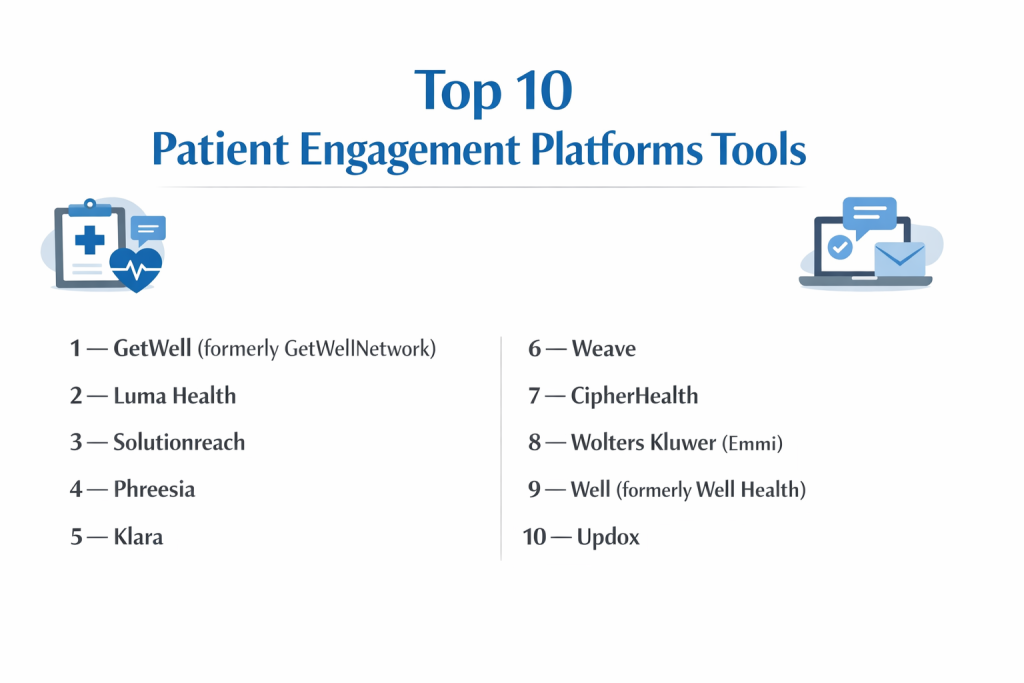
Top 10 Patient Engagement Platforms Tools
1 — Getwell (formerly GetWellNetwork)
Getwell is an enterprise-grade platform that focuses on the entire care continuum, offering a “high-tech, high-touch” approach to patient engagement in both inpatient and outpatient settings.
- Key features:
- Getwell Anywhere: Extends the engagement experience from the hospital bed to the patient’s home.
- Interactive Patient Care (IPC): Uses hospital room televisions to provide education and entertainment.
- Automated Care Pathways: Proactive outreach based on specific clinical events or diagnoses.
- Digital Rounding: Tools for clinicians to capture patient feedback in real-time during hospital stays.
- Bi-directional EHR Integration: Seamless data flow with major systems like Epic and Cerner.
- Pros:
- Exceptional at managing the transition from hospital to home, reducing readmission rates.
- Highly immersive experience for inpatient settings that improves HCAHPS scores.
- Cons:
- High implementation cost and complexity for smaller organizations.
- Hardware requirements for inpatient modules can be significant.
- Security & compliance: HIPAA, HITRUST CSF Certified, SOC 2 Type II, and ISO 27001.
- Support & community: Dedicated clinical transformation teams, 24/7 technical support, and executive-level account management.
2 — Luma Health
Luma Health is known as a leading “Patient Success Platform” that focuses heavily on the “Digital Front Door,” automating the patient journey from discovery to post-care.
- Key features:
- Smart Scheduling: Automatically fills cancellations by texting patients on a waitlist.
- Multi-channel Communication: Seamless switching between SMS, email, and voice.
- Zero-Login Patient Portal: Allows patients to complete tasks without remembering passwords.
- Actionable Reminders: Patients can confirm, cancel, or reschedule directly via text.
- Feedback & Reputation Management: Automatically prompts patients for reviews after a visit.
- Pros:
- The most user-friendly interface for patients, leading to very high engagement rates.
- Significant reduction in administrative manual labor through “smart” automation.
- Cons:
- Can be overly “chatty” if not configured correctly, leading to patient message fatigue.
- Premium features like advanced analytics are at a higher price tier.
- Security & compliance: HIPAA compliant, SOC 2 Type II, and 256-bit data encryption.
- Support & community: Strong onboarding program, extensive online help center, and active community webinars.
3 — Solutionreach
Solutionreach is one of the pioneers of the patient engagement space, offering a robust set of tools primarily focused on the ambulatory and dental markets.
- Key features:
- SR Conversations: A two-way text messaging tool that integrates with the practice’s landline.
- Patient Newsletters: Drag-and-drop templates for marketing and health education.
- SR Intake: Fully digital registration and consent forms to eliminate paper.
- ASAP Lists: Targeted outreach to fill last-minute schedule gaps.
- Reviews & Referrals: Automated tools to grow the practice’s online presence.
- Pros:
- Very mature platform with a massive library of templates and pre-built workflows.
- Excellent for dental and vision practices that require high-frequency reminders.
- Cons:
- Some of the legacy features can feel a bit dated compared to newer SaaS competitors.
- Integration with certain niche EHRs can be less stable than with major players.
- Security & compliance: HIPAA and HITECH compliant; supports encrypted messaging and audit logs.
- Support & community: Dedicated success advocates and a comprehensive training “Academy.”
4 — Phreesia
Phreesia is a powerhouse in the patient intake space, focusing on the “point of service” engagement to streamline the financial and clinical data collection process.
- Key features:
- Phreesia Mobile: Allows patients to check in for appointments on their own mobile devices.
- Registration Automation: Intelligently captures insurance data and demographic updates.
- Patient Payments: Integrated tools for collecting co-pays and settling balances during check-in.
- Clinical Screening: Automated tools for GAD-7, PHQ-9, and other vital screenings.
- Appointment Accelerator: Uses data to identify and fill gaps in the provider’s schedule.
- Pros:
- The gold standard for reducing front-desk wait times and improving collection rates.
- Highly effective clinical screening tools that integrate directly into the medical record.
- Cons:
- Some patients find the intake process too long if many clinical surveys are enabled.
- The pricing model can be complex depending on the modules selected.
- Security & compliance: PCI-DSS Level 1, SOC 2 Type II, and HIPAA compliant.
- Support & community: Enterprise-level support with dedicated implementation managers.
5 — Klara
Kara (by Modmed) is a communication-first platform that focuses on centralizing all patient interactions into a single, collaborative team inbox.
- Key features:
- Unified Messaging: Consolidates SMS, web chat, and internal team communication.
- Automated Assistant: Handles routine queries like “Where is the office?” or “How do I pay my bill?”
- Telemedicine: High-quality video visits integrated directly into the chat flow.
- Document Exchange: Securely send and receive images, insurance cards, and lab results.
- EHR Sync: Automatically pushes communication logs into the patient’s chart.
- Pros:
- Dramatically reduces phone volume for medical practices.
- The “Team Inbox” model ensures no patient message falls through the cracks.
- Cons:
- Less focus on “marketing” or “newsletters” compared to platforms like Solutionreach.
- Primarily designed for smaller to mid-sized practices rather than large inpatient systems.
- Security & compliance: HIPAA compliant with end-to-end encryption for all messages.
- Support & community: Known for being very responsive; offers tailored onboarding and training.
6 — Weave
Weave is a “Unified Business Platform” that combines a sophisticated phone system with patient engagement tools, primarily targeting the SMB dental and medical market.
- Key features:
- Smart Phone System: Instantly displays patient details on the screen when they call.
- Two-Way Texting: Allows for quick, personalized communication from the practice number.
- Online Scheduling: Enables patients to book appointments directly from the website.
- Payments & Financing: Integrated “Text-to-Pay” and Buy Now, Pay Later (BNPL) options.
- Digital Forms: Simple mobile-friendly forms for intake and updates.
- Pros:
- Having the phone system and engagement platform in one tool is highly efficient.
- Very modern and attractive interface that staff generally enjoy using.
- Cons:
- You essentially have to switch your phone provider to get the most value.
- Not suitable for large hospital systems with complex PBX requirements.
- Security & compliance: HIPAA compliant; supports SSO and encrypted data storage.
- Support & community: High ratings for customer service and a very active user community.
7 — CipherHealth
CipherHealth is an enterprise-focused platform that specializes in high-volume automated outreach and “rounding” to improve the patient experience at scale.
- Key features:
- CipherOutreach: Automated voice and text programs for post-discharge follow-ups.
- CipherRounding: Digital tools for staff to track patient needs and safety checks.
- Longitudinal Engagement: Sustained outreach for chronic disease management.
- Advanced Analytics: Predictive modeling to identify patients at risk of readmission.
- Multi-lingual Support: Comprehensive capabilities for diverse patient populations.
- Pros:
- Excellent for large-scale health systems focused on value-based care metrics.
- Highly data-driven, providing deep insights into patient sentiment and health trends.
- Cons:
- Can feel too “corporate” or automated for small, personalized boutique practices.
- Implementation requires a significant commitment from clinical leadership.
- Security & compliance: HITRUST CSF Certified, HIPAA, and SOC 2 Type II.
- Support & community: Strategic advisory services and professional technical support.
8 — Wolters Kluwer (Emmi)
Emmi is a platform that focuses heavily on “Health Literacy” and patient education, providing high-quality multimedia content to engage patients in their own care.
- Key features:
- Multimedia Education: Engaging videos and interactive programs on complex medical topics.
- Decision Support: Tools to help patients weigh the pros and cons of different treatments.
- Surgical Prep: Automated programs that guide patients through pre-op and post-op care.
- EHR Integration: Records completion of educational modules directly in the medical record.
- Standardized Content: Peer-reviewed information that ensures clinical accuracy.
- Pros:
- Best-in-class educational content that is easy for laypeople to understand.
- Reduces the time clinicians spend repeating basic instructions.
- Cons:
- Primarily a content/education tool; lacks the deep scheduling/billing features of Luma or Phreesia.
- Can be seen as a “niche” addition rather than a total engagement solution.
- Security & compliance: HIPAA compliant; standards-based integration (HL7/FHIR).
- Support & community: Professional clinical support and extensive content libraries.
9 — Well (formerly Well Health)
Well is an enterprise-level communication engine designed to unify the fragmented patient experience by acting as a central orchestration layer for all outreach.
- Key features:
- Unified Communication: Orchestrates messages from different departments into one thread.
- Intelligent Routing: Directs patient replies to the correct staff member or department.
- Campaign Management: High-volume outreach for vaccinations or health screenings.
- Integration Engine: Deep connectivity with Epic, Cerner, Meditech, and Athenahealth.
- Conversation History: A complete, searchable record of every interaction with a patient.
- Pros:
- Solves the problem of “Too many departments texting the patient” at once.
- Extremely scalable for the world’s largest health systems.
- Cons:
- Requires a high level of technical maturity to implement and optimize.
- Pricing is significantly higher than SMB-focused engagement tools.
- Security & compliance: SOC 2 Type II, HIPAA, and HITRUST certified.
- Support & community: High-touch enterprise support and a robust developer API.
10 — Updox
Updox provides a versatile “Collaboration Platform” that combines engagement tools with healthcare CRM features, making it a favorite for independent pharmacies and clinics.
- Key features:
- Video Chat: Easy, one-click telehealth sessions for patients.
- Secure Texting: HIPAA-compliant messaging for both patients and colleagues.
- Electronic Fax: Fully integrated digital faxing to move toward a paperless office.
- Broadcast Messaging: Quickly notify all patients of office closures or flu clinics.
- Patient Portal: A simple, secure area for patients to view records and pay bills.
- Pros:
- One of the most affordable ways to get a comprehensive toolset for a small practice.
- The integration of digital fax and engagement is a unique, time-saving feature.
- Cons:
- The user interface is functional but lacks the “slickness” of newer competitors.
- Automation features are less “intelligent” than those found in Luma or Well.
- Security & compliance: HIPAA compliant and ONC-certified; supports encryption and audit logs.
- Support & community: Strong US-based support team and extensive self-help documentation.
Comparison Table
| Tool Name | Best For | Platform(s) Supported | Standout Feature | Rating |
| Getwell | Large Inpatient Systems | Web / Tablet / TV | Inpatient TV Integration | 4.6 / 5 |
| Luma Health | Digital Front Door / SMB | Web / Mobile | Smart Waitlist Automation | 4.8 / 5 |
| Solutionreach | Dental & Vision | Web / Mobile | SR Conversations Texting | 4.5 / 5 |
| Phreesia | Intake & Collections | Web / Tablet | Mobile Check-In & Payments | 4.7 / 5 |
| Klara | Team Collaboration | Web / Mobile | Centralized Team Inbox | 4.6 / 5 |
| Weave | SMB Medical/Dental | Web / Phone / Mobile | Unified Phone & Engagement | 4.7 / 5 |
| CipherHealth | Post-Discharge Follow-up | Web / Voice / SMS | Automated Voice Outreach | 4.4 / 5 |
| Wolters Kluwer | Patient Education | Web / Mobile | Interactive Video Content | 4.3 / 5 |
| Well | Enterprise Orchestration | Web / Mobile / API | Unified Dept. Messaging | 4.8 / 5 |
| Updox | Independent Pharmacies | Web / Mobile | Integrated Digital Faxing | 4.2 / 5 |
Evaluation & Scoring of Patient Engagement Platforms
| Category | Weight | Score | Evaluation Details |
| Core Features | 25% | 9.5/10 | Identification, messaging, and scheduling features are highly advanced. |
| Ease of Use | 15% | 8.2/10 | Front-end patient tools are excellent; back-end admin panels can be complex. |
| Integrations | 15% | 8.5/10 | EHR integration is standard but varies in “bi-directional” depth. |
| Security & Compliance | 10% | 9.8/10 | Extremely high standards due to federal healthcare regulations. |
| Performance | 10% | 9.0/10 | Cloud-based SaaS models ensure high uptime and message delivery. |
| Support & Community | 10% | 8.4/10 | Strong professional support, though small vendors are more personal. |
| Price / Value | 15% | 7.6/10 | High enterprise fees can be a barrier for smaller, non-profit facilities. |
Which Patient Engagement Platforms Tool Is Right for You?
Solo Users vs SMB vs Mid-Market vs Enterprise
If you are a solo practitioner, look at Updox or Klara; they provide the essential tools without unnecessary “enterprise” bloat. For SMBs (small clinics and dental offices), Luma Health and Weave are the clear winners due to their focus on ease of use and immediate ROI. Mid-market multi-specialty groups should consider Solutionreach or Phreesia. Finally, Enterprise systems (hospitals and large networks) require the orchestration power of Well or the inpatient-focused depth of Getwell.
Budget-conscious vs Premium Solutions
If you are budget-conscious, Updox provides a massive amount of functionality (including faxing) for a very reasonable price. On the other hand, Premium solutions like AthenaOne’s native tools or Well are worth the investment for large organizations where even a 1% reduction in “no-shows” equates to millions in saved revenue.
Feature Depth vs Ease of Use
If your priority is Ease of Use for both staff and patients, Luma Health is difficult to beat. Their “no-login” approach for patients is a game-changer. If you require Feature Depth—specifically for clinical education or post-surgical guidance—the specialized content of Wolters Kluwer (Emmi) or the complex inpatient workflows of Getwell are superior.
Integration and Scalability Needs
For organizations that plan to grow through acquisition, Scalability and EHR Agnosticism are key. Luma Health and Well are excellent at “layering” over multiple different EHRs. If you are deeply committed to a single ecosystem like Epic, using Getwell or Phreesia (which have decades of deep integration history with Epic) will provide a more “native” feel.
Security and Compliance Requirements
Every tool on this list is HIPAA compliant. However, for institutions handling sensitive government contracts or large-scale clinical research, look for HITRUST CSF certification. Getwell, Well, and CipherHealth lead the way in these high-level security validations, providing an extra layer of trust for institutional risk managers.
Frequently Asked Questions (FAQs)
1. What is the difference between a Patient Portal and an Engagement Platform?
A Patient Portal is a “passive” site where patients go to see data. An Engagement Platform is “active”—it proactively reaches out via SMS or email to prompt the patient to take an action, such as scheduling or paying a bill.
2. Do these platforms require patients to download an app?
Modern platforms (like Luma or Well) use “responsive web” and SMS, meaning patients do not need to download an app. Some enterprise systems like MyChart or Healow offer apps, but adoption is usually higher when no download is required.
3. Can these tools help reduce my “no-show” rate?
Yes. By using multi-channel reminders (text, email, and voice) and “smart” waitlists, practices typically see a 20% to 50% reduction in missed appointments.
4. Are these messages secure and HIPAA compliant?
Yes. While standard SMS is not HIPAA compliant, these platforms use “Secure Links.” The patient receives a text with a link that takes them to an encrypted, browser-based environment where PHI can be safely shared.
5. How much does a patient engagement platform cost?
Small clinics can expect to pay $150–$500 per month per provider. Large enterprises usually pay based on “patient volume” or “total beds,” with annual contracts ranging from $20k to $500k+.
6. Do they integrate with all EHRs?
Most integrate with major systems like Epic, Cerner, and Athenahealth. For smaller, niche EHRs, you may need to use an “SFTP” or “CSV” upload, though API-based integration is becoming more common.
7. Can I use these platforms for marketing?
Some (like Solutionreach) have strong marketing and newsletter tools. Others (like Phreesia) are strictly clinical and administrative. Always check the “Campaign” features if marketing is a priority.
8. Can patients pay their bills through these platforms?
Yes, tools like Phreesia and Weave have integrated “Text-to-Pay” features that allow patients to settle their balances in seconds from their phones.
9. How do these tools help with “Population Health”?
They allow you to send “Broadcast” messages to specific groups—for example, texting all diabetic patients who haven’t had an A1C test in six months to prompt them to schedule.
10. What is the biggest mistake practices make during implementation?
Over-automation. If you send too many texts (reminders, check-ins, reviews), patients will opt-out. It is essential to find a balance and respect the patient’s communication preferences.
Conclusion
Patient engagement platforms have become the mandatory connective tissue of modern medicine. Whether you are a large health system focusing on the inpatient experience with Getwell, or an independent practice using the automated “waitlist” features of Luma Health, the impact is clear: better communication leads to better health.
The “best” platform is not the one with the most features, but the one that aligns most closely with your specific patient demographic and administrative pain points. By investing in a platform that prioritizes ease of use and deep EHR integration, you are not just buying software—you are building a more resilient and patient-centered practice for the future.