Introduction
A Hospital Information System (HIS) is the digital backbone of modern healthcare infrastructure. It is a comprehensive, integrated software solution designed to manage every aspect of a hospital’s operation, from medical and administrative to financial and legal. By centralizing data into a single source of truth, an HIS allows healthcare providers to access patient records in real-time, automate complex billing cycles, and coordinate care across diverse departments like radiology, the laboratory, and the pharmacy. The ultimate goal of an HIS is to improve the quality of patient care while reducing operational costs and human error.
The importance of these systems cannot be overstated. In a high-stakes clinical environment, the ability to instantly retrieve a patient’s allergy history or previous lab results can be life-saving. Key real-world use cases include electronic health record (EHR) management, computerized physician order entry (CPOE), revenue cycle management (RCM), and population health analytics. When evaluating an HIS, decision-makers must prioritize interoperability, user experience (UX), regulatory compliance, and scalability to ensure the system can grow alongside the institution.
Best for: Large multi-facility hospital networks, academic medical centers, and community hospitals that require high-level integration, automated workflows, and robust data analytics to manage high patient volumes.
Not ideal for: Small, independent private practices or solo practitioners who may find the high cost and complexity of a full-scale HIS overwhelming. For these users, a lighter Electronic Medical Record (EMR) or specialized practice management software is often a better fit.
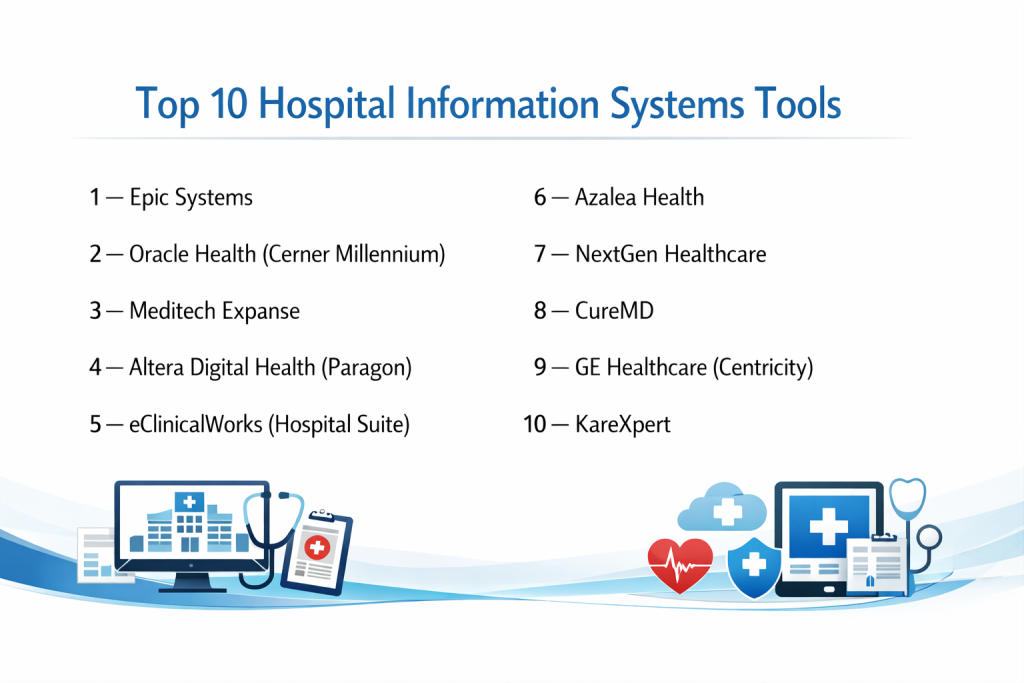
Top 10 Hospital Information Systems Tools
1 — Epic Systems
Epic is widely considered the gold standard for large-scale healthcare organizations. Known for its “closed-loop” integration, it provides a seamless experience across nearly every medical specialty and department.
- Key features:
- MyChart Patient Portal: The industry-leading tool for patient engagement and record access.
- Care Everywhere: A powerful interoperability framework for sharing records across different health systems.
- Chronicles Database: A high-performance database optimized for large-scale clinical data.
- Specialty-Specific Modules: Tailored workflows for cardiology, oncology, transplants, and more.
- Epic Cosmos: A massive research network that allows clinicians to query de-identified data from millions of patients.
- Pros:
- Unmatched integration; data flows perfectly between the ER, ICU, and outpatient clinics.
- Strong emphasis on patient-centered care through its robust mobile apps.
- Cons:
- Extremely high implementation costs and long rollout periods.
- The software is notoriously complex, requiring significant training for clinical staff.
- Security & compliance: HIPAA, HITECH, ONC-ATCB certified; features advanced AES-256 encryption and multi-factor authentication (MFA).
- Support & community: Exceptional professional support and a massive, active user community that shares “best practice” builds.
2 — Oracle Health (Cerner Millennium)
Following its acquisition by Oracle, Cerner Millennium has integrated powerful cloud and AI capabilities into its enterprise-grade platform, making it a favorite for global health systems and government contracts.
- Key features:
- HealtheIntent: A cloud-based population health platform that aggregates data from non-Cerner systems.
- Millennium EHR: A highly scalable clinical framework used by some of the world’s largest hospitals.
- PowerChart: A comprehensive clinician desktop for charting, ordering, and results review.
- AI-Powered Clinical Assistants: Voice-to-text and automated documentation tools to reduce physician burnout.
- Interoperability Tiers: Strong support for HL7 and FHIR standards for external data exchange.
- Pros:
- Highly scalable, making it ideal for national-level healthcare deployments.
- Strong data analytics and population health management tools.
- Cons:
- The user interface can feel dated compared to newer, cloud-native competitors.
- System performance can lag during peak usage hours in very large environments.
- Security & compliance: ISO 27001, SOC 2 Type II, HIPAA, and GDPR compliant; utilizes Oracle’s enterprise-grade cloud security.
- Support & community: Extensive global support network; strong documentation and structured onboarding programs.
3 — Meditech Expanse
Meditech Expanse is a web-based, mobile-friendly HIS that focuses on ease of use and modernizing the clinician experience through a personalized, “app-like” interface.
- Key features:
- Mobile-First Design: Optimized for tablets and smartphones, allowing clinicians to chart at the bedside.
- Integrated Care Compass: A visual tool that helps nurses and doctors track patient progress and tasks.
- High-Plex Interoperability: Native tools for connecting with community partners and retail pharmacies.
- Revenue Cycle Integration: A unified clinical and financial database to prevent billing gaps.
- Expanse Patient Connect: Automated patient communication via text and email.
- Pros:
- Often more affordable than Epic or Oracle Cerner for mid-market hospitals.
- The web-based interface is intuitive and requires less “clicking” than legacy systems.
- Cons:
- Smaller library of third-party integrations compared to the “Big Two.”
- Reporting tools are powerful but can be difficult for non-technical users to customize.
- Security & compliance: ONC-certified; HIPAA compliant; supports SSO (Single Sign-On) and audit logs for all data access.
- Support & community: Known for high customer satisfaction and a “human” approach to technical support.
4 — Altera Digital Health (Paragon)
Formerly part of McKesson and Allscripts, Altera Paragon is an integrated HIS designed specifically for community and mid-sized hospitals that need full functionality without enterprise-level complexity.
- Key features:
- Microsoft-Based Architecture: Uses a familiar technology stack, making it easier for local IT teams to manage.
- Integrated Clinical & Financials: A single database ensures that clinical actions automatically trigger billing events.
- Physician Hub: A personalized dashboard that centralizes labs, notes, and orders.
- Rules-Based Engine: Automated alerts for drug-drug interactions and clinical decision support.
- OneContent: A comprehensive document management system for paperless operations.
- Pros:
- Lower total cost of ownership (TCO) compared to high-end enterprise systems.
- Faster implementation timelines for hospitals under 300 beds.
- Cons:
- Lacks some of the “bleeding edge” AI and research features found in Epic.
- Frequent corporate ownership changes have historically impacted update speeds.
- Security & compliance: HIPAA and HITECH compliant; supports encrypted data transmission and role-based access.
- Support & community: Dedicated client managers; community focuses on the specific needs of community health systems.
5 — eClinicalWorks (Hospital Suite)
While widely known for its ambulatory EHR, eClinicalWorks offers an integrated hospital suite that is a popular choice for rural hospitals and multi-specialty clinics.
- Key features:
- Prisma: A health information search engine that aggregates records from various disparate sources.
- Veva: An AI assistant for clinical documentation and ambient listening.
- Telehealth Integration: Native video visit capabilities built directly into the scheduling module.
- Revenue Cycle Management (RCM): Automated claim scrubbing to improve first-pass payment rates.
- Cloud-First Infrastructure: Reduced need for expensive on-site server hardware.
- Pros:
- Extremely competitive pricing and transparent subscription models.
- Excellent for facilities that manage a mix of inpatient and outpatient care.
- Cons:
- Customer support is often cited as being slower than premium competitors.
- Some users find the interface cluttered with too many nested menus.
- Security & compliance: SOC 2, HIPAA, and ISO 27001 compliant; advanced data encryption and threat monitoring.
- Support & community: Large user base; extensive online training academy and yearly user conferences.
6 — Azalea Health
Azalea Health provides a cloud-native HIS platform specifically designed to address the unique challenges of rural and community hospitals.
- Key features:
- Integrated RCM: Strong focus on the financial health of the hospital through automated billing.
- Lightweight Deployment: Can be accessed via any web browser without complex local installations.
- Telehealth-Ready: Built-in virtual care tools for reaching remote patient populations.
- Public Health Reporting: Automated links to state registries for immunizations and lab reporting.
- Collaborative Charting: Allows multiple providers to view and update charts simultaneously.
- Pros:
- One of the easiest systems to learn and navigate for clinical staff.
- Zero-footprint architecture saves significantly on hardware and IT maintenance.
- Cons:
- Not designed for large, multi-state academic medical centers.
- Limited depth in highly specialized modules (e.g., complex cardiology or neurosurgery).
- Security & compliance: 2015 Edition ONC-Certified; HIPAA compliant; supports encrypted messaging and data storage.
- Support & community: Responsive US-based support; focuses heavily on the rural health community.
7 — NextGen Healthcare
NextGen is a leader in specialty-specific care, offering an HIS suite that excels in managing orthopedic, behavioral health, and surgical centers.
- Key features:
- NextGen Share: An interoperability platform that facilitates easy data exchange with other EHRs.
- Patient Experience Platform (PXP): A comprehensive tool for self-scheduling and digital intake.
- MIPS/MACRA Reporting: Automated tracking of quality metrics for government reimbursements.
- Specialty Templates: Thousands of pre-built templates for over 25 medical specialties.
- Mobile Solutions: Robust mobile apps for both patients and providers.
- Pros:
- Superior customization options for specialty-specific workflows.
- Strong financial and practice management modules.
- Cons:
- Upgrades can be technically challenging if the system is heavily customized.
- The patient portal has faced criticism for being less user-friendly than MyChart.
- Security & compliance: HIPAA, GDPR, and NIST compliant; features robust audit trails and data access controls.
- Support & community: Professional training services and a large library of self-help documentation.
8 — CureMD
CureMD offers an all-in-one HIS platform that emphasizes “simplicity without compromise,” providing enterprise features at a price point accessible to mid-sized organizations.
- Key features:
- Avalon iPad App: A purpose-built mobile EHR for physicians on the move.
- Smart Billing: Integrated clearinghouse and real-time eligibility verification.
- Clinical Decision Support: Real-time alerts based on evidence-based medicine.
- Patient Portal: Secure access for patients to view results and pay bills.
- Document Management: Centralized scanning and storage for historical paper records.
- Pros:
- High value-to-cost ratio; includes many features that others charge as “add-ons.”
- Frequent, automatic updates ensure the system stays current with regulations.
- Cons:
- User interface is functional but lacks the modern “polish” of competitors like Meditech.
- Support response times can vary depending on the complexity of the issue.
- Security & compliance: ISO 27001, SOC 2, and HIPAA compliant; uses advanced encryption for all “data at rest.”
- Support & community: 24/7 technical support; proactive account management for enterprise clients.
9 — GE Healthcare (Centricity)
Centricity is a powerful HIS platform designed for large-scale imaging and data-intensive environments, leveraging GE’s deep history in medical hardware.
- Key features:
- Device Integration: Exceptional ability to connect with medical devices and imaging systems (PACS).
- Medical Quality Improvement Consortium (MQIC): Access to anonymized data for clinical benchmarking.
- Financial Management Suite: Highly advanced tools for managing hospital revenue cycles.
- High-Volume Charting: Designed to handle massive amounts of clinical data without slowing down.
- Interoperability Hub: Seamless connections to external labs and diagnostic centers.
- Pros:
- The best choice for hospitals with heavy radiology and diagnostic imaging needs.
- Very stable and reliable platform for high-volume environments.
- Cons:
- The learning curve is steep, particularly for administrative staff.
- High initial investment and ongoing maintenance costs.
- Security & compliance: HIPAA compliant; supports NIST standards for cybersecurity; features robust encryption.
- Support & community: Professional enterprise-level support; extensive global presence and engineering backing.
10 — KareXpert
KareXpert is a disruptive, cloud-native HIS that uses a “Digital Health Platform” approach to connect every department in a hospital within a single, unified ecosystem.
- Key features:
- SaaS Delivery: A true multi-tenant cloud platform with zero on-site infrastructure.
- AI-Driven Dashboards: Real-time clinical and operational analytics.
- Connected Ecosystem: Includes modules for LIS (Labs), RIS (Radiology), and Pharmacy.
- Hyper-Personalized Workflows: Allows different hospital roles to see only the data they need.
- Paperless OPD/IPD: Complete digitization of outpatient and inpatient departments.
- Pros:
- Rapid deployment—can be live in weeks rather than months.
- Modern, clean UI that significantly reduces the training burden on staff.
- Cons:
- Newer to the Western market compared to established giants like Epic.
- Smaller network of pre-existing integrations with legacy insurance systems.
- Security & compliance: HIPAA and GDPR compliant; uses AWS-backed security protocols and AES-256 encryption.
- Support & community: Growing community; emphasizes a “Customer Success” model with high-touch onboarding.
Comparison Table
| Tool Name | Best For | Platform(s) Supported | Standout Feature | Rating |
| Epic Systems | Large IDNs & Academic Centers | Windows / iOS | Care Everywhere Interoperability | 4.8 / 5 |
| Oracle Health | Global Systems & Gov | Cloud / Windows | HealtheIntent Analytics | 4.6 / 5 |
| Meditech Expanse | Mid-Market Hospitals | Web / Mobile | Mobile-First UI | 4.7 / 5 |
| Altera Paragon | Community Hospitals | Windows (On-prem) | Integrated Financial/Clinical | 4.2 / 5 |
| eClinicalWorks | Rural & Multi-specialty | Cloud / Web | Prisma Health Search | 4.4 / 5 |
| Azalea Health | Rural Community Health | Cloud-Native | Lightweight Deployment | 4.5 / 5 |
| NextGen | Specialty-Specific Care | Cloud / Windows | Specialized Templates | 4.3 / 5 |
| CureMD | Budget-Conscious Mid-Size | Cloud / iOS | Avalon iPad App | 4.2 / 5 |
| GE Centricity | Imaging-Intensive Labs | Windows / Web | Device/PACS Integration | 4.1 / 5 |
| KareXpert | Modern Digital Hospitals | Cloud-SaaS | Unified Platform Architecture | N/A |
Evaluation & Scoring of Hospital Information Systems
| Category | Weight | Score | Reasoning |
| Core Features | 25% | 9.5/10 | Identification, CPOE, and RCM are mature across all top-tier vendors. |
| Ease of Use | 15% | 7.0/10 | Legacy systems (Epic/Cerner) still struggle with UX compared to newer SaaS. |
| Integrations | 15% | 9.2/10 | Interoperability is at an all-time high due to FHIR and HL7 standards. |
| Security & Compliance | 10% | 9.8/10 | Healthcare standards are non-negotiable and strictly adhered to. |
| Performance | 10% | 8.5/10 | Cloud-based tools lead in uptime; on-prem can suffer during hardware aging. |
| Support & Community | 10% | 8.8/10 | Enterprise support is professional, though sometimes slow for smaller users. |
| Price / Value | 15% | 7.5/10 | High upfront costs remain a barrier for many mid-sized facilities. |
Which Hospital Information Systems Tool Is Right for You?
Solo Users vs SMB vs Mid-Market vs Enterprise
If you are an Enterprise organization with thousands of beds, Epic Systems or Oracle Health are your primary choices. They have the architectural “heft” required to manage massive data volumes. Mid-Market hospitals (100–300 beds) will find Meditech Expanse or Altera Paragon much more manageable in terms of cost and IT staffing. Small/Rural facilities should prioritize cloud-native systems like Azalea Health or KareXpert, which remove the burden of managing on-site servers.
Budget-conscious vs Premium Solutions
If you have a Premium budget and want the best patient portal and research tools on the market, Epic is the clear winner. However, for a Budget-conscious facility that still needs comprehensive features, CureMD or eClinicalWorks offer excellent functionality at a significantly lower total cost of ownership (TCO).
Feature Depth vs Ease of Use
For Ease of Use, Meditech Expanse and KareXpert lead the pack with modern, web-based interfaces that feel more like consumer apps than 1990s software. If you require Feature Depth—specifically for niche clinical specialties or research—the complexity of Epic or NextGen becomes a necessary trade-off for the granular control they offer.
Integration and Scalability Needs
Hospitals that are part of a larger network or those that frequently exchange data with external labs and imaging centers should look at GE Healthcare (Centricity) or Epic. These vendors have the strongest interoperability frameworks. If your goal is Scalability—expanding from a single clinic to a multi-hospital chain—Oracle Health is built for that exact growth trajectory.
Security and Compliance Requirements
Every tool on this list meets basic HIPAA and ONC requirements. However, if you are operating in a highly regulated government or international environment, Oracle Health and GE Healthcare offer the most robust, battle-tested compliance frameworks that extend into global standards like GDPR and ISO 27001.
Frequently Asked Questions (FAQs)
1. What is the difference between HIS and EHR?
An Electronic Health Record (EHR) is a digital version of a patient’s medical history. A Hospital Information System (HIS) is the broader infrastructure that includes the EHR but also manages billing, inventory, staffing, and departmental operations.
2. How long does it take to implement a new HIS?
For large enterprise systems like Epic, implementation can take 12 to 24 months. For cloud-native systems like Azalea or KareXpert, the process can often be completed in 3 to 6 months.
3. What is “Interoperability,” and why is it important?
Interoperability is the ability of different systems to “talk” to each other. It ensures that if a patient is treated at Hospital A, their records can be instantly accessed by a specialist at Hospital B.
4. Are cloud-based HIS platforms secure?
Yes. Modern cloud-based HIS platforms often provide better security than local servers because they are managed by specialized teams and hosted on highly secure infrastructure like AWS, Azure, or Oracle Cloud.
5. How much does a typical HIS cost?
Costs vary wildly. A community hospital might pay $1M–$5M over five years, while a large academic medical center might invest hundreds of millions of dollars into an Epic rollout.
6. Can an HIS help reduce physician burnout?
Yes, if implemented correctly. Systems with AI-assisted documentation (like Oracle Health) and mobile-friendly interfaces (like Meditech Expanse) aim to reduce the time doctors spend “clicking” and increase time spent with patients.
7. Does every hospital need an HIS?
Any hospital seeking to improve efficiency, patient safety, and financial health needs an HIS. Most modern insurance providers and government regulations effectively mandate the use of these systems.
8. What is CPOE?
Computerized Physician Order Entry (CPOE) allows doctors to enter medication and lab orders directly into the system, reducing errors caused by messy handwriting or verbal misunderstandings.
9. Can an HIS manage pharmacy and laboratory data?
Yes. Comprehensive systems like the ones listed above have specific modules (LIS for Labs and RIS for Radiology) that ensure data flows seamlessly from those departments into the patient’s central record.
10. What is the biggest mistake hospitals make when choosing a system?
Buying a system based on features rather than workflow. If a system has a million features but is too hard for nurses to use during a busy shift, it will ultimately fail to deliver a return on investment.
Conclusion
Selecting a Hospital Information System is one of the most critical decisions a healthcare leadership team will ever make. Whether you choose the industry-leading integration of Epic Systems, the cloud-powered analytics of Oracle Health, or the nimble, modern interface of Meditech Expanse, the priority must always be on how the system serves the people using it.
There is no single “best” HIS; rather, there is a best HIS for your specific patient population, budget, and clinical specialty. By focusing on interoperability, ease of use, and a solid return on investment, you can ensure that your hospital remains competitive and capable of delivering world-class care in an increasingly digital world.