Introduction
Pharmacovigilance (PV) software is a highly specialized category of health-informatics technology designed to monitor the safety of pharmaceutical products. These platforms facilitate the collection, detection, assessment, monitoring, and prevention of adverse effects or any other drug-related problems. In an industry where patient safety is the highest priority, PV software serves as the central repository for Adverse Event (AE) reporting. It automates the complex task of processing safety data from various sources—including clinical trials, spontaneous reports from healthcare providers, and even social media—ensuring that pharmaceutical companies can identify potential safety signals early and report them to regulatory bodies like the FDA or EMA.
The importance of these tools cannot be overstated, as they ensure compliance with strict global regulations while protecting public health. Key real-world use cases include managing Individual Case Safety Reports (ICSRs), generating Periodic Benefit-Risk Evaluation Reports (PBRERs), and conducting signal detection using advanced statistical algorithms. When evaluating a PV platform, users should prioritize E2B(R3) compliance, automated medical coding (MedDRA/WHODrug), robust audit trails, and seamless integration with clinical trial management systems.
Best for: Drug safety officers, Qualified Persons for Pharmacovigilance (QPPV), and regulatory affairs teams within pharmaceutical companies, Contract Research Organizations (CROs), and biotech startups. It is essential for organizations that have products in clinical trials or already on the market.
Not ideal for: General healthcare providers or small pharmacies that only need to report occasional side effects. These entities can typically use free regulatory portals (like MedWatch) rather than investing in a complex, dedicated enterprise software suite.
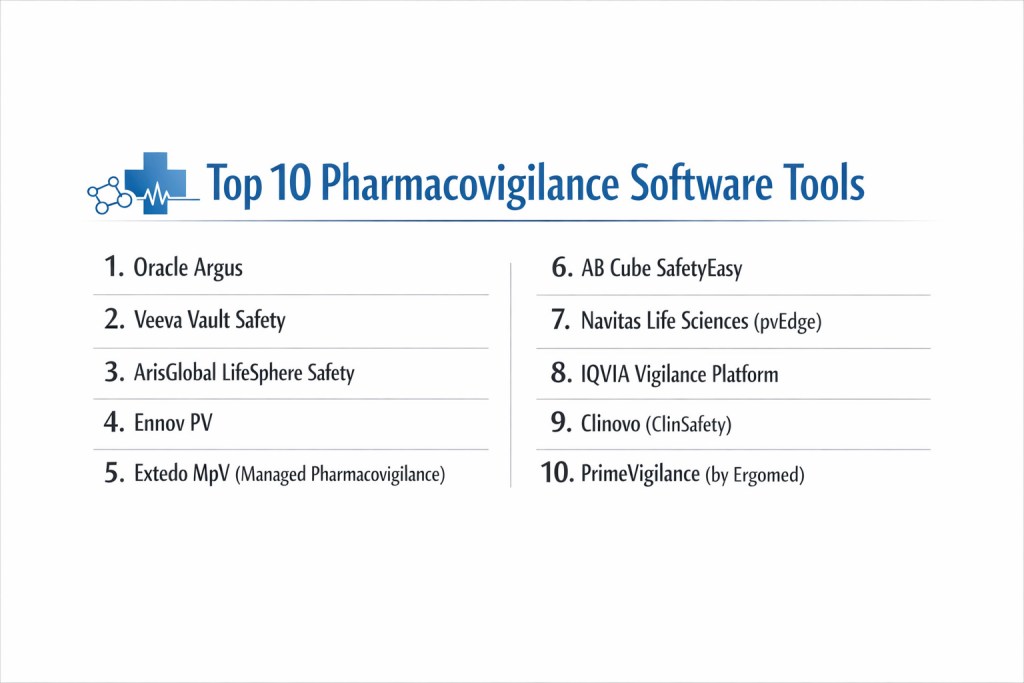
Top 10 Pharmacovigilance Software Tools
1 — Oracle Argus
Oracle Argus is widely regarded as the market-leading safety platform for the life sciences industry. It is an enterprise-grade solution designed to handle massive volumes of safety data while maintaining world-class regulatory compliance.
- Key features:
- Global Case Processing: A unified database to manage cases across different geographical regions and languages.
- Automated Expedited Reporting: Smart logic that determines when and where a report needs to be sent based on local laws.
- Integrated Signal Management: Advanced algorithms to detect patterns of adverse events early.
- Regulatory Interchange: Native support for E2B(R2) and E2B(R3) electronic transmissions.
- Comprehensive Audit Logs: Tracks every single change made to a safety case for total transparency.
- Pros:
- The most robust and feature-rich platform available for large-scale operations.
- Extremely high trust level with global regulatory agencies.
- Cons:
- Implementation is a massive undertaking that requires significant time and IT resources.
- The user interface can feel dated and overly complex for smaller teams.
- Security & compliance: ISO 27001, SOC 1/2, HIPAA, GDPR, and full 21 CFR Part 11 compliance.
- Support & community: Extensive global support network, a massive user group (OHUG), and professional consulting services.
2 — Veeva Vault Safety
Veeva Vault Safety is a modern, cloud-native platform that is rapidly gaining market share. It focuses on simplifying the user experience while providing real-time visibility into the safety data lifecycle.
- Key features:
- Real-time Dashboards: Visual insights into case processing metrics and reporting timelines.
- Automated Intake: Uses AI and OCR technology to extract data from safety forms automatically.
- Seamless Ecosystem: Integrates natively with Veeva Vault Clinical and Quality suites.
- Configurable Workflows: Allows teams to adapt the software to their specific internal SOPs without coding.
- SafetyDocs: Built-in document management for safety-related protocols and submissions.
- Pros:
- Very modern, intuitive interface that mimics consumer-grade software.
- Rapid deployment cycles and automatic updates twice a year.
- Cons:
- Some advanced signal detection features are still maturing compared to legacy leaders.
- Best utilized if your organization is already invested in the Veeva ecosystem.
- Security & compliance: SOC 2 Type II, ISO 27001, HIPAA, GDPR, and 21 CFR Part 11.
- Support & community: Excellent “Veeva Learn” training portal and a dedicated customer success manager for every account.
3 — ArisGlobal LifeSphere Safety
LifeSphere Safety is a pioneer in using cognitive computing and automation to reduce the manual effort involved in pharmacovigilance.
- Key features:
- LifeSphere Multi-Vigilance: An AI-powered engine for automated case intake and triage.
- Global Reporting Engine: Pre-configured rules for more than 100 regulatory authorities.
- Built-in Medical Coding: Seamless integration with the latest MedDRA and WHODrug dictionaries.
- Literature Monitoring: Automated scanning of scientific journals for relevant safety signals.
- Signal and Risk Management: Holistic view of the benefit-risk profile of a drug.
- Pros:
- Industry-leading automation that can reduce manual case processing by up to 50%.
- Scalable for both small biotech firms and global pharmaceutical giants.
- Cons:
- The configuration of the AI engine requires a high-quality initial data set.
- Can be quite expensive due to the advanced nature of the automation tools.
- Security & compliance: SOC 2, HIPAA, GDPR, and ISO 27001 certified.
- Support & community: Strong professional services team and a well-regarded annual user conference.
4 — Ennov PV
Ennov PV is a highly flexible, mid-market solution that offers a unified platform for pharmacovigilance, regulatory affairs, and quality management.
- Key features:
- Consolidated Database: Manage human, veterinary, and medical device safety in one place.
- Easy Configuration: Users can modify screens and fields without needing IT intervention.
- Automated E2B Generation: One-click generation of regulatory-compliant XML files.
- Dashboarding: High-level views of departmental performance and case backlogs.
- Workflow Automation: Tracks case progress from receipt to final submission.
- Pros:
- Excellent value for money for mid-sized pharmaceutical companies.
- Very fast implementation compared to Oracle or ArisGlobal.
- Cons:
- Lacks some of the “deep” AI automation found in the top-tier competitors.
- User community is smaller, specifically outside of the European market.
- Security & compliance: GDPR compliant, 21 CFR Part 11, and data encryption at rest.
- Support & community: Responsive technical support and personalized onboarding programs.
5 — Extedo MpV (Managed Pharmacovigilance)
Extedo is well known for its regulatory submission tools, and its MpV platform offers a streamlined way to manage the safety of products throughout their lifecycle.
- Key features:
- eRDM Integration: Connects safety reports directly with electronic document management.
- Automated Case Validation: Checks for mandatory fields before submission to prevent rejections.
- Support for E2B(R3): Fully compliant with the latest technical standards for data exchange.
- Query Management: Tools to follow up with reporters for missing information.
- Reporting Calendar: Visual reminders for periodic and expedited report deadlines.
- Pros:
- Seamless transition for companies already using Extedo for eCTD submissions.
- Highly reliable and stable platform with a focus on regulatory accuracy.
- Cons:
- The interface is more functional/utilitarian than modern.
- Not as well suited for high-volume signal detection as specialized tools.
- Security & compliance: ISO 27001, GDPR, and 21 CFR Part 11.
- Support & community: Extensive training webinars and a dedicated customer support portal.
6 — AB Cube SafetyEasy
SafetyEasy is a specialized, cloud-based solution that is particularly popular with CROs and small-to-medium enterprises (SMEs) due to its ease of setup.
- Key features:
- Multivigilance Support: Specialized modules for drugs, devices, vaccines, and cosmetics.
- Fast Setup: Can be deployed in a matter of weeks rather than months.
- Automated Medical Coding: Instant access to MedDRA and WHODrug updates.
- Electronic Transmission: Direct links to EudraVigilance and other regulatory gateways.
- Simple Interface: Minimalist design that reduces the risk of data entry errors.
- Pros:
- Very cost-effective and transparent pricing model.
- Ideal for smaller teams that don’t need the “bloat” of enterprise software.
- Cons:
- Not designed for extremely high-volume data (tens of thousands of cases per month).
- Limited advanced analytics and AI capabilities.
- Security & compliance: HIPAA, GDPR, and 21 CFR Part 11 compliant.
- Support & community: Strong reputation for personalized, direct-line customer support.
7 — Navitas Life Sciences (pvEdge)
pvEdge is a comprehensive safety database that is built on a “service-first” philosophy, often used as part of a managed-services arrangement.
- Key features:
- Integrated Medical Review: Tools for physicians to provide narrative assessments easily.
- Regulatory Intelligence: Built-in logic that stays updated with the latest global reporting rules.
- Reconciliation Tools: Ensures safety data matches clinical trial data.
- Custom Reporting: Easy-to-use report writer for internal ad-hoc requests.
- Global Tracking: Monitor the status of safety reports worldwide in a single view.
- Pros:
- Exceptional customer service and a “partnership” approach to implementation.
- Very strong at handling the reconciliation between safety and clinical databases.
- Cons:
- Less focus on “self-service” configuration compared to Veeva.
- The platform is less known in the North American market compared to Europe and Asia.
- Security & compliance: ISO 27001, GDPR, and 21 CFR Part 11.
- Support & community: High-touch support with dedicated account managers.
8 — IQVIA Vigilance Platform
IQVIA is a global leader in clinical data, and its Vigilance platform leverages this massive data ecosystem to provide unparalleled safety insights.
- Key features:
- Cognitive Case Processing: Uses AI to automate the intake and narrative writing of cases.
- Smart Signal Detection: Combines your data with IQVIA’s vast global datasets for context.
- Regulatory Portal: Centralized hub for managing all interactions with health authorities.
- Integrated Medical Coding: High-speed coding with built-in quality checks.
- Mobile Intake: Tools for field reps or physicians to report events via mobile.
- Pros:
- Access to IQVIA’s proprietary data for better signal contextualization.
- Top-tier security and infrastructure suitable for the largest pharma companies.
- Cons:
- Can be very expensive for smaller organizations.
- The platform is so broad that it can take a long time to learn every module.
- Security & compliance: SOC 1/2, ISO 27001, GDPR, and HIPAA compliant.
- Support & community: Global enterprise-level support with 24/7 availability.
9 — Clinovo (ClinSafety)
ClinSafety is a cloud-based safety system designed for smaller biotech companies and CROs that need a compliant, easy-to-use system without the enterprise price tag.
- Key features:
- Standardized Case Entry: Guided workflows to ensure all required E2B data is captured.
- Instant Validation: Flags errors before the user leaves the screen.
- Automated Coding: Integrated MedDRA browser for accurate classification.
- Basic Signal Detection: Tools to track event frequency and identify trends.
- Cloud-Native: No hardware to maintain; accessible from any web browser.
- Pros:
- One of the most affordable options for startups.
- Very simple, clean user interface that requires minimal training.
- Cons:
- Limited scalability for very large pharmaceutical organizations.
- Fewer integrations with third-party clinical systems.
- Security & compliance: 21 CFR Part 11 and HIPAA compliant.
- Support & community: Personalized support and helpful onboarding for small teams.
10 — DrugCard
DrugCard pharmacovigilance platform is an AI-powered SaaS solution founded in 2021 and headquartered in Tallinn. DrugCard serves pharmaceutical companies, CROs, and marketing authorization holders across Europe, the Middle East, and Asia. The platform monitors 2,200+ local journals across 121+ countries and 100+ languages, including sources not indexed in PubMed, reducing literature screening time by up to 70%.
- Key features:
- Literature Monitoring: Automated monitoring of PubMed and 2,200+ local journals across 121+ countries in 100+ languages.
- Regulatory Intelligence: Centralized tracking of regulatory updates from global and local health authorities.
- Adverse Event Database: Safety case management with AI Case Intake – automatic extraction of ADR data from unstructured text, powered by LLM.
- SimpleSearch: Free tool for instant global literature search, no setup required.
- eCTD Light Documentation: Streamlined regulatory submission document management.
- Pros:
- Unmatched local journal coverage not available on legacy platforms.
- Fast onboarding; teams become productive within days.
- Software and managed PV services combined under one roof.
- Cons:
- Best suited for small-to-mid-sized PV teams.
- Security & compliance: Hosted on AWS (ISO/IEC 27001), ISO 9001-certified QMS, compliant with EMA/95595/2022 (GVP), EU GMP Annex 11, and GAMP 5.
Support & community: Dedicated customer success team and fully managed PV services – literature screening, case processing, ICSRs, QPPV provision, signal detection, medical writing, PSURs, and PV consultancy.
Comparison Table
| Tool Name | Best For | Platform(s) Supported | Standout Feature | Rating |
| Oracle Argus | Large Enterprises | Cloud / On-Premise | Regulatory Trust & Scale | 4.8 / 5 |
| Veeva Vault Safety | Modern Biotech | Cloud / Web | Real-time Dashboards | 4.7 / 5 |
| LifeSphere Safety | Automation Seekers | Cloud / Web | AI-Powered Case Triage | 4.6 / 5 |
| Ennov PV | Mid-Market | Cloud / Web | Unified PV/Reg/Quality | 4.4 / 5 |
| Extedo MpV | Submission Focus | Cloud / Web | Native eCTD Integration | N/A |
| SafetyEasy | Small Teams / CROs | Cloud / Web | Multivigilance Modules | 4.5 / 5 |
| pvEdge | Reconciliation Needs | Cloud / Web | Managed Service Focus | N/A |
| IQVIA Vigilance | Big Pharma | Cloud / Web | Cognitive AI & Data Access | 4.7 / 5 |
| ClinSafety | Startups | Cloud / Web | Affordability & Simplicity | N/A |
| PrimeVigilance | Literature-Heavy PV | Cloud / Web | Expert-Led Literature Scan | N/A |
Evaluation & Scoring of Pharmacovigilance Software
| Category | Weight | Score | Reasoning |
| Core Features | 25% | 9.4/10 | E2B(R3) compliance and MedDRA coding are now standard in top tools. |
| Ease of Use | 15% | 7.5/10 | Enterprise tools are still quite complex; newer SaaS apps score higher. |
| Integrations | 15% | 8.2/10 | Ecosystems like Veeva and Oracle lead in connecting safety with clinical data. |
| Security & Compliance | 10% | 9.8/10 | This is a non-negotiable area; almost all leaders have perfect compliance. |
| Performance | 10% | 8.8/10 | Cloud platforms have improved latency even for global databases. |
| Support | 10% | 8.5/10 | Professional services are common, but documentation quality varies. |
| Price / Value | 15% | 7.8/10 | High total cost of ownership; mid-market tools provide the best ROI. |
Which Pharmacovigilance Software Tool Is Right for You?
Solo Users vs. SMB vs. Mid-Market vs. Enterprise
For solo consultants or small research boutiques, ClinSafety or SafetyEasy provide the necessary compliance without the high overhead. Mid-Market firms looking to scale will find Ennov PV or LifeSphere Safety to be the best balance of automation and price. Enterprise giants—those with hundreds of products and thousands of adverse events monthly—almost always require the reliability and regulatory “weight” of Oracle Argus or IQVIA.
Budget-conscious vs. Premium Solutions
If you are budget-conscious, look for a “modular” system where you only pay for the cases you process, such as SafetyEasy. For those who view safety as a strategic advantage and have the budget, Premium solutions like Veeva Vault Safety or Oracle Argus offer “Active Monitoring” and AI features that can significantly reduce the risk of a regulatory audit or product recall.
Feature Depth vs. Ease of Use
If your team is small and doesn’t have a dedicated IT department, Ease of Use should be your top priority. In this case, Veeva is the clear winner. However, if you need Feature Depth—such as the ability to manage complex “Combination Products” (drug + device) or specialized veterinary safety—the technical depth of Ennov PV or Oracle is worth the extra complexity.
Integration and Scalability Needs
Do you plan on integrating your safety data with your Electronic Lab Notebook (ELN) or Clinical Trial Management System (CTMS)? If so, a platform like Veeva or IQVIA is best because they offer a “Unified Cloud” where data flows automatically between departments. If you are a CRO that needs to host multiple clients in one system, look for “Multi-tenant” architectures like SafetyEasy.
Security and Compliance Requirements
Every tool on this list is built to meet 21 CFR Part 11 and GDPR. However, if you operate in specialized markets like the US government or defense, you may need tools that are FedRAMP authorized (Oracle). Always ask the vendor for their latest SOC 2 Type II report during the audit process.
Frequently Asked Questions (FAQs)
1. What is E2B(R3) compliance?
It is the international standard for the electronic transmission of Individual Case Safety Reports (ICSRs). Any modern PV software must support this to be useful for regulatory submissions.
2. Can I use Excel instead of PV software?
Technically yes for tracking, but it is not compliant. Excel lacks an unalterable audit trail and electronic signatures, which are mandatory for 21 CFR Part 11. Using Excel for PV is a major regulatory risk.
3. What is MedDRA coding?
MedDRA is a standardized medical terminology used to classify adverse events. PV software integrates this so that “headache” and “migraine” can be analyzed under the same clinical umbrella.
4. How long does it take to implement a PV system?
Small cloud-based systems like SafetyEasy can be ready in 4–6 weeks. Large enterprise systems like Oracle Argus can take 6 months to over a year to fully configure and validate.
5. Is my data safe in the cloud?
Yes. Modern PV vendors use multi-layered encryption, regular penetration testing, and geographically redundant backups to ensure data is safer than it would be on a local office server.
6. Can PV software detect a “Signal” automatically?
Yes. Advanced tools use statistical “Disproportionality Analysis” to flag when a specific side effect is happening more often than expected for a particular drug.
7. Do I need to validate the software myself?
Even if the vendor provides a “validated” system, your company is still responsible for “User Acceptance Testing” (UAT) to prove the software works for your specific business processes.
8. Can these tools handle medical device safety?
Most can, but some (like Ennov PV and Oracle) have specific modules designed for the unique reporting requirements of medical device malfunctions.
9. How much does PV software cost?
Pricing is typically based on the number of cases processed per year or the number of users. It can range from $10,000 for a small setup to millions for an enterprise-wide global license.
10. What is a QPPV?
The Qualified Person for Pharmacovigilance is a person required by European law who is personally responsible for the safety of a drug. They are the primary users of these software systems.
Conclusion
The selection of a Pharmacovigilance software is one of the most critical decisions a pharmaceutical company can make. It is the line of defense that protects both the patient and the company’s regulatory standing. While Oracle Argus remains the powerful incumbent for large-scale operations, the rise of cloud-native, AI-driven platforms like Veeva and LifeSphere is making safety management more efficient than ever before.
The “best” tool is the one that fits your specific volume of cases and your team’s technical capacity. By moving away from manual spreadsheets and into a dedicated, compliant PV platform, you ensure that your drug safety operations are not just a “regulatory checkbox,” but a proactive system for protecting public health.
One aspect that deserves more attention is how well these platforms handle data migration and system adoption. In many organizations, the biggest challenge isn’t choosing the software itself—it’s ensuring teams can transition smoothly without disrupting existing pharmacovigilance workflows.