PEP Screening Tools:
Introduction
PEP Screening Tools (Politically Exposed Person screening) are specialized compliance solutions used by businesses to identify and monitor individuals who hold—or have held—prominent public positions. These include government officials, high-ranking military officers, and senior executives of state-owned enterprises, as well as their Relative and Close Associates (RCAs). Because these individuals hold significant influence and power over public assets and policy, they are inherently at a higher risk for involvement in bribery, corruption, and money laundering. PEP screening tools automate the process of cross-referencing customer data against vast global databases to flag potential exposure before a business relationship is finalized.
The importance of these tools has surged in the face of increasingly aggressive global anti-money laundering (AML) regulations. Failing to identify a PEP or conduct Enhanced Due Diligence (EDD) on them can result in devastating consequences, including multimillion-dollar regulatory fines and permanent reputational damage. In a digital-first economy, manual searches are no longer sufficient. Modern PEP screening tools utilize AI and machine learning to cut through the “noise” of common names and false positives, providing real-time alerts and comprehensive audit trails. This ensures that organizations can fulfill their legal obligations without slowing down the customer onboarding experience or burdening compliance teams with manual labor.
Key Real-World Use Cases
PEP screening tools are deployed across various high-risk scenarios:
- Customer Onboarding (KYC): Instantly checking new accounts for political exposure during the sign-up phase in banking or fintech apps.
- Wealth Management: Screening high-net-worth individuals to ensure the source of wealth is legitimate and not derived from state corruption.
- Periodic Re-screening: Automatically checking an entire client base whenever a PEP database is updated or a client’s political status changes (e.g., after an election).
- Relative and Associate Detection: Identifying the family members or business partners of a PEP who may be used as conduits for illicit funds.
- iGaming and Casinos: Verifying the identities of high-stakes players to comply with strict gambling regulations and prevent laundering of public funds.
What to Look For (Evaluation Criteria)
When selecting a PEP screening solution, compliance officers should evaluate the following:
- Data Quality and Depth: Does the tool cover multiple “tiers” of PEPs (Foreign, Domestic, International Organization) and their immediate RCAs?
- Fuzzy Matching and Phonetics: How well does the tool handle name variations, nicknames, and transliteration between different alphabets (e.g., Cyrillic to English)?
- Risk-Based Scoring: Can you customize thresholds based on your firm’s specific risk appetite?
- Adverse Media Integration: Does the tool correlate PEP status with negative news or ongoing criminal investigations?
Best for:
- Financial Institutions and Banks: Tier 1 and Tier 2 banks requiring industrial-scale screening for millions of global customers.
- Fintechs and Neo-banks: Rapidly growing firms that need API-first solutions to keep onboarding fast and compliant.
- Legal and Real Estate Firms: Professionals handling large assets who are legally mandated to perform AML due diligence.
- Corporate Compliance Departments: Any enterprise operating in high-corruption jurisdictions.
Not ideal for:
- Small Local Retailers: Businesses with low transaction values and no international customer base.
- Firms with Static Client Lists: If your business has a handful of long-term clients in low-risk sectors, manual government-provided lists may be sufficient.
- Purely Domestic, Low-Risk Sectors: Industries like local education or utilities where political exposure risk is negligible.
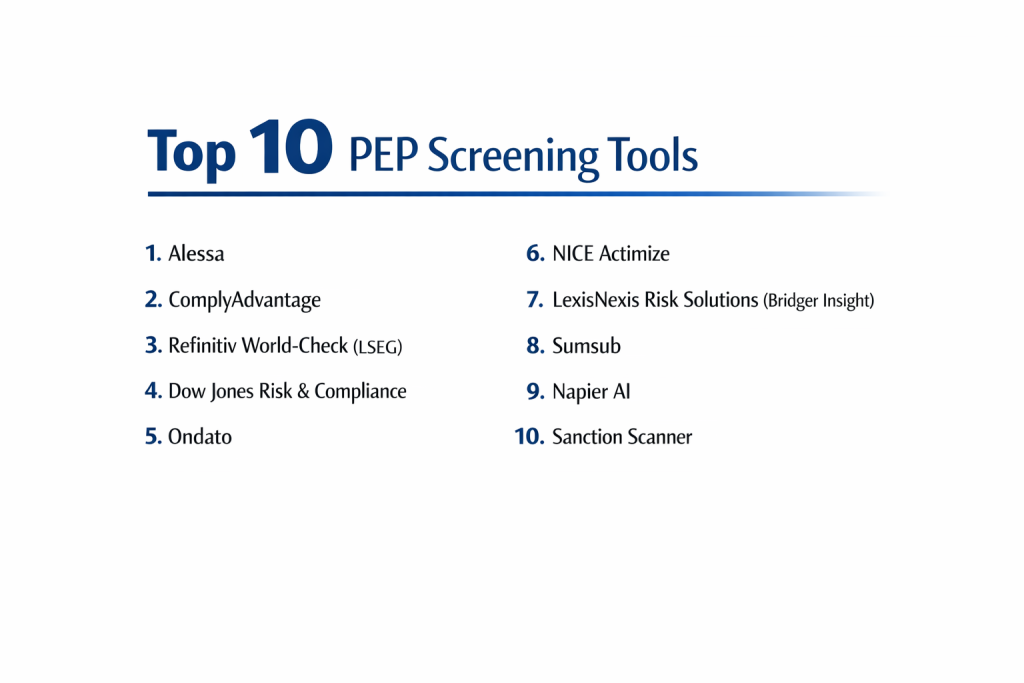
Top 10 PEP Screening Tools
1 — Alessa
Alessa is a top-ranked, all-in-one AML platform known for its intelligent design and cost-efficiency. It specializes in transforming complex data into actionable risk intelligence for banks and MSBs.
Key features:
- Proprietary PEP Scoring: Evaluates geography, role, and relationship types to provide a nuanced risk score rather than a simple “yes/no” flag.
- Natural Language Processing (NLP): Advanced AI that understands the context of a match to reduce false alarms.
- Real-Time Integration: Screens customers during onboarding and provides continuous monitoring post-onboarding.
- Crypto Exchange Monitoring: Includes screening against 600+ crypto exchanges for broader financial crime detection.
- Audit-Ready Reporting: Generates detailed case reports that meet the highest regulatory standards.
Pros:
- Highly configurable workflows allow teams to tailor the tool to their specific risk appetite.
- Excellent at reducing false positives through sophisticated “fuzzy matching” algorithms.
Cons:
- The initial configuration can be complex for very small teams without dedicated IT support.
- Performance can depend heavily on the quality of the initial customer data provided.
Security & compliance: SOC 2 Type II, GDPR compliant, and features robust encryption for data at rest and in transit.
Support & community: Offers dedicated customer success managers, 24/7 global technical support, and extensive online training modules.
2 — ComplyAdvantage
ComplyAdvantage is a modern, AI-native leader that provides a real-time database of people and companies to help firms manage their financial crime risks with high speed.
Key features:
- Dynamic Risk Data: Global PEP lists are updated in real-time, catching status changes as they happen.
- API-First Design: Designed specifically for seamless integration into modern tech stacks and mobile apps.
- Adverse Media Integration: Links PEP profiles directly to real-time news stories for a 360-degree view.
- RCA Mapping: Automatically identifies and maps out family members and close associates of PEPs.
- Developer-Friendly Documentation: Clear, well-structured API guides that make implementation fast.
Pros:
- The “instant-on” nature of their cloud database means you don’t have to wait for batch updates.
- One of the most intuitive user interfaces in the compliance market.
Cons:
- Pricing can be higher than traditional “batch” tools due to its real-time nature.
- Some users may find the sheer volume of data “too much” without aggressive tuning of risk filters.
Security & compliance: ISO 27001, SOC 2, and compliant with global AML/CTF regulations.
Support & community: Responsive developer support, active LinkedIn community, and regular industry insight reports.
3 — Refinitiv World-Check (LSEG)
Refinitiv World-Check, now part of the London Stock Exchange Group, remains the “gold standard” for institutional-grade PEP and sanctions data.
Key features:
- Massive Global Database: Contains millions of structured profiles spanning PEPs, RCAs, and sanctioned individuals.
- World-Check One: A unified platform for screening, remediation, and audit trail management.
- UBO Identification: Deep capability in identifying Ultimate Beneficial Owners in complex corporate structures.
- High-Integrity Data: Profiles are curated by a global team of researchers to ensure extreme accuracy.
- Specialized Tiers: Categorizes PEPs into specific risk tiers (e.g., Tier 1 for heads of state, Tier 4 for local officials).
Pros:
- The most widely accepted database by global regulators; using World-Check carries high “credibility” during audits.
- Exceptional coverage of non-English speaking jurisdictions and local political roles.
Cons:
- The legacy platform can feel slower and more “clunky” than modern SaaS startups.
- Implementation typically requires a longer timeline and more manual data mapping.
Security & compliance: Bank-grade security, ISO 27001, and SOC 2 compliant.
Support & community: Global enterprise support network, physical offices in major financial hubs, and a massive user base.
4 — Dow Jones Risk & Compliance
Dow Jones leverages its world-class news and research heritage to provide a highly accurate, human-curated PEP and risk database.
Key features:
- Human-Verified Content: Unlike “scraper” tools, Dow Jones researchers manually verify profile updates.
- Sanctions Ownership Research: Specifically tracks entities owned by sanctioned PEPs (the “50% Rule”).
- Rich Biographic Data: Profiles often include photographs, dates of birth, and detailed political histories.
- Adverse Media Classification: Categorizes news by risk type (e.g., financial crime, corruption) for faster review.
- Global Sanctions Alerts: Real-time push notifications when a PEP is added to a major government watchlist.
Pros:
- The highest data integrity in the market, leading to fewer false positives based on “bad data.”
- Excellent for Enhanced Due Diligence (EDD) where deep biographic details are required.
Cons:
- Often considered one of the more expensive options in the category.
- Primary focus is on the data feed; users may need an external platform for case management.
Security & compliance: ISO 27001, GDPR compliant, and strict data privacy protocols.
Support & community: Premier client service for enterprise accounts and access to a global network of risk experts.
5 — Ondato
Ondato is a rapidly rising European RegTech provider that offers a comprehensive “onboarding-plus-compliance” platform favored by high-growth fintechs.
Key features:
- Ondato OS: A unified hub for identity verification, PEP screening, and document checks.
- 3-Hour Refresh Cycle: One of the fastest list-update cycles in the industry to catch recent political shifts.
- AI Rangers: Specialized “bots” that automatically scan and report on suspicious matches in seconds.
- No-Code Rule Builder: Allows compliance officers to adjust matching logic without needing an IT developer.
- Biometric Integration: Connects PEP screening directly to liveness and face-match checks.
Pros:
- Streamlines the entire customer journey from ID verification to ongoing PEP monitoring in one tool.
- Very fast time-to-market; can be up and running in a matter of days.
Cons:
- Newer to the market compared to giants like Dow Jones, so it may have less historical data.
- Focus is primarily on digital onboarding; might lack depth for complex manual trade investigations.
Security & compliance: SOC 2 Type II, ISO 27001, and fully compliant with EU AMLD6 directives.
Support & community: Excellent onboarding documentation and a highly responsive customer success team.
6 — NICE Actimize
NICE Actimize is the market leader for enterprise-scale financial crime prevention, used by many of the world’s largest investment banks.
Key features:
- X-Sight Cloud: A cloud-native platform for AI-powered screening and autonomous investigations.
- Entity Resolution: Uses graph technology to find hidden links between customers and known PEPs.
- Watchlist Filtering (WLF): A high-performance engine capable of processing millions of transactions in real-time.
- Behavioral Analytics: Learns from past investigator decisions to automatically clear future false positives.
- Global Regulatory Content: Pre-configured to meet the specific mandates of hundreds of global jurisdictions.
Pros:
- Incredible scalability for organizations with massive datasets and complex operations.
- Offers a “single pane of glass” for all AML, fraud, and PEP compliance needs.
Cons:
- Significant cost and implementation complexity make it inaccessible for most SMEs.
- The feature set can be overwhelming for teams looking for a simple, single-purpose tool.
Security & compliance: Federal-grade security standards, SOC 1/2, ISO 27001, and HIPAA compliant.
Support & community: Extensive professional services, global 24/7 support, and a robust annual user conference.
7 — LexisNexis Risk Solutions (Bridger Insight)
LexisNexis is a global data giant whose Bridger Insight XG platform is a staple for mid-market and enterprise compliance teams.
Key features:
- World-Check Data Integration: Leverages high-quality data within a proprietary investigative interface.
- Batch Screening: Highly efficient at screening massive legacy databases in a single run.
- Risk-Based Scoring: Sophisticated algorithms to categorize matches into low, medium, or high risk.
- Integrated ID Verification: Seamlessly combines physical identity checks with PEP/Sanctions screening.
- Workflow Automation: Automates the “remediation” process, documenting why a match was cleared.
Pros:
- A very stable, proven platform with a massive track record in the financial industry.
- Combines public records and legal data with standard PEP lists for a deeper view.
Cons:
- User experience can feel somewhat “legacy” compared to newer SaaS competitors.
- API documentation is functional but can be difficult for modern developers to navigate quickly.
Security & compliance: ISO 27001, SOC 2, and adheres to strict global data residency requirements.
Support & community: Extensive library of documentation and dedicated regional support teams.
8 — Sumsub
Sumsub has become a favorite in the crypto and “gig economy” spaces due to its developer-first approach and lightning-fast verification.
Key features:
- Customizable Onboarding Flows: Drag-and-drop builder to insert PEP checks anywhere in the user journey.
- Global Watchlist Coverage: Access to UN, EU, OFAC, and local lists for 220+ countries.
- One-Click Case Management: A modern, Kanban-style view for reviewing flagged PEP matches.
- Travel Rule Solution: Specialized tools for crypto firms to meet “Travel Rule” requirements alongside PEP screening.
- Automated EDD: Automatically triggers extra questions or document requests if a PEP match is found.
Pros:
- Exceptional speed; most PEP and sanctions checks are completed in under 60 seconds.
- Very competitive, transparent pricing model for startups.
Cons:
- The “all-in-one” nature means it may lack the deep, niche features of a dedicated enterprise engine.
- Support can be more “self-service” focused for lower-tier accounts.
Security & compliance: GDPR compliant, SOC 2, and localized compliance settings for 220+ jurisdictions.
Support & community: Helpful online “Compliance Academy” and 24/7 chat-based technical support.
9 — Napier AI
Napier AI is a modern “Intelligent Compliance” platform that emphasizes agile, cloud-native deployment and human-AI collaboration.
Key features:
- Sandbox Environment: Unique feature allowing you to test rule changes against historical data before going live.
- Intelligent Screening: Employs machine learning to learn your firm’s specific “false positive” patterns.
- Explainable AI: Provides clear, human-readable reasons for why a specific PEP match was flagged.
- Low-Code Rules Engine: Empowers compliance officers to build and deploy complex risk models without IT.
- Rapid Deployment: Cloud-first architecture allows for faster implementation than legacy systems.
Pros:
- The “Sandbox” feature is a massive time-saver for refining screening accuracy.
- Designed with modern compliance officers in mind; it’s intuitive and visually helpful.
Cons:
- Being a high-growth scale-up, it may not have the same breadth of global physical support offices as Oracle or IBM.
- Advanced features are mostly geared toward larger, more technical organizations.
Security & compliance: ISO 27001, SOC 2, and designed for GDPR “right to be forgotten” protocols.
Support & community: High-touch implementation support and a growing community of modern compliance professionals.
10 — Sanction Scanner
Sanction Scanner is a nimble, cost-effective provider that has gained traction by making high-level AML and PEP screening accessible to SMBs.
Key features:
- Real-Time Global Database: Access to 3,000+ watchlists and PEP databases in real-time.
- Adverse Media Screening: Tracks negative news to provide a more holistic risk score.
- Simple API/Web Interface: Users can screen names manually in a web portal or integrate via a simple API.
- Batch Screening: Efficiently handles large-scale periodic re-screening for small to medium databases.
- Affordable Pricing: Specifically designed for firms that need compliance without the million-dollar price tag.
Pros:
- Probably the easiest “entry-level” tool for a small firm to get compliant today.
- No complex “implementation project” required; you can start screening in minutes.
Cons:
- Lacks the deep “Entity Resolution” and “Graph AI” features of institutional giants.
- Reporting is clean but may not be as “granular” as what a Tier 1 regulator would expect from a major bank.
Security & compliance: ISO 27001, GDPR compliant, and utilizes secure cloud hosting.
Support & community: Friendly, responsive support and a straightforward online knowledge base.
Comparison Table
| Tool Name | Best For | Platform(s) Supported | Standout Feature | Rating |
| Alessa | Unified AML/Compliance | Cloud / Hybrid | Context-Driven PEP Scoring | 4.7 |
| ComplyAdvantage | Fintechs & High-Growth | SaaS (API-First) | Real-Time Dynamic Risk Data | 4.6 |
| Refinitiv (LSEG) | Tier 1 Banks / Institutions | Cloud / On-Prem | Tiered PEP Categorization | 4.5 |
| Dow Jones | Deep Due Diligence (EDD) | SaaS / Data Feed | 100% Human-Verified Data | 4.4 |
| Ondato | SME / Digital Onboarding | SaaS (Cloud) | 3-Hour Update Frequency | 4.8 |
| NICE Actimize | Massive Enterprises | On-Prem / Cloud | Graph-Based Entity Resolution | 3.8 |
| LexisNexis | Integrated Risk Programs | Cloud / Hybrid | Bridger Insight XG Engine | 4.4 |
| Sumsub | Crypto & Neobanks | SaaS (Cloud) | All-in-One KYC Journey | 4.7 |
| Napier AI | AI-Forward Teams | Cloud (SaaS) | Sandbox Testing Environment | N/A |
| Sanction Scanner | Budget-Conscious SMBs | Web / API | Extreme Ease of Use | 4.7 |
Evaluation & Scoring of PEP Screening Tools
| Criterion | Weight | Evaluation Focus |
| Core Features | 25% | PEP/RCA depth, fuzzy matching, and real-time updates. |
| Ease of Use | 15% | Dashboard UI, alert remediation speed, and manual search speed. |
| Integrations | 15% | API quality, pre-built CRM connectors, and developer docs. |
| Security & Compliance | 10% | SOC 2/ISO status, encryption, and audit trail quality. |
| Performance | 10% | Latency of checks and accuracy of matching (low false positives). |
| Support | 10% | Account management, 24/7 help, and training availability. |
| Price / Value | 15% | Cost vs. features and operational time savings. |
Which PEP Screening Tool Is Right for You?
Solo Users vs SMB vs Mid-Market vs Enterprise
Solo practitioners (like independent auditors or lawyers) and SMBs should look at Sanction Scanner or Sumsub. These tools provide the necessary “checkbox” compliance at an affordable price with almost zero implementation time. Mid-Market firms with more complex risks are better served by Alessa or Ondato, which offer more robust case management. Enterprises and multi-national banks will almost certainly require NICE Actimize, Refinitiv, or LexisNexis to handle their volume and regulatory complexity.
Budget-Conscious vs Premium Solutions
If Budget is your primary concern, Sanction Scanner and Sumsub offer transparent, “pay-as-you-go” or low-tier subscription models. If you are a Premium institution where the “Source of Wealth” of your clients is a massive legal risk, the high cost of Dow Jones or Refinitiv data is an essential investment to avoid billion-dollar fines.
Feature Depth vs Ease of Use
For Ease of Use, Ondato and Sumsub are the clear winners; you don’t need to be a “compliance engineer” to use them. For Feature Depth, Napier AI and Actimize offer the most advanced technology (like sandbox testing and behavior modeling), but they require a more technical team to manage effectively.
Integration and Scalability Needs
If you need to Integrate into a custom mobile app or web platform, ComplyAdvantage is the developer’s choice. For Scalability, if you need to re-screen 100 million customers every single night without the system crashing, NICE Actimize or Oracle are the proven workhorses of the industry.
Security and Compliance Requirements
While all listed tools are secure, firms with high Security and Data Residency requirements (where data must stay in a specific country) should look at Alessa or NICE Actimize, as they offer hybrid or on-premise installation options that pure SaaS tools cannot match.
Frequently Asked Questions (FAQs)
What is the difference between a PEP and an RCA?
A PEP is the individual in power (e.g., a Minister). An RCA (Relative or Close Associate) is someone connected to them, like a spouse, child, or business partner, who might be used to hide illicit funds.
How often should I re-screen my customers?
Regulators typically expect “continuous monitoring,” but at a minimum, high-risk customers should be re-screened daily or whenever a major global election or political shift occurs.
Can these tools tell me if a person is “no longer” a PEP?
Yes. Modern databases track “former PEPs.” However, many regulations require you to treat someone as a PEP for 12–24 months after they leave office.
What is “Fuzzy Matching”?
It’s a technology that identifies names that are similar but not identical (e.g., “Jon Smith” vs “John Smyth”). This is vital for catching typos or deliberate attempts to evade screening.
Do I have to stop doing business with someone if they are a PEP?
No. Being a PEP is not a crime. It simply means you must perform “Enhanced Due Diligence” (EDD) to ensure their funds are legitimate.
Can these tools help with “Adverse Media”?
Most top-tier tools (like ComplyAdvantage and Dow Jones) integrate real-time news to see if a PEP has recently been accused of a crime, even if they aren’t on a sanctions list yet.
How do these tools handle different languages?
Advanced tools use “phonetic matching” and transliteration to find names across different alphabets (Cyrillic, Arabic, Chinese, etc.) to ensure nothing is missed.
Is my customer data safe with these vendors?
Yes, provided you choose vendors with SOC 2 or ISO 27001 certification. They use bank-level encryption to ensure your customer PI (Personally Identifiable Information) is protected.
What happens if I miss a PEP match?
You can face heavy fines from regulators like the FCA or FinCEN. Additionally, your banking partners may refuse to work with you if they feel your compliance is weak.
How long does it take to implement a PEP screening tool?
Simple SaaS tools can be integrated via API in a few days. Enterprise-wide systems for large banks can take 6 months to a year to fully configure and test.
Conclusion
The selection of a PEP Screening Tool is no longer just a “check-the-box” activity for compliance departments. it is a critical component of a firm’s operational resilience and reputation management. Whether you are a small fintech looking for the agility of ComplyAdvantage or a global bank relying on the institutional weight of Refinitiv, the goal remains the same: to act with clarity and confidence in an increasingly complex world.
The “best” tool is the one that aligns with your specific volume, technical capabilities, and risk appetite. By investing in a solution that minimizes false positives while ensuring global data coverage, you aren’t just meeting a regulation—you are protecting your business from the profound risks of the modern financial era.