Introduction
Trade Surveillance Systems are specialized software platforms that monitor financial trading activity to detect potential market abuse, fraud, and regulatory violations. They act as the “compliance police” for financial markets, using complex algorithms and rules to analyze every order and trade, searching for suspicious patterns like insider trading, spoofing, or market manipulation. Think of them as a sophisticated, real-time monitoring system that listens to every conversation on the trading floor (digital or physical) and flags anything that sounds illegal or unethical.
This software is critically important because financial regulators worldwide (like the SEC, FCA, and MAS) mandate that financial institutions have effective surveillance in place. The consequences of failure are severe: multi-million (or billion) dollar fines, criminal charges, and irreparable reputational damage. Beyond compliance, these systems protect the integrity of markets and ensure a level playing field for all participants. Real-world use includes a bank monitoring its equity traders for signs of front-running client orders, a broker-dealer detecting potential spoofing in the futures market, or an asset manager ensuring its traders are not engaging in insider trading ahead of corporate announcements.
When choosing a tool, you should look for: coverage of relevant asset classes (equities, FX, fixed income, derivatives), the sophistication of its detection scenarios (pre-built and customizable), data integration capabilities, investigation and case management workflows, reporting tools for regulators, and scalability to handle your trade volume.
Best for: These systems are essential for Chief Compliance Officers, Surveillance Analysts, Heads of Trading, and Risk Managers. They are mandatory for banks, broker-dealers, asset managers, hedge funds, proprietary trading firms, and exchanges—any regulated entity that executes trades in financial markets.
Not ideal for: A very small investment advisor with no trading desk, who only places orders through third-party brokers, likely relies on the broker’s surveillance. A non-financial company with no market-facing trading activity has no need for this specialized software. It is a regulatory necessity for active trading entities.
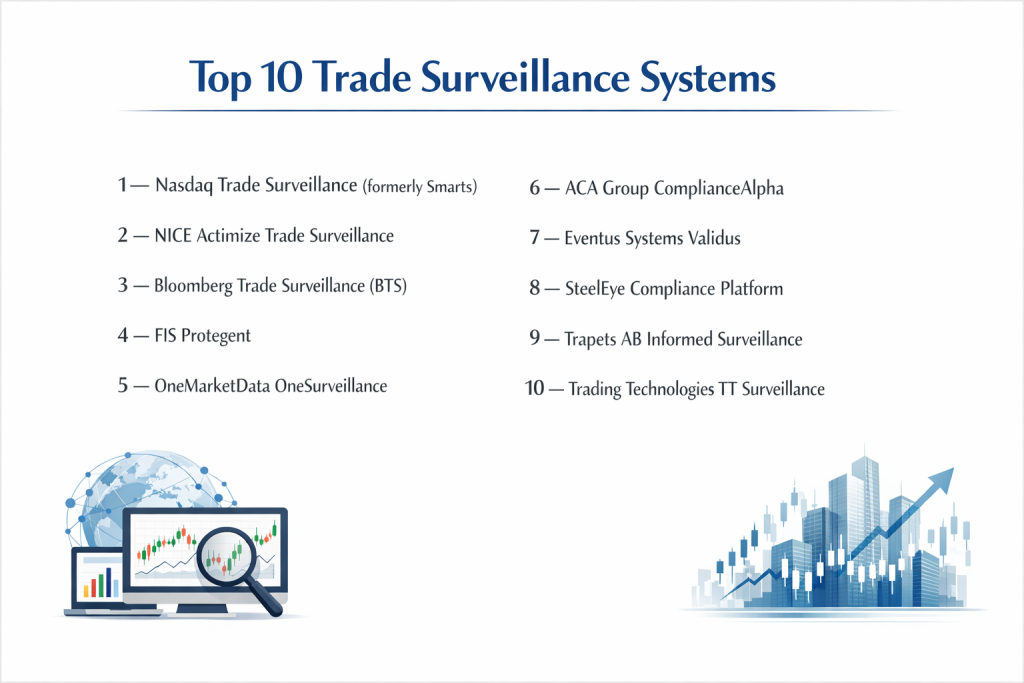
Top 10 Trade Surveillance Systems
1 — Nasdaq Trade Surveillance (formerly Smarts)
Nasdaq Trade Surveillance (previously known as Smarts) is one of the most widely deployed surveillance platforms globally. It’s known for its powerful, behavior-based analytics and is used by many of the world’s largest exchanges and regulators themselves.
Key features:
- Behavioral Detection Models: Goes beyond simple rules to analyze trader intent and patterns of activity over time.
- Multi-Asset Class Coverage: Strong across equities, derivatives, FX, fixed income, and commodities.
- Market-Wide Surveillance: Unique capability to analyze cross-market and cross-product manipulation (e.g., equities vs. options).
- Visual Investigation Tools: Link analysis charts and timelines to visualize relationships between entities, accounts, and trades.
- Integrated Communications Surveillance: Can correlate trade alerts with voice, chat, and email data (often via partnership).
- Regulatory Technology Provider: Used by over 50 market regulators, lending credibility.
Pros:
- The gold standard for detection sophistication, particularly for market manipulation.
- Unparalleled pedigree and trust, having been adopted by major exchanges.
- Powerful visualization tools that help investigators understand complex abuse.
Cons:
- Can be expensive, with costs often suited for larger institutions.
- The depth of features can mean a steeper learning curve for new analysts.
- Implementation and configuration can be a significant project.
Security & compliance: Enterprise-grade security. The platform is designed to meet the highest global regulatory standards (MiFID II, MAR, MAS, etc.).
Support & community: Supported by Nasdaq’s global professional services. Has a large user community among top-tier banks and exchanges.
2 — NICE Actimize Trade Surveillance
NICE Actimize is a giant in financial crime and compliance. Its trade surveillance solution is part of a broader suite, offering the advantage of a unified platform for surveillance, AML, and fraud.
Key features:
- Holistic Surveillance Suite: Part of the NICE Actimize FRM (Financial Markets Risk) suite, allowing correlation between trade data, communications, and conduct risk.
- Advanced AI & Machine Learning: Uses supervised and unsupervised ML to detect novel, emerging patterns of abuse.
- Pre-Post Trade Integration: Monitors orders (pre-trade) and executions (post-trade) for a complete view of intent and outcome.
- Cloud-Native SaaS Offering: Available as a scalable, managed service (Actimize Cloud).
- Extensive Library of Scenarios: Hundreds of pre-built detection scenarios for global regulations.
- Case Manager & Workflow: Robust tools for alert triage, investigation, audit trails, and reporting.
Pros:
- Powerful AI/ML capabilities that reduce false positives and find complex patterns.
- Significant advantage of integration with communications and AML surveillance.
- Scalable cloud option reduces IT burden and offers operational flexibility.
Cons:
- As part of a massive suite, it can be complex to navigate and may include more than some firms need.
- Pricing for the full integrated suite can be substantial.
- Some users note that the user interface could be more modern and intuitive.
Security & compliance: Cloud platform with SOC 2, ISO 27001 certifications. Compliant with global financial regulations.
Support & community: Global 24/7 support and professional services from one of the largest vendors in the space.
3 — Bloomberg Trade Surveillance (BTS)
Bloomberg Trade Surveillance leverages the ubiquitous Bloomberg ecosystem. It’s a natural, integrated choice for firms already deeply embedded in the Bloomberg Terminal for data, news, and trading.
Key features:
- Deep Bloomberg Data Integration: Seamlessly ingests trade and order data from Bloomberg execution platforms (TOTL, PORT, AES) and the Bloomberg Vault for communications.
- Unified Compliance Workstation: Surveillance alerts, communications review, and compliance tools can be accessed within the familiar Bloomberg Terminal interface.
- Bloomberg Intelligence & News Context: Alerts can be enriched with relevant news and research from Bloomberg, aiding investigations.
- Pre-Trade Surveillance: Real-time checks against compliance rules before orders are executed.
- Coverage for Key Asset Classes: Strong for fixed income, FX, and derivatives traded via Bloomberg.
- Regulatory Change Management: Bloomberg’s regulatory teams help update scenarios for new rules.
Pros:
- Extremely efficient integration for firms that trade and communicate primarily on Bloomberg.
- Reduces data aggregation headaches by using a single, trusted vendor for market data and surveillance.
- Provides valuable contextual data (news) directly within the investigation workflow.
Cons:
- Best for Bloomberg-centric shops; integrating non-Bloombrook data streams can be less seamless.
- Part of the expensive Bloomberg ecosystem, adding to the overall cost.
- May offer less flexibility for highly customized, proprietary detection logic than best-of-breed platforms.
Security & compliance: Inherits the high-security standards of the Bloomberg network and data centers. Widely accepted by regulators.
Support & community: Supported by Bloomberg’s dedicated compliance specialists and help desk.
4 — FIS Protegent
FIS Protegent is a comprehensive trade surveillance and compliance platform, particularly strong in the wealth and asset management space. It offers a balance of surveillance, compliance testing, and reporting.
Key features:
- Tailored for Asset & Wealth Managers: Scenarios and workflows designed for issues like best execution, client suitability, and allocation fairness.
- Integrated Compliance Testing: Tools for testing adherence to internal rules, regulatory limits, and client mandates.
- Personal Trading & Conflicts Monitoring: Monitors employee personal account trading for conflicts of interest.
- Client Reporting & Transparency: Helps generate reports for clients on best execution and trade activity.
- Data Aggregation & Normalization: Strong tools for pulling in data from multiple, disparate sources (brokers, custodians, OMS).
- Rule Builder: Allows compliance teams to build and modify surveillance rules without heavy IT support.
Pros:
- Excellent fit for the specific surveillance needs of buy-side firms (e.g., best execution, Reg BI).
- Good balance of surveillance and broader compliance management functionality.
- Often more accessible and configurable for compliance teams at mid-sized firms.
Cons:
- May lack the ultra-low-latency, high-frequency trading (HFT) focus of systems built for sell-side market makers.
- The user interface is functional but can feel dated compared to newer cloud platforms.
- Part of a larger FIS ecosystem, which can influence product direction.
Security & compliance: Enterprise security standards. Focused on buy-side regulatory requirements like MiFID II, SEC rules.
Support & community: Supported by FIS’s global financial services organization.
5 — OneMarketData OneSurveillance
OneMarketData specializes in high-performance data management for quantitative finance. Its OneSurveillance platform is built on this foundation, targeting low-latency surveillance for high-frequency and algorithmic trading.
Key features:
- Ultra-Low Latency Analytics: Built on the high-performance OneTick data platform, capable of analyzing massive tick data in real-time.
- Focus on Algorithmic & HFT Surveillance: Detection scenarios tailored for layering, spoofing, momentum ignition, and other electronic trading abuses.
- Custom Scenario Development: Powerful tools for quants and developers to build proprietary, complex surveillance models.
- Comprehensive Tick Data Replay: Ability to replay market data to test new scenarios or investigate past events with precision.
- Flexible Deployment: Can be deployed on-premise, in the cloud, or as a managed service.
- Strong Data Management: Handles normalized data from any source.
Pros:
- The performance leader for firms that need to surveil high-volume, algorithmic trading.
- Unmatched flexibility for firms that want to build their own sophisticated detection logic.
- Excellent for investigating market microstructure abuse.
Cons:
- Requires significant technical expertise (quant/developer) to leverage its full customizability.
- Can be overkill for a firm with only manual or low-frequency trading.
- Less focus on integrated communications surveillance out-of-the-box.
Security & compliance: Can be configured for secure, auditable environments. The focus is on the performance and accuracy of the detection engine.
Support & community: Support is geared towards technically sophisticated users and developers.
6 — ACA Group ComplianceAlpha
ACA Group is a leading consulting and managed services firm. Its ComplianceAlpha platform is a cloud-based, integrated compliance management system that includes trade surveillance as a core module.
Key features:
- Unified Compliance Platform: Trade surveillance is integrated with portfolio compliance, personal trading, marketing review, and regulatory filing workflows.
- Managed Services & Expert Support: Can be paired with ACA’s expert compliance consultants for alert review, tuning, and program management.
- Cloud-Native & Configurable: Modern SaaS platform that business users can configure without coding.
- Designed for Investment Advisers & Funds: Built with the SEC, CFTC, and global hedge fund/private equity regulations in mind.
- Vendor-Agnostic Data Integration: Pulls in data from any OMS, broker, or administrator.
- Transparency & Reporting: Clear dashboards and tools for reporting to management and regulators.
Pros:
- Ideal for firms that want to outsource surveillance expertise or tightly integrate it with other compliance functions.
- The managed service option reduces the burden on internal compliance teams.
- Modern, user-friendly interface designed for compliance professionals, not developers.
Cons:
- The detection engine may not be as deeply customizable or high-frequency focused as pure-play surveillance vendors.
- The value is in the platform+service combination; the software alone may be less differentiated.
- Primarily targeted at the buy-side, not sell-side trading desks.
Security & compliance: Cloud platform with robust security (SOC 2). The company itself is a regulated compliance consultancy.
Support & community: Support is deeply tied to ACA’s client success and consulting teams.
7 — Eventus Systems Validus
Eventus Validus is a modern, AI-powered trade surveillance platform known for its ease of use, rapid deployment, and competitive pricing. It targets firms of all sizes looking for an effective, agile solution.
Key features:
- AI-Driven Alert Prioritization: Uses machine learning to rank alerts by true risk, dramatically reducing false positives.
- Rapid Time-to-Value: Can be implemented and live in weeks, not months, due to its cloud-native architecture.
- Multi-Asset Coverage: Covers equities, options, futures, FX, fixed income, and digital assets/crypto.
- Intuitive Visual Case Manager: Clean, modern interface for investigators to review alerts and link related activity.
- Comprehensive API Library: Easy integration with OMS, EMS, brokers, and communications systems.
- Transparent Pricing: Simple, all-inclusive pricing model based on message volume.
Pros:
- Excellent user experience and a focus on making surveillance efficient for analysts.
- Fast, low-friction implementation and onboarding process.
- Strong value proposition, particularly for mid-market firms and those in emerging asset classes like crypto.
Cons:
- As a younger company, it has a shorter track record than legacy giants like Nasdaq or Actimize.
- May lack some of the extreme depth of pre-built scenarios for niche products or regions.
- The focus on ease of use may mean less granular control for hardcore quant developers.
Security & compliance: Cloud-native with SOC 2 Type II, ISO 27001 certifications. Meets key global regulatory standards.
Support & community: Known for responsive, high-touch customer support and success management.
8 — SteelEye Compliance Platform
SteelEye is a data-first, integrated surveillance platform built in the cloud from the ground up. It consolidates trade, communications, and voice data into a single analytics engine for holistic surveillance.
Key features:
- Fully Integrated Data Lake: Ingests and correlates trades, emails, chats (Bloomberg, Teams, Slack), voice calls, and voice recordings in one place.
- Behavioral Analytics Across Channels: Detects suspicious patterns by analyzing language in communications alongside trading activity.
- Regulatory Recordkeeping: Provides compliant, immutable storage for all communications data, solving the recordkeeping requirement alongside surveillance.
- Automated Regulatory Reporting: Can automate the generation and filing of certain regulatory reports (e.g., MiFID II RTS 6).
- Cloud-Native & Scalable: Built as a modern, multi-tenant SaaS application.
- Focus on Holistic Conduct Risk: Looks at the complete picture of employee conduct.
Pros:
- Leading platform for truly integrated trade and communications surveillance (TMS).
- Solves both surveillance and recordkeeping challenges with one platform.
- Modern architecture designed for the complexity and volume of today’s multi-channel communications.
Cons:
- The integrated approach requires bringing all data into one platform, which can be a significant project.
- Pricing reflects the broad value of combined surveillance and recordkeeping.
- May be more than needed for a firm that already has a communications surveillance solution in place.
Security & compliance: Cloud platform with strong encryption, based in compliant jurisdictions (UK, US). Meets MiFID II, SEC, CFTC requirements.
Support & community: Dedicated customer success and implementation teams.
9 — Trapets AB Informed Surveillance
Trapets, based in Sweden, is a long-standing specialist in surveillance, particularly well-regarded in the Nordic region and for market operators. Its Informed Platform is used by multiple European exchanges and trading venues.
Key features:
- Exchange & MTF Surveillance Specialization: Deep expertise in monitoring trading venues for disorderly trading and market manipulation.
- Real-Time Pre-Trade Controls: Powerful tools for enforcing price collars, order size limits, and other market rules in real-time.
- Multi-Jurisdictional Rule Sets: Pre-configured for regulations across Europe, Asia, and other regions.
- Market Abuse Regulation (MAR) Focus: Strong suite of detection scenarios specifically for the EU’s MAR.
- Visual Pattern Recognition: Tools to identify classic chart-based manipulation patterns.
- Proven Track Record: Used by numerous regulated markets and authorities.
Pros:
- A trusted, specialist vendor with deep expertise in exchange-level surveillance.
- Very strong in real-time, pre-trade risk and controls.
- Reliable and robust system with a long history in the market.
Cons:
- Less visible in the large global investment bank space compared to Nasdaq or Actimize.
- Brand recognition is strongest in Europe.
- May not market its cloud capabilities as aggressively as newer pure-SaaS vendors.
Security & compliance: High-security standards suitable for exchanges and regulators. Compliant with EU regulations like MAR.
Support & community: Strong regional support in Europe, with a loyal user base among exchanges and brokers.
10 — Trading Technologies TT Surveillance
Trading Technologies (TT) is best known as a leading futures and derivatives trading platform. Its TT Surveillance module is a natural extension, offering tightly integrated surveillance for firms trading on the TT platform.
Key features:
- Native Integration with TT Platform: Seamlessly monitors all order and trade activity from the TT trading application with zero extra integration.
- Real-Time Alerts: Provides surveillance alerts in real-time to compliance officers within the TT ecosystem.
- Futures & Derivatives Focus: Scenarios optimized for detecting abuse in global futures, options, and swaps markets.
- Customizable Dashboards: Compliance officers can build custom views of trader activity and alerts.
- Trade Replay: Functionality to replay trading sessions for investigation.
- Cost-Effective for TT Clients: Adds surveillance capability with minimal additional infrastructure for existing TT users.
Pros:
- The simplest, most integrated solution for firms that execute primarily on the TT platform.
- Real-time alerting allows for potential intervention before a violation is complete.
- Leverages existing TT infrastructure and relationship.
Cons:
- Only effective for monitoring trading done through TT; other execution channels require separate surveillance.
- A niche solution compared to multi-asset, multi-channel enterprise platforms.
- Detection library may be narrower than best-of-breed standalone systems.
Security & compliance: Part of the secure TT trading infrastructure. Meets baseline requirements for broker-dealers.
Support & community: Supported by TT’s existing client support channels.
Comparison Table
| Tool Name | Best For (target user or scenario) | Platform(s) Supported | Standout Feature | Rating |
|---|---|---|---|---|
| Nasdaq Trade Surveillance | Exchanges, top-tier banks, and firms needing the most sophisticated, behavior-based detection. | On-premise, Cloud, SaaS | Behavioral Analytics & Market-Wide Surveillance | High (Market Leader) |
| NICE Actimize Trade Surveillance | Large financial institutions wanting an integrated AI-driven suite (surveillance, comms, AML). | Cloud (SaaS), On-premise | Integrated Financial Crime Suite & Advanced AI/ML | High |
| Bloomberg Trade Surveillance | Firms deeply embedded in the Bloomberg ecosystem for trading, data, and communications. | Integrated with Bloomberg Terminal | Deep Native Bloomberg Data & Workflow Integration | High |
| FIS Protegent | Asset managers, wealth managers, and buy-side firms focused on best execution and compliance testing. | On-premise, Cloud | Buy-Side Specialization & Integrated Compliance Testing | High |
| OneMarketData OneSurveillance | High-frequency trading firms and quants needing ultra-low-latency surveillance of algorithmic trading. | On-premise, Cloud, Managed | High-Performance Analytics for HFT & Custom Model Development | Medium/High |
| ACA Group ComplianceAlpha | Investment advisers and funds seeking a cloud compliance platform with optional managed services. | Cloud (SaaS) | Integrated Compliance Platform + Managed Services Option | Medium/High |
| Eventus Systems Validus | Firms of all sizes wanting a modern, AI-powered, user-friendly platform with fast implementation. | Cloud (SaaS) | AI-Powered Alert Prioritization & Rapid Deployment | Medium/High |
| SteelEye Compliance Platform | Firms needing a fully integrated solution for trade AND multi-channel communications surveillance. | Cloud (SaaS) | Fully Integrated Trade & Comms Surveillance Data Lake | Medium/High |
| Trapets AB Informed Surveillance | Trading venues (exchanges, MTFs) and European brokers needing strong pre-trade controls. | On-premise, Cloud | Exchange-Level Surveillance & Real-Time Pre-Trade Controls | Medium/High |
| Trading Technologies TT Surveillance | Firms that execute their derivatives trading primarily on the TT platform. | Integrated with TT Platform | Native, Real-Time Surveillance for TT Platform Users | Medium (Niche) |
Evaluation & Scoring of Trade Surveillance Systems
Score tools (1-10) using this rubric. Multiply by the weight to get a total score out of 100.
| Evaluation Category | Weight | What to Look For |
|---|---|---|
| Core Features | 25% | Detection scenario sophistication (pre-built/custom), multi-asset coverage, real-time vs. T+1, investigation workflow tools, reporting. |
| Ease of Use | 15% | Intuitiveness of alert review interface, efficiency of case management, clarity of visualizations, ease of configuring rules/alerts. |
| Integrations & Ecosystem | 15% | Ease of ingesting data from your OMS/EMS, brokers, and communications archives; API quality; pre-built connectors. |
| Security & Compliance | 10% | Data encryption, audit trail completeness, user access controls, and the platform’s acceptance by your primary regulators. |
| Performance & Reliability | 10% | Ability to handle your message/ trade volume without latency, system uptime, scalability during peak market events. |
| Support & Community | 10% | Quality of implementation help, responsiveness of technical support, availability of tuning services, user community for best practices. |
| Price / Value | 15% | Total cost (licensing, implementation, data hosting) relative to the regulatory coverage, risk reduction, and operational efficiency gained. |
Which Trade Surveillance System Tool Is Right for You?
Find the best fit based on your organization’s profile:
- By Organization Type & Trading Activity:
- Large Global Investment Bank / Sell-Side Firm: Nasdaq or NICE Actimize for their depth, scale, and regulator trust. Bloomberg BTS if you are a Bloomberg-centric shop.
- Asset Manager / Hedge Fund / Buy-Side Firm: FIS Protegent or ACA ComplianceAlpha for their buy-side focus. OneMarketData if you are a quant fund.
- High-Frequency / Algorithmic Trading Firm: OneMarketData OneSurveillance for performance, or Eventus Validus for its modern AI approach.
- Exchange / Trading Venue: Nasdaq (used by many peers) or Trapets for specialized venue surveillance.
- Mid-Market Broker-Dealer / Advisory Firm: Eventus Validus (for speed/value), ACA (for platform+service), or FIS Protegent.
- Budget-Conscious vs Premium Solutions:
- Budget-Conscious / Seeking Value: Modern cloud-native platforms like Eventus Validus and SteelEye often offer more predictable pricing and faster ROI than legacy on-premise systems. Consider niche solutions like TT Surveillance if they fit your execution pattern perfectly.
- Premium Solutions: Nasdaq and the full NICE Actimize suite represent top-tier investments where the cost is justified by brand trust, extreme sophistication, and global support.
- Feature Depth vs Ease of Use & Deployment:
- Prioritize Feature Depth/Customization: OneMarketData (for quants), Nasdaq (for behavioral models).
- Prioritize Ease of Use & Fast Deployment: Eventus Validus, ACA ComplianceAlpha, and SteelEye emphasize modern UX and cloud agility.
- Integration and Data Needs:
- If 90%+ of your trading is on Bloomberg, Bloomberg BTS is the most efficient path.
- If you trade futures on TT, TT Surveillance is a logical add-on.
- If you need to correlate trades with complex communications (chat, voice), look at SteelEye or NICE Actimize.
- If you have many data sources, prioritize platforms with strong normalization and aggregation tools (FIS, ACA, Eventus).
- Security and Compliance Requirements:
- All systems must be secure. For global systemically important banks (G-SIBs), the regulatory acceptance of Nasdaq or Actimize is a key factor.
- If you are subject to EU MAR, ensure the vendor has dedicated scenarios and a track record.
- Cloud vs. On-Premise: Regulators now broadly accept secure cloud deployments (SOC 2 certified). This is no longer a major barrier.
Frequently Asked Questions (FAQs)
1. What’s the difference between trade surveillance and communications surveillance?
Trade surveillance analyzes orders and trades. Communications surveillance (or eComms) analyzes emails, chats, and voice for problematic language. Integrated Surveillance (like SteelEye) correlates both to see, for example, a trader chatting about a tip and then trading on it.
2. What is “spoiling” and “layering”?
These are forms of market manipulation. Spoofing is placing large orders with the intent to cancel them before execution to create false supply/demand. Layering is placing multiple non-bona fide orders at different price levels to create a misleading market depth. Surveillance systems look for rapid order entry/cancel patterns to detect this.
3. Do we need real-time surveillance or is end-of-day (T+1) enough?
Real-time allows for potential intervention to prevent a violation and is expected for active trading desks. T+1 is often sufficient for monitoring asset managers for issues like best execution or insider trading. Most firms need a mix: real-time for market manipulation, T+1 for other risks.
4. What are “false positives” and how can we reduce them?
A false positive is an alert that does not indicate true misconduct. They waste investigator time. Reduction methods include: tuning scenario thresholds, using AI/ML to prioritize alerts (like Eventus), and adding market context (was there news?) to filter noise.
5. Can surveillance systems monitor for best execution?
Yes. This is a core function for buy-side systems like FIS Protegent. They analyze if client orders were executed at favorable prices compared to the market, and if order handling processes were fair.
6. How long does implementation typically take?
For a complex, on-premise system at a large bank: 6-12 months. For a modern cloud SaaS platform (Eventus, SteelEye): 4-12 weeks. Time depends on data integration complexity and scenario customization.
7. What is a “surveillance scenario”?
A pre-programmed rule or model that looks for a specific risk. Examples: “Marking the Close” (flipping price at session end), “Front Running” (trading ahead of a known client order), “Wash Trades” (trading with oneself to create false volume).
8. Do we need to keep all our trade data for surveillance?
Yes, regulators require firms to maintain complete, time-sequenced records of all orders and trades (often for 5+ years). The surveillance system both analyzes this data and, in some cases (like SteelEye), can also serve as the compliant recordkeeping repository.
9. Can we build our own surveillance system in-house?
Technically yes, but it’s strongly discouraged. The complexity of detection logic, the need for ongoing regulatory updates, and the resource drain are immense. The regulatory risk of getting it wrong far outweighs the cost of a proven vendor system.
10. What happens when the system generates an alert?
It enters an investigation workflow. An analyst reviews the alert, gathers context (market data, communications), interviews the trader if needed, and makes a determination: false positive, escalate for discipline, or report to regulator. The system should document every step for the audit trail.
Conclusion
Selecting the right Trade Surveillance System is a critical risk management and regulatory imperative, not just an IT purchase. The market offers established giants like Nasdaq for behavioral analytics, integrated suites from NICE Actimize, specialized platforms like OneMarketData for HFT, and agile modern solutions like Eventus Validus. The correct choice is dictated by your trading profile, regulatory footprint, and operational philosophy.
The essential insight is that surveillance is moving from a check-the-box compliance cost to a strategic intelligence function. The best systems do more than just flag potential abuse; they provide insights into trading behavior, improve market quality, and protect the firm’s reputation. Involve compliance, trading, IT, and legal teams in the selection. Prioritize a system that your analysts will actually use effectively, not just one with the longest feature list. In an era of increasing regulatory scrutiny and market complexity, your surveillance platform is a key line of defense—choose a partner that makes that defense both robust and intelligent.