Introduction
A Core Banking System (CBS) is the central processing unit of a financial institution. It is the back-end technology that supports a bank’s most common transactions, acting as the definitive “source of truth” for all financial data. The term “CORE” stands for Centralized Online Real-time Exchange, which perfectly describes its function: managing the opening of new accounts, processing deposits and withdrawals, calculating interest, managing loans, and maintaining the master ledger. In the past, these systems were massive on-premise mainframes that processed data in “batches” overnight. Modern core banking systems, however, are increasingly cloud-native, utilizing microservices to allow for real-time processing and seamless integration with the broader fintech ecosystem via APIs.
The importance of a core banking system cannot be overstated; it is the heartbeat of a bank. Without a high-performing core, a financial institution cannot offer modern services like instant payments or mobile banking. As consumer expectations evolve, the core system determines how quickly a bank can launch new products—such as specialized savings accounts or green finance initiatives. Furthermore, a CBS is the primary tool for regulatory compliance, ensuring that every transaction is logged for Anti-Money Laundering (AML) and “Know Your Customer” (KYC) audits. It reduces operational risk by automating complex calculations and eliminating the manual data entry that often leads to human error.
Key Real-World Use Cases
Core banking systems are utilized across the entire spectrum of financial services to ensure operational stability:
- Retail Deposit Management: Handling millions of checking and savings accounts, ensuring that balances are updated instantly across ATMs, mobile apps, and branches.
- Lending Operations: Automating the lifecycle of a loan, from the initial disbursement to the monthly interest accrual and final payoff.
- Banking-as-a-Service (BaaS): Enabling “neobanks” to launch by providing them with a licensed, secure back-end ledger they can build their apps on.
- Global Remittances: Facilitating the movement of money across borders by integrating with international networks like SWIFT or ISO 20022 messaging.
- Financial Reporting: Automatically generating the balance sheets and regulatory reports required by central banks and government auditors.
What to Look For (Evaluation Criteria)
Selecting a core banking system is a decadel-long commitment. Decision-makers should evaluate vendors based on:
- Architecture Agility: Is the system cloud-native and modular? A “composable” core allows you to swap out specific modules without breaking the entire system.
- API Connectivity: Does the vendor provide a robust set of RESTful APIs? This is critical for connecting to modern digital banking platforms and third-party fintech tools.
- Real-Time Processing: Does the system process transactions the moment they happen, or does it still rely on “end-of-day” batch processing?
- Scalability: Can the system handle a sudden 10x increase in transaction volume during peak shopping holidays or economic shifts?
Best for:
- Retail and Commercial Banks: Who need a reliable, high-volume engine to manage daily customer deposits and loans.
- Credit Unions: Seeking to modernize their member services with mobile-first features and automated interest tracking.
- Fintech Startups: Looking for a cloud-native “ledger-in-a-box” to bring a new financial product to market rapidly.
- Digital Transformation Officers: Tasked with migrating an institution away from 40-year-old legacy mainframes.
Not ideal for:
- Niche Investment Boutiques: That handle very few, highly complex, manual transactions that don’t require a mass-market automated ledger.
- Simple Payment Processors: Who only move money but don’t hold deposits or provide traditional banking products like loans or interest.
- Non-Financial Corporations: Who may need an ERP system for accounting but do not operate as a licensed financial intermediary.
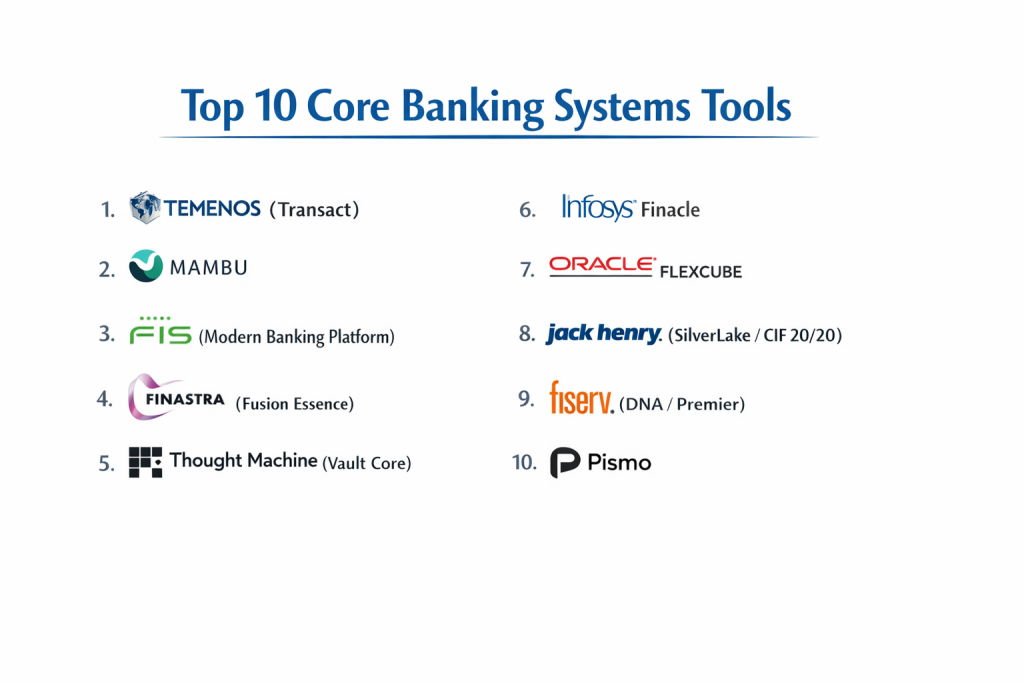
Top 10 Core Banking Systems Tools
1 — Temenos (Transact)
Temenos is a dominant global player, offering “Transact” as its flagship core banking product. It is known for its incredible breadth of features and its ability to serve everyone from micro-finance institutions to the world’s largest Tier 1 banks.
Key features:
- Composable Banking: A modular architecture that lets banks deploy only the specific functions they need.
- Cloud-Agnostic: Can run on AWS, Azure, Google Cloud, or on-premise.
- Explainable AI: Built-in AI that helps with credit scoring and fraud detection while providing clear reasons for its decisions.
- Global Compliance: Pre-configured for over 150 different regulatory jurisdictions.
- 24/7 Real-Time Ledger: Eliminates the need for traditional “close-of-business” batch windows.
Pros:
- Massive global reach and a huge ecosystem of certified implementation partners.
- Highly scalable, capable of handling hundreds of millions of accounts on a single instance.
Cons:
- Implementation is often a multi-year project that requires significant capital and technical resources.
- The system is so feature-rich that it can be overly complex for smaller, simpler institutions.
Security & compliance: ISO 27001, SOC 1/2/3, GDPR, and HIPAA compliant.
Support & community: Extensive “Temenos Learning Community” (TLC), global user conferences, and premium enterprise support tiers.
2 — Mambu
Mambu is the “disruptor” in the space, offering a pure SaaS, cloud-native platform. It pioneered the concept of “composable banking,” focusing on being the engine that allows banks to build their own unique experiences.
Key features:
- Pure SaaS Model: Constant updates and no maintenance “version lock” for the bank.
- API-First Design: Thousands of endpoints to connect to any digital front-end or payment gateway.
- High-Speed Product Factory: Create and launch new deposit or loan products in minutes via the UI.
- Low-Code Configuration: Allows business users to adjust interest rates or fees without a developer.
- Multi-Cloud Resilience: Built-in redundancy across different cloud provider regions.
Pros:
- The favorite of “neobanks” and digital-first projects for its rapid time-to-market.
- Predictable subscription pricing that scales as the bank’s customer base grows.
Cons:
- Lacks some of the “deep” legacy features for complex commercial trade finance compared to older giants.
- Banks must have a strong internal tech team to handle the “API-first” integrations.
Security & compliance: SOC 2 Type II, ISO 27001, and GDPR compliant.
Support & community: Exceptional digital documentation, a growing partner ecosystem, and dedicated customer success managers.
3 — FIS (Modern Banking Platform)
FIS is a powerhouse in the United States, and its Modern Banking Platform (MBP) is a reimagined, cloud-native core built specifically for the needs of large, complex institutions.
Key features:
- Component-Based Architecture: Allows for incremental modernization instead of a “big bang” replacement.
- Native Integration: Deep connectivity with the massive FIS ecosystem (payments, fraud, etc.).
- Advanced Analytics: Real-time data streaming into executive dashboards.
- Enterprise Grade: Designed specifically to handle the high-security requirements of large-cap banks.
- Global Payments Support: Integrated with real-time payment networks like FedNow and RTP.
Pros:
- The “safe choice” for large North American banks due to FIS’s long history and scale.
- Excellent at managing the bridge between legacy data and modern cloud performance.
Cons:
- Typically carries a higher price point suited for enterprise-scale budgets.
- Implementation can be bureaucratic due to the sheer size of the organization.
Security & compliance: FFIEC regulated, SOC 2 Type II, and GLBA compliant.
Support & community: Robust enterprise support infrastructure and a massive annual user conference (FIS Emerald).
4 — Finastra (Fusion Essence)
Finastra’s Fusion Essence is a cloud-first core banking system that focuses on “Open Banking” and retail banking excellence. It is designed to be lean, fast, and highly integrated.
Key features:
- FusionFabric.cloud: An open developer platform that allows banks to “plug in” third-party apps instantly.
- Integrated Digital Front-End: Offers a pre-built mobile and web experience if needed.
- Automated Regulatory Reporting: Native tools for local reporting in major European and Asian markets.
- Modular Retail Suite: Covers deposits, loans, and payments in a single, unified codebase.
- SaaS Deployment: Fully managed in the cloud to reduce internal IT overhead.
Pros:
- Very strong “Open Banking” philosophy that makes it easy to collaborate with fintechs.
- User interface for bank staff is modern and significantly more intuitive than legacy cores.
Cons:
- Not as widely used for ultra-complex “Corporate/Investment” banking as some rivals.
- Support response times can vary depending on the region.
Security & compliance: ISO 27001, SOC 2, and GDPR compliant.
Support & community: Finastra Universe events and a comprehensive online developer portal.
5 — Thought Machine (Vault Core)
Thought Machine is a UK-based firm that has taken the industry by storm with “Vault Core,” a system built on a “Smart Contracts” logic that makes it incredibly flexible.
Key features:
- Smart Contracts Engine: Every financial product is a piece of code, allowing for infinite customization.
- Universal Product Engine: Can run any product from a simple checking account to complex mortgages.
- Cloud-Native Design: Built from the ground up for the cloud (no legacy code).
- Real-Time Data Streaming: Every transaction can be streamed instantly to external data lakes.
- Zero Downtime: Designed for continuous updates without ever taking the system offline.
Pros:
- Unmatched flexibility; you can literally “code” a new type of bank account that has never existed.
- High-performance architecture that appeals to “tech-forward” Tier 1 banks.
Cons:
- Requires a highly technical staff proficient in Python to write the “Smart Contracts.”
- Being a newer player, the ecosystem of third-party “pre-built” integrations is still growing.
Security & compliance: SOC 2 Type II and GDPR compliant.
Support & community: High-touch engineering support and detailed technical documentation for developers.
6 — Infosys Finacle
Finacle is a global heavyweight used by banks in over 100 countries. It is known for its extreme “depth” of functionality and its ability to handle massive, multi-country operations.
Key features:
- Multi-Entity/Multi-Currency: Perfect for banks operating across dozens of different countries.
- Blockchain-Ready: Native support for distributed ledger technology for trade finance.
- AI-Driven Automation: High levels of “straight-through processing” (STP) to reduce manual work.
- Comprehensive Corporate Suite: Deep features for trade finance, liquidity management, and cash pooling.
- Extensive Partner Network: Thousands of certified consultants worldwide.
Pros:
- Proven at a scale that very few systems can match (used by some of the world’s largest banks).
- The functionality is so deep that you will likely never “outgrow” the system.
Cons:
- The user interface can feel industrial and complex for non-technical bank staff.
- Traditionally slow to upgrade due to the massive amount of custom code often used.
Security & compliance: ISO 27001, SOC 1/2, and localized global compliance.
Support & community: Global 24/7 support centers and a massive user community.
7 — Oracle (FLEXCUBE)
Oracle’s FLEXCUBE is a legendary name in core banking, providing a stable, highly secure environment for retail, corporate, and investment banking.
Key features:
- Oracle Database Integration: Leverages the world-class performance and security of the Oracle tech stack.
- Deep Corporate Functionality: Market-leading tools for syndicated loans and treasury operations.
- Digital Experience Suite: Optional pre-integrated front-end for mobile and web.
- Machine Learning Integration: Uses Oracle’s AI tools for predictive analytics on customer churn.
- On-Premise or Cloud: One of the few giants that still offers excellent on-premise support for sensitive regions.
Pros:
- Exceptional stability; it is the “IBM” of core banking—no one gets fired for buying Oracle.
- Incredibly strong reporting and data management capabilities.
Cons:
- Can be very expensive when factoring in database licenses and support.
- Often seen as less “agile” than the newer cloud-native competitors.
Security & compliance: FFIEC, SOC 1/2, ISO 27001, and GDPR compliant.
Support & community: Global Oracle support network and a vast library of technical resources.
8 — Jack Henry (SilverLake / CIF 20/20)
Jack Henry is a staple of the American community banking landscape, providing a stable, integrated environment for thousands of institutions.
Key features:
- Deep Integration: Core, lending, and payments are designed to work together natively.
- Regulatory Focus: Heavily optimized for the specific needs of US-based community banks.
- Automated Compliance: Automatic updates for federal banking regulations.
- User-Friendly Admin: Designed for bankers who may not have a background in IT.
- Strong Reporting: Built-in tools for FFIEC and other domestic reporting requirements.
Pros:
- The gold standard for customer service and “partnership” in the US community banking space.
- Very predictable implementation costs and timelines.
Cons:
- Not designed for international banks or multi-currency operations.
- The tech stack is traditional, though they are moving toward more cloud-native options.
Security & compliance: FFIEC regulated, SOC 2 Type II, and GLBA compliant.
Support & community: Outstanding regional support and an incredibly active user group (JHA User Group).
9 — Fiserv (DNA / Premier)
Fiserv is the other major player in the US, offering the “DNA” core, which is known for its “Person-Centric” data model rather than an “Account-Centric” one.
Key features:
- Person-Centric Model: View all of a customer’s relationships (loans, deposits, family accounts) in one view.
- Open Architecture: Allows banks to build their own “apps” on top of the core.
- Fiserv AppMarket: A marketplace where banks can buy pre-built enhancements.
- Scalable Performance: Reliable for institutions ranging from small credit unions to large regionals.
- Integrated Payments: Direct connection to the Zelle and Fiserv payment networks.
Pros:
- The person-centric view is a massive advantage for relationship managers.
- Strong balance between tradition and modernization.
Cons:
- Upgrading between different Fiserv cores can be as difficult as switching vendors.
- The system requires specialized knowledge to manage and tune effectively.
Security & compliance: FFIEC regulated, SOC 2 Type II, and GLBA compliant.
Support & community: Large-scale enterprise support and regular “Pinnacle” user conferences.
10 — Pismo
Pismo is a newer, cloud-native player (recently acquired by Visa) that offers a high-performance, API-first core for both banking and card issuance.
Key features:
- Unified Platform: Handles both core banking (ledgers) and card processing (issuance).
- Microservices Architecture: Every function is a separate service for maximum reliability.
- Global Cloud Footprint: Deployed across AWS, Google, and Azure globally.
- Extreme Scalability: Built to handle thousands of transactions per second.
- Developer First: Documentation and sandboxes are built specifically for modern engineering teams.
Pros:
- Perfect for firms that want to issue their own cards while managing the ledger.
- Incredibly lean and fast compared to traditional enterprise systems.
Cons:
- Still establishing its “legacy” feature set for things like complex mortgages.
- Being newer, it has fewer “legacy-trained” consultants available in the market.
Security & compliance: PCI DSS Level 1, SOC 2, and GDPR compliant.
Support & community: Strong digital support and a very modern approach to client onboarding.
Comparison Table
| Tool Name | Best For | Platform(s) Supported | Standout Feature | Rating |
| Temenos | Global Complexity | Cloud / On-Prem | Composable Modules | N/A |
| Mambu | Neobanks / SaaS | Cloud-Native (SaaS) | Rapid Product Factory | N/A |
| FIS | US Large Banks | Cloud / Hybrid | Componentized Core | N/A |
| Finastra | Open Banking | Cloud (SaaS) | FusionFabric Ecosystem | N/A |
| Thought Machine | Custom Innovation | Cloud-Native | Smart Contract Ledger | N/A |
| Finacle | Global Tier 1 | Cloud / On-Prem | Multi-Country Scaling | N/A |
| Oracle | Stability / Corporate | Cloud / On-Prem | Deep Treasury Modules | N/A |
| Jack Henry | US Community Banks | On-Prem / Hybrid | Regulatory Reliability | N/A |
| Fiserv | Relationship Banking | Cloud / Hybrid | Person-Centric Data | N/A |
| Pismo | Cards + Banking | Cloud-Native | Unified Issuance/Core | N/A |
Evaluation & Scoring of Core Banking Systems
| Criterion | Weight | Evaluation Focus |
| Core Features | 25% | Ledger accuracy, real-time processing, and product flexibility. |
| Ease of Use | 15% | Administrative interface, low-code tools, and staff onboarding. |
| Integrations | 15% | API maturity, third-party marketplace, and core-to-digital sync. |
| Security & Compliance | 10% | Encryption, audit logs, and regulatory pre-configurations. |
| Performance | 10% | Transaction per second (TPS) limits and system uptime. |
| Support | 10% | Professional services, training docs, and community forums. |
| Price / Value | 15% | Total cost of ownership vs. operational efficiency gains. |
Which Core Banking System Tool Is Right for You?
Solo Users vs SMB vs Mid-Market vs Enterprise
There is no “Solo User” for a core banking system, as these require a banking license. However, for Digital Startups (SMB equivalents), Mambu and Pismo are the leaders due to their low entry costs and rapid setup. Mid-Market and Community Banks are best served by Jack Henry or Finastra, which offer more “hands-on” support. Enterprises with millions of accounts must look toward the “Big Three” of Temenos, Finacle, or FIS.
Budget-Conscious vs Premium Solutions
If you are looking for Budget-Value, a pure SaaS model like Mambu is often best because it eliminates the need for expensive data centers and huge IT maintenance teams. Premium solutions like Thought Machine or Temenos carry higher license fees but provide the “Smart Contract” or “Composable” power that can generate massive revenue through unique product offerings.
Technical Depth vs Simplicity
For Technical Depth, Thought Machine is unrivaled—but you must have a team of Python developers. If you want Simplicity so your branch staff can operate the system with minimal training, Jack Henry and Fiserv have decades of experience in refining the “Banker’s Desktop.”
Security and Compliance Requirements
If you are operating in a highly sensitive region that forbids cloud storage, Oracle and Temenos are your best bets as they still offer top-tier on-premise deployments. If you are in the United States, the domestic focus of FIS, Fiserv, and Jack Henry ensures you are always ahead of the latest FFIEC and OCC examinations.
Frequently Asked Questions (FAQs)
What is the difference between a legacy core and a modern core?
Legacy cores process data in “batches” (usually at night) and are hard to change. Modern cores are cloud-native, process data in real-time, and use APIs to connect to other apps.
How long does a core conversion take?
For a small bank, it can take 6–12 months. For a large international bank, a core transformation can take 3–5 years.
Can I run a bank without a core system?
No. A core system is the legal and financial “ledger” required by regulators to track customer deposits and ensure the bank’s solvency.
What is “Composable Banking”?
It is a philosophy where the bank is built from independent modules (like Lego blocks) that can be swapped out individually without affecting the rest of the system.
Is cloud banking safe?
Yes. In many cases, cloud-native cores (Mambu, Thought Machine) are more secure than on-premise systems because they use modern encryption and are monitored 24/7 by cloud providers like AWS or Azure.
How does a core system help with compliance?
It automatically flags suspicious transactions for AML (Anti-Money Laundering) and maintains an unalterable “audit trail” for every action taken in the system.
What is an API in banking?
An API (Application Programming Interface) is a “doorway” that allows your core system to talk to other software, like a mobile banking app or a credit scoring tool.
Does a core system handle ATMs?
Yes, the core system is what the ATM talks to when you ask for a balance or a withdrawal to ensure you have enough funds.
Can I build my own financial products?
With modern cores like Thought Machine or Mambu, yes. You can define the interest, fees, and rules of a new product via code or a configuration UI.
What is the “Person-Centric” model?
It is a data structure where the customer (the person) is at the center, allowing the bank to see every account that person owns across different branches or products.
Conclusion
The decision to choose a Core Banking System is the most significant technological choice a financial institution will ever make. In 2026, the industry is clearly bifurcating: institutions that cling to legacy mainframes are finding it impossible to compete on speed and cost, while those migrating to Cloud-Native and Composable cores are unlocking new levels of agility.
Whether you choose the global power of Temenos, the SaaS simplicity of Mambu, or the customizable innovation of Thought Machine, the goal remains the same: accuracy, security, and scalability. The “best” system is the one that aligns with your institutional culture and your long-term vision for the customer experience. Focus on API connectivity and real-time data, and you will build a foundation that can survive any market shift.