Introduction
Crisis management platforms are specialized software solutions designed to help organizations prepare for, respond to, and recover from unexpected disruptive events. These platforms serve as a centralized “command center” during high-pressure situations, ranging from natural disasters and cyberattacks to public relations scandals and supply chain failures. Unlike standard project management tools, these systems are built for speed and resilience. They combine mass notification capabilities, real-time collaboration tools, and digitized playbooks to ensure that the right people have the right information at exactly the right time. When seconds count, these platforms eliminate the “fog of war” by providing a single source of truth for decision-makers.
The importance of these platforms has skyrocketed as the global business environment becomes more volatile. A delayed response to a crisis can result in catastrophic financial loss, legal liability, and permanent damage to a brand’s reputation. Crisis management software automates the most time-consuming parts of a response—such as calling down a phone tree or locating employees in a danger zone—allowing leaders to focus on strategic decisions. By maintaining a clear audit trail of every action taken, these tools also provide invaluable data for post-incident analysis and regulatory compliance, ensuring that the organization is better prepared for the next challenge.
Key Real-World Use Cases
Crisis management platforms are deployed across a variety of critical scenarios:
- Severe Weather Events: Tracking hurricanes or wildfires in relation to office locations and sending mass evacuation alerts to affected staff.
- Cybersecurity Breaches: Coordinating the IT, legal, and PR teams through a secure “out-of-band” communication channel when corporate email is compromised.
- Product Recalls: Managing the rapid dissemination of instructions to distributors and customers while tracking the status of the response.
- Executive Protection: Monitoring the safety of high-profile leaders during international travel in high-risk regions.
- Active Shooter Situations: Providing law enforcement with building blueprints while simultaneously instructing employees to “run, hide, or fight.”
What to Look For (Evaluation Criteria)
When evaluating a platform, consider these essential technical and functional pillars:
- Resilience and Uptime: Can the platform function if your primary servers go down? Look for “out-of-band” capabilities.
- Multichannel Notification: Does it support SMS, voice, email, desktop alerts, and even social media integration?
- Ease of Use Under Stress: Is the interface intuitive enough for a panicked user to navigate without a manual?
- Digitized Playbooks: Can you convert your 200-page paper crisis plan into actionable, digital task lists?
- Global Reach: Does it support multi-language translation and international SMS delivery?
Best for:
- Chief Security Officers (CSOs) and Risk Managers: Who need to oversee global physical and digital threats.
- Business Continuity Planners: Responsible for ensuring the organization can function during a disruption.
- Large Enterprises: Companies with thousands of employees and multiple geographic locations.
- Government and Healthcare Entities: Organizations where crisis response is a matter of public safety.
Not ideal for:
- Small Local Businesses: A five-person retail shop can likely manage crises via a simple WhatsApp group and a basic emergency plan.
- Static Project Teams: If your “crisis” is just a missed deadline, standard tools like Trello or Asana are more appropriate.
- Budget-Zero Organizations: High-end crisis platforms require significant investment in both licensing and ongoing training.
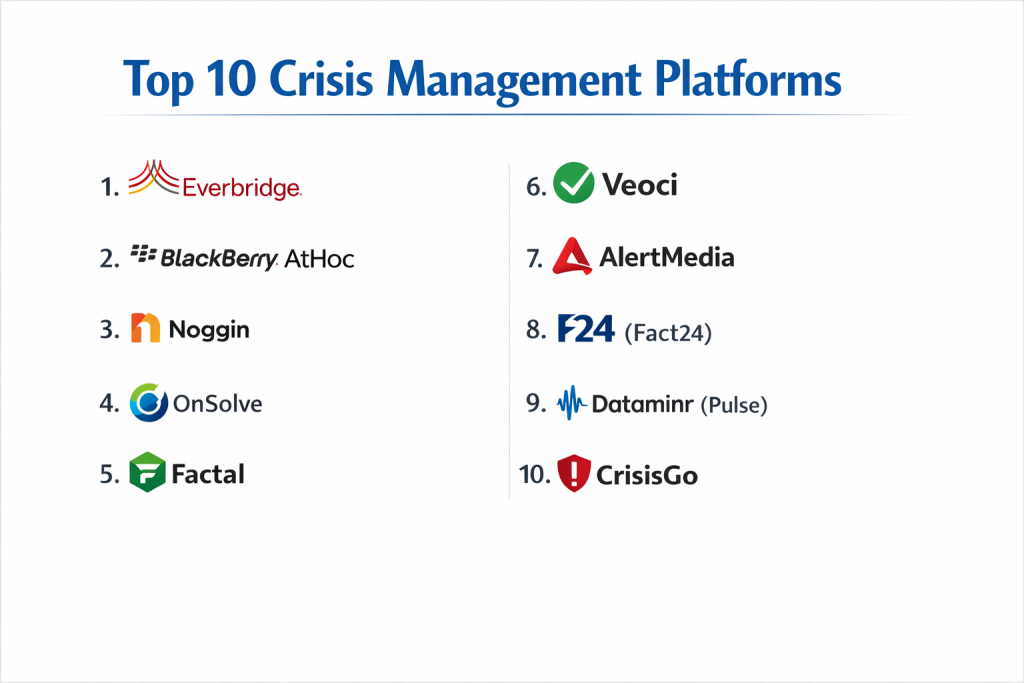
Top 10 Crisis Management Platforms
1 — Everbridge
Everbridge is widely considered the market leader in Critical Event Management (CEM). It is an enterprise-grade platform that monitors thousands of data feeds to alert organizations about threats to their people and assets.
Key features:
- Mass Notification: Industry-leading ability to send millions of messages across 100+ communication modalities.
- Visual Command Center: A “map-first” interface showing global threats (fire, flood, protest) relative to company assets.
- Crisis Management Playbooks: Fully digitized, step-by-step response plans that assign tasks automatically.
- IT Alerting: Specialized workflows for managing server outages and DevOps incidents.
- Community Engagement: Tools for local governments to alert citizens during public emergencies.
Pros:
- Unmatched global infrastructure and delivery reliability during massive disasters.
- Comprehensive ecosystem that covers everything from physical security to IT resilience.
Cons:
- Extremely expensive and often requires a dedicated administrator to manage.
- The interface can be overly complex for smaller organizations.
Security & compliance: FedRAMP authorized, SOC 2 Type II, GDPR, and ISO 27001.
Support & community: 24/7 global enterprise support, dedicated account managers, and a massive annual user conference.
2 — BlackBerry AtHoc
AtHoc is a highly secure crisis communication platform favored by government agencies, military branches, and large-scale industrial organizations. It leverages BlackBerry’s legacy in secure mobile communication.
Key features:
- Secure Two-Way Messaging: Allows users to respond to alerts with their status (e.g., “Safe” or “Need Help”).
- Personnel Accountability: Rapidly accounts for 100% of staff via real-time tracking and check-ins.
- Inter-Agency Exchange: Allows different organizations (e.g., a hospital and the local police) to share alerts.
- Desktop and IP Phone Alerts: Can take over screen displays and office phones for immediate attention.
- Field Reporting: Allows users to send “eyes-on” reports with photos and GPS coordinates back to the command center.
Pros:
- Government-grade security that meets the highest military standards.
- Excellent integration with existing hardware like sirens and public address systems.
Cons:
- The user interface feels dated compared to modern cloud-native startups.
- Heavy focus on “notification” sometimes leaves “long-term recovery” features lacking.
Security & compliance: FedRAMP, HIPAA, SOC 2, and FIPS 140-2 compliant.
Support & community: Robust documentation and specialized support for government and defense clients.
3 — Noggin
Noggin is a flexible, all-in-one platform that handles business continuity, incident management, and crisis communication. It is known for its high degree of configurability.
Key features:
- Integrated Information Management: Combines incident logs, asset registries, and contact lists in one view.
- Customizable Dashboards: Users can build a “Common Operating Picture” tailored to their specific role.
- Situation Reports (SITREPs): Automated generation of formal reports for stakeholders.
- Volunteer and Resource Management: Specific tools for managing large-scale humanitarian or community responses.
- Mobile App: Full functionality on mobile for field-based crisis teams.
Pros:
- Highly flexible; you can build almost any workflow without needing a custom developer.
- Strong focus on “Information Management” rather than just “Mass Messaging.”
Cons:
- The high level of customization means it takes longer to set up correctly.
- The pricing structure can be confusing depending on the modules selected.
Security & compliance: ISO 27001, SOC 2, and GDPR compliant.
Support & community: Strong presence in the APAC and EMEA regions with dedicated professional services.
4 — OnSolve
OnSolve (formed by the merger of Send Word Now, CodeRED, and Mir3) is a powerful CEM platform that emphasizes AI-powered risk intelligence and reliable notification delivery.
Key features:
- Risk Intelligence: AI scans thousands of sources to filter out “noise” and show only relevant threats.
- Critical Communications: High-speed delivery to SMS, voice, email, and social media.
- Dynamic Geofencing: Send alerts to anyone currently physically located within a specific boundary on a map.
- Incident Management: Simple, intuitive task lists for coordinating response teams.
- Integration Cloud: Easily connects to HRIS and CRM systems to keep contact lists updated.
Pros:
- One of the most reliable and fastest notification delivery speeds in the industry.
- The AI filtering is excellent at reducing “alert fatigue” for safety officers.
Cons:
- Some of the legacy interfaces from merged products still feel a bit disconnected.
- Professional services are often required for complex enterprise integrations.
Security & compliance: FedRAMP, SOC 2 Type II, and GDPR compliant.
Support & community: Comprehensive training via OnSolve University and 24/7 technical support.
5 — Factal
Factal is a “Risk Intelligence” platform that focuses on the first stage of crisis management: knowing something is happening. It is used by major global newsrooms and corporate security teams.
Key features:
- Verified Real-Time Alerts: Human journalists verify social media and news reports before they reach you.
- Proximity Alerts: Notifies you only if a verified event is within a certain distance of your assets.
- Direct Chat with Journalists: Allows users to ask questions to the Factal newsroom for more context.
- Collaborative Map: See your company locations overlaid with verified global incidents.
- Clean API: Feeds verified threat data into other systems like Everbridge or Noggin.
Pros:
- Extremely high accuracy; they almost never send “fake news” alerts.
- Very simple, clean interface that focuses on information, not complex menus.
Cons:
- It is not a full “Response” platform (it doesn’t have task lists or playbooks).
- Requires integration with a separate communication tool to send mass alerts.
Security & compliance: SOC 2 Type II and GDPR compliant.
Support & community: High-touch service with direct access to their global newsroom staff.
6 — Veoci
Veoci is a modern, cloud-native platform that excels in “Workflow Automation.” It is particularly popular in the aviation, higher education, and healthcare sectors.
Key features:
- Digitized Command Center: Virtual rooms where teams can chat, share files, and update status logs.
- Form Builder: Create custom entry forms for tracking damage assessments or health checks.
- Visual Task Boards: Drag-and-drop tasks to manage the progress of a response.
- GIS Integration: Sophisticated mapping that can show building floor plans and utility lines.
- Asset Tracking: Track the location of emergency supplies or vehicles in real-time.
Pros:
- The most “modern” and user-friendly interface among the enterprise platforms.
- Highly collaborative; feels more like a modern work tool than a legacy database.
Cons:
- Can be “too flexible” for teams that want a rigid, pre-set framework.
- Initial configuration of workflows can be time-consuming for the admin.
Security & compliance: SOC 2 Type II, HIPAA, and GDPR compliant.
Support & community: Excellent onboarding and a proactive customer success team.
7 — AlertMedia
AlertMedia is a fast-growing platform that focuses on being the most intuitive and easy-to-use CEM solution. It is a favorite for mid-market and enterprise companies that want to move quickly.
Key features:
- Two-Way Messaging: Simple interface for seeing who is safe and who needs help.
- Threat Intelligence: Integrated map showing weather, crime, and health threats.
- Safety Map: Real-time visibility into employee locations (via mobile opt-in) during a crisis.
- Custom Groups: Automatically syncs with Azure AD or Okta to keep teams updated.
- Desktop Alerts: Intrusive full-screen alerts for employees at their desks.
Pros:
- Widely considered to have the best user interface (UI) in the industry.
- Extremely fast to implement; most companies are live in weeks, not months.
Cons:
- Might lack some of the deepest “industrial” features for chemical or nuclear facilities.
- The threat intelligence, while good, is less detailed than Factal or Everbridge.
Security & compliance: SOC 2 Type II and GDPR compliant.
Support & community: Highly rated 24/7 customer support and an extensive resource library.
8 — F24 (Fact24)
F24 is Europe’s leading crisis management provider. It is the go-to solution for companies that prioritize strict European data privacy standards and localized support.
Key features:
- Crisis Management 2.0: A complete suite for planning, alerting, and incident logging.
- Confidential Audio Conferencing: Automatically dials response team members into a secure call.
- Task Management: Clear oversight of who is doing what during the initial minutes of a crisis.
- Scenario Planning: Allows teams to “dry run” different crises in a sandbox environment.
- Public Warning System: Tools for governments to alert the general public via cell broadcast.
Pros:
- Best-in-class adherence to GDPR and European security requirements.
- Very strong presence and support across all major European countries.
Cons:
- Less brand recognition and support infrastructure in North America.
- The platform can feel slightly more rigid than “no-code” tools like Veoci.
Security & compliance: ISO 27001, GDPR, and SOC 2.
Support & community: Local support in multiple European languages and a strong professional community.
9 — Dataminr (Pulse)
Dataminr is the world’s leading AI platform for real-time event detection. It is the “early warning system” used by global corporations to stay ahead of breaking news.
Key features:
- AI Signal Detection: Analyzes billions of public data points to find the first sign of a crisis.
- Hyper-Local Context: Shows you incidents happening right outside your specific office address.
- Pulse Dashboards: Visualizations of how global events are affecting your supply chain.
- Integrations: Direct plugins for Slack, Microsoft Teams, and other crisis tools.
- Custom Alerting: Set specific keywords (e.g., “Fire” + “Warehouse #4”) for instant alerts.
Pros:
- Unmatched speed; they often detect events minutes before major news outlets.
- Excellent for supply chain monitoring and protecting globally distributed assets.
Cons:
- It is an intelligence tool, not a full response platform (no task lists or check-ins).
- The volume of alerts can be overwhelming if not configured correctly.
Security & compliance: SOC 2 Type II and GDPR compliant.
Support & community: High-level strategic support for global security operations centers (GSOCs).
10 — CrisisGo
CrisisGo is a specialized platform built primarily for the education and public sector. It focuses on getting safety plans into the pockets of every teacher, student, and staff member.
Key features:
- Panic Buttons: Digital panic buttons that send location and live video to authorities.
- Digital Safety Folders: Puts building maps and emergency roles on everyone’s phone.
- Two-Way Group Messaging: Facilitates communication between classrooms and the front office.
- Check-in/Roster: Teachers can rapidly account for every student during a drill or real event.
- Integration with IoT: Can trigger door locks and strobes during a lockdown.
Pros:
- Highly specialized for the unique needs of schools and campuses.
- Very affordable for public sector and non-profit organizations.
Cons:
- Lacks the “Global Supply Chain” and “Business Continuity” depth of Everbridge.
- Not designed for corporate PR or IT crisis management.
Security & compliance: FERPA, HIPAA, and COPPA compliant.
Support & community: Excellent training specifically for school administrators and first responders.
Comparison Table
| Tool Name | Best For | Platform(s) Supported | Standout Feature | Rating |
| Everbridge | Global Enterprises | Web / iOS / Android | CEM Command Center | N/A |
| AtHoc | Government / Military | Web / Mobile / Desktop | Agency Interoperability | N/A |
| Noggin | Info Management | Web / Mobile | Highly Customizable Forms | N/A |
| OnSolve | Fast Mass Alerts | Web / Mobile | AI Risk Intelligence | N/A |
| Factal | Verified Intelligence | Web / Mobile | Human-Verified Alerts | N/A |
| Veoci | Collaborative Teams | Web / Mobile | Visual Task Boards | N/A |
| AlertMedia | Modern Ease of Use | Web / Mobile | UI/UX Simplicity | N/A |
| Fact24 | European Market | Web / Mobile | Secure Audio Conferencing | N/A |
| Dataminr | AI Event Detection | Web / Mobile | First-to-Know AI Speed | N/A |
| CrisisGo | Schools / Education | Web / Mobile | Mobile Panic Buttons | N/A |
Evaluation & Scoring of Crisis Management Platforms
| Criterion | Weight | Evaluation Focus |
| Core Features | 25% | Mass notification, threat intelligence, and playbooks. |
| Ease of Use | 15% | Intuitiveness under high-stress conditions. |
| Integrations | 15% | Connectivity with HRIS, AD, and IT ticketing systems. |
| Security & Compliance | 10% | FedRAMP, GDPR, HIPAA, and data encryption. |
| Performance | 10% | Message delivery speed and platform uptime. |
| Support | 10% | Onboarding, 24/7 availability, and training. |
| Price / Value | 15% | Scalability of the cost vs. risk reduction. |
Which Crisis Management Platform Is Right for You?
Solo Users vs SMB vs Mid-Market vs Enterprise
If you are an SMB, you should look for simplicity. AlertMedia is the strongest choice here because it doesn’t require a full-time employee to manage the software. Mid-Market companies with international offices may prefer OnSolve or Fact24 for their balance of global reach and speed. Enterprise giants with complex supply chains and thousands of assets are almost certainly going to need Everbridge or Dataminr to manage the sheer volume of data and risk they face daily.
Budget-Conscious vs Premium Solutions
For those with limited budgets, CrisisGo (if in education) or the core messaging tier of AlertMedia offer the best value. If you are a “Fortune 500” company where an hour of downtime costs millions, the Premium cost of Everbridge or Dataminr is essentially an insurance policy that pays for itself after the first major incident is successfully mitigated.
Feature Depth vs Ease of Use
If you want Feature Depth—meaning you want to track air quality sensors, manage medical staff rosters, and write custom code for workflows—Noggin or Veoci are the leaders. However, if you want Ease of Use so that any manager can send an alert during a fire drill with 5 minutes of training, AlertMedia and OnSolve are the winners.
Integration and Scalability Needs
If you need the system to “speak” to your building’s fire alarm system or your police department’s radio frequency, AtHoc or Everbridge have the hardware-integration legacy required. For companies that want their crisis alerts to flow into Slack or Microsoft Teams, cloud-native tools like Dataminr or Veoci offer much more modern API connections.
Security and Compliance Requirements
If you are a US government contractor, FedRAMP authorization (offered by Everbridge, AtHoc, and OnSolve) is usually a non-negotiable requirement. For European companies, Fact24 is the gold standard for GDPR compliance. Healthcare organizations should strictly prioritize Veoci or AtHoc due to their strong HIPAA compliance for handling employee health status.
Frequently Asked Questions (FAQs)
What is the difference between an LMS and a Crisis Platform?
An LMS is for training; a Crisis Platform is for live response. One prepares you for the future; the other manages the present emergency.
Can these platforms work without the internet?
Most use “multi-modal” notification, meaning if the internet is down, they can still send alerts via cellular SMS or traditional phone calls.
How do these tools locate employees?
They usually sync with your HR system for “Home Office” locations and use mobile GPS or Wi-Fi check-ins (with permission) for “Current” locations.
Is my data private?
Professional platforms use high-level encryption and allow you to “opt-in” to location tracking, ensuring you are only tracked during an active emergency.
What is ‘Alert Fatigue’?
It’s when employees stop reading alerts because they get too many irrelevant ones. Good platforms use AI to only send alerts to people in the actual danger zone.
How long does it take to implement?
Simple messaging tools can be live in a week. Complex CEM suites for global enterprises can take 3 to 6 months to integrate and train.
Do these tools provide the crisis plans?
Most don’t write the plan for you, but they provide templates and “Playbooks” where you can upload and digitize your existing paper plans.
Can they integrate with social media?
Yes, tools like OnSolve can automatically post alerts to your company’s X (Twitter) or Facebook pages to keep the public informed.
Are these tools useful for IT outages?
Absolutely. Many companies use these for “Major Incident Management” (MIM) to gather IT teams into a bridge call when a server goes down.
What is ‘Out-of-Band’ communication?
It means communicating using a system that is separate from your main corporate network. If your company email is hacked, the crisis platform is your “Out-of-Band” way to talk securely.
Conclusion
The “best” crisis management platform is not the one with the most icons on the dashboard; it is the one that your team can actually operate when a building is shaking or a cyber-ransom note appears on every screen. If you prioritize modern collaboration and user experience, AlertMedia and Veoci are leading the new wave of crisis tech. If you are a global enterprise with a high risk profile, the “industrial strength” of Everbridge or the AI-speed of Dataminr are the gold standards.
In the end, these platforms are about more than just technology—they are about resilience. By moving your crisis plans from a dusty binder into a digital command center, you are giving your team the power to respond with clarity instead of chaos. Start by mapping out your top three risks, run a trial with a small response team, and choose the platform that gives you the most confidence that you can protect your people and your business when it matters most.