Introduction
Airport Operations Management Software (AOMS) is a comprehensive digital platform that acts as the central nervous system of an airport. It coordinates the hundreds of people, assets, and moving parts—from runway inspections and gate assignments to baggage handling and passenger flow—to ensure everything runs on time, safely, and efficiently.
This software is critically important because modern airports are like small, fast-paced cities. Without a unified system to manage operations, chaos would ensue, leading to flight delays, security issues, poor passenger experiences, and significant financial losses. A powerful AOMS turns isolated data into actionable intelligence, enabling proactive decision-making.
In daily use, this software is deployed for real-time flight information displays, managing gate and stand allocations for aircraft, coordinating ground handling services like refueling and catering, overseeing baggage systems to prevent mishandling, and ensuring compliance with strict aviation safety and security regulations. When choosing an AOMS, key evaluation criteria include: integration capabilities with existing systems (airlines, ATC, security), scalability for future growth, real-time data processing and visualization, mobile accessibility for staff on the move, and the depth of resource management (equipment, personnel, facilities).
Best for: This software is essential for Airport Operations Directors, Ground Handling Managers, Airfield Managers, Duty Managers, and IT teams within airports of all sizes. It is also used by fixed-base operators (FBOs), ground service providers, and aviation authorities. It delivers the highest value for mid-sized to large hub airports with complex, multi-stakeholder environments.
Not ideal for: Very small general aviation airports with a handful of daily movements may find the cost and complexity of a full AOMS unnecessary. For basic flight tracking alone, a simpler, specialized tool might suffice. It is also not a replacement for core airline systems like crew scheduling or revenue management.
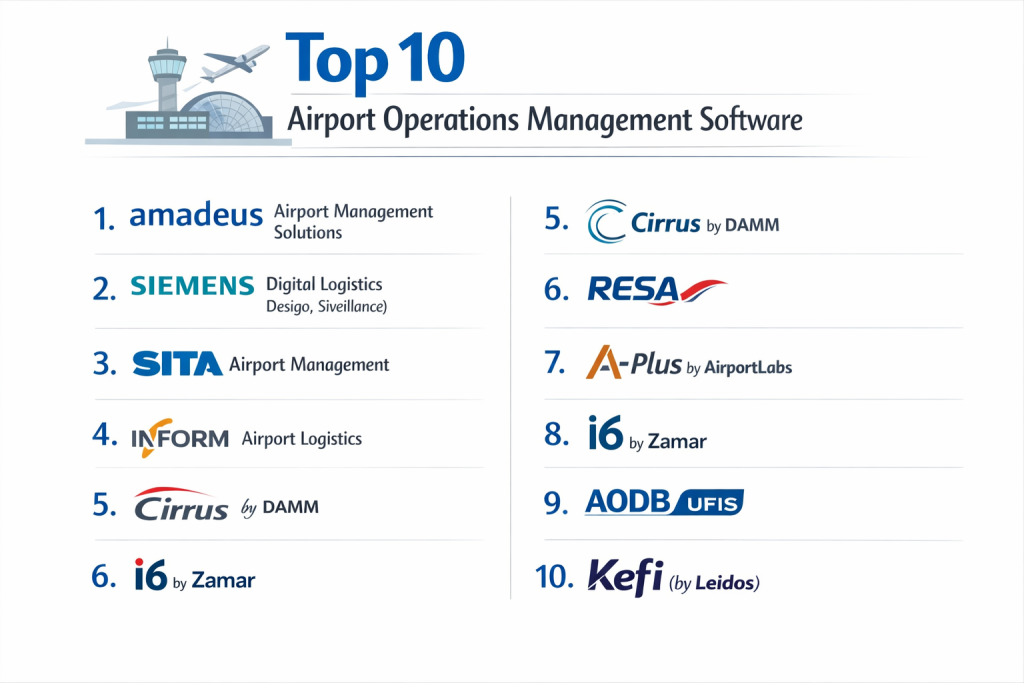
Top 10 Airport Operations Management Software
Here is a detailed analysis of the leading platforms that keep the world’s airports running smoothly.
1 — Amadeus Airport Management Solutions
Amadeus provides a comprehensive, modular suite that covers the entire passenger journey and airport operations. It’s a global leader, known for deep integration with airline systems and its massive travel distribution network.
Key features:
- Unified passenger processing: Manages check-in, boarding, baggage handling, and flight information displays from a single platform.
- Resource Management System (RMS): Allocates gates, stands, check-in counters, and baggage carousels dynamically based on real-time flight data.
- Airport Operational Database (AODB): Acts as the single source of truth for all flight and resource data, critical for large hubs.
- Collaboration tools: Facilitates communication between airlines, ground handlers, and airport staff.
- Business intelligence: Provides analytics on operational performance, passenger flow, and resource utilization.
- Global scale and integration: Leverages Amadeus’s vast connections to hundreds of airlines and travel sellers.
Pros:
- Exceptionally powerful integration with airline reservation and departure control systems.
- Provides a true end-to-end view from booking to boarding gate.
- Proven at some of the world’s largest and most complex airports.
Cons:
- Can be a significant, long-term enterprise commitment with high costs.
- The breadth of the suite can make implementation complex and lengthy.
- May be more system than needed for a small or regional airport.
Security & compliance: Enterprise-grade security as a global travel tech provider. Compliant with major standards like ISO 27001 and GDPR, with features tailored for aviation security protocols.
Support & community: 24/7 global support and a dedicated customer success framework. Has a vast user community and regular industry user group events.
2 — Siemens Digital Logistics (Desigo, Siveillance)
Siemens offers a suite that blends traditional airport operations with smart building and IoT (Internet of Things) management. It’s renowned for integrating operational control with physical infrastructure like HVAC, lighting, and security systems.
Key features:
- Holistic airport management: Combines flight operations, resource scheduling, and terminal/building management in one platform.
- IoT and sensor integration: Uses data from thousands of sensors to optimize energy use, passenger comfort, and asset health.
- Advanced visualization: Central control room dashboards that provide a unified view of all airport systems.
- Apron and stand management: Sophisticated tools for managing aircraft turnaround and ground vehicle movements.
- Predictive maintenance: Uses AI to forecast equipment failures before they disrupt operations.
- Strong focus on sustainability: Tools to monitor and reduce the airport’s carbon footprint and energy consumption.
Pros:
- Unmatched for airports wanting to deeply integrate physical infrastructure with operational software.
- Powerful data-driven approach to efficiency, cost-saving, and sustainability.
- Backed by Siemens’ engineering expertise and long-term stability.
Cons:
- The integrated building management focus may be overkill for airports only seeking core ops tools.
- Can involve a high degree of customization and configuration.
- May require partnerships with other specialists for certain airline-facing functions.
Security & compliance: Industrial-grade cybersecurity from Siemens. Complies with international standards for critical infrastructure. Often chosen for its robust security architecture.
Support & community: Global support network from Siemens. Strong presence in Europe and among airports investing in smart infrastructure.
3 — SITA Airport Management
SITA is a co-operative owned by the air transport industry, giving it unique insight into airport and airline needs. Its portfolio is broad, covering communications, passenger processing, and operations.
Key features:
- AirportConnect: A family of solutions for common-use passenger processing (CUPPS), enabling any airline to use any check-in desk or gate.
- FlightInformed: Real-time flight information management system that feeds displays, apps, and operational systems.
- Baggage management: WorldTracer for baggage reconciliation and tracking, and BagManager for handling optimization.
- AODB and resource management: Core database and planning tools for airport resources.
- Global communications network: Provides the underlying connectivity for many airline and airport systems worldwide.
- Mobile workforce tools: Apps for staff to manage tasks, communications, and operations on the move.
Pros:
- Deep, trusted relationships within the industry due to its co-operative model.
- Extremely strong in common-use passenger processing and global baggage tracking.
- Reliable, global network and communications backbone.
Cons:
- Some solutions can be seen as legacy systems, though modernizing.
- The breadth of offerings can sometimes lead to a “best-of-suite” rather than “best-of-breed” perception for individual modules.
- Integration between its own various products can sometimes be a project in itself.
Security & compliance: Industry-standard for aviation communications and data. Heavily invested in cybersecurity for its global network.
Support & community: Extensive global support presence at airports worldwide. A pillar of the air transport IT community for decades.
4 — INFORM Airport Logistics
INFORM specializes in optimization software using artificial intelligence and advanced algorithms. Its AirportSync suite is focused on maximizing the efficiency and profitability of resource-constrained operations like stands, gates, and baggage systems.
Key features:
- AI-powered optimization: Core strength is using algorithms to solve complex scheduling and allocation puzzles in real-time.
- Stand & Gate Management: Dynamically assigns aircraft to the most efficient stands, considering size, services needed, and passenger connections.
- Baggage flow optimization: Manages the entire baggage journey to minimize mishandling and delays.
- Turnaround Management: Coordinates all ground handling activities (cleaning, catering, fueling) to reduce aircraft turnaround time.
- “What-if” scenario simulation: Allows planners to test the impact of disruptions or schedule changes before implementing them.
- Focus on hard ROI: Designed to deliver measurable cost savings and efficiency gains.
Pros:
- Possibly the strongest pure optimization engine in the airport software market.
- Delivers clear, quantifiable improvements in asset utilization and on-time performance.
- Agile and focused on solving specific, high-value operational problems.
Cons:
- Less of a comprehensive “everyday” control system and more of a strategic optimization layer.
- May need to be integrated with a primary AODB or flight information system.
- The mathematical approach can require specialized knowledge to configure and interpret.
Security & compliance: German-engineered with high standards for data integrity and security. Models can be configured to ensure compliance with safety regulations.
Support & community: Specialized support from optimization experts. Growing reputation among efficiency-focused airports.
5 — Cirrus by DAMM
Cirrus is a modern, cloud-native AODB and operations platform designed for agility and ease of use. It targets airports looking to replace legacy systems with a flexible, web-based solution.
Key features:
- True cloud-native AODB: Built for the cloud from the ground up, enabling rapid deployment and updates.
- API-first architecture: Designed for easy integration with other best-of-breed systems via modern APIs.
- Configurable workflow engine: Allows airports to model their unique business processes without extensive coding.
- Real-time dashboarding: Highly visual, customizable dashboards for operational control centers.
- Integrated resource management: Handles gates, stands, check-in desks, and baggage belts.
- Mobile-friendly: Fully responsive design works on any device for staff in the field.
Pros:
- Fast to implement and scale compared to traditional on-premise systems.
- Highly adaptable to an airport’s specific way of working.
- Lower upfront IT infrastructure cost due to cloud subscription model.
Cons:
- As a newer entrant, it has a shorter track record at the world’s largest mega-hubs.
- Cloud dependency requires reliable internet connectivity, which can be a concern for some locations.
- May lack some of the ultra-deep, legacy integrations of established players.
Security & compliance: Built on modern cloud security principles (e.g., in AWS/Azure). SOC 2 compliant and adheres to data protection regulations like GDPR.
Support & community: Agile, responsive support model. Building a community among mid-sized and regional airports adopting cloud technology.
6 — RESA Airport
RESA provides a comprehensive suite centered around a powerful AODB. It is widely used across Europe and other regions, known for its robustness and strong focus on airside and passenger operations.
Key features:
- Core AODB and FIDS: Reliable flight information and database at the heart of the system.
- Resource Manager: Comprehensive module for managing gates, stands, counters, and baggage facilities.
- Apron Manager: Specialized tools for managing ground handling activities, vehicle dispatch, and safety zones.
- Billing and invoicing: Strong functionality for calculating and issuing charges to airlines for landing, parking, and use of services.
- Statistical reporting: Extensive library of standard and customizable operational and financial reports.
- Web and mobile access: Provides operational views and data entry for staff outside the control room.
Pros:
- Mature, stable, and highly reliable system with a strong installed base.
- Excellent all-rounder that covers core operational and commercial needs well.
- Strong in airside operations and ground handling coordination.
Cons:
- User interface and user experience have historically been more functional than cutting-edge.
- Can be perceived as a more traditional, on-premise oriented solution.
- Customizations may require more direct vendor engagement.
Security & compliance: Meets high standards for operational technology in aviation. Specific certifications should be confirmed with the vendor.
Support & community: Solid, experienced support team. Well-established in its core markets with regular user conferences.
7 — A-Plus by AirportLabs
A-Plus is a suite from AirportLabs focused on unifying operational data and providing intuitive tools for daily airport management, particularly suited for small and medium-sized airports.
Key features:
- Modular and scalable: Airports can start with core modules (AODB, FIDS) and add others (Resource Management, Reporting) as needed.
- User-friendly interface: Designed to be intuitive and reduce training time for operational staff.
- Integrated FIDS and AODB: Tight coupling of the flight database and public display systems.
- Operational dashboards: Provides key performance indicators (KPIs) and alerts for duty managers.
- Mobile inspections: Tools for conducting and logging airfield inspections (runways, taxiways) on tablets.
- Cost-effective pricing: Aimed at being accessible for regional and municipal airports.
Pros:
- Excellent fit for regional airports needing professional-grade tools without mega-hub complexity.
- Focus on usability and getting value quickly.
- Flexible modular approach helps control costs.
Cons:
- May not have the depth of features required for a highly complex, multi-runway hub with hundreds of daily movements.
- Brand and market presence are smaller than the global giants.
- Ecosystem of third-party integrations may be less extensive.
Security & compliance: Implements standard aviation IT security practices. Complies with data protection regulations relevant to its markets.
Support & community: Responsive, direct support from the vendor. Growing user base among regional airports.
8 — i6 by Zamar
i6 is a comprehensive operations and management platform that emphasizes integration and business intelligence. It aims to connect data from across the airport to drive better decisions.
Key features:
- Single integrated platform: Combines AODB, resource management, billing, and business intelligence.
- Advanced BI and analytics: Strong focus on transforming operational data into strategic insights.
- Passenger flow management: Tools to monitor and predict passenger congestion throughout the terminal.
- Master planning module: Supports long-term capacity planning and “what-if” analysis for infrastructure changes.
- Commercial management: Manages retail and advertising space, leases, and non-aeronautical revenue.
- Configurable rules engine: Allows business rules for resource allocation and billing to be modeled visually.
Pros:
- Powerful business intelligence capabilities that help airports grow revenue and optimize costs.
- Good balance between operational control and commercial management.
- Integrated design can reduce data silos and manual reporting work.
Cons:
- The wide scope can mean a broad implementation project.
- May be more system than needed for an airport focused purely on core flight ops.
- Less frequently mentioned in the context of ultra-large hubs compared to Amadeus or SITA.
Security & compliance: Enterprise security features. The platform’s design supports audit trails and compliance reporting.
Support & community: Provides implementation and support services. Has a diverse international customer base.
9 — AODB by UFIS Airport Solutions
UFIS (now part of Advantech) offers a range of airport solutions, with its AODB being a core, battle-tested product known for stability and flexibility in handling diverse data sources.
Key features:
- Robust AODB engine: A mature, high-performance database designed to handle real-time flight data from numerous feeds.
- ” Airport Central” concept: Aims to be the central integration point for all other airport systems.
- Flexible data handling: Known for successfully interfacing with a wide variety of legacy and modern airline and handling agent systems.
- Customizable workflows: Can be adapted to support an airport’s specific operational procedures.
- Core resource management: Provides standard tools for gate, stand, and counter planning.
- Strong European foundation: Widely deployed across airports in Germany and Central Europe.
Pros:
- Extremely reliable and proven core AODB technology.
- High degree of flexibility in integrating with complex system landscapes.
- Deep understanding of European airport operations and regulations.
Cons:
- Some components of the broader suite may have less modern user interfaces.
- Global brand recognition outside its core region is lower than the top-tier players.
- The pace of cloud innovation may be measured compared to born-in-the-cloud rivals.
Security & compliance: German engineering standards ensure high reliability and data integrity. Meets relevant aviation authority requirements.
Support & community: Strong regional support. Trusted by a stable, long-term customer base.
10 — Kefi (by Leidos)
Kefi is an integrated airport operations platform from Leidos, a major defense and aviation technology company. It emphasizes resilience, security, and providing a unified operational picture.
Key features:
- Common Operational Picture (COP): A unified dashboard that fuses data from flight ops, security, baggage, and other systems for situational awareness.
- Incident and disruption management: Tools to log, track, and collaboratively resolve operational incidents.
- Integrated security coordination: Can interface with security systems for credentialing and alarm management.
- Automated messaging: Manages the automatic distribution of flight updates to stakeholders via SMS, email, or other channels.
- Configurable for any size: Used by both large international airports and smaller regional fields.
- Backed by Leidos: Benefits from the scale and security expertise of a large government contractor.
Pros:
- Excellent for airports prioritizing security integration and a unified command-and-control view.
- Strong capabilities for managing irregular operations and incidents.
- Scalable and backed by a financially stable, experienced technology partner.
Cons:
- May be perceived as having a stronger public-sector/defense pedigree than a pure commercial aviation focus.
- The feature set might be heavily weighted towards security and resilience over commercial optimization.
- Market chatter and reviews can be less prevalent than for more consumer-facing brands.
Security & compliance: Inherits top-tier security credentials from Leidos’s work in defense and homeland security. Meets stringent government security standards.
Support & community: Supported by Leidos’s global infrastructure. Used by a mix of government and commercial airport operators.
Comparison Table
| Tool Name | Best For (Target User or Scenario) | Platform(s) Supported | Standout Feature | Rating |
|---|---|---|---|---|
| Amadeus | Large global hubs needing deep airline integration & passenger processing | On-premise, Cloud, Web | Unmatched Airline System Integration & End-to-End Suite | N/A |
| Siemens Digital Logistics | Airports wanting IoT, smart building, & physical infrastructure integration | On-premise, Cloud, IoT | Holistic Physical & Digital Operations Management | N/A |
| SITA Airport Management | Airports valuing industry co-operative model & global network/comms | On-premise, Cloud, Network | Industry-Owned Trust & Common-Use Passenger Systems | N/A |
| INFORM AirportSync | Airports focused on maximizing efficiency via AI optimization | On-premise, Cloud | AI-Powered Optimization for Resources & Baggage | N/A |
| Cirrus (DAMM) | Airports seeking a modern, agile, cloud-native AODB platform | Cloud-native (SaaS), Web | API-First, Configurable Cloud Platform for Agility | N/A |
| RESA Airport | Reliable, comprehensive operations for mid-sized & European airports | On-premise, Web | Robust All-Rounder with Strong Airside Focus | N/A |
| A-Plus (AirportLabs) | Small & medium-sized regional airports needing cost-effective tools | Web, Cloud, Mobile | User-Friendly & Modular for Regional Airports | N/A |
| i6 (Zamar) | Airports wanting strong business intelligence & commercial management | On-premise, Web, BI | Integrated Business Intelligence & Revenue Insights | N/A |
| UFIS AODB | Airports with complex legacy system integration needs | On-premise, Client/Server | Flexible, Proven AODB Engine for Complex Landscapes | N/A |
| Kefi (Leidos) | Airports prioritizing security integration & unified command/control | On-premise, Web | Common Operational Picture & Security Coordination | N/A |
Evaluation & Scoring of Airport Operations Management Software
To make an objective comparison, score each platform from 1 (Poor) to 5 (Excellent) based on your airport’s specific operational profile and needs.
| Evaluation Criteria | Weight | Score (1-5) | Weighted Score | Notes on What to Look For |
|---|---|---|---|---|
| Core Features | 25% | Does it have a strong AODB, resource management, FIDS, and handling coordination? | ||
| Ease of Use | 15% | Is the interface intuitive for controllers and field staff? Will training be lengthy? | ||
| Integrations & Ecosystem | 15% | Can it connect to your airlines, ground handlers, ATC, billing, and security systems? | ||
| Security & Compliance | 10% | Does it meet aviation authority standards? How does it handle cybersecurity threats? | ||
| Performance & Reliability | 10% | Can it run 24/7/365 without downtime? Is it fast during peak operational periods? | ||
| Support & Community | 10% | Is vendor support expert and responsive? Is there a user community for shared learning? | ||
| Price / Value | 15% | Does the total cost (license, implementation, support) align with the operational and financial benefits? | ||
| TOTAL SCORE | 100% | /100 |
Which Airport Operations Management Software Is Right for You?
The right platform depends on your airport’s size, growth trajectory, and specific operational challenges.
- Regional & Municipal Airports (Under 5 million passengers): Prioritize value and ease. A-Plus by AirportLabs is an excellent fit. Cirrus offers a modern cloud path. The core modules of RESA or i6 can also work well.
- Mid-Sized & Growing Hubs (5-30 million passengers): You need robustness and scalability. RESA Airport and i6 are strong contenders. INFORM can drive major efficiency gains. SITA or Amadeus solutions scaled for this market are also key players.
- Large International Hubs & Mega-Hubs (30+ million passengers): You need proven scale, extreme reliability, and deep integration. Amadeus, SITA, and Siemens are the traditional powerhouses. INFORM often acts as a critical optimization layer on top.
- Airports Focused on Smart Infrastructure & Sustainability: Siemens Digital Logistics is the leader in blending physical and digital operations for smart, efficient terminals.
- Airports with Complex Legacy Systems: UFIS AODB specializes in flexible integration. A modern API-first platform like Cirrus can also act as a new layer to connect legacy systems.
- Budget-Conscious vs. Premium: A-Plus and cloud-based Cirrus (OpEx model) can offer favorable economics. Amadeus, Siemens, and SITA represent major strategic investments. INFORM is a premium product focused on delivering a strong ROI.
- Feature Depth vs. Ease of Use: Amadeus and Siemens offer immense depth. A-Plus and Cirrus prioritize user-friendliness. RESA and i6 strike a balance.
- Integration Needs: If you are an Amadeus airline customer, their airport suite offers natural synergy. If you rely on SITA’s network, their solutions integrate well. For a best-of-breed strategy, ensure the platform has strong, modern APIs (like Cirrus or INFORM).
- Security & Compliance Requirements: All serious platforms meet baseline needs. For airports with heightened security concerns or government mandates, Kefi (Leidos) and Siemens have particularly strong pedigrees. Always verify the specific certifications required by your national aviation authority.
Frequently Asked Questions (FAQs)
1. What is an AODB and why is it the heart of an AOMS?
The Airport Operational Database (AODB) is the single, authoritative source for all flight information (schedules, actual times, statuses). Every other system—FIDS, resource management, billing—feeds from and updates this core database. A robust AODB is non-negotiable for reliable operations.
2. How do these systems improve an airport’s on-time performance (OTP)?
They improve OTP by: Optimizing gate/stand assignments to reduce taxi times, coordinating ground handling to speed up aircraft turnarounds, providing real-time visibility to quickly resolve delays, and using predictive analytics to foresee and mitigate potential bottlenecks.
3. Can these systems help increase non-aeronautical revenue (retail, food)?
Yes. Modern AOMS platforms with passenger flow analytics can help retailers understand peak times and optimize staffing. Systems like i6 have modules to directly manage retail leases and advertising space. Better operational flow also puts more, happier passengers in the terminal with time to spend.
4. How long does a typical AOMS implementation take?
For a large, comprehensive suite at a major hub, it’s a multi-year program (3-5 years). For a core AODB and resource management system at a mid-sized airport, 12-24 months is common. Cloud-based point solutions (like specific optimization modules) can be live in under 12 months.
5. What is “common-use” and why is it important?
Common-use means airport-owned check-in desks, gates, and baggage drops that any airline can use. It provides massive flexibility and efficiency, preventing resources from sitting idle. Software from SITA and Amadeus are leaders in enabling common-use passenger processing (CUPPS).
6. How do these tools handle irregular operations (IROPS like bad weather)?
This is a key test. The best systems provide real-time situational awareness, collaboration tools to coordinate all stakeholders, simulation capabilities to test recovery plans, and automated passenger re-accommodation messaging. They shift from planning tools to crisis management hubs.
7. Is the move to the cloud happening in airport operations?
Yes, but cautiously. Non-critical functions, data analytics, and new platforms like Cirrus are cloud-first. However, the core, real-time AODB and control systems often remain on-premise or in a private cloud due to latency and reliability requirements. The trend is towards hybrid models.
8. What about integration with Air Traffic Control (ATC) systems?
This is a critical and sensitive integration. Leading AOMS platforms have secure, standardized data links (often via A-CDM – Airport Collaborative Decision Making protocols) to share flight plans, estimated times, and surface movements with ATC for a unified picture of the airfield.
9. What’s a common mistake airports make when selecting an AOMS?
Choosing a system based on features alone without a clear integration strategy. The value is unlocked when data flows seamlessly between the AOMS, airlines, ground handlers, and other systems. Underestimating the integration effort is the number one cause of project delays and cost overruns.
10. How do we justify the high cost of such a system?
Build a business case around: Hard cost savings (reduced delays, lower fuel burn from efficient taxiing, optimized staffing), revenue protection (higher on-time performance attracts airlines), increased non-aeronautical revenue, and risk mitigation (avoiding regulatory fines, improving safety).
Conclusion
Selecting an Airport Operations Management Software is a foundational strategic decision that will define an airport’s efficiency, passenger experience, and financial performance for a decade or more. It is the technological cornerstone upon which modern, collaborative, and resilient airport operations are built.
The right choice is not about finding the software with the most features, but the platform that most closely aligns with your airport’s unique operational identity, growth ambitions, and existing technological landscape. A massive global hub has fundamentally different needs than an agile regional airport or one embarking on a “smart city” transformation.
There is no universal “best” system. The optimal AOMS is the one that becomes an invisible, reliable force multiplier for your team—providing the clarity, control, and intelligence needed to manage the daily ballet of aviation seamlessly. By prioritizing core integration capabilities, scalability, and a partner that understands your vision, you can implement a system that not only manages today’s operations but also paves the way for the airports of the future.