Introduction
A corporate travel booking platform is a specialized software tool that companies use to book, manage, and pay for employee business travel. It’s much more than a consumer travel site—it’s a system that enforces company travel policies, ensures traveler safety, manages budgets, and streamlines the process of booking flights, hotels, and rental cars. Think of it as an online travel agent, expense tracker, and policy manager all in one, designed specifically for business needs.
This type of platform is critically important because it turns the chaos of managing business travel into a controlled, efficient process. It saves countless hours for both employees and finance teams, ensures employees book within approved budgets and preferred vendors, provides critical duty-of-care support in emergencies, and delivers clear data for analyzing travel spend and trends.
Real-world use cases include: a sales team booking trips to client sites while adhering to per-diem limits; an executive assistant coordinating complex multi-city international travel for leadership; a finance department automatically reconciling travel expenses with corporate credit cards; and HR or security teams locating employees during a natural disaster or crisis. When choosing a platform, key evaluation criteria are: policy compliance and enforcement tools, integration with expense management software, traveler safety and risk management features, quality of customer support (especially for disruptions), global travel inventory (air, hotel, car), and the total cost of ownership (fees, management costs).
Best for: These platforms are essential for Travel Managers, Finance Directors, CFOs, Executive Assistants, and HR/Security teams in companies where employees travel regularly for work. They are used by small businesses, mid-market companies, and large global enterprises across all industries, particularly consulting, sales, professional services, and field service.
Not ideal for: Companies where employees rarely travel (a few times a year) or where all travel is arranged through a traditional travel agency via phone/email. They are also not designed for personal vacation planning or for managing group/event travel, which requires different tools.
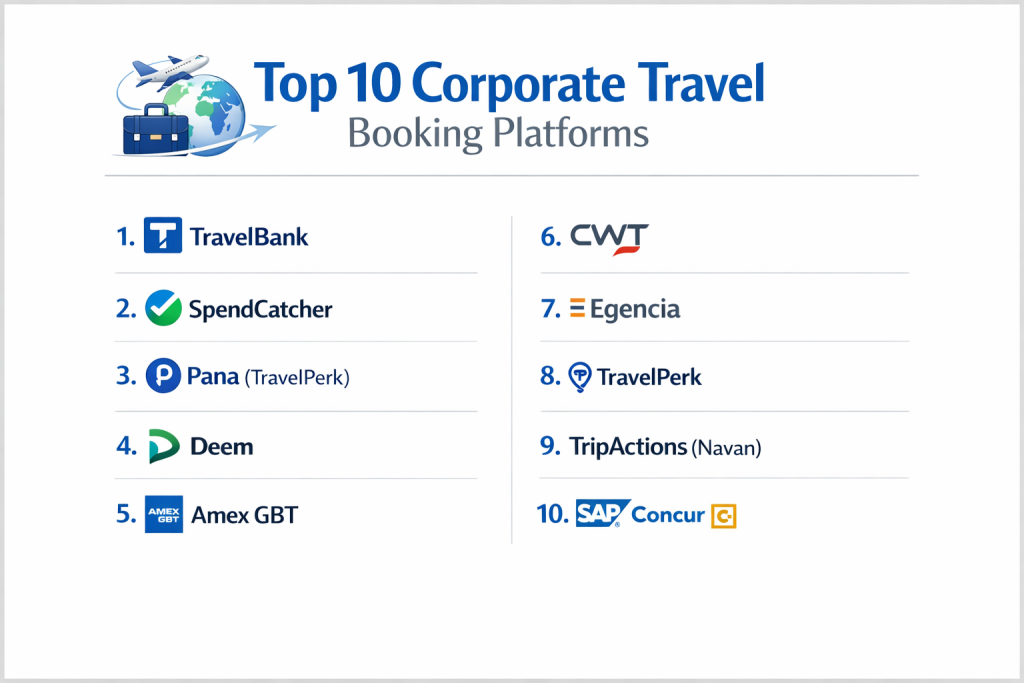
Top 10 Corporate Travel Booking Platforms
Here is a detailed analysis of the leading platforms that manage the complexities of business travel.
1 — SAP Concur
SAP Concur is the giant in the corporate travel and expense management space. It’s a comprehensive, integrated suite that combines travel booking, expense reporting, and invoice management into one powerful, global platform.
Key features:
- End-to-End Integration: Seamlessly connects travel booking with expense reporting and corporate card reconciliation.
- Strong Policy Enforcement: Highly configurable rules engine to enforce travel policies at the point of booking.
- Global Scale: Extensive global content for flights, hotels, and ground transportation.
- Detailed Analytics & Reporting: Robust business intelligence tools for deep spend analysis and program optimization.
- Mobile-First Experience: Excellent mobile apps for travelers to book, track expenses, and get support on the go.
- Ecosystem & Marketplace: Vast network of integrated partners (Uber, Lyft, restaurants) and apps.
Pros:
- The most comprehensive and integrated T&E (Travel & Expense) platform on the market.
- Unmatched data insights and reporting capabilities for large, complex organizations.
- Industry-standard reliability and global support network.
Cons:
- Can be complex and expensive to implement and administer, often seen as “heavyweight.”
- The user interface, while powerful, can feel dense and less modern than newer challengers.
- Best value is realized when using the full suite (Travel + Expense); using only travel can be costly.
Security & compliance: Enterprise-grade security as part of SAP. Strong compliance features for GDPR, SOC 1 & 2, and other regional regulations. A trusted partner for highly regulated industries.
Support & community: Provides 24/7 traveler support and dedicated account management for clients. Has a massive user and partner community, along with extensive training resources.
2 — TripActions (Now Navan)
TripActions, rebranding as Navan, is a modern, user-centric platform known for its consumer-like interface and a unique model that incentivizes cost-saving behavior through rewards (like gift cards) for employees.
Key features:
- Consumer-Grade UX: Intuitive, app-first design that employees actually enjoy using.
- Rewards Program: “TripBucks” or similar rewards incentivize travelers to book within policy and choose cost-effective options.
- All-in-One Pricing: Simplified pricing model that includes booking fees, support, and often corporate card processing.
- Real-Time Travel Support: 24/7 in-app chat and phone support for travelers.
- AI-Powered Recommendations: Suggests optimal flights and hotels based on policy, price, and traveler preference.
- Integrated Expense Management: Built-in expense tracking and corporate card offering.
Pros:
- Exceptional user adoption rates due to its ease of use and rewarding experience.
- Proven to drive policy compliance and cost savings through behavioral economics.
- Modern, agile platform that iterates quickly and feels like a consumer app.
Cons:
- The rewards model, while effective, can be seen as gimmicky by some traditional finance departments.
- Historically focused on the mid-market; while scaling enterprise, it may lack some ultra-complex configurability of legacy players.
- The rebrand to Navan and rapid evolution can cause some user confusion.
Security & compliance: Robust security infrastructure. SOC 2 Type II certified, GDPR compliant, and meets standard enterprise security requirements.
Support & community: Known for outstanding, proactive 24/7 traveler support. Strong focus on customer success and a loyal following in the tech and startup sectors.
3 — TravelPerk
TravelPerk is a fast-growing platform that combines a vast inventory (one of the largest in the industry) with a simple, flexible user experience and strong focus on sustainability and support.
Key features:
- Vast Inventory (“StarSearch”): Aggregates content from hundreds of sources, including budget airlines and boutique hotels.
- FlexiPerk: A popular add-on that allows cancellations on any booking up to two hours before, for a small fee (typically ~$50).
- GreenPerk: Integrated carbon offsetting for every trip booked.
- Advanced Reporting: User-friendly but powerful analytics dashboard.
- 7-Star Support: Commitment to high-touch, responsive customer service.
- Slack & HRIS Integrations: Strong integrations for modern workplace tools.
Pros:
- Unbeatable inventory breadth, ensuring the best prices and options.
- Flexibility (FlexiPerk) is a huge value for dynamic businesses and reduces traveler anxiety.
- Excellent, human-centric customer support.
Cons:
- The platform’s flexibility and vast options can sometimes work against strict policy enforcement if not configured tightly.
- Add-ons like FlexiPerk and GreenPerk increase the cost per booking.
- Less of a deep, integrated expense management suite compared to Concur.
Security & compliance: Bank-level security, GDPR compliant, ISO 27001 certified, and holds a SOC 2 Type II report. A secure, modern platform.
Support & community: “7-Star Support” is a key differentiator—highly rated by users. Popular among European and international companies, and businesses valuing sustainability.
4 — Engine
Engine is the modern travel platform for booking and managing work trips. It saves businesses time and money through an intuitive travel network that connects to nearly every hotel room, airline, and car rental company in the U.S. Customers rely on the platform to centralize their travel program while making the process more enjoyable for everyone involved.
Key Features:
- Spend Control: Admins can set rate caps and class-of-service rules that block out-of-policy options or route them to manager approval at search, cart, and checkout.
- Duty of Care: The dashboard surfaces every booked trip on a Safety page with traveler contact information and risk-flagged itineraries from International SOS.
- Unified Visibility: Provides a real-time view of all company travel and spend by department or project.
- Flexible Bookings: Users can modify reservations or add flexibility to bookings to only pay for the nights they stay.
Pros:
- No membership fee or agent-assist fees for users.
- Finance teams gain control over spend before it happens through proactive policy enforcement.
- Eliminates the need for traveler cards and individual expense reports by using a single invoice.
Cons:
- The platform provides booking-based visibility rather than real-time GPS tracking for travelers.
- Larger room blocks require RFPs with the dedicated Groups team instead of self-serve booking.
Security & Compliance: Engine ensures organizational compliance through automated policy enforcement at the point of booking and detailed financial reporting. Learn more at engine.com.
Support & Community: The platform is designed for ease of use, helping project managers and coordinators manage travel without the friction of traditional processes.
5 — CWT (Carlson Wagonlit Travel)
CWT is one of the world’s largest traditional travel management companies (TMCs) with a powerful digital platform. It represents the “high-touch” model, combining its own online booking tool with deep expertise from human travel consultants.
Key features:
- Blended Service Model: Seamlessly moves travelers between self-service online booking and expert agent assistance.
- Global Consulting Services: Offers strategic consulting for travel program optimization, sourcing, and risk management.
- myCWT Platform: Its proprietary digital platform for booking, mobile travel management, and analytics.
- Strong Risk & Security Services: Industry-leading duty-of-care, tracking, and crisis management.
- Global Footprint: Physical offices and expertise in hundreds of countries.
- Sourcing & Negotiation: Leverages its massive volume to negotiate bespoke rates with airlines and hotels.
Pros:
- Unmatched for complex, global, high-security travel requiring expert human intervention.
- Provides strategic value beyond booking—true travel program management.
- Trusted by the largest multinational corporations and governments.
Cons:
- The cost structure typically involves management fees and can be higher than online-first platforms.
- The digital platform may not be as sleek or intuitive as born-digital competitors.
- Best suited for very large enterprises with sophisticated, high-volume programs.
Security & compliance: A leader in travel risk and security, with dedicated teams and tools. Complies with the highest international standards for data and operational security.
Support & community: 24/7 agent support is core to its offering. The community is its vast network of corporate clients and travel industry partners.
6 — American Express Global Business Travel (Amex GBT)
American Express GBT is another global TMC powerhouse, formed by the merger of American Express Business Travel and others. It combines the clout of the American Express brand with comprehensive travel management services and technology.
Key features:
- Integrated Payment Solutions: Deep integration with American Express Commercial Card products for streamlined reconciliation.
- Neo™ Platform: Its modern, data-driven online booking tool and traveler app.
- Meetings & Events Management: Strong capabilities for managing group travel and corporate events.
- Consultative Account Management: Dedicated teams for strategic travel program oversight.
- Extensive Supplier Relationships: Strong negotiated air, hotel, and car rental programs.
- Risk Management: Comprehensive duty-of-care and traveler tracking services.
Pros:
- Excellent for companies that value the American Express ecosystem, especially for payments.
- Strong hybrid of sophisticated technology and high-touch service.
- Trusted brand with a long history of serving corporate clients.
Cons:
- Like CWT, it is a traditional TMC with a corresponding fee structure.
- Can be perceived as less agile or innovative than some newer, digital-native players.
- Best fit is typically for mid-to-large market companies and enterprises.
Security & compliance: Leverages American Express’s world-class security and compliance infrastructure. A top choice for companies with stringent financial and data controls.
Support & community: Provides 24/7 agent support and dedicated account management. A stalwart in the corporate travel industry.
7 — Deem (Formerly Etta)
Deem is a focused corporate booking platform known for its high configurability and strong focus on workflow automation. It often powers the white-label or co-branded booking tools for other TMCs and large enterprises.
Key features:
- Highly Configurable Workflows: Can be tailored to match complex corporate approval chains and policies.
- Cost Control Tools: Advanced features for budget management and pre-trip approval.
- White-Label Capabilities: Often used as the engine behind other companies’ branded travel tools.
- Integrated Ground Transportation: Strong focus on booking and managing car services, taxis, and ride-sharing.
- Analytics Suite: Solid reporting and data visualization tools.
- API-First Architecture: Designed for deep integration into other enterprise systems.
Pros:
- Extremely flexible and can be molded to fit unique, complex business processes.
- Powerful for enforcing strict cost controls and approval workflows.
- A “platform for platforms,” trusted for its robustness.
Cons:
- Less of a household name for end-user travelers; often works in the background.
- The user interface can feel more utilitarian than consumer-inspired.
- May require more technical resources to implement and customize fully.
Security & compliance: Enterprise-grade security with a focus on data protection and secure transactions. Relevant compliance certifications should be confirmed.
Support & community: Support is typically channeled through the TMC or partner that implements it. Has a strong reputation among travel industry technologists.
8 — Pana (Now part of TravelPerk)
Pana, now integrated into TravelPerk, was notable for its unique, concierge-like model powered by a blend of AI and human assistants. It catered to companies wanting a highly personalized, white-glove service without the complexity of self-booking.
Key features:
- Conversational AI + Human Concierge: Travelers request trips via chat/message, and AI + human experts handle all research and booking.
- Zero Self-Booking: Removes the burden of searching and booking from the employee.
- Proactive Travel Management: Concierge team manages changes, disruptions, and questions 24/7.
- Policy Adherence: Humans ensure every booking complies with company policy.
- Simple Pricing: Often a flat per-trip or per-traveler fee.
Pros:
- Maximizes employee productivity and satisfaction by completely outsourcing the booking task.
- Exceptional service level and personalization.
- Simple, predictable experience for travelers.
Cons:
- Less transparency and control for travelers who prefer to search and choose themselves.
- The concierge model can be more expensive per booking than self-service platforms.
- As part of TravelPerk, its future as a distinct offering may evolve.
Security & compliance: Inherits TravelPerk’s security posture. The human-in-the-loop model requires strong training and protocols for data handling.
Support & community: The concierge service is the support. It cultivated a very loyal user base among executives and busy professionals.
9 — SpendCatcher (by Coupa)
While Coupa is primarily a spend management platform, its SpendCatcher module for travel uses AI to capture travel expenses from any booking source (corporate platform, direct booking, even personal cards) and enforce policy after the fact.
Key features:
- “Book Anywhere” Policy: Uses AI to scan receipts and itineraries from any booking channel and apply policy rules.
- Real-Time Policy Guidance: App provides feedback on spend against policy as expenses are incurred.
- Integrated with Coupa’s Procure-to-Pay Suite: Part of a full suite for managing all company spend.
- Focus on Compliance & Data: Aims to bring visibility and control to out-of-channel (“leaked”) spend.
- Simplified Expensing: Automatically creates expense reports from captured data.
Pros:
- Revolutionary approach for companies struggling with policy leakage and lack of visibility.
- Empowers employees with flexibility while giving finance control and data.
- Integrates travel spend with the broader picture of company procurement.
Cons:
- Not a booking platform in the traditional sense; it’s a compliance and capture layer.
- May not provide the upfront savings of negotiated rates or proactive trip support.
- Part of a larger ERP-like suite, so may only make sense for existing Coupa users.
Security & compliance: As a major spend management platform, Coupa has strong enterprise security and compliance certifications (SOC 1, SOC 2, ISO 27001).
Support & community: Support through Coupa. Serves finance and procurement professionals in mid-to-large enterprises.
10 — TravelBank
TravelBank merges travel booking, expense management, and budgeting into a single, user-friendly app. It’s geared toward small and mid-sized businesses that want an all-in-one solution without enterprise complexity.
Key features:
- Unified Travel & Expense: Book travel and file expenses in the same app, with receipts automatically attached.
- Dynamic Budgeting: Set trip budgets and track spending against them in real time.
- Smart Policy Engine: Configurable policies that guide employees during booking and expense submission.
- Corporate Card Integration: Offers a corporate card that syncs seamlessly with the platform.
- Simple Pricing: Transparent, per-active-user monthly subscription.
- Mobile-First Design: Clean, intuitive app for travelers and approvers.
Pros:
- Excellent all-in-one value for SMBs looking to streamline T&E.
- Real-time budget tracking helps control costs proactively.
- Very easy to adopt and use, with a modern interface.
Cons:
- Travel inventory and global support may not be as deep as specialized or global TMCs.
- May lack the ultra-granular policy configurability required by large, complex organizations.
- A smaller player in a market of giants.
Security & compliance: Uses bank-level encryption and is PCI DSS compliant. Stated to be SOC 2 compliant and GDPR ready.
Support & community: Provides customer support via email, chat, and phone. Popular in the startup and tech SMB space.
Comparison Table
| Tool Name | Best For (Target User or Scenario) | Platform(s) Supported | Standout Feature | Rating |
|---|---|---|---|---|
| SAP Concur | Large enterprises needing integrated travel, expense & invoice management | Web, Mobile, ERP | Market-Leading Integration & Data Depth | N/A |
| TripActions (Navan) | Companies prioritizing user adoption & behavioral cost savings | Web, Mobile, App | Rewards-Driven UX & Modern Design | N/A |
| TravelPerk | Businesses valuing inventory choice, flexibility & great support | Web, Mobile | Vast Inventory & FlexiPerk Cancellation | N/A |
| Egencia | Companies wanting Expedia’s power with corporate controls | Web, Mobile | Expedia-Powered Inventory & Scale | N/A |
| CWT | Global enterprises needing high-touch service & risk management | Web, Mobile, Agents | Blended Human/Digital Service & Global Consulting | N/A |
| Amex GBT | Mid-to-large companies in the Amex ecosystem | Web, Mobile, Agents | Amex Card Integration & Trusted Brand | N/A |
| Deem | Complex organizations needing highly configurable workflows | Web, Mobile, API | Deep Workflow Customization & White-Label Engine | N/A |
| Pana (TravelPerk) | Busy teams wanting a full-service, concierge experience | Mobile, Chat | AI+Human Concierge Service | N/A |
| SpendCatcher (Coupa) | Companies wanting to control spend after any booking source | Web, Mobile, AI | “Book Anywhere” AI-Powered Policy Enforcement | N/A |
| TravelBank | SMBs wanting a simple, all-in-one travel & expense app | Web, Mobile | Unified Travel, Expense & Budgeting for SMBs | N/A |
Evaluation & Scoring of Corporate Travel Booking Platforms
To compare effectively, score each platform from 1 (Poor) to 5 (Excellent) based on your company’s specific travel program needs.
| Evaluation Criteria | Weight | Score (1-5) | Weighted Score | Notes on What to Look For |
|---|---|---|---|---|
| Core Features | 25% | Does it handle booking, policy, expense, safety, and reporting adequately? | ||
| Ease of Use | 15% | Will employees actually use it, or will they book elsewhere? Is it intuitive? | ||
| Integrations & Ecosystem | 15% | Does it connect to your ERP, HR system, expense tool, and corporate cards? | ||
| Security & Compliance | 10% | How does it protect traveler data? Does it meet your industry’s regulatory needs? | ||
| Performance & Reliability | 10% | Is it always available? Can it handle booking volumes during peak times? | ||
| Support & Community | 10% | Is support available 24/7? Can they help during a flight cancellation at 2 AM? | ||
| Price / Value | 15% | Understand the total cost: booking fees, management fees, implementation, etc. | ||
| TOTAL SCORE | 100% | /100 |
Which Corporate Travel Booking Platform Is Right for You?
Your company size, travel volume, and need for control versus flexibility are the key decision drivers.
- Small Businesses & Startups (1-50 travelers): Prioritize simplicity and value. TravelBank offers a great all-in-one package. TravelPerk provides flexibility and excellent support. If employees book rarely, a managed card with expense software might suffice.
- Mid-Market Companies (50-500 travelers): You need robust policy and growing support. TripActions (Navan) drives adoption and savings. TravelPerk scales well here. Egencia and Amex GBT offer strong mid-market programs. Deem works if you have complex workflows.
- Large Enterprises & Global Corporations (500+ travelers): You need global scale, deep integration, and strategic management. SAP Concur is the integrated suite leader. CWT and Amex GBT provide high-touch TMC services. TripActions and TravelPerk are aggressively competing in this space with modern platforms.
- Budget-Conscious vs. Premium: Online-first platforms (TravelPerk, TripActions, TravelBank) often have more transparent, all-in pricing. Traditional TMCs (CWT, Amex GBT) provide premium service with a corresponding management fee model. Concur is a major investment.
- Feature Depth vs. Ease of Use: Concur and Deem offer immense depth and configurability. TripActions and TravelBank prioritize a seamless user experience. TravelPerk balances both well.
- Integration Needs: If you use SAP or Oracle ERP, Concur has native strength. If you use Slack extensively, check TravelPerk. If American Express Commercial Cards are your payment method, Amex GBT integrates tightly. For Coupa users, SpendCatcher is logical.
- Security & Compliance Requirements: For highly regulated industries (finance, government), the proven track records of Concur, CWT, and Amex GBT are key. For global data privacy (GDPR), ensure any platform you choose has robust controls. All major players invest heavily here.
Frequently Asked Questions (FAQs)
1. What’s the difference between a booking platform and a Travel Management Company (TMC)?
A booking platform is primarily the software tool. A TMC (like CWT or Amex GBT) is a full-service partner that provides the platform plus strategic consulting, human agents, negotiated rates, and 24/7 support. Many platforms are offered by TMCs, and some TMCs use third-party platforms.
2. Can we enforce our travel policy with these tools?
Yes, that’s a primary function. You can set rules for booking classes (economy only), preferred airlines/hotels, maximum nightly rates, and required approval workflows. The best tools enforce policy at the point of booking, preventing out-of-policy purchases.
3. How do these platforms save the company money?
Through: Policy enforcement (preventing overly expensive bookings), negotiated rates with vendors (via the platform/TMC’s volume), visibility into spend (identifying waste), and incentivizing cost-saving behavior (like TripActions’ rewards).
4. What is “duty of care” and why is it important?
Duty of care is a company’s legal and ethical obligation to ensure employee safety while traveling for work. Platforms provide traveler tracking, risk alerts (for natural disasters or unrest), and emergency communication tools. This is non-negotiable for responsible companies.
5. What if an employee books outside the platform (“leakage”)?
This is a major challenge. Solutions include: mandating platform use via expense reimbursement rules, using tools like Coupa SpendCatcher to capture out-of-channel spend, or integrating corporate cards so all spend is visible regardless of source.
6. How do approvals work?
Managers can be required to approve trips before booking, especially if they exceed budget or policy. The platform automates this workflow, sending requests via email or in-app and tracking the approval chain.
7. Can employees earn personal loyalty points (air miles, hotel points) on business travel?
Typically, yes. Companies usually let employees keep frequent flyer miles and hotel points from business travel as a perk. The platform should allow the traveler to enter their loyalty numbers during booking.
8. How is customer support handled during travel disruptions?
This is a key differentiator. Look for 24/7 support via phone, chat, or app. Some platforms use AI for quick rebooking, while others connect you to a human agent. The best proactively reach out to travelers affected by delays or cancellations.
9. Do we need to integrate with our expense software?
Absolutely. A seamless flow from booking to expense reporting is a huge time-saver. Ideally, booked trip data (flights, hotels) automatically populates an expense report, requiring only receipt upload for meals and incidentals.
10. What’s the biggest mistake companies make when choosing a platform?
Choosing based on price or features alone, without considering user adoption. If the tool is difficult or frustrating, employees will book elsewhere, causing policy leakage, lost data, and ultimately, higher costs. The best tool is one your travelers will actually use.
Conclusion
Selecting a corporate travel booking platform is a strategic decision that impacts your company’s finances, operational efficiency, and employee well-being. It’s an investment in a system that should work invisibly well for travelers while providing crystal-clear control and insight for managers and finance teams.
The right choice hinges on understanding your company’s travel DNA. Is your priority cutting costs, ensuring safety, empowering employees, or gaining strategic insights? The landscape offers solutions from high-touch global service models to sleek, behavioral-science-driven apps, each with a different philosophy.
There is no single “best” platform for every company. The optimal platform is the one that aligns with your company’s culture, scales with your growth, and strikes the perfect balance between control and flexibility. By carefully weighing the needs of your travelers against the requirements of your finance and risk teams, you can implement a travel management solution that not only saves money but also makes life on the road smoother, safer, and more productive for your entire team.
A feature that can make a big difference in real-world use is how quickly the platform handles itinerary changes and travel disruptions. Flexible rebooking options and clear communication during unexpected situations are often just as important as the initial booking experience.