Introduction
Travel Management Software (TMS) is a centralized digital platform designed to help organizations plan, track, and analyze corporate travel. Unlike consumer-grade booking sites, these platforms are engineered to balance the needs of the traveler with the financial and safety requirements of the company. A robust TMS consolidates flights, hotels, rail, and car rentals into a single interface while simultaneously enforcing company travel policies, automating expense reporting, and providing real-time “Duty of Care” alerts to keep employees safe during transit.
travel management is no longer just about finding the cheapest flight; it is about data visibility and employee well-being. Modern software uses AI to suggest personalized itineraries that fit within budget constraints and carbon emission targets. By using a TMS, companies can eliminate the “rogue booking” (where employees book on external sites), ensuring that every dollar spent is accounted for and every traveler is reachable in an emergency. This digital oversight is essential for maintaining tax compliance, managing VAT recoveries, and negotiating better corporate rates with airlines and hotel chains.
Key Real-World Use Cases
- Policy Enforcement: Automatically flagging a business-class flight that exceeds the company’s “economy-only” rule for domestic trips.
- Duty of Care: Instantly locating and messaging all employees currently in a city affected by a sudden natural disaster or political unrest.
- Expense Automation: Seamlessly pushing digital receipts from a hotel booking directly into an accounting system like SAP Concur or NetSuite.
- Sustainability Tracking: Calculating the carbon footprint of all corporate trips to meet annual ESG (Environmental, Social, and Governance) reporting requirements.
What to Look For (Evaluation Criteria)
When selecting a TMS, prioritize Inventory Breadth—the software must have access to global distribution systems (GDS) as well as low-cost carriers and Airbnb-style accommodations. Mobile Functionality is equally critical; travelers need to be able to change a flight or chat with support from an airport gate. Furthermore, evaluate the Reporting Suite for its ability to provide real-time spend data. Finally, ensure the tool has strong Integration Capabilities with your existing HRIS (HR Information System) and expense platforms to minimize manual data entry.
Best for: Travel managers, CFOs, and HR directors in companies ranging from mid-market startups to global enterprises. It is vital for businesses where employees travel frequently for sales, field service, or executive meetings.
Not ideal for: Solo freelancers or very small teams with occasional travel needs (one or two trips a year). For these users, standard consumer tools or a basic corporate credit card portal are usually more cost-effective.
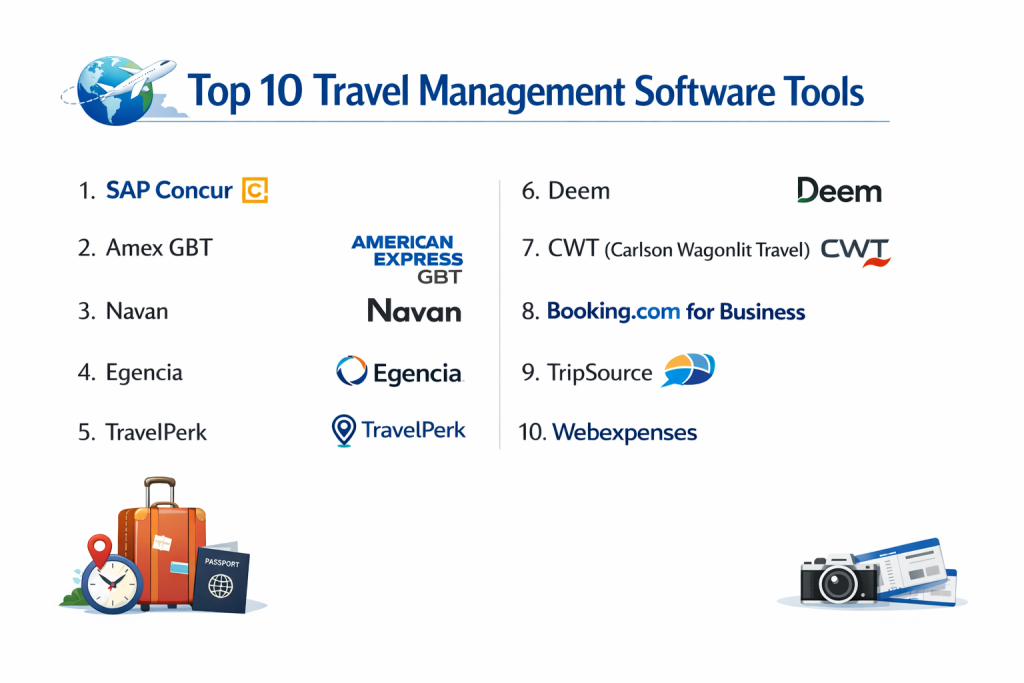
Top 10 Travel Management Software Tools
1 — Navan (formerly TripActions)
Navan is a modern, high-growth platform that combines corporate travel, cards, and expenses into a single, AI-driven experience.
- Key features
- AI-powered personalizations that learn traveler preferences over time.
- Integrated “Navan Connect” card for seamless expense reconciliation.
- Real-time global dashboard for Duty of Care and traveler tracking.
- Carbon offset tracking and sustainability reporting.
- 24/7 proactive support via chat, phone, and email.
- Inventory including GDS, NDC, and direct hotel connects.
- “Bleisure” support allowing employees to book personal trips on the same platform.
- Pros
- The most intuitive mobile app in the industry, significantly increasing employee adoption.
- Real-time expense visibility eliminates the “end-of-month” manual reporting headache.
- Cons
- Can be more expensive than legacy players for very large, traditional enterprises.
- High reliance on their own fintech ecosystem for the best experience.
- Security & compliance: SOC 2 Type II, GDPR, PCI DSS compliant, and supports SSO/SAML.
- Support & community: High-touch 24/7 support with an average response time of under 60 seconds.
2 — SAP Concur
SAP Concur is the “old guard” and the global leader in travel and expense management, offering unparalleled depth for large-scale corporations.
- Key features
- Deep integration with the broader SAP ERP ecosystem.
- “Concur Travel” allows for highly granular policy configurations.
- Integrated expense management with “Concur Expense.”
- TripIt Pro integration for advanced itinerary management.
- Extensive App Center with hundreds of third-party connectors.
- Global VAT reclamation and tax compliance tools.
- Automated audit trails for every transaction.
- Pros
- The “gold standard” for compliance and audit requirements in highly regulated industries.
- Scalability that can handle hundreds of thousands of employees across 100+ countries.
- Cons
- The user interface can feel dated and clunky compared to modern SaaS tools.
- Implementation is a long, complex process often requiring external consultants.
- Security & compliance: ISO 27001, SOC 1 & 2, HIPAA, GDPR, and FedRAMP authorized.
- Support & community: Massive global user group, extensive certification programs, and 24/7 enterprise support.
3 — TravelPerk
Based in Europe but with a massive global reach, TravelPerk is known for having the “world’s largest inventory” and a focus on flexibility.
- Key features
- “FlexiPerk” feature allowing for cancellation of any trip for any reason with a 80% refund.
- Zero-subscription fee tier for small businesses.
- Carbon footprint reporting and offsetting via “GreenPerk.”
- Integration with Slack, HRIS tools (like BambooHR), and expense apps.
- VAT-ready invoices consolidated into one simple monthly document.
- Group booking management for company retreats or events.
- Concierge service for complex visas or special requests.
- Pros
- The FlexiPerk feature provides incredible peace of mind in an unpredictable travel market.
- Very transparent pricing and a high-quality consumer-grade booking experience.
- Cons
- While inventory is vast, some niche regional airlines may still require manual booking.
- Customer support, while good, can be slower during peak global travel disruptions.
- Security & compliance: SOC 2, GDPR compliant, and uses advanced encryption for payment data.
- Support & community: 24/7 human support (no chatbots), extensive help center, and localized support in multiple languages.
4 — Egencia (by American Express GBT)
Egencia combines the technology of a modern platform with the traditional clout of American Express Global Business Travel.
- Key features
- Access to Amex GBT’s massive negotiated rates and preferred inventory.
- Smart mix of automated booking and human agency support.
- Sophisticated traveler risk management and “Safe Travel” newsfeeds.
- Visual analytics dashboard for “Savings Opportunities” identification.
- Cross-device syncing (start booking on desktop, finish on mobile).
- Automated flight and hotel price tracking (re-books if prices drop).
- Integrated approval workflows that don’t slow down the traveler.
- Pros
- Exceptional negotiating power; the corporate rates are often unbeatable.
- Strong balance between a self-service platform and a traditional travel agency.
- Cons
- The platform can feel “corporate-heavy” for small, agile startups.
- Transitioning between the tech platform and human agents can occasionally be disjointed.
- Security & compliance: ISO 27001, GDPR, and PCI DSS compliant.
- Support & community: 24/7 global support with access to highly experienced travel counselors.
5 — Deem (by Etta)
Deem, now part of the Travelport family, focuses on “Mobile-First” travel management with a high emphasis on the traveler’s physical journey.
- Key features
- “Etta” mobile app designed for accessibility and ease of use.
- Safety check features that show neighborhood crime stats and hotel safety.
- Deep integration with Ground Transportation (Uber for Business / Lyft).
- Automated policy audit at the time of booking.
- Eco-check features to help travelers choose lower-emission flights.
- Calendar integration that automatically populates itineraries.
- Support for “Guest Bookings” for non-employee travelers (candidates/consultants).
- Pros
- One of the best user interfaces for ground transportation and car rentals.
- Very high scores for accessibility (ADA compliance) and inclusivity.
- Cons
- Not as “all-in-one” as Navan (requires separate expense software).
- Inventory in certain Asian and African markets is less comprehensive than competitors.
- Security & compliance: SOC 2 Type II, GDPR, and Privacy Shield certified.
- Support & community: Robust online training for travel managers and 24/7 support.
6 — CWT (formerly Carlson Wagonlit Travel)
CWT is a traditional global powerhouse that has pivoted heavily toward “Digital-First” management via its myCWT platform.
- Key features
- myCWT platform for seamless booking across web, app, and messaging.
- High-touch counselor support for complex, multi-leg international trips.
- “CWT Solutions Group” for deep data consulting and spend optimization.
- Specialized “Energy, Resources & Marine” travel division.
- Real-time flight alerts and gate change notifications.
- Integrated hotel reviews from travelers within the same company.
- Messaging-based booking (book a trip via a chat interface).
- Pros
- Unmatched expertise in complex, “high-touch” industries like oil and gas.
- The ability to text a real person to change a flight is a major traveler favorite.
- Cons
- The technology platform can sometimes lag behind Navan or TravelPerk in terms of “slickness.”
- Pricing is typically opaque and geared toward large corporate contracts.
- Security & compliance: ISO 27001, GDPR, and PCI DSS Level 1.
- Support & community: Global presence with local experts in nearly every country.
7 — Spotnana
Spotnana is the “new kid on the block,” offering a cloud-native infrastructure that aims to modernize the underlying plumbing of the travel industry.
- Key features
- Content-agnostic platform (sees NDC, GDS, and direct content equally).
- Open API architecture allowing companies to build their own travel tools.
- Real-time global data parity (everyone sees the same price at the same time).
- Simplified global service model (no regional silos).
- Transparent “flat-fee” pricing per trip.
- Sustainability data embedded at the point of purchase.
- Ability for travel agencies to use Spotnana as their underlying “OS.”
- Pros
- The most modern, “clean” technology stack in the travel industry.
- Total transparency in pricing and inventory—no hidden markups.
- Cons
- Still a relatively young company; lacks the “decades of data” of a Concur.
- The community of third-party “integrations” is still growing.
- Security & compliance: SOC 2 Type II and GDPR compliant.
- Support & community: Tech-forward support team and a growing developer community.
8 — Lola.com (now Capital One Travel)
While Lola was acquired by Capital One, its technology powers a massive portion of the SMB travel market through Capital One Business.
- Key features
- Extremely simplified booking for small teams.
- Real-time spend tracking integrated with business credit cards.
- Easy-to-use “Travel Policy” builder.
- 24/7 “human” support for travelers.
- Centralized invoicing and reporting.
- Automatic rewards points integration.
- Simple traveler profile management.
- Pros
- The easiest tool for a small business owner to set up (minutes, not weeks).
- Perfect integration for those already using Capital One for business banking.
- Cons
- Lacks the deep enterprise features needed by companies with 500+ travelers.
- Inventory is more geared toward domestic North American travel.
- Security & compliance: Varies (Bank-level security via Capital One), GDPR, PCI DSS.
- Support & community: High-quality phone and chat support.
9 — BCD Travel
BCD is another global giant that excels in “Program Management,” helping companies build entire travel cultures.
- Key features
- “TripSource” app for traveler engagement and itinerary management.
- “DecisionSource” for advanced data analytics and benchmarking.
- SolutionSource marketplace for vetted third-party tech.
- Virtual payment automation to reduce credit card fraud.
- Comprehensive traveler “Well-being” tracking.
- Specialized support for “Life Sciences” and “Entertainment” sectors.
- Global network covering 100+ countries.
- Pros
- Excellent at turning travel data into actionable cost-saving strategies.
- One of the best at managing “Guest” travel and large group movements.
- Cons
- The software interface can be intimidating for casual travelers.
- Geared primarily toward “Managed Travel” (high-volume accounts).
- Security & compliance: ISO 9001, ISO 27001, and GDPR compliant.
- Support & community: Industry-leading consultancy services and global 24/7 support.
10 — FCM Travel
FCM is known for its “Alternative” approach, focusing on flexibility and a highly personalized user interface called “HUB.”
- Key features
- “HUB” platform—a personalized portal for every user.
- “Sam” (Smart Assistant for Mobile) AI chatbot for travel alerts.
- Global “Price Booking” technology to find the best fare worldwide.
- Flexible, modular contract structures.
- Dedicated account managers for every client, regardless of size.
- Integration with a wide range of local expense providers.
- Strong “Offline” support for when tech isn’t enough.
- Pros
- One of the most flexible players; they adapt to your process, not vice versa.
- The “Sam” AI is genuinely helpful and less intrusive than other chatbots.
- Cons
- Can be a bit “agent-heavy,” which may frustrate users who want 100% automation.
- The “HUB” can sometimes feel like a collection of different tools rather than one unified app.
- Security & compliance: GDPR, PCI DSS, and ISO 27001 compliant.
- Support & community: Excellent regional support with a “local” feel in international markets.
Comparison Table
| Tool Name | Best For | Platform(s) Supported | Standout Feature | Rating |
| Navan | SMB to Enterprise | Web, iOS, Android | Integrated Cards & AI | 4.8 / 5 |
| SAP Concur | Global Corporations | Web, iOS, Android | Deep ERP Ecosystem | 4.4 / 5 |
| TravelPerk | European / High-Flex | Web, iOS, Android | FlexiPerk (Any-reason Refund) | 4.7 / 5 |
| Egencia | Value Seekers | Web, iOS, Android | Amex Negotiated Rates | 4.5 / 5 |
| Deem | Ground Travel / UX | Web, iOS, Android | Safety/Accessibility Focus | 4.6 / 5 |
| CWT | Complex Sectors | Web, iOS, Android, SMS | Messaging-based Booking | 4.4 / 5 |
| Spotnana | Tech-Forward / API | Web, iOS, Android | Open API Architecture | 4.5 / 5 |
| Capital One Travel | Small Teams / SMB | Web, Mobile | Banking Integration | N/A |
| BCD Travel | Data / Consulting | Web, App | DecisionSource Analytics | 4.3 / 5 |
| FCM Travel | Personalization | Web, iOS, Android | “Sam” AI Assistant | 4.4 / 5 |
Evaluation & Scoring of Travel Management Software
| Category | Weight | Score (1-10) | Evaluation Rationale |
| Core Features | 25% | 9 | Most tools have mastered the “Book-Track-Report” lifecycle. |
| Ease of Use | 15% | 8 | Huge gap between modern SaaS (Navan) and legacy hubs (Concur). |
| Integrations | 15% | 8 | ERP and HRIS integrations are now standard, but depth varies. |
| Security & Compliance | 10% | 10 | Non-negotiable in this space; all top 10 are highly certified. |
| Performance | 10% | 9 | High reliability is expected for Duty of Care requirements. |
| Support & Community | 10% | 9 | The industry is moving back to “Human + Tech” support models. |
| Price / Value | 15% | 8 | ROI is usually high due to savings on “rogue” spending. |
Which Travel Management Tool Is Right for You?
Solo Users vs SMB vs Mid-Market vs Enterprise
If you are a Small Business (SMB), look no further than TravelPerk or Capital One Travel. They offer low barrier-to-entry pricing and simple interfaces. Mid-Market companies experiencing rapid growth will benefit most from Navan, which scales effortlessly and adds expense management. Large Enterprises with complex international tax needs and thousands of travelers are still best served by the robust architecture of SAP Concur or the deep agency support of BCD Travel.
Budget-conscious vs Premium Solutions
If you are Budget-conscious, choose a platform like TravelPerk that offers a “Free” tier with no monthly subscription. You only pay when you travel. If you are looking for a Premium Solution, Egencia or CWT provide a “Concierge” level of service that justifies their higher management fees by saving your executives time and securing lower corporate rates.
Feature Depth vs Simplicity
For those who want Simplicity, Spotnana or Capital One Travel provide a clean, “no-nonsense” booking experience. If you need Feature Depth—including carbon offsetting, VAT recovery, guest traveler portals, and complex multi-level approval workflows—SAP Concur is the heavy hitter.
Integration and Scalability Needs
If your company lives in the SAP ecosystem, Concur is the logical choice. If you use a wide variety of modern tools like Slack, BambooHR, and Expensify, TravelPerk or Navan offer the most “friendly” open APIs. For companies that want to build their own internal travel dashboard, Spotnana is the only tool that truly offers the “Developer-First” infrastructure to do so.
Security and Compliance Requirements
Every tool on this list meets basic GDPR and PCI DSS requirements. However, if your company works with the government or in highly regulated medical/legal fields, you should prioritize SAP Concur or BCD Travel, as they hold the most rigorous global certifications (including FedRAMP for government agencies).
Frequently Asked Questions (FAQs)
1. Does travel management software actually save money?
Yes. Most businesses save 10–20% by eliminating “unmanaged spend” and accessing corporate-only rates. The software also saves hundreds of hours of manual administrative labor in finance departments.
2. Can employees still use their own loyalty points?
Yes. Every platform on this list allows travelers to add their frequent flyer and hotel loyalty numbers to their profiles. The bookings count toward their status just like a consumer booking.
3. What is “Duty of Care” and why is it in the software?
Duty of Care is a company’s legal obligation to keep employees safe. TMS tools include GPS tracking and emergency messaging so a company can find and help its staff during a crisis.
4. How long does it take to implement a TMS?
For SMB tools like TravelPerk, it can take less than an hour. For enterprise tools like SAP Concur, implementation can take 3–6 months due to the complexity of ERP integrations.
5. Can I manage personal travel on these platforms?
Some platforms, like Navan and TravelPerk, allow “Personal Travel” booking. This is a popular employee perk, as it allows them to access corporate rates for their own vacations.
6. Does the software handle “Unused Tickets”?
Yes. One of the biggest savings areas is tracking “Unused Ticket Credits” from canceled flights. Professional TMS tools automatically apply these credits to future bookings so they don’t expire.
7. Can I set different rules for different employees?
Absolutely. You can set a policy where VPs can book Business Class for long-haul flights while junior staff are restricted to Economy, all managed automatically at the point of search.
8. What happens if a flight is canceled?
The traveler can use the app to chat with a support agent immediately. Because the software has the booking data, the agent can re-book them on the next available flight without the traveler waiting in line at the airport.
9. Is this software expensive?
Pricing models vary. Some charge a monthly subscription, while others charge a flat fee per booking (e.g., $10–$25 per trip). Most companies find the savings on flights far outweigh the software cost.
10. Can I use the software for group travel?
Most platforms have a “Group” or “Events” module. This allows a manager to invite 50 people to a conference and track everyone’s arrival without manually checking 50 separate itineraries.
Conclusion
The “best” Travel Management Software is the one that your employees will actually use. A platform can have the most advanced reporting in the world, but if the booking experience is frustrating, employees will revert to booking on Expedia or direct sites, leaving you with no data and no control.
For the modern, agile company, Navan and TravelPerk offer the best balance of technology and user experience. For the global giant, SAP Concur and Egencia provide the safety and compliance guardrails necessary for thousands of travelers. Ultimately, choosing a TMS is an investment in your company’s culture—respecting your travelers’ time while protecting your company’s bottom line.