Introduction
AI Governance & Policy Tools are specialized platforms designed to provide oversight, risk management, and regulatory compliance for artificial intelligence systems. As businesses transition from experimental AI to production-grade deployments, these tools act as the “compliance engine,” ensuring that AI models operate within ethical, legal, and safety boundaries. They provide a structured framework to manage the entire AI lifecycle—from data sourcing and model training to real-time monitoring and decommissioning. By centralizing AI policies, these platforms help organizations avoid the “black box” problem, ensuring that every AI-driven decision is transparent, explainable, and accountable.
The importance of AI governance cannot be overstated in a landscape defined by rapid innovation and shifting regulations like the EU AI Act and NIST frameworks. Without these tools, organizations risk significant legal liabilities, reputational damage from biased outputs, and security vulnerabilities. AI Governance & Policy Tools provide the technical guardrails necessary to detect model drift, mitigate algorithmic bias, and protect sensitive data. They transform abstract ethical principles into concrete, measurable metrics that can be audited by internal teams or external regulators.
Key Real-World Use Cases
- Regulatory Alignment: Automatically mapping AI development processes to global standards such as the EU AI Act or ISO/IEC 42001.
- Algorithmic Bias Mitigation: Identifying and correcting discriminatory patterns in credit scoring, hiring, or healthcare diagnostic models.
- Model Inventory & Cataloging: Maintaining a “Single Source of Truth” for every AI model used across a global enterprise to ensure no “shadow AI” exists.
- Explainable AI (XAI): Generating human-readable “Factsheets” that explain how a complex neural network reached a specific conclusion.
- Third-Party Risk Management: Assessing the safety and compliance of vendor-provided AI tools before they are integrated into the corporate stack.
What to Look For (Evaluation Criteria)
When evaluating an AI governance platform, prioritize Automated Reporting and Audit Trails, which are essential for proving compliance during a regulatory inquiry. Multi-Model Support is also critical, as most enterprises use a mix of open-source and proprietary models. Look for Policy Templates that can be customized for specific industries (e.g., Finance or Healthcare) and Real-time Monitoring capabilities that can trigger “kill switches” if a model begins to exhibit unsafe behavior.
Best for: Chief Information Security Officers (CISOs), Data Privacy Officers (DPOs), Legal Counsel, and AI Ethics committees within large enterprises and highly regulated industries like banking and insurance.
Not ideal for: Small startups with only one or two internal AI models, or individual developers who are not yet subject to formal regulatory reporting requirements.
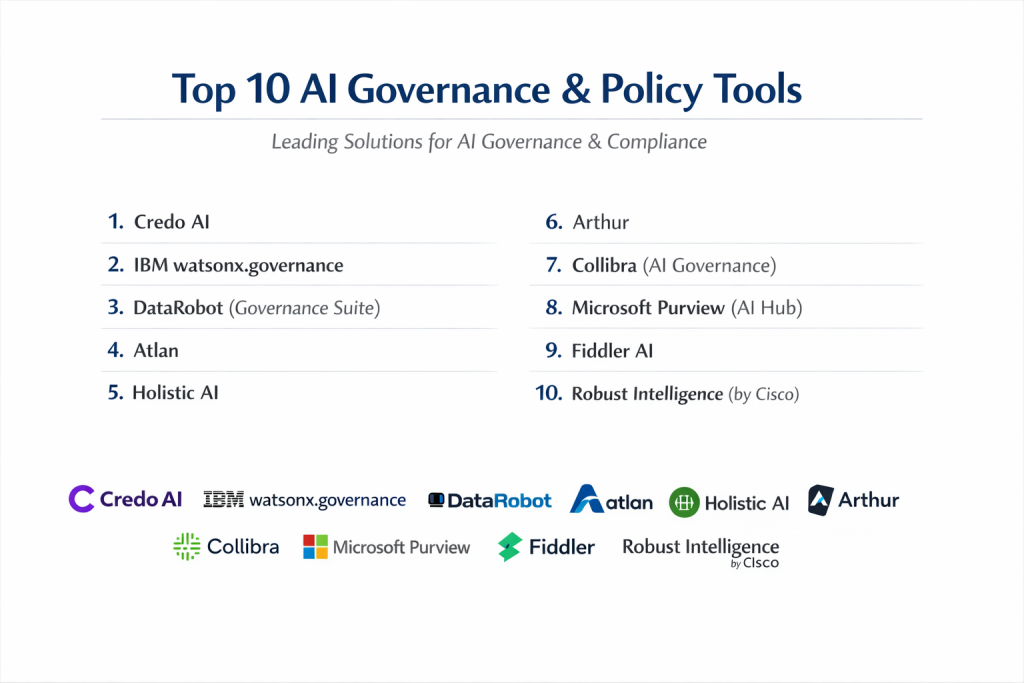
Top 10 AI Governance & Policy Tools
1 — Credo AI
Credo AI is a comprehensive Governance, Risk, and Compliance (GRC) platform specifically built for the AI era, focusing on translating high-level policy into technical requirements.
- Key features:
- Policy Intelligence: Automatically stays updated with global AI regulations to guide internal development.
- Risk Impact Assessments: Standardized templates to evaluate the potential harm of an AI deployment.
- Governance Workflows: Step-by-step paths for stakeholders in legal, data science, and business units.
- Evidence Collection: Automated gathering of model metrics to prove compliance for audits.
- Customizable Guardrails: Set performance and bias thresholds that models must meet before promotion to production.
- Pros:
- Excellent for cross-functional collaboration between technical and non-technical teams.
- Highly proactive in mapping features to the EU AI Act and other emerging laws.
- Cons:
- Can have a steep learning curve for teams not familiar with GRC concepts.
- Integration with certain legacy on-prem systems can be complex.
- Security & compliance: SOC 2 Type II compliant, GDPR focused, and supports ISO 27001 standards.
- Support & community: High-quality professional services for enterprise onboarding and a robust library of whitepapers.
2 — IBM watsonx.governance
Part of the broader watsonx platform, this tool provides automated end-to-end governance for both traditional machine learning and generative AI models.
- Key features:
- AI Factsheets: Automated documentation that acts as a “nutrition label” for AI models.
- Model Lifecycle Tracking: Monitors models from the moment data is ingested until the model is retired.
- Bias & Drift Detection: Real-time alerts when a model’s accuracy or fairness begins to degrade.
- Open Architecture: Can govern models built in non-IBM environments like AWS, Azure, or Google Cloud.
- Regulatory Accelerators: Pre-built configurations for HIPAA, GDPR, and financial services regulations.
- Pros:
- Unmatched depth in “Factsheet” documentation for external auditing requirements.
- Benefits from IBM’s decades of experience in enterprise-grade security and transparency.
- Cons:
- The interface can feel more “corporate” and complex compared to agile startups.
- Full value is often best realized when used within the broader IBM ecosystem.
- Security & compliance: FIPS 140-2, HIPAA, SOC 2, and GDPR compliant; built on IBM’s secure cloud infrastructure.
- Support & community: World-class enterprise support and a massive global user community.
3 — DataRobot (Governance Suite)
DataRobot offers a specialized governance suite within its unified AI platform, emphasizing the “Quality Assurance” aspect of the AI lifecycle.
- Key features:
- Centralized Registry: A single hub to view and manage all models (LLMs and traditional ML) in one place.
- Automated Compliance Documentation: One-click generation of 100+ page compliance reports.
- Continuous Testing: Automated “challenger” models that test your production models for vulnerabilities.
- RBAC & Approvals: Granular controls over who can edit, deploy, or view sensitive AI assets.
- Model Versioning: Complete history of every iteration, including data lineage and parameter changes.
- Pros:
- Best-in-class for automating the tedious task of manual report writing.
- Seamlessly bridges the gap between MLOps (performance) and Governance (policy).
- Cons:
- Can be expensive for organizations that only need the governance features without the full platform.
- Some advanced features require deep technical knowledge of DataRobot’s unique architecture.
- Security & compliance: SOC 2 Type II, ISO 27001, and HIPAA compliant.
- Support & community: Extensive training through DataRobot University and dedicated customer success managers.
4 — Atlan
Atlan is a “Data & AI Governance” platform that focuses on the metadata layer, providing deep visibility into where AI data comes from.
- Key features:
- Unified Metadata Lakehouse: Connects data assets to AI models for full “end-to-end” lineage.
- Automated Policy Enforcement: Automatically applies access controls based on the sensitivity of the data.
- AI Asset Catalog: A searchable directory of all prompts, models, and datasets.
- Context-First Design: Allows users to see who owns a model and its intended purpose.
- Active Metadata: Triggers alerts in downstream tools if an upstream data source becomes non-compliant.
- Pros:
- Exceptional for organizations where AI governance starts with robust data governance.
- Highly modern, “Slack-like” UI that encourages daily usage across the team.
- Cons:
- Less focused on model-specific bias testing than specialized tools like Credo.
- Primarily a data-first tool, which might miss some nuanced “model behavior” risks.
- Security & compliance: SOC 2, GDPR, and ISO 27001 compliant; supports fine-grained Attribute-Based Access Control (ABAC).
- Support & community: Excellent documentation and a very active community of data leaders.
5 — Holistic AI
Holistic AI is a specialized risk management platform that provides independent auditing and assessment for AI systems.
- Key features:
- Algorithm Auditing: Independent 3rd-party validation of model safety and fairness.
- Risk Mapping: Visualizes the interdependencies of models and the risks they pose to the business.
- Compliance Dashboards: Real-time views of how your models stack up against the EU AI Act.
- Impact Assessments: Tools to measure the societal and ethical footprint of your AI.
- Standardized Reporting: Generates reports ready for submission to regulatory bodies.
- Pros:
- The gold standard for organizations that need “external validation” for high-stakes AI.
- Very strong focus on the “human impact” and ethics of AI, not just the technical metrics.
- Cons:
- More focused on auditing than the day-to-day “ops” of running models.
- Smaller integration library compared to platforms like Microsoft or IBM.
- Security & compliance: ISO 27001 and GDPR focused; adheres to strict privacy-by-design principles.
- Support & community: High-touch consulting services and deep expertise in AI policy law.
6 — Arthur
Arthur provides a “Central Nervous System” for model monitoring, focusing on explainability and safeguarding models in real-time.
- Key features:
- Arthur Scope: Specialized tool for monitoring LLM prompts and responses for hallucination.
- Explainable AI: Uses advanced math to explain why a model made a specific prediction.
- Fairness Monitoring: Continuous tracking of disparate impact across different demographic groups.
- Data Integrity Checks: Identifies “out-of-distribution” data that could lead to model failure.
- API-First Design: Designed to be integrated easily into any existing CI/CD pipeline.
- Pros:
- Extremely strong in technical explainability and root-cause analysis.
- The “Firewall” for LLMs is highly effective at preventing toxic outputs in production.
- Cons:
- Can require significant data science effort to set up custom “fairness” metrics.
- Not a full GRC platform; lacks some of the legal/policy mapping found in Credo.
- Security & compliance: SOC 2 compliant; supports encryption at rest and in transit.
- Support & community: Excellent technical documentation and responsive developer support.
7 — Collibra (AI Governance)
Collibra, a leader in data intelligence, expanded into AI governance to provide a holistic view of the data-to-model pipeline.
- Key features:
- Model Catalog: A central repository for metadata, ownership, and documentation of AI models.
- Policy Manager: Tools to define and enforce organizational policies globally.
- Lineage Tracking: Visualizes exactly which datasets were used to train which models.
- Workflow Automation: Automates the “request-review-approve” process for new AI projects.
- Enterprise Scalability: Built to handle the complexity of Fortune 500 organizations.
- Pros:
- Unbeatable for large companies that already use Collibra for data governance.
- Provides the most comprehensive “lineage” view in the industry.
- Cons:
- Heavy enterprise pricing makes it inaccessible for smaller organizations.
- Implementation can take months due to the platform’s vast scope.
- Security & compliance: FedRAMP authorized, SOC 2, ISO 27001, and GDPR compliant.
- Support & community: Collibra University offers extensive certifications and professional training.
8 — Microsoft Purview (AI Hub)
Purview is Microsoft’s unified data and AI governance solution, natively integrated into the Azure and Microsoft 365 ecosystem.
- Key features:
- Data Loss Prevention (DLP) for AI: Prevents sensitive data from being sent to public LLMs.
- Sensitivity Labeling: Automatically tags and protects AI inputs and outputs based on content.
- AI Risk Reports: Summarizes risky behaviors across all Copilot and Azure OpenAI usage.
- One-Click Compliance: Leverages existing M365 compliance labels for AI governance.
- Usage Auditing: Detailed logs of who is using which AI tools and for what purpose.
- Pros:
- The natural choice for organizations already “all-in” on Microsoft.
- Best-in-class for preventing data leakage through employee use of ChatGPT/Copilots.
- Cons:
- Highly Microsoft-centric; governing non-Azure AI tools is more difficult.
- Can feel like a “monitoring” tool more than a “policy creation” tool.
- Security & compliance: Inherits Microsoft’s massive global compliance portfolio (HIPAA, FedRAMP, etc.).
- Support & community: Professional enterprise support and extensive online documentation.
9 — Fiddler AI
Fiddler is a specialized “Model Performance Management” platform with a strong emphasis on trust and transparency.
- Key features:
- Auditor Tool: An open-source suite for testing the robustness and safety of LLMs.
- Explainability at Scale: High-performance explanations for complex “black-box” models.
- Model Drift Monitoring: Deep diagnostics to find exactly why a model is losing accuracy.
- Pre-production Validation: A sandbox to test models against regulatory requirements before launch.
- Alerting Framework: Highly customizable alerts based on ethical and performance thresholds.
- Pros:
- Very strong technical foundation; built by experts in explainable AI.
- The “Auditor” tool is one of the best for testing LLM vulnerabilities.
- Cons:
- Focuses more on the “technical monitoring” than the “legal policy” management.
- UI can be technical, potentially alienating legal or compliance users.
- Security & compliance: SOC 2 Type II compliant; emphasizes data privacy for monitoring.
- Support & community: Good technical blog and active participation in the AI safety community.
10 — Robust Intelligence (by Cisco)
Recently acquired by Cisco, Robust Intelligence provides a “Continuous AI Governance” platform focused on security and safety.
- Key features:
- AI Firewall: Wraps around models in production to block adversarial attacks and toxic inputs.
- Automated Risk Assessments: Automatically runs thousands of tests to find model weaknesses.
- Compliance Automation: Maps test results directly to frameworks like the NIST AI RMF.
- Model Inventory: Automatically discovers and catalogs “Shadow AI” across the network.
- Supply Chain Security: Evaluates the risks of 3rd-party models and open-source datasets.
- Pros:
- The best tool for organizations primarily concerned with “AI Security” and preventing attacks.
- Benefits from Cisco’s world-class cybersecurity infrastructure and support.
- Cons:
- Can be very intensive on compute resources during the “testing” phase.
- Less focus on the “data lineage” side compared to Atlan or Collibra.
- Security & compliance: SOC 2, ISO 27001, and advanced Cisco security certifications.
- Support & community: Top-tier enterprise support and global security community access.
Comparison Table
| Tool Name | Best For | Platform(s) Supported | Standout Feature | Rating (TrueReview) |
| Credo AI | Multi-Stakeholder GRC | Web, API | Policy-to-Technical Mapping | 4.8 / 5 |
| IBM watsonx | Global Enterprises | On-Prem, Cloud | AI Factsheets | 4.7 / 5 |
| DataRobot | Automated Compliance | Cloud, Hybrid | 1-Click Compliance Reports | 4.6 / 5 |
| Atlan | Data-First Governance | Web, SaaS | Active Metadata Lineage | 4.8 / 5 |
| Holistic AI | Ethical Auditing | Web, API | Independent 3rd-Party Audits | N/A |
| Arthur | Explainability & XAI | Web, API | Real-time LLM Firewall | 4.7 / 5 |
| Collibra | Large-Scale Lineage | Web, On-Prem | Integrated Data Intelligence | 4.5 / 5 |
| Microsoft Purview | Azure/M365 Shops | Azure Native | Data Leakage Prevention | 4.6 / 5 |
| Fiddler AI | Model Monitoring | Web, API | Advanced Drift Diagnostics | 4.7 / 5 |
| Robust Intelligence | AI Security | Cloud, Hybrid | Adversarial Attack Defense | N/A |
Evaluation & Scoring of AI Governance & Policy Tools
| Category | Weight | Score (1-10) | Evaluation Rationale |
| Core features | 25% | 9.5 | The market has matured significantly; bias and drift detection are now standard. |
| Ease of use | 15% | 7.8 | Still a highly technical category; tools like Atlan are leading in UI/UX. |
| Integrations | 15% | 8.5 | Cloud-native tools integrate well; legacy tools still struggle with non-native APIs. |
| Security & compliance | 10% | 9.8 | This is the core value proposition, so most tools score exceptionally high here. |
| Performance | 10% | 8.7 | Real-time firewalls can add slight latency, but most platforms are optimized. |
| Support & community | 10% | 9.0 | Strong backing from major tech firms (IBM, Microsoft, Cisco) ensures longevity. |
| Price / value | 15% | 8.2 | High entry costs are offset by the massive cost of regulatory non-compliance. |
Which AI Governance & Policy Tool Is Right for You?
Small to Mid-Market vs. Enterprise
For Small to Mid-Market companies, the full-scale GRC platforms might be overkill. Tools like Arthur or Fiddler AI are often better fits because they focus on the immediate technical risks—explainability and monitoring—without the administrative overhead of massive data governance suites. For Enterprises, the choice is usually between Credo AI (if you need a policy-first approach) and IBM watsonx or Collibra (if you need a deep, data-first lineage approach). These tools handle the millions of data points and thousands of models typical of global operations.
Budget and Value
AI governance is an “insurance policy.” If you are budget-conscious, starting with open-source tools or the governance features already included in your cloud provider (like Microsoft Purview for Azure users) is the most logical path. However, the “value” of a premium solution like DataRobot or Holistic AI comes during an actual audit; having automated, 3rd-party validated reports can save a company millions in legal fees and regulatory fines.
Feature Depth vs. Simplicity
If your priority is Simplicity, Atlan provides the most user-friendly interface that business teams will actually use. If you need Feature Depth for high-stakes decisions (like AI in medical diagnostics or autonomous driving), you need the deep diagnostic capabilities of Fiddler AI or the adversarial testing of Robust Intelligence.
Integration and Scalability Needs
Organizations with a Fragmented Tech Stack (using multiple clouds and local servers) should look for “agnostic” tools like Credo AI or IBM watsonx.governance. If your ecosystem is Uniform (entirely on Microsoft or AWS), the native governance tools provided by those vendors will offer much deeper, out-of-the-box integration.
Security and Compliance Requirements
If you are operating in the European Union, look for tools like Holistic AI or Credo AI, which have built their platforms around the EU AI Act since day one. If you are a U.S. Federal Government contractor, Collibra is a standout choice due to its FedRAMP authorization and long history with public sector compliance.
Frequently Asked Questions (FAQs)
1. What is the difference between AI Governance and MLOps?
MLOps is about the “speed and health” of a model (is it running? is it fast?). AI Governance is about the “legality and ethics” of a model (is it legal? is it fair? is it following company policy?).
2. Does the EU AI Act require me to use these tools?
Not explicitly, but the Act requires high-risk AI systems to have documentation, logs, and bias testing. These tools automate those requirements, making it nearly impossible to comply manually at scale.
3. Can these tools govern “Shadow AI” that employees use?
Yes. Tools like Microsoft Purview and Robust Intelligence can scan network traffic to identify unauthorized AI tools being used by employees, bringing them under the governance umbrella.
4. How long does it take to implement an AI governance tool?
For a mid-sized company using a SaaS tool like Arthur, it can take 2–4 weeks. For a global enterprise implementing Collibra, it can take 6 months or more to map all data sources.
5. Do these tools work with Generative AI and LLMs?
Yes. Modern tools now include specialized features for LLMs, such as “Hallucination detection” and “Prompt security,” which weren’t necessary for traditional machine learning.
6. Who in the company usually “owns” the governance tool?
It is often a shared responsibility between the CISO (for security), the General Counsel (for legal compliance), and the Head of AI (for model performance).
7. Can I use these tools if my models are on-premise?
Yes. Platforms like IBM watsonx and Collibra offer hybrid or on-premise deployment options for companies that cannot move their data to the public cloud.
8. Do these tools help with “Explainability”?
Absolutely. This is a core feature. They use techniques like SHAP or LIME to break down complex neural networks into charts that show which factors most influenced an AI’s decision.
9. Are there any free or open-source AI governance tools?
There are specialized open-source libraries like Fiddler’s Auditor or IBM’s AI Fairness 360, but full-scale management platforms are almost exclusively commercial.
10. How do these tools handle “Model Drift”?
They continuously compare production data to the data the model was trained on. If the real-world data starts looking too different, the tool triggers an alert so engineers can retrain the model.
Conclusion
Navigating the future of artificial intelligence requires more than just high-performance models; it requires a foundational commitment to safety and transparency. AI Governance & Policy Tools have moved from “nice-to-have” features to essential business infrastructure. Whether you are a global bank needing to prove fair lending practices or a tech startup ensuring your chatbot isn’t leaking customer data, there is a tool designed for your specific risk profile.
The most important takeaway when choosing a platform is that governance is not a “set-and-forget” task. The “best” tool is the one that fits seamlessly into your developers’ existing workflows while providing the legal team with the reporting they need to sleep soundly. By investing in these guardrails today, you are not just avoiding fines—you are building the trust necessary for long-term AI success.