Introduction
Model Monitoring and Drift Detection Tools are sophisticated software frameworks designed to track the health, accuracy, and reliability of machine learning (ML) models once they are deployed into live production. In the lifecycle of an AI system, deployment is not the finish line; it is the beginning of a continuous oversight phase. These tools act as “health monitors” for AI, ensuring that the model continues to perform as expected even when the real-world data it encounters changes over time.
The importance of these tools stems from the volatile nature of data. Unlike traditional software, AI models are “probabilistic”—their quality depends entirely on the data they ingest. When the statistical properties of production data shift away from the training data (a phenomenon known as Data Drift) or the relationship between variables changes (Concept Drift), the model’s accuracy inevitably degrades. This leads to “silent failure,” where the system continues to provide answers that are technically valid but practically incorrect. In high-stakes environments like finance, healthcare, or autonomous systems, these failures can lead to significant financial loss, ethical bias, or safety hazards.
Key Real-World Use Cases
- Dynamic Financial Markets: Monitoring credit scoring models to ensure they adapt to sudden shifts in interest rates or economic inflation without unfairly penalizing borrowers.
- Personalized E-commerce: Tracking recommendation engines to identify when seasonal trends or viral shifts make past suggestions irrelevant to current consumer behavior.
- Predictive Maintenance: Ensuring that industrial AI models correctly identify hardware failures even as sensors age or environmental conditions fluctuate.
- Healthcare Diagnostics: Verifying that medical imaging AI remains accurate across different hospital sites where imaging equipment or patient demographics may vary.
What to Look For (Evaluation Criteria)
When evaluating these tools, users should prioritize:
- Drift Detection Depth: Support for various statistical tests like Kolmogorov-Smirnov (KS), Population Stability Index (PSI), and Kullback-Leibler (KL) divergence.
- Explainability (XAI): The ability to not just alert on a failure, but to pinpoint which specific features or data slices are causing the degradation.
- Real-Time vs. Batch Support: Flexibility to monitor low-latency streaming data or high-volume daily batches.
- Governance and Bias Tracking: Built-in checks for demographic parity and equal opportunity metrics to ensure ethical AI compliance.
- Integration Ecosystem: Seamless connectivity with existing data stacks like AWS, Azure, Databricks, and CI/CD pipelines.
Best for: Data Scientists, ML Engineers, and Compliance Officers in medium-to-large enterprises, particularly those in regulated industries (Finance, Healthcare, Public Sector) who manage mission-critical AI applications.
Not ideal for: Early-stage researchers, students, or hobbyists working on static datasets or one-off experimental projects where models are not exposed to live, changing data streams.
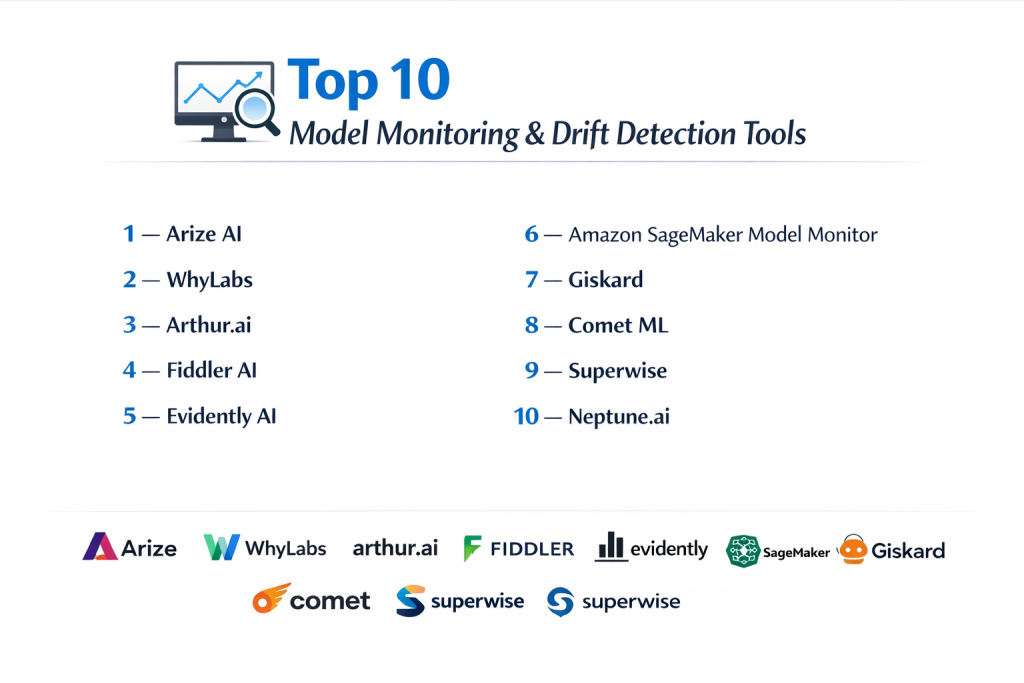
Top 10 Model Monitoring & Drift Detection Tools
1 — Arize AI
Arize AI is an “ML Observability” platform that goes beyond simple monitoring to help teams troubleshoot and visualize exactly why a model is underperforming in the wild.
- Key features:
- 3D Embedding Visualization: Interactive maps that allow teams to see high-dimensional data shifts visually.
- Automated Root Cause Analysis: Connects performance drops directly to specific data slices.
- LLM & RAG Evaluation: Specialized tools for monitoring generative AI, including prompt tracing and hallucination detection.
- Fairness & Bias Tracking: Continuous monitoring for algorithmic bias across protected classes.
- Validation Store: Comparative analysis of production data against training and validation baselines.
- Pros:
- Unmatched visualization capabilities for complex, unstructured data.
- Strong focus on modern Generative AI and Large Language Model (LLM) workflows.
- Cons:
- Can be overly complex for teams with very basic monitoring requirements.
- The enterprise tier represents a significant financial investment.
- Security & compliance: SOC 2 Type II, GDPR, HIPAA compliant, SSO/SAML support, and encryption at rest and in transit.
- Support & community: High-quality documentation, a very active Slack community, and a dedicated customer success team for enterprise clients.
2 — WhyLabs
WhyLabs is a privacy-first observability platform that uses “statistical profiles” to monitor data health without ever needing to move or store raw customer data.
- Key features:
- Zero-Egress Privacy: Statistical summaries (profiles) are sent for analysis, ensuring raw data stays in your environment.
- Lightweight Profiling (whylogs): Extremely low compute overhead, making it ideal for high-scale or edge deployments.
- Automatic Data Integrity: Instant detection of schema changes, missing values, and data type mismatches.
- Unified Monitoring: Supports both structured ML data and unstructured LLM inputs/outputs.
- Fast Setup: Can be integrated into a Python or Java environment in minutes.
- Pros:
- The gold standard for industries with strict data privacy requirements.
- Highly scalable and cost-effective due to its lightweight “profiling” approach.
- Cons:
- Lack of raw data access in the UI makes some deep-dive forensic debugging difficult.
- Dashboard customization is slightly more limited compared to specialized visualization tools.
- Security & compliance: SOC 2 Type II, GDPR, and ISO 27001. Designed to satisfy the most stringent infosec reviews.
- Support & community: Strong open-source foundation via the whylogs library and a responsive Discord community.
3 — Arthur.ai
Arthur is an enterprise-grade platform built specifically for high-stakes AI governance, with a heavy emphasis on fairness, ethics, and regulatory compliance.
- Key features:
- Advanced Policy Engine: Allows teams to set and enforce custom performance and compliance rules.
- Bias Mitigation: Proactive tools to identify and correct discriminatory patterns in model outputs.
- Explainable AI (XAI): Built-in support for SHAP and other feature importance methods.
- Business Impact Tracking: Directly links model performance metrics to business-level KPIs.
- Audit Trails: Detailed logging for every model change and performance alert for regulatory reporting.
- Pros:
- Superior tool for teams that prioritize “Responsible AI” and governance.
- Highly specialized for large-scale corporate environments with complex legal requirements.
- Cons:
- Higher cost of entry makes it less accessible for startups.
- Integration can be more complex than “plug-and-play” developer tools.
- Security & compliance: SOC 2, HIPAA, GDPR, and ISO 27001. Offers VPC and on-premise deployment options.
- Support & community: High-touch enterprise support, including onboarding workshops and dedicated technical account managers.
4 — Fiddler AI
Fiddler AI focuses on “Model Performance Management,” providing a bridge between technical model health and business-level explainability.
- Key features:
- Unified Observability: A single dashboard for traditional ML and generative AI agents.
- Deep Explainability: Provides fine-grained insights into which features influenced a specific prediction.
- Fiddler Guardrails: Real-time protection against toxic outputs, PII leakage, and hallucinations in LLMs.
- Segment Analysis: Allows users to “slice and dice” data to find performance issues in specific subgroups.
- Model Red Teaming: Pre-deployment stress testing to find model vulnerabilities.
- Pros:
- Excellent for cross-functional teams where business stakeholders need to understand AI decisions.
- Strong real-time protection features for LLM-powered applications.
- Cons:
- The user interface can feel data-heavy and overwhelming for casual users.
- Requires consistent metadata management to get the full value of the explainability features.
- Security & compliance: SOC 2 Type II, GDPR, and FedRAMP ready. Supports full data isolation.
- Support & community: Robust educational webinars, a comprehensive resource library, and standard enterprise support.
5 — Evidently AI
Evidently AI is the leading open-source choice for developers, offering a modular framework for monitoring and evaluating ML models throughout the lifecycle.
- Key features:
- 100+ Pre-built Metrics: Wide-ranging library for data drift, quality, and model performance.
- Interactive Reports: Generates shareable HTML reports for easy collaboration.
- Test Suites: Allows for “unit testing” of data and models within CI/CD pipelines.
- LLM Tracing & Evaluation: Recent additions for monitoring generative AI conversations and RAG pipelines.
- Modular Architecture: Can be used as a standalone Python library or a managed cloud service.
- Pros:
- The most flexible and developer-friendly tool for customized monitoring.
- Free open-source version is incredibly powerful and well-maintained.
- Cons:
- Self-hosting the dashboard requires managing your own infrastructure.
- Lacks the “out-of-the-box” governance features found in enterprise-only platforms.
- Security & compliance: Varies; the Cloud version is SOC 2 and GDPR compliant. Open-source depends on user deployment.
- Support & community: Massive community of ML practitioners on Discord and GitHub; excellent documentation.
6 — Amazon SageMaker Model Monitor
For companies fully invested in the Amazon Web Services (AWS) ecosystem, SageMaker Model Monitor provides a seamless, managed monitoring solution.
- Key features:
- Native AWS Integration: Works out-of-the-box with SageMaker endpoints and S3 buckets.
- Automated Baselines: Automatically suggests monitoring rules based on your training data.
- SageMaker Clarify Integration: Built-in bias detection and feature importance analysis.
- CloudWatch Integration: Uses standard AWS alerting and logging systems.
- Serverless Execution: Scales automatically without requiring manual server management.
- Pros:
- Zero infrastructure management for existing AWS users.
- Highly reliable and backed by the world’s largest cloud provider.
- Cons:
- Strict vendor lock-in; not suitable for multi-cloud or on-premise models.
- The AWS console interface is notoriously complex for non-engineers.
- Security & compliance: Inherits all AWS certifications including HIPAA, FedRAMP, SOC 1/2/3, and GDPR.
- Support & community: Professional AWS support and a global network of AWS Certified partners.
7 — Giskard
Giskard is a specialized “QA for AI” framework that focuses on finding vulnerabilities and bugs in models through automated testing and collaboration.
- Key features:
- Automated Security Scan: Identifies hallucinations, bias, and prompt injections in LLMs.
- Collaborative Debugging: Allows business stakeholders to “red team” and comment on model failures in a shared UI.
- Domain-Specific Testing: Lets users define custom “slices” of data to test specific business rules.
- CI/CD Integration: Runs automated regression tests every time a model is updated.
- Open-Source Core: A powerful library for local testing and debugging.
- Pros:
- The best tool for fostering collaboration between technical teams and business domain experts.
- Very effective at finding “edge case” failures that statistical monitoring might miss.
- Cons:
- Less focus on continuous, real-time operational metrics compared to WhyLabs or Arize.
- Implementation of complex business tests requires some manual setup.
- Security & compliance: GDPR compliant; SOC 2 (Cloud) and supports air-gapped/on-premise deployments.
- Support & community: Active Discord community, high-quality technical blog, and enterprise-tier support.
8 — Comet ML
Comet ML is a comprehensive MLOps platform that provides robust production monitoring as an extension of its popular experiment tracking capabilities.
- Key features:
- Model Performance Management (MPM): Centralized dashboard for tracking production accuracy vs. training benchmarks.
- Experiment Lineage: Connects production alerts directly back to the code and data used to train the model.
- Custom Panels: Allows teams to build their own visualizations using JavaScript and Python.
- Collaboration Workspaces: Shared environments for teams to manage projects and experiments.
- Alerting System: Notifications for drift thresholds via Slack, Email, and PagerDuty.
- Pros:
- Provides a “single source of truth” from the research phase to production.
- Very clean, modern UI that is easy to navigate for teams of all sizes.
- Cons:
- Monitoring features, while strong, are slightly less “forensic” than specialized observability tools.
- Can become expensive as the number of experiments and models grows.
- Security & compliance: SOC 2 Type II and GDPR compliant. Supports on-premise and VPC.
- Support & community: Known for excellent, fast-responding customer support and helpful documentation.
9 — Superwise
Superwise focuses on “Autonomous AI Governance,” aiming to automate the heavy lifting of monitoring setup through intelligent, self-adjusting thresholds.
- Key features:
- Self-Adjusting Thresholds: Learns the “normal” variance of your data to reduce false-positive alerts.
- Automatic Multi-Segmenting: Identifies specific sub-populations where the model is failing.
- Data Quality Guardrails: Detects breaks in upstream data pipelines that affect model performance.
- Enterprise Governance UI: Clean dashboards designed for both engineers and risk managers.
- Workflow Automation: Integrates with standard incident management tools like Jira and ServiceNow.
- Pros:
- Significantly reduces “alert fatigue” through smart, contextual thresholding.
- Requires very little manual maintenance once the initial integration is complete.
- Cons:
- Less control over the specific statistical math used for drift detection.
- Smaller community and third-party integration list compared to the industry giants.
- Security & compliance: SOC 2 and GDPR compliant. Focused on enterprise-grade data isolation.
- Support & community: Personalized onboarding for business clients and a responsive support desk.
10 — Neptune.ai
Neptune.ai is a high-speed metadata store that is purpose-built for monitoring and debugging foundation models and large-scale training runs.
- Key features:
- High-Throughput Ingestion: Can handle millions of data points per second with near-zero latency.
- Flexible Metadata Logging: Logs everything from gradients and losses to live drift metrics.
- Scalable Self-Hosting: Designed from the ground up to be deployed on your own infrastructure.
- Run Comparison: Side-by-side analysis of live production runs against historical training data.
- Organization-Wide RBAC: Fine-grained access controls for large teams and multiple projects.
- Pros:
- The fastest and most reliable interface for managing massive amounts of model metadata.
- Extremely lightweight API that is a favorite among research-heavy engineering teams.
- Cons:
- Requires more manual coding to set up specific “drift” logic compared to turnkey platforms.
- Currently going through a roadmap transition following its acquisition by OpenAI.
- Security & compliance: SOC 2 Type II and GDPR compliant. Industry-leading 99.9% uptime SLA.
- Support & community: Priority Slack support for enterprise clients and a reputation for technical excellence.
Comparison Table
| Tool Name | Best For | Platform(s) Supported | Standout Feature | Rating (G2/TrueReview) |
| Arize AI | Deep Troubleshooting | Cloud / SaaS | 3D Embedding Visuals | 4.8 / 5 |
| WhyLabs | Privacy & Regulation | Cloud / On-prem | Zero-Egress Profiling | 4.6 / 5 |
| Arthur.ai | Governance / Bias | Cloud / SaaS / VPC | Advanced Policy Engine | 4.9 / 5 |
| Fiddler AI | Business Explainability | Cloud / SaaS | MPM Performance Link | 4.7 / 5 |
| Evidently AI | Python Developers | Python / Cloud | Open-Source Reports | 4.5 / 5 |
| SageMaker Monitor | AWS Ecosystem | AWS Cloud | Managed Native Infrastructure | 4.4 / 5 |
| Giskard | Collaborative QA | Cloud / SaaS | Automated Security Scan | N/A |
| Comet ML | Full ML Lifecycle | Cloud / SaaS | Experiment-to-Prod Lineage | 4.6 / 5 |
| Superwise | Scalable Operations | Cloud / SaaS | Autonomous Thresholding | N/A |
| Neptune.ai | Large-scale Logging | Cloud / SaaS / On-prem | High-Speed Metadata Store | 4.8 / 5 |
Evaluation & Scoring of Model Monitoring Tools
The following table evaluates the “Model Monitoring” category as a whole, scoring based on current industry standards and technical requirements.
| Category | Weight | Score (1-10) | Evaluation Rationale |
| Core features | 25% | 9 | Most tools now provide excellent drift and accuracy tracking for both ML and LLMs. |
| Ease of use | 15% | 7 | While the UIs are improving, setting up deep observability still requires technical expertise. |
| Integrations | 15% | 8 | Ecosystem support is strong across Snowflake, Databricks, and major cloud providers. |
| Security & compliance | 10% | 9 | SOC 2 and GDPR are standard, with increasing support for HIPAA and VPC deployments. |
| Performance | 10% | 8 | Real-time monitoring for massive high-frequency data streams is still being optimized. |
| Support & community | 10% | 8 | Open-source tools (Evidently, Giskard) have the largest and most helpful communities. |
| Price / value | 15% | 7 | The total cost of ownership can be high for enterprises managing hundreds of models. |
Which Model Monitoring Tool Is Right for You?
Small to Mid-Market vs. Enterprise
For solo users and small startups, Evidently AI or Giskard are the clear winners due to their open-source roots and ease of local integration. Mid-market companies with growing AI teams will find the best balance of features and cost in WhyLabs or Comet ML. Large Enterprises—especially those in banking or healthcare—should opt for Arthur.ai or Fiddler, as these platforms provide the “auditability” and rigorous governance required by legal departments.
Budget and Value
If your budget is zero, start with Evidently AI. If you have a modest budget but need to prioritize data privacy (avoiding the cost of high-bandwidth data transfers), WhyLabs is remarkably cost-efficient. For premium, “no-expense-spared” troubleshooting, Arize AI provides the most value through its deep forensic visualizations.
Technical Depth vs. Simplicity
Users who want to drill down into the math and see high-dimensional maps of their data will prefer Arize AI. Conversely, teams that want a tool to act as a “silent assistant” that only alerts them when something is truly wrong should look toward the autonomous features of Superwise.
Security and Compliance Requirements
If your organization mandates that raw data never leaves its network, WhyLabs (via statistical profiling) or the self-hosted versions of Neptune.ai or Arthur.ai are the only viable paths. For those in the US government sector, Fiddler AI and SageMaker offer the most robust FedRAMP-ready options.
Frequently Asked Questions (FAQs)
1. What is the difference between data drift and concept drift?
Data drift refers to changes in the input data (e.g., your customers are suddenly older), whereas concept drift refers to a change in the relationship between input and output (e.g., people stop buying houses even if their income remains the same).
2. Can these tools automatically fix my model?
Generally, no. They act as a diagnostic system. They can trigger a “retraining pipeline” via webhooks, but a data scientist usually needs to review the new data and validate the updated model before it goes live.
3. Do these tools work for Large Language Models (LLMs)?
Yes. Most leading tools (like Arize, Fiddler, and Evidently) now include specialized modules for tracking “hallucinations,” prompt effectiveness, and response toxicity.
4. How is model monitoring different from regular software monitoring?
Software monitoring (like Datadog) checks if the system is “on” (latency, CPU). Model monitoring checks if the system is “right” (accuracy, bias, drift). An AI can be 100% online but 0% accurate.
5. Is my data safe with these platforms?
Most platforms are SOC 2 compliant. However, if you have extreme privacy needs, tools like WhyLabs ensure that no raw data ever leaves your servers—only statistical summaries are shared.
6. Do I need these tools if I have a small model?
If your model makes decisions that affect people’s money, health, or safety, yes. If it is a low-risk internal experiment, manual checks might suffice initially.
7. What are “Ground Truth” metrics?
Ground truth is the actual outcome (e.g., did the customer actually pay the loan?). Monitoring tools often compare the model’s prediction with the ground truth to calculate real-world accuracy.
8. Can I monitor models running on the edge or mobile?
Yes. Lightweight profiling libraries like WhyLabs’ “whylogs” are specifically designed to run on resource-constrained edge devices and send only small profiles back to a central server.
9. How do I get started without a big budget?
Download the open-source version of Evidently AI or Giskard. You can run these locally in a Jupyter notebook to see how your model is behaving before committing to a paid platform.
10. What is the most common mistake in model monitoring?
Setting too many alerts. If your monitoring tool sends 50 emails a day for minor statistical changes, your team will eventually ignore them (alert fatigue), potentially missing a major failure.
Conclusion
Building an AI model is a significant achievement, but maintaining that model’s integrity in the real world is where the true value is realized. Model Monitoring & Drift Detection Tools are the essential safeguards that turn experimental AI into reliable business infrastructure.
The “best” tool is not universal; it is the one that aligns with your technical stack, your regulatory environment, and your team’s expertise. Whether you choose the open-source flexibility of Evidently AI, the privacy-first approach of WhyLabs, or the enterprise governance of Arthur.ai, the goal remains the same: ensuring your AI stays accurate, fair, and trustworthy.