Introduction
MLOps Platforms (Machine Learning Operations) are the bridge between a successful experimental model in a data scientist’s notebook and a reliable, scalable service in a production environment. Just as DevOps revolutionized software development by automating the path from code to deployment, MLOps provides a framework for the entire machine learning lifecycle. These platforms integrate data engineering, model training, deployment, and real-time monitoring into a single, automated pipeline. They ensure that AI models are not just “one-hit wonders” but consistent, manageable assets that can be updated and audited without breaking the underlying business systems.
The importance of MLOps has surged as organizations realize that building a model is only 10% of the challenge; the remaining 90% is maintaining it. MLOps platforms solve the problem of “model drift,” where a model’s accuracy fades as real-world data changes. They provide version control for datasets and models, automate testing, and offer the infrastructure needed to deploy models as live APIs. By implementing MLOps, companies can reduce the time-to-market for AI features from months to days, while ensuring that the models remain ethical, transparent, and accurate.
Key Real-World Use Cases
- Automated Financial Trading: Managing the retraining of high-frequency trading models to adapt to market volatility.
- E-commerce Recommendation Engines: Ensuring thousands of personalized product suggestions are served in milliseconds across global regions.
- Predictive Maintenance: Orchestrating models across thousands of IoT sensors to predict factory equipment failure before it occurs.
- Healthcare Diagnostics: Providing an audit trail for AI-assisted medical imaging to meet strict regulatory and safety standards.
What to Look For (Evaluation Criteria)
When selecting an MLOps platform, prioritize Model Observability (how well can you see errors?) and Reproducibility (can you recreate a model from six months ago?). You should also look for Pipeline Orchestration, which automates the flow from raw data to deployment, and Feature Stores, which allow teams to share and reuse data points. Finally, ensure the platform offers CI/CD for ML, enabling automated testing of models before they go live.
Best for: Machine Learning Engineers, DevOps Engineers, and Data Science Managers in mid-to-large enterprises. It is ideal for industries like FinTech, HealthTech, and e-commerce where models must be highly reliable, frequently updated, and strictly audited.
Not ideal for: Individual researchers or very small teams building static, “one-and-done” models. If you only plan to run a model once for a report and never deploy it as a live service, the overhead of an MLOps platform may not be worth the investment.
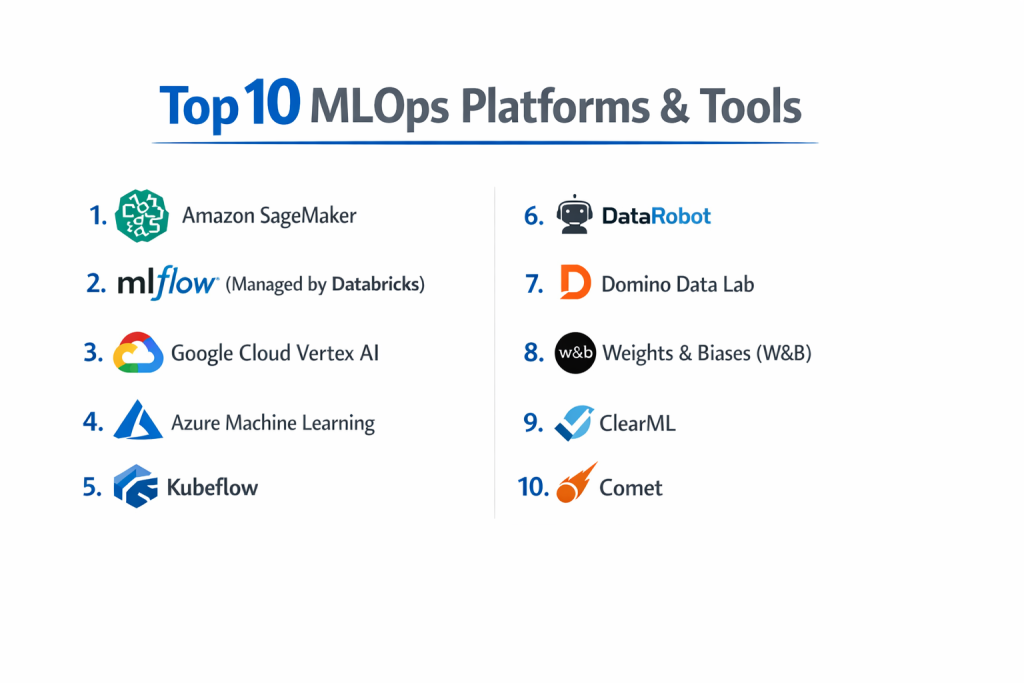
Top 10 MLOps Platforms Tools
1 — Amazon SageMaker
Amazon SageMaker is a comprehensive, end-to-end MLOps platform that lives within the AWS ecosystem. It provides a massive suite of tools designed to cover every stage of the machine learning lifecycle at a global scale.
- Key features:
- SageMaker Pipelines: Purpose-built CI/CD service for machine learning.
- Model Monitor: Automatically detects concept drift and data quality issues in production.
- SageMaker Feature Store: A centralized repository to store, share, and manage features.
- Model Registry: Tracks model versions, metadata, and approval status.
- Clarify: Detects potential bias and provides model explainability.
- Edge Manager: Extends MLOps capabilities to IoT and edge devices.
- Pros:
- Unmatched scalability; it can handle the world’s largest AI workloads.
- Deepest integration with other AWS services (S3, Lambda, IAM).
- Cons:
- The pricing is notoriously complex and can spiral if not monitored.
- The learning curve is steep, often requiring AWS-specific certifications.
- Security & compliance: SOC 1/2/3, ISO, HIPAA, GDPR, PCI DSS, and FedRAMP compliant; utilizes AWS IAM for granular permissions.
- Support & community: Enterprise-grade support; massive community and endless third-party tutorials.
2 — MLflow (Managed by Databricks)
Originally an open-source project, MLflow has become the industry standard for experiment tracking and model management. The managed version on Databricks offers a seamless, collaborative MLOps experience.
- Key features:
- Tracking: Records and queries experiments (code, data, config, and results).
- Models: A standard format for packaging machine learning models.
- Model Registry: Centralized hub for collaborative model lifecycle management.
- Unity Catalog Integration: Provides centralized governance and data lineage.
- Recipes: Pre-defined templates for common ML tasks to ensure best practices.
- Pros:
- Agnostic to the ML library; works with PyTorch, TensorFlow, Scikit-learn, etc.
- Extremely strong “experiment tracking” that is the favorite of data scientists.
- Cons:
- The open-source version lacks some of the robust security features found in the Databricks version.
- Can require significant custom engineering to build a full deployment pipeline.
- Security & compliance: SOC 2 Type II, ISO 27001, HIPAA, and GDPR compliant (in Databricks environment).
- Support & community: One of the largest open-source communities in the ML world; Databricks provides premium support.
3 — Google Cloud Vertex AI
Vertex AI is Google’s unified AI platform that combines its Auto-ML and AI Platform into a single environment. It focuses on high-level automation and “Google-grade” infrastructure.
- Key features:
- Vertex AI Pipelines: Serverless orchestration for ML workflows using Kubeflow.
- Vertex Feature Store: Fully managed repository for sharing ML features.
- Model Monitoring: Tracks performance and alerts users to data skew.
- Vertex Vizier: A black-box optimization service for hyperparameter tuning.
- Prediction Service: Scalable model hosting for online and batch predictions.
- Pros:
- Native support for Google’s specialized TPU (Tensor Processing Unit) hardware.
- Best-in-class AutoML features for teams that want to automate model creation.
- Cons:
- Documentation can sometimes lag behind the rapid release of new features.
- Tight coupling with Google Cloud Platform can lead to vendor lock-in.
- Security & compliance: HIPAA, GDPR, SOC 2, and ISO compliant; includes VPC Service Controls.
- Support & community: Backed by Google Cloud’s professional support and a rapidly growing user base.
4 — Azure Machine Learning
Microsoft Azure Machine Learning is a cloud-based environment used to train, deploy, automate, manage, and track ML models. It is designed for enterprise-level security and seamless integration with the Microsoft stack.
- Key features:
- Azure ML Pipelines: Reusable workflows for model training and evaluation.
- Responsible AI Dashboard: Integrated tools for fairness, interpretability, and error analysis.
- Managed Endpoints: Simplifies model deployment for both real-time and batch scoring.
- Model Data Collector: Automatically captures data from models in production.
- Integration with Azure DevOps: Robust CI/CD for ML using familiar DevOps tools.
- Pros:
- Perfect for organizations already heavily invested in Microsoft 365 and Azure.
- Excellent focus on “Responsible AI” and governance.
- Cons:
- The user interface can feel cluttered and unintuitive compared to modern rivals.
- Performance can be inconsistent during high-demand scaling events.
- Security & compliance: ISO 27001, HIPAA, FedRAMP, SOC 2, and GDPR compliant; utilizes Microsoft Entra ID.
- Support & community: Significant enterprise support resources and a large corporate user base.
5 — Kubeflow
Kubeflow is an open-source MLOps platform designed to make deployments of machine learning workflows on Kubernetes simple, portable, and scalable.
- Key features:
- Kubeflow Pipelines: For building and deploying multi-step ML workflows.
- Katib: Specialized tool for hyperparameter tuning and neural architecture search.
- KFServing: Provides a Kubernetes Custom Resource Definition for serving ML models.
- Notebooks: Integrated Jupyter notebooks that run directly in the cluster.
- Multi-tenancy: Allows different teams to share the same Kubernetes cluster securely.
- Pros:
- Completely cloud-agnostic; run it on AWS, Google, or your own servers.
- Zero licensing costs, making it ideal for large-scale, cost-conscious projects.
- Cons:
- Requires extensive knowledge of Kubernetes to install and maintain.
- Managing upgrades and dependencies can be a full-time job for a DevOps team.
- Security & compliance: Varies; security is entirely dependent on the configuration of your Kubernetes cluster.
- Support & community: Massive open-source community; no official corporate support unless purchased through a vendor like Arrikto.
6 — DataRobot
DataRobot is a leader in “Value-Driven AI,” focusing on high-end automation that covers both the creation of models (AutoML) and their ongoing management (MLOps).
- Key features:
- MLOps Management Console: A single pane of glass to monitor all production models.
- Challenger Models: Automatically tests new models against current ones in production.
- Automated Retraining: Triggers new training cycles based on performance degradation.
- Bias Monitoring: Continuous checks for ethical AI and fairness in live data.
- Portable Prediction Agents: Allows models to be deployed in any environment (Cloud, On-prem, Edge).
- Pros:
- The most “user-friendly” platform for non-engineers and business analysts.
- Automated “Compliance Documentation” saves weeks of manual report writing.
- Cons:
- Very high cost; strictly an enterprise solution.
- “Black box” nature can frustrate developers who want to control low-level code.
- Security & compliance: SOC 2 Type II, ISO 27001, HIPAA ready, and GDPR compliant.
- Support & community: High-touch customer success teams and a dedicated training academy.
7 — Domino Data Lab
Domino is an Enterprise MLOps platform that provides an “open” environment, allowing data scientists to use their favorite tools while providing the IT department with oversight and reproducibility.
- Key features:
- Reproducibility Engine: Automatically tracks code, data, and environment for every run.
- Integrated Model Monitoring: Centralized dashboard for drift and accuracy alerts.
- Self-Service Infrastructure: Data scientists can spin up GPUs without IT help.
- Knowledge Center: A searchable library of all past experiments and models.
- Model APIs: One-click deployment of models as REST endpoints.
- Pros:
- Excellent for highly regulated industries like banking and insurance.
- Allows for “Hybrid Cloud” (running some things on-prem, others in the cloud).
- Cons:
- Lacks the deep “AutoML” features found in competitors like DataRobot.
- Can feel like an “orchestration layer” rather than a native compute platform.
- Security & compliance: SOC 2 Type II, HIPAA ready, and strong support for air-gapped security.
- Support & community: Professional enterprise support and a community focused on “Scientific Computing.”
8 — Weights & Biases (W&B)
Weights & Biases is a developer-first MLOps platform that has become the cult favorite for deep learning teams and researchers. It focuses on the “developer experience.”
- Key features:
- Experiments: Beautiful, real-time dashboards for tracking training metrics.
- Artifacts: Version control for datasets and model weights.
- Tables: Interactive tools for visualizing and debugging data.
- Sweeps: Automated hyperparameter optimization.
- Reports: Collaborative docs to share findings with the team.
- Pros:
- The most elegant and modern user interface in the MLOps space.
- Extremely easy to integrate into existing Python code (just a few lines of code).
- Cons:
- Historically stronger on “experimenting” than on “deploying” (though this is improving).
- Costs can escalate quickly for teams with many users and large data artifacts.
- Security & compliance: SOC 2 Type II compliant; offers private cloud and on-premise options for enterprises.
- Support & community: Very active Discord community and excellent technical documentation.
9 — ClearML
ClearML is an open-source MLOps suite that aims to be a “Swiss Army Knife” for ML teams. It is known for its ability to turn any local machine into a part of a cloud compute cluster.
- Key features:
- Experiment Manager: Automatically tracks everything without requiring code changes.
- Orchestration: Seamlessly moves tasks from a local laptop to a cloud GPU.
- Data Management: Versioned data lakes with efficient local caching.
- Serving: Scalable model serving with built-in auto-scaling.
- Hyper-Parameter Optimization: Integrated tool for finding the best model settings.
- Pros:
- Highly flexible and “developer-friendly” with minimal boilerplate code.
- The open-source version is incredibly feature-rich for free.
- Cons:
- The web UI can sometimes feel slightly less polished than Weights & Biases.
- Smaller enterprise ecosystem than the major cloud providers.
- Security & compliance: SSO, RBAC, and encryption; enterprise version is SOC 2 compliant.
- Support & community: Active Slack channel and comprehensive open-source documentation.
10 — Comet
Comet is an enterprise MLOps platform that allows data scientists and teams to track, compare, explain, and optimize their experiments and models across the entire lifecycle.
- Key features:
- MPM (Model Production Monitoring): Integrated monitoring for production models.
- Comet Artifacts: Track and version your datasets and models across the pipeline.
- Visualizations: Custom panels to visualize complex data types like audio or video.
- Enterprise Governance: Robust RBAC and project management for large teams.
- SDK Integration: Works with any language and any machine learning library.
- Pros:
- Excellent at handling non-tabular data (images, audio, video).
- Very stable and reliable for high-traffic enterprise environments.
- Cons:
- Not as “well-known” in the broader developer community as MLflow or W&B.
- Can be complex to set up for simple, straightforward projects.
- Security & compliance: SOC 2 Type II compliant; features strong encryption and SSO support.
- Support & community: High-quality professional support and a dedicated user community.
Comparison Table
| Tool Name | Best For | Platform(s) Supported | Standout Feature | Rating |
| Amazon SageMaker | AWS-heavy Orgs | AWS Only | End-to-end AWS Integration | 4.5/5 |
| MLflow | Experiment Tracking | Cloud, On-prem | Open-standard Portability | 4.7/5 |
| Vertex AI | Google Cloud Users | Google Cloud | TPU Hardware Support | 4.4/5 |
| Azure ML | Microsoft Orgs | Azure Only | Responsible AI Dashboard | 4.3/5 |
| Kubeflow | K8s/Cost-conscious | Kubernetes | Cloud Agnostic (Open) | N/A |
| DataRobot | Business Analysts | Cloud, On-prem | Automated Governance | 4.6/5 |
| Domino Lab | Regulated Industries | Hybrid, Cloud | Reproducibility Engine | 4.4/5 |
| Weights & Biases | Deep Learning Devs | Cloud, Private | UI & Dev Experience | 4.8/5 |
| ClearML | Agile Dev Teams | Cloud, On-prem | Resource Orchestration | 4.5/5 |
| Comet | Enterprise Video/Audio | Cloud, On-prem | Custom Data Viz | 4.4/5 |
Evaluation & Scoring of MLOps Platforms
| Category | Weight | Evaluation Criteria |
| Core Features | 25% | Availability of Tracking, Registry, Monitoring, and Pipelines. |
| Ease of Use | 15% | UI quality, developer experience, and onboarding speed. |
| Integrations | 15% | Native support for Python, Spark, Git, and Cloud Providers. |
| Security & Compliance | 10% | SOC 2, HIPAA, GDPR, SSO, and Audit Trail depth. |
| Performance | 10% | Real-time monitoring latency and pipeline scaling speed. |
| Support & Community | 10% | Documentation quality and active user forums. |
| Price / Value | 15% | Transparency of pricing and ROI for enterprise teams. |
Which MLOps Platform Is Right for You?
Solo Users vs. SMB vs. Mid-Market vs. Enterprise
Solo users and students should start with MLflow or Weights & Biases; they are free to use and teach you the industry standards. SMBs usually find the most success with ClearML or Comet, which offer a great balance of power without requiring a dedicated DevOps team. Mid-Market and Enterprise organizations almost always require the massive scale and regulatory features of SageMaker, Vertex AI, or Domino Data Lab.
Budget-Conscious vs. Premium Solutions
If you have a limited budget, Kubeflow is technically “free,” but remember that you will pay with your time in managing the Kubernetes cluster. For a “middle-of-the-road” cost with great features, ClearML is an excellent value. If budget is no object and you need to save time, DataRobot is the premium choice that automates nearly every step of the process.
Feature Depth vs. Ease of Use
If you prioritize ease of use, Weights & Biases and DataRobot are the winners—they are beautiful, intuitive, and designed to stay out of your way. If you need feature depth and want to customize every single part of the infrastructure, SageMaker and Kubeflow provide the most “knobs and dials” to turn.
Integration and Scalability Needs
For scalability, the big three cloud providers (AWS, Google, Microsoft) are the undisputed kings; they can spin up thousands of GPUs in seconds. For integration, if your data is already in a “Lakehouse,” MLflow (via Databricks) is the most logical choice as it lives right next to your data.
Security and Compliance Requirements
Companies in Banking, Healthcare, or Government must look for Domino Data Lab or the Enterprise versions of SageMaker/Azure. These platforms offer the “audit trails” and “reproducibility” reports that are required to prove to a regulator exactly why an AI made a specific decision.
Frequently Asked Questions (FAQs)
What is the difference between DevOps and MLOps?
DevOps focuses on the lifecycle of code and software. MLOps focuses on the lifecycle of Code + Data. Because data changes constantly (model drift), MLOps requires unique tools for monitoring and retraining.
Do I really need an MLOps platform?
If you have more than one model in production, or if you need to retrain your models more than once a month, yes. Without a platform, managing the “spaghetti code” of different model versions becomes impossible.
Is MLflow better than Weights & Biases?
It depends on your goal. MLflow is better for standard machine learning and enterprise model registries. Weights & Biases is generally better for deep learning, computer vision, and high-end research.
How much does MLOps software cost?
Cloud-native tools are “pay-as-you-go” (often $1–$3 per hour). SaaS tools like W&B or Comet usually start at $50–$100 per user per month. Enterprise platforms can cost $100k+ per year.
Can I build my own MLOps platform?
You can (using tools like Airflow and Git), but it is rarely recommended. The engineering hours required to maintain a “DIY” platform usually cost far more than a subscription to a professional tool.
What is “Model Drift”?
Model drift occurs when the statistical properties of the target variable, which the model is trying to predict, change over time in unforeseen ways. This leads to the model becoming less accurate.
Does MLOps help with AI Ethics?
Yes. Modern platforms like DataRobot and SageMaker have built-in “Bias Detection” that alerts you if your model is discriminating based on race, gender, or age.
What is a “Feature Store”?
A feature store is a central place to store cleaned data points (like “average customer spend”). It allows different teams to use the same data without having to clean it twice.
Can I run MLOps on-premise?
Yes. Platforms like ClearML, Domino Data Lab, and Kubeflow are designed to be installed on your own servers if you cannot use the public cloud.
How long does it take to implement MLOps?
For a small team using a SaaS tool like Comet, you can be up and running in a few days. For an enterprise-wide rollout, expect a 3 to 6-month implementation period.
Conclusion
The “best” MLOps Platform is not a universal winner, but a specific fit for your organizational culture and technical stack. If you are an AWS shop, SageMaker is your home. If you are a team of deep learning researchers, Weights & Biases will feel like magic. If you are a bank that needs total control, Domino is the answer.
The most important insight is that MLOps is no longer “optional” for companies that are serious about AI. As we move into an era of Generative AI and real-time decision-making, the ability to monitor, audit, and retrain your models is the only thing that stands between an innovative product and a catastrophic failure. Start small, pick a tool that grows with you, and focus on reproducibility above all else.