Introduction
A Consent Management Platform (CMP) is a specialized software solution designed to help businesses legalise their data collection processes. In essence, it serves as the bridge between a website or mobile app and its users, ensuring that any personal data gathered—ranging from simple cookies to complex identifiers—is done so with the user’s explicit and informed permission. These platforms provide the technical infrastructure to display consent banners, categorize trackers, log user choices for audit purposes, and communicate those preferences to third-party marketing and analytics tools.
The importance of CMPs has skyrocketed due to the global shift toward stricter privacy regulations. Governments worldwide have established high standards for how companies must treat individual data. Without a central system to manage these permissions, a business risks not only massive legal fines but also a significant loss of consumer trust. A reliable CMP automates the difficult task of staying compliant while allowing marketing teams to continue gathering the insights they need to grow.
Key Real-World Use Cases
- Cookie Compliance: Automatically scanning and blocking non-essential cookies until a visitor makes a choice on a website.
- Mobile App Privacy: Integrating SDKs into iOS and Android apps to manage tracking permissions in line with app store requirements.
- Connected TV (CTV): Managing viewer consent on platforms like Roku or Apple TV where traditional web banners do not work.
- Data Subject Requests: Assisting users in exercising their rights to see, change, or delete their personal information.
- Marketing Orchestration: Ensuring that email and advertising tools only fire when a user has opted in, preventing accidental “spamming” of unconsented users.
What to Look For (Evaluation Criteria)
When evaluating a CMP, look for Geolocational Awareness, which ensures users see the specific banner required by their local laws. Integration Depth is also vital; the platform must work seamlessly with your Tag Manager (like Google Tag Manager) and your advertising stack. Finally, prioritize Transparency in reporting—you need clear, unchangeable logs that can prove compliance if an auditor ever comes knocking.
Best for:
These tools are essential for Digital Marketing Managers, Privacy Officers, and Web Developers in companies of all sizes. They are particularly critical for e-commerce brands, global media publishers, and SaaS companies that operate across international borders.
Not ideal for:
Small, local businesses that do not use any tracking pixels, third-party analytics, or advertising cookies. If your website is purely informational and collects zero data, the cost and technical overhead of a CMP may be unnecessary.
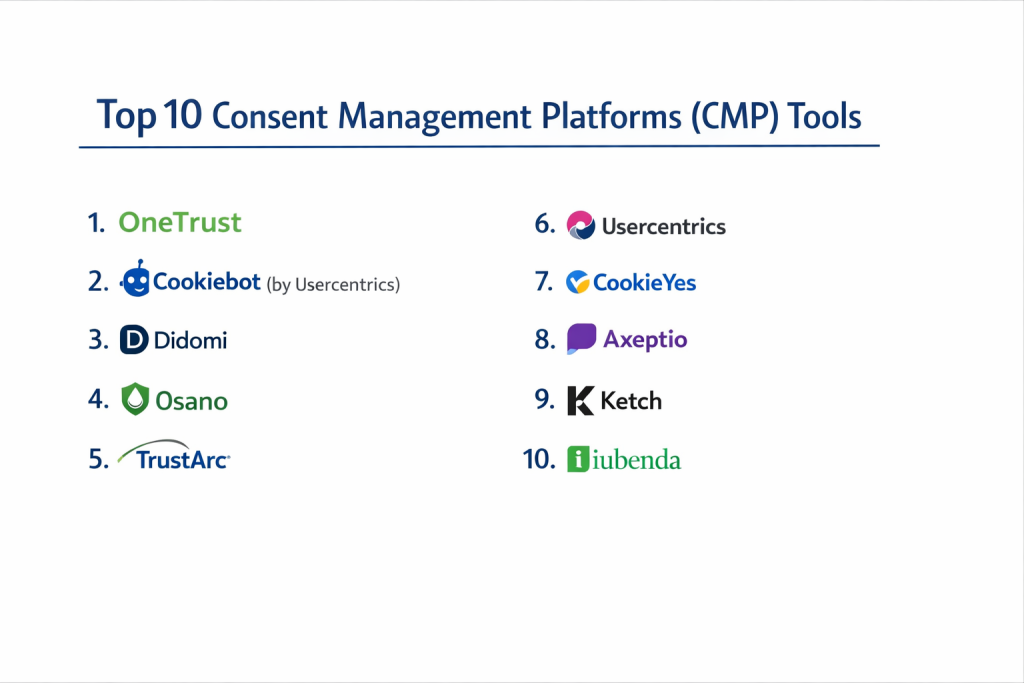
Top 10 Consent Management Platforms (CMP) Tools
1 — OneTrust
OneTrust is widely regarded as the industry leader in the privacy and consent space. It is a massive, modular platform that handles everything from cookie consent to internal ethics and vendor risk management.
- Key features:
- Highly advanced cookie scanning and auto-categorization of trackers.
- Universal consent across web, mobile, and Connected TV.
- Dynamic geo-targeting to show the right banner for 100+ countries.
- Deep integration with Google Consent Mode v2 and IAB TCF 2.2.
- Detailed A/B testing to optimize banner acceptance rates.
- Automated Data Subject Access Request (DSAR) workflows.
- Pros:
- The most comprehensive feature set available on the market.
- Excellent for large organizations with complex, multi-brand requirements.
- Cons:
- The setup process is notoriously complex and often requires a specialist.
- Pricing can be opaque and significantly higher than mid-market alternatives.
- Security & compliance: SOC 2 Type II, ISO 27001 certified, GDPR, CCPA/CPRA, and LGPD compliant.
- Support & community: Offers a massive knowledge base, dedicated account managers for enterprise tiers, and a certification program for privacy professionals.
2 — Cookiebot (by Usercentrics)
Cookiebot is a popular choice for SMBs and mid-market companies that want a “set-and-forget” solution. It is famous for its powerful scanning engine that finds cookies many other tools miss.
- Key features:
- Patented monthly scanning technology that detects all cookies and trackers.
- Automatic blocking of all scripts until the user provides consent.
- Support for 47+ languages with automatic translation.
- Cloud-based storage for all user consent logs.
- Native WordPress plugin and easy Google Tag Manager templates.
- Pros:
- Extremely easy to implement with a single line of code.
- Very transparent, page-based pricing that is easy to budget for.
- Cons:
- Limited design customization compared to enterprise-tier tools.
- Automatic blocking can sometimes interfere with site functionality if not tuned.
- Security & compliance: GDPR, ePrivacy, and CCPA compliant; supports IAB TCF 2.2.
- Support & community: Solid email-based support and an extensive library of self-help articles.
3 — Didomi
Didomi focuses on high-performance consent and preference management. It is a favorite for global brands that want a clean, fast user experience that doesn’t slow down their digital properties.
- Key features:
- Cross-device consent synchronization (web, app, TV).
- High-speed performance with minimal impact on page load times.
- Advanced preference centers where users can toggle specific data uses.
- Robust APIs and SDKs for developer-heavy environments.
- Support for the latest IAB TCF standards.
- Pros:
- Beautifully designed UI that feels modern and professional.
- Exceptional uptime and reliability for high-traffic sites.
- Cons:
- Primarily focused on the European market, though expanding globally.
- May be overkill for a simple one-domain website.
- Security & compliance: GDPR, CPRA, and Law 25 (Quebec) compliant; high-grade data encryption.
- Support & community: Dedicated customer success managers and active technical documentation.
4 — Osano
Osano positions itself as the “trust platform.” It is unique because it includes a “No-Fine Guarantee” for certain customers, showing their confidence in their compliance logic.
- Key features:
- Consent management for 50+ countries with localized legal wording.
- Monitoring of vendor privacy practices to alert you of risks.
- Automated DSAR management with a user-friendly portal.
- Seamless “Copy and Paste” installation.
- Simplified data mapping and inventory tools.
- Pros:
- The most user-friendly interface in the privacy industry.
- Excellent for companies that don’t have a large legal department.
- Cons:
- Customization of legal policies is more limited than rivals.
- Lower-tier plans have strict traffic and domain limits.
- Security & compliance: SOC 2 Type II, GDPR, CCPA, and VCDPA compliant.
- Support & community: Responsive live chat and a community forum for privacy enthusiasts.
5 — TrustArc
TrustArc is one of the oldest names in the privacy industry. Their CMP is part of a broader suite focused on privacy governance and risk automation.
- Key features:
- Intelligence system that automatically updates banners as laws change.
- Risk scoring for third-party trackers and cookies.
- Deep reporting on consent conversion and visitor behavior.
- Privacy Impact Assessment (PIA) automation.
- Managed service options for companies that want TrustArc to run the tool.
- Pros:
- Backed by deep legal expertise and a long history in the field.
- Great for businesses that need a formal, auditable privacy program.
- Cons:
- The user interface can feel slightly dated compared to newer SaaS tools.
- Not as strong on Connected TV support as specialized rivals.
- Security & compliance: HIPAA, GDPR, ISO 27001, and SOC 2 compliant.
- Support & community: Excellent onboarding and high-quality educational webinars.
6 — Usercentrics
Based in Germany, Usercentrics is a powerhouse for companies that need high levels of customization and strict adherence to European standards.
- Key features:
- Full UI customization to match your exact brand identity.
- Native SDKs for mobile apps and Connected TV.
- Integration with 2,200+ technology vendors.
- Detailed analytics on banner interaction and opt-in rates.
- Support for “Google Consent Mode v2” out of the box.
- Pros:
- Extremely flexible and adapts to almost any web architecture.
- One of the best mobile SDKs available for app developers.
- Cons:
- The technical documentation can be dense and difficult for beginners.
- Costs can rise quickly as you add more domains or higher traffic.
- Security & compliance: GDPR, CCPA, and LGPD compliant; IAB TCF 2.2 certified.
- Support & community: Strong European-based support and detailed technical guides.
7 — CookieYes
CookieYes has quickly become a leader in the SMB space by offering a straightforward, affordable, and effective tool that works on almost any platform.
- Key features:
- Automatic cookie scanning with real-time categorization updates.
- Support for “Google Consent Mode v2” and multi-state US laws.
- Customizable banners with professional templates.
- Record-keeping of all user consents for audit defense.
- Plugins for WordPress, Shopify, Wix, and Squarespace.
- Pros:
- Transparent, low-cost pricing starting at a very affordable rate.
- The setup takes less than five minutes for a standard website.
- Cons:
- Lacks the advanced “Preference Center” depth of enterprise tools.
- Not designed for complex, cross-domain enterprise ecosystems.
- Security & compliance: GDPR, CCPA, and CNIL compliant; basic audit logging.
- Support & community: Friendly email support and a helpful blog for small business owners.
8 — Axeptio
Axeptio takes a “design-first” approach. Instead of boring, legalistic banners, Axeptio focuses on friendly, conversational interfaces that actually improve trust.
- Key features:
- “Cookie-friendly” design with cute illustrations and warm language.
- Simple toggle switches for users to select their preferences.
- Strong focus on A/B testing and conversion optimization.
- Seamless integration with most modern marketing stacks.
- Specialized modules for publishers and ad-heavy sites.
- Pros:
- Highest “opt-in” rates due to its non-threatening design.
- Very lightweight and does not interfere with site speed.
- Cons:
- Regulatory coverage is more narrow than the giant platforms.
- Lacks native mobile SDKs for Android and iOS apps.
- Security & compliance: GDPR and Law 25 (Quebec) compliant.
- Support & community: Responsive customer support with a focus on UX advice.
9 — Ketch
Ketch is a modern, data-centric platform that treats consent as a fundamental part of the data stack rather than just a banner on a website.
- Key features:
- “Identity Recognition” that syncs preferences across devices automatically.
- Programmatic API-first approach for developers.
- Zero-impact tag infrastructure that keeps site performance high.
- No-code integration with hundreds of CRMs and databases.
- Dynamic policy templates that update instantly with new laws.
- Pros:
- The best choice for companies with a sophisticated technical stack.
- Automates the enforcement of consent directly in your databases.
- Cons:
- May have a steeper learning curve for marketing-only teams.
- The platform is very powerful, making it “too much” for tiny blogs.
- Security & compliance: SOC 2 Type II, GDPR, CCPA, and HIPAA compliant.
- Support & community: Detailed API documentation and high-touch enterprise support.
10 — Iubenda
Iubenda is a versatile tool that combines consent management with a legal policy generator. It is ideal for startups and agencies that need to generate a full set of legal documents.
- Key features:
- Auto-generating Privacy and Cookie Policies based on your app usage.
- Integrated cookie banner that syncs with your policies.
- Internal “Consent Database” to store records of all user agreements.
- Support for 15+ languages with professional translations.
- Specific compliance tools for the ePrivacy Directive.
- Pros:
- Provides high-quality, lawyer-backed documents at a fraction of the cost.
- Excellent “all-in-one” solution for the legal basics.
- Cons:
- The dashboard can feel a bit cluttered with many different products.
- Not built for the deep technical scanning required by huge enterprises.
- Security & compliance: GDPR, CCPA, and Australian Privacy Act compliant.
- Support & community: Multi-language support and very helpful educational resources.
Comparison Table
| Tool Name | Best For | Platform(s) Supported | Standout Feature | Rating |
| OneTrust | Global Enterprise | Web, App, CTV | Full Privacy GRC Suite | 4.3/5 |
| Cookiebot | SMBs / Mid-Market | Web, WordPress | Patented Auto-Scanner | 4.0/5 |
| Didomi | High-Traffic Brands | Web, App, CTV | Cross-Device Syncing | 4.6/5 |
| Osano | Lean Privacy Teams | Web, SaaS | No-Fine Guarantee | 4.8/5 |
| TrustArc | Governance Teams | Web, Hybrid | Law Intelligence Engine | 4.2/5 |
| Usercentrics | Global Marketing | Web, Mobile, CTV | 2,200+ Vendor Support | 4.4/5 |
| CookieYes | Small Websites | Web, All CMS | 5-Minute Setup | 4.7/5 |
| Axeptio | UX-Conscious Sites | Web, Publisher | Conversational Interface | 4.5/5 |
| Ketch | Technical/Dev Teams | API, Cloud, Web | Permission Orchestration | 4.7/5 |
| Iubenda | Startups & Agencies | Web, Mobile | Policy Generator Combo | 4.5/5 |
Evaluation & Scoring of Consent Management Platforms (CMP)
| Criteria | Weight | Evaluation Method |
| Core features | 25% | Presence of scanning, geo-targeting, and banner customization. |
| Ease of use | 15% | Time required to install and ease of navigation for non-tech users. |
| Integrations | 15% | Number of native connections to ad tech and marketing stacks. |
| Security & compliance | 10% | Internal security certifications (SOC 2) and legal updates. |
| Performance | 10% | Impact on page load speed and script execution delay. |
| Support & community | 10% | Availability of human support and quality of documentation. |
| Price / value | 15% | Cost relative to the depth of features and traffic limits. |
Which Consent Management Tool Is Right for You?
Solo Users vs. SMB vs. Mid-Market vs. Enterprise
If you are running a single or a small shop, CookieYes or Iubenda offer the best balance of price and simplicity. Mid-market companies that need a bit more automation should look at Cookiebot or Osano. For large, global enterprises with multiple brands, OneTrust, Didomi, or Usercentrics are the only tools capable of handling the scale.
Budget-Conscious vs. Premium Solutions
If budget is your primary concern, look for tools with a free tier for low-traffic sites, like Cookiebot or Axeptio. Premium solutions like OneTrust or TrustArc are expensive but provide peace of mind through deep legal research and advanced features like vendor risk management.
Feature Depth vs. Ease of Use
Developers will love Ketch for its API-first approach, whereas marketing managers will likely prefer Osano or Axeptio for their visual, no-code interfaces.
Integration and Scalability Needs
For companies using a large number of SaaS tools, Usercentrics and DataGrail (a CMP-adjacent tool) are excellent. If you anticipate growing quickly, choose a tool that scales by domain or traffic tier rather than one that requires a full contract renegotiation for every small change.
Security and Compliance Requirements
Always verify that your CMP is “IAB TCF 2.2” certified if you run ads. For highly sensitive industries like healthcare or finance, ensure the tool has SOC 2 Type II or ISO 27001 certifications to prove their own data centers are secure.
Frequently Asked Questions (FAQs)
1. What is the difference between a cookie banner and a CMP?
A cookie banner is just the visual part the user sees. A CMP is the “engine” behind it that scans for cookies, stores the legal logs, and tells your advertising tools when they are allowed to work.
2. Are CMPs legally required?
Under laws like GDPR in Europe and several US state laws, you must get permission before using non-essential trackers. A CMP is the most reliable way to fulfill this legal requirement.
3. Can a CMP slow down my website?
Yes, but high-quality tools like Didomi or Ketch use lightweight scripts to ensure the impact is almost invisible to the user. Always test your site speed after installation.
4. Do these tools work on mobile apps?
Many do, but you need to look for tools that offer “Native SDKs” for iOS and Android, such as Usercentrics or OneTrust.
5. What is Google Consent Mode v2?
It is a requirement from Google for advertisers. It allows your site to communicate a user’s consent status to Google tools so they can still provide basic analytics even if a user declines tracking.
6. How long should I store consent logs?
Most regulations suggest keeping logs for several years to prove compliance in the event of an audit. Most CMPs handle this storage for you automatically.
7. Can I design my own banner?
Yes, most tools allow you to change colors and fonts. Some, like Axeptio, are highly flexible, while others like Cookiebot have more rigid templates.
8. What happens if I don’t use a CMP?
You risk being fined by data protection authorities. In Europe, these fines can be up to 4% of your global revenue. You also risk being banned from using Google Ads if you don’t use a certified CMP.
9. Do I need a CMP for every country?
You only need to show a banner to users in regions where privacy laws require it. The best tools automatically detect where a user is and only show a banner when necessary.
10. How often should I scan my website for cookies?
Most experts recommend a full scan at least once a month, as your developers or marketing team may add new tools that you need to disclose to your users.
Conclusion
The “best” Consent Management Platform is rarely the one with the most features; it is the one that fits seamlessly into your existing workflow. For smaller sites, a simple and affordable tool like CookieYes provides everything needed to be legal in minutes. For large-scale corporations, the investment in a platform like OneTrust or Didomi is a necessary step to protect a global brand.
When making your final choice, remember that privacy is about more than just a checkbox. It is about building a relationship with your customers. A well-designed, transparent consent experience doesn’t just keep the lawyers happy—it shows your users that you respect their data, which is the most valuable asset any business can have.