Introduction
Bot Management Tools are specialized security solutions designed to identify, categorize, and mitigate automated traffic. Unlike standard firewalls that look for known malicious signatures, these tools use behavioral analysis, machine learning, and fingerprinting to distinguish between legitimate human users, helpful bots, and harmful automated scripts.
The importance of these tools lies in protecting a company’s revenue and reputation. Malicious bots engage in credential stuffing (using stolen passwords to take over accounts), inventory hoarding (adding items to carts to prevent real customers from buying), and web scraping (stealing proprietary pricing or content). Key evaluation criteria for these tools include the false positive rate (to ensure real customers aren’t blocked), detection latency, and the ability to handle low-and-slow attacks that fly under the radar of traditional rate limiting.
Best for: E-commerce retailers, financial institutions, airline/travel booking sites, and media companies. It is essential for CISO roles, security engineers, and DevOps teams in mid-to-large enterprises where automated attacks directly impact the bottom line.
Not ideal for: Small static websites or personal blogs with low traffic and no sensitive user data. In these cases, a simple CAPTCHA or basic cloud firewall is usually sufficient without the overhead of a dedicated bot management suite.
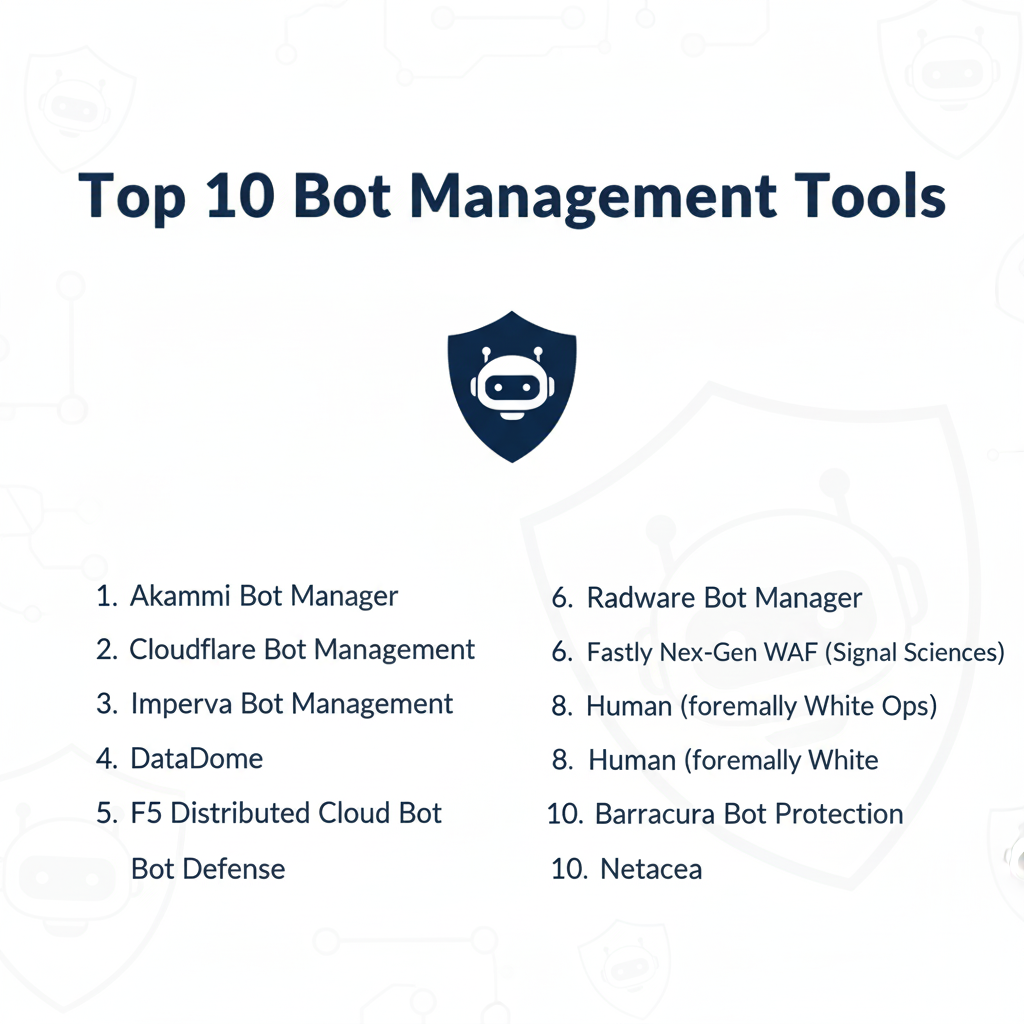
Top 10 Bot Management Tools
1 — Akamai Bot Manager
Akamai is a veteran in the edge security space, providing one of the most comprehensive bot management platforms that leverages a massive global data set to identify emerging threats.
- Key Features:
- Behavioral Biometrics: Analyzes mouse movements, keystrokes, and device orientation to detect non-human patterns.
- Edge Deployment: Blocks malicious bots at the network edge before they reach your data center.
- Bot Directory: A massive, constantly updated library of “known good” bots.
- Detailed Analytics: Provides high-resolution visibility into bot categories and attack vectors.
- Automated Tuning: Uses machine learning to minimize false positives over time.
- Pros:
- Unrivaled accuracy for high-traffic global enterprises.
- Excellent visibility into “shadow” bots that attempt to mimic specific browsers.
- Cons:
- Premium pricing makes it inaccessible for many smaller businesses.
- Configuration can be complex and typically requires a dedicated security team.
- Security & Compliance: SOC 2 Type II, ISO 27001, GDPR, PCI DSS, and HIPAA compliant.
- Support & Community: High-tier enterprise support, dedicated account managers, and a deep knowledge base.
2 — Cloudflare Bot Management
Cloudflare utilizes data from millions of websites to provide an automated, highly effective bot defense that is natively integrated into their CDN and WAF.
- Key Features:
- Global Threat Intelligence: Identifies bots based on signals seen across 20% of the web.
- Bot Score: Assigns a score (1-99) to every request to determine the likelihood of it being a bot.
- JavaScript Challenges: Uses “invisible” challenges instead of intrusive CAPTCHAs.
- API Protection: Specialized defense for backend mobile and web APIs.
- Verified Bot Program: Automatically allows search engines and social media crawlers.
- Pros:
- Extremely fast deployment; can be activated for web assets via DNS proxy.
- The invisible challenges significantly improve the user experience compared to traditional methods.
- Cons:
- Granular control and advanced bot logs are limited to Enterprise customers.
- Some highly sophisticated, custom-built bots can occasionally bypass the automated score.
- Security & Compliance: PCI DSS Level 1, SOC 2 Type II, GDPR, and ISO 27001/27701.
- Support & Community: Extensive community forums, detailed documentation, and 24/7/365 support for higher tiers.
3 — Imperva Bot Management
Imperva (formerly Distil Networks) is a pioneer in the bot defense industry, known for its ability to handle complex attacks on mobile apps and APIs.
- Key Features:
- Device Fingerprinting: Identifies attackers even if they rotate IPs or use different browsers.
- Advanced Challenge Actions: Includes hard blocks, CAPTCHAs, or “deceptive data” responses.
- Account Takeover (ATO) Protection: Specifically monitors login pages for brute force attempts.
- Mobile SDK: Native protection for iOS and Android applications.
- Community Intelligence: Shares data across all Imperva customers to block known bad actors.
- Pros:
- Very strong at protecting against “scraping” attacks on proprietary data.
- Deceptive response feature (feeding bots fake data) is excellent for confusing attackers.
- Cons:
- The management console can be less intuitive than modern SaaS-only tools.
- Integration into existing CI/CD pipelines can sometimes be clunky.
- Security & Compliance: FIPS 140-2, PCI DSS, SOC 2, and HIPAA compliant.
- Support & Community: Strong professional services team and a comprehensive technical knowledge base.
4 — DataDome
DataDome is a SaaS-first bot management solution that focuses on real-time protection and ease of integration for DevOps teams.
- Key Features:
- Real-time Detection: Processes every request in under 2 milliseconds.
- Multi-cloud Support: Deploys easily on AWS, Azure, GCP, and specialized platforms like Salesforce.
- Custom CAPTCHA: Features their own user-friendly, privacy-focused CAPTCHA.
- Autonomous Mitigation: Does not require manual rule-writing for most attacks.
- Account Takeover Protection: Specialized dashboard for monitoring credential stuffing.
- Pros:
- Extremely low latency; has minimal impact on site performance.
- Very easy to install as a module on NGINX, Apache, or Lambda@Edge.
- Cons:
- Pricing scales based on the number of requests, which can become expensive for high-traffic sites.
- Reporting detail is good, but custom reporting options are fewer than top-tier rivals.
- Security & Compliance: GDPR compliant, SOC 2 Type II, and ISO 27001.
- Support & Community: Responsive support via Slack/Email and very clear technical documentation.
5 — F5 Distributed Cloud Bot Defense
F5 (incorporating Shape Security) offers a high-end solution designed to protect the world’s largest banks and airlines from sophisticated automated fraud.
- Key Features:
- AI/ML Engine: Uses supervised and unsupervised learning to detect bot evolution.
- Telemetry Collection: Gathers deep technical data from the client-side to identify “headless” browsers.
- API & Mobile Protection: Comprehensive defense for modern application architectures.
- Managed Services: Offers a “Security Operations Center” (SOC) model where F5 experts tune your rules.
- Deceptive Responses: Redirects bots to fake pages to drain their resources.
- Pros:
- Probably the highest efficacy rate in the industry against “Advanced Persistent Bots.”
- Excellent at reducing the financial cost of fraud and credential stuffing.
- Cons:
- One of the most expensive solutions available.
- Best suited for very large organizations with existing F5 infrastructure.
- Security & Compliance: Common Criteria, FIPS 140-2, SOC 2, and PCI DSS.
- Support & Community: World-class enterprise support and a highly technical “DevCentral” community.
6 — Radware Bot Manager
Radware focuses on a “positive security” model, combining intent-based analysis with traditional defenses to secure web and mobile applications.
- Key Features:
- Intent-Based Analysis: Determines the “why” behind traffic to separate humans from scripts.
- Crypto-Challenge: Uses non-intrusive computational challenges to slow down bot attacks.
- IP Agnostic Detection: Tracks bots even as they shift through thousands of residential IPs.
- L7 DDoS Integration: Seamlessly works with Radware’s DDoS mitigation suite.
- Advanced Reporting: Provides granular data on the “Business Impact” of blocked bots.
- Pros:
- Strongest choice for companies already using Radware’s network security stack.
- Highly effective against “low and slow” scraping attempts.
- Cons:
- The interface can be overly technical for business-side users.
- Deployment may require more networking expertise than simple SaaS proxies.
- Security & Compliance: SOC 2, PCI DSS, and HIPAA compliant.
- Support & Community: Reliable professional support and a long-standing history in the networking space.
7 — Fastly Next-Gen WAF (Signal Sciences)
Fastly’s bot management is part of their “Next-Gen WAF,” emphasizing developer speed and modern software architecture.
- Key Features:
- Threshold-Based Blocking: Uses proprietary “SmartCloud” tech to detect bot spikes.
- Agent-Based Deployment: Can run directly on your servers or at the edge.
- DevOps First: Integrates with Slack, PagerDuty, and Datadog out of the box.
- Visibility: Clearly shows developers exactly why a request was flagged as a bot.
- Virtual Patching: Protects against bot scans for newly discovered vulnerabilities.
- Pros:
- The most developer-friendly interface and API in the category.
- Very low false-positive rate; “set it and forget it” for many common use cases.
- Cons:
- Bot-specific features aren’t as deep as specialized vendors like DataDome or F5.
- Does not have a native “biometric” analysis (mouse movement, etc.) as strong as Akamai.
- Security & Compliance: SOC 2 Type II, PCI DSS, HIPAA, and GDPR.
- Support & Community: High-quality technical support and a modern, active developer community.
8 — Human (formerly White Ops)
Human is a specialist in “Human Verification,” focusing heavily on the advertising and media sectors to prevent ad fraud and content scraping.
- Key Features:
- Human Verification Engine: Uses 2,500+ signals to verify the humanity of a user.
- Ad Fraud Protection: Specifically targets bots designed to click on ads.
- Bot Mitigation for E-commerce: Blocks scalping bots from buying out inventory.
- Satori Threat Intelligence: A specialized research team that hunts for new botnets.
- Post-Bid Detection: Can identify fraudulent traffic even after a transaction occurs.
- Pros:
- Unrivaled in the advertising and marketing-tech space.
- Very strong privacy focus; does not rely on PII (Personally Identifiable Information).
- Cons:
- Highly specialized; may lack some broader WAF features found in other suites.
- UI is tailored more toward fraud analysts than general IT staff.
- Security & Compliance: SOC 2 Type II compliant and GDPR ready.
- Support & Community: High-touch enterprise service model with a focus on strategic partnership.
9 — Barracuda Bot Protection
Barracuda provides an accessible, cloud-based bot management solution that is ideal for mid-market companies needing integrated security.
- Key Features:
- AI-Driven Mitigation: Uses a cloud-hosted brain to identify bot patterns.
- Credential Stuffing Defense: Monitors for reused passwords across user accounts.
- Web Scraping Protection: Prevents competitors from stealing pricing data.
- Integration with WAF-as-a-Service: Part of Barracuda’s broader cloud security suite.
- Simple Dashboard: Easy-to-read reports for IT generalists.
- Pros:
- Excellent value for money; very competitive pricing for the features provided.
- “Wizard-based” setup makes it easy to get running without a security degree.
- Cons:
- Lacks the deep “behavioral biometric” analysis of Akamai or F5.
- Not intended for ultra-high-scale, global carrier-grade environments.
- Security & Compliance: PCI DSS, SOC 2, and GDPR compliant.
- Support & Community: Very strong customer service reputation and an extensive training library.
10 — Netacea
Netacea is a UK-based specialist that uses an “Intent Analytics” engine to identify bots by their behavior rather than their identity.
- Key Features:
- Intent Analytics: Focuses on what a user is doing rather than who they say they are.
- Agentless Deployment: No software to install on your servers; works via cloud logs.
- Scalping Protection: Specifically built to stop “sneaker bots” and ticket scalpers.
- API & Mobile Defense: Full visibility into non-browser traffic.
- Business Logic Protection: Identifies bots that bypass standard security to exploit app logic.
- Pros:
- The agentless approach is great for companies that don’t want to modify their app code.
- Highly specialized and effective for high-demand product launches (retail/tickets).
- Cons:
- Log-based analysis can occasionally have a slight delay compared to inline blocking.
- Less brand recognition in the US compared to titans like Cloudflare or Akamai.
- Security & Compliance: ISO 27001, SOC 2, and GDPR compliant.
- Support & Community: Direct access to bot specialists and high-quality onboarding support.
Comparison Table
| Tool Name | Best For | Platform(s) Supported | Standout Feature | Rating (Gartner/TrueReview) |
| Akamai | High-Scale Enterprise | Edge / Global | Behavioral Biometrics | 4.7 / 5 |
| Cloudflare | Ease of Use / Speed | Cloud (SaaS) | Global Intelligence | 4.6 / 5 |
| Imperva | Web Scraping / ATO | Hybrid / Cloud | Deceptive Responses | 4.5 / 5 |
| DataDome | DevOps / Real-time | SaaS / Edge | 2ms Detection Speed | 4.8 / 5 |
| F5 (Shape) | Advanced Fraud | Hybrid / Cloud | Managed SOC Model | 4.6 / 5 |
| Radware | “Low & Slow” Attacks | Appliance / Cloud | Intent-based Analysis | 4.3 / 5 |
| Fastly | Modern Developers | Agent / Cloud | DevOps Integrations | 4.5 / 5 |
| Human | Ad Fraud / Media | Cloud / SaaS | 2,500+ Verify Signals | 4.4 / 5 |
| Barracuda | Mid-market / SMB | SaaS | Simple Setup Wizard | 4.2 / 5 |
| Netacea | Product Launches | Log-based / Cloud | Agentless Deployment | 4.6 / 5 |
Evaluation & Scoring of Bot Management Tools
We have evaluated these tools using a weighted scoring system to provide a balanced view for various business needs.
| Category | Weight | Evaluation Criteria |
| Core Features | 25% | Presence of Behavioral analysis, Fingerprinting, and ATO protection. |
| Ease of Use | 15% | Intuitiveness of dashboard and simplicity of initial deployment. |
| Integrations | 15% | Compatibility with major clouds, WAFs, and SIEM tools. |
| Security & Compliance | 10% | Certifications like SOC 2 and GDPR-friendly data handling. |
| Performance | 10% | Latency impact on the user and speed of attack mitigation. |
| Support & Community | 10% | Availability of 24/7 support and quality of technical docs. |
| Price / Value | 15% | ROI for the target business size and transparency of pricing. |
Which Bot Management Tool Is Right for You?
Solo Users vs SMB vs Mid-Market vs Enterprise
- Solo/Micro-businesses: You likely don’t need a dedicated bot manager. Cloudflare’s Free tier or a basic WAF plugin is usually enough.
- SMBs: Barracuda or Cloudflare Pro offer excellent “out of the box” protection without requiring a dedicated security hire.
- Mid-Market: DataDome and Fastly are the winners here. They offer developer-friendly tools that scale as your traffic grows.
- Enterprise: Akamai and F5 are the heavyweights. If you are a global bank or an airline, you need the biometric depth these vendors provide.
Budget-Conscious vs Premium Solutions
If you are strictly budget-driven, Cloudflare and Barracuda provide the most features per dollar. If you are looking for a premium “hands-off” experience where a vendor manages the threats for you, F5’s managed service or Akamai are the top choices.
Feature Depth vs Ease of Use
- Ease of Use: DataDome can be set up in minutes via a web-server module. Cloudflare is similarly simple if you are already using their CDN.
- Feature Depth: Netacea (for logic attacks) and F5 (for fraud) offer depths of analysis that simple WAF-based bot tools cannot match.
Frequently Asked Questions (FAQs)
1. Is a WAF the same as bot management?
No. A WAF blocks traffic based on rules (like “no SQL injection”). Bot management looks at how the user behaves to see if they are a human or a script.
2. Why should I care about “good bots”?
Search engines (Google) and social media (Facebook) use bots to index and share your site. If your tool blocks them, your SEO and social traffic will drop.
3. Will bot management slow down my website?
Most modern tools (like DataDome or Cloudflare) add less than 2-10ms of latency, which is unnoticeable to humans.
4. What is “Credential Stuffing”?
It is a bot attack where hackers take lists of leaked usernames and passwords from other sites and try them on your site to take over accounts.
5. How do bots bypass traditional CAPTCHAs?
Modern bots use AI to solve images or use “CAPTCHA farms” where humans are paid small amounts to solve them for the bot in real-time.
6. Can bot management tools protect mobile apps?
Yes. Vendors like Imperva, F5, and DataDome offer SDKs specifically designed to secure mobile API traffic.
7. What are “Residential Proxies”?
Attackers buy access to thousands of home IP addresses. This makes it look like the “bot” is just a regular person at home, making it harder to block by IP.
8. Do I need a security team to run these tools?
Cloud-native tools like Barracuda or Cloudflare are designed for IT generalists. High-end tools like F5 usually require specialized security knowledge.
9. What is the biggest mistake people make when buying bot management?
Choosing a tool based solely on price. A cheap tool that blocks 1% of your real customers (False Positives) will cost you more in lost sales than the software price.
10. How do these tools handle privacy (GDPR)?
Most professional tools are now “PII-free.” They look at technical fingerprints (how the mouse moves, browser settings) rather than who the person is.
Conclusion
The “best” bot management tool is not a one-size-fits-all solution. It is a balance between the complexity of the threats you face and the resources of your team. For e-commerce leaders, the biometric precision of Akamai is a standard for a reason. For modern startups, the speed and developer-centric nature of DataDome and Fastly make them the top contenders.
Before choosing, run a “shadow” or “detection-only” trial. This allows you to see how much bot traffic you currently have without affecting your real users. You might be surprised at what is hiding in your logs.