Introduction
Unit testing frameworks are standardized libraries or platforms that allow developers to write, execute, and manage tests for the smallest testable parts of an application—typically individual functions, methods, or classes. These frameworks provide the necessary infrastructure to “assert” that a specific input produces the expected output, ensuring that the internal logic of the code remains sound even as the broader system evolves.
The importance of these frameworks lies in their ability to catch bugs early in the development cycle, where they are significantly cheaper and easier to fix. By providing immediate feedback to the developer, unit testing frameworks facilitate Refactoring (improving code without changing behavior), Documentation (the tests act as living examples of how code works), and Regression Testing (ensuring new changes don’t break old features).
Key Real-World Use Cases
- Test-Driven Development (TDD): Writing tests before the actual code to define functional requirements.
- CI/CD Pipeline Validation: Automatically running tests on every “git push” to prevent broken builds.
- Legacy Code Migration: Safely updating old codebases by wrapping them in unit tests first.
- Edge Case Verification: Testing how a function handles null values, empty strings, or extreme mathematical inputs.
What to Look For
When choosing a framework, developers should evaluate execution speed (tests must be fast enough to run frequently), mocking capabilities (the ability to simulate external dependencies like databases), and extensibility. A framework that integrates seamlessly with your IDE and your build system (like Maven, Gradle, or NPM) is essential for a smooth developer experience.
Best for: Software engineers, full-stack developers, and DevOps teams across all industries—from high-growth startups to Fortune 500 enterprises—aiming to reduce technical debt and increase release velocity.
Not ideal for: Purely visual or UX-focused testing where tools like Selenium or Cypress (End-to-End tools) are more appropriate, or for non-technical stakeholders who require “no-code” testing solutions.
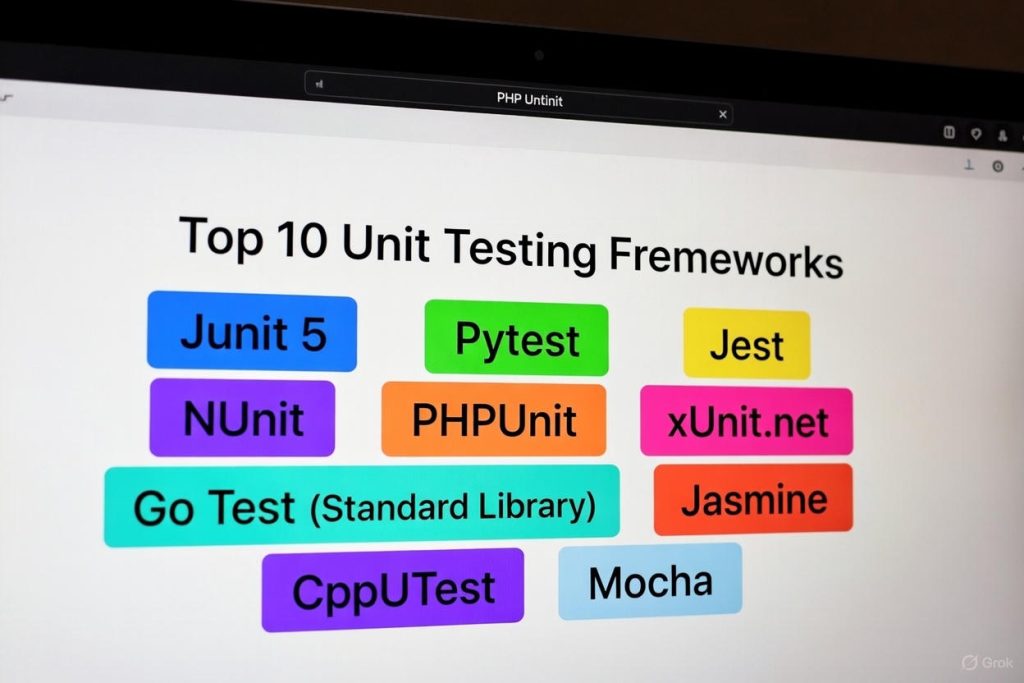
Top 10 Unit Testing Frameworks
1 — JUnit 5
JUnit 5 is the premier testing framework for the Java ecosystem. It is composed of several different modules from three different sub-projects like JUnit Platform, JUnit Jupiter, and JUnit Vintage, making it highly modular and powerful for modern Java applications.
- Key Features:
- Modular architecture for flexible test execution.
- Support for “Parameterized Tests” to run the same test with different data sets.
- Nested tests for better organizational hierarchy of complex test suites.
- “Dynamic Tests” generated at runtime.
- Built-in support for Timeout and Assertion handling.
- Pros:
- Unrivaled ecosystem support; integrates with every major Java IDE and build tool.
- Highly extensible via the Extension Model, replacing the old “Rules” system.
- Cons:
- The transition from JUnit 4 to 5 can be complex for very large legacy projects.
- Requires Java 8 or higher, which may be a barrier for extremely old systems.
- Security & Compliance: Supports secure execution in CI/CD environments; audit logs are typically handled via the integrated build server (Jenkins/GitHub Actions).
- Support & Community: Massive global community; extensive documentation and thousands of third-party plugins and tutorials.
2 — Pytest
Pytest is the go-to framework for Python developers, known for its “no-boilerplate” philosophy. It allows developers to write small, readable tests while scaling to support complex functional testing for applications and libraries.
- Key Features:
- Simple
assertstatement usage (no need forassertEqualorassertTruemethods). - “Fixtures” for modular and reusable test setup and teardown.
- Powerful plugin architecture with over 800+ community plugins.
- Ability to run existing unittest or nose test suites automatically.
- Detailed info on failing assert statements without extra code.
- Simple
- Pros:
- Significantly reduces the amount of code required to write a test.
- The fixture system is highly superior to traditional setup/teardown methods.
- Cons:
- The “magic” behind fixtures can sometimes make the test flow harder for beginners to trace.
- Highly specific syntax can make it difficult to switch back to standard Python libraries.
- Security & Compliance: N/A (Standard library security applies).
- Support & Community: One of the most active communities in the Python world; excellent documentation and enterprise support through third-party consultants.
3 — Jest
Jest is a delightful JavaScript Testing Framework with a focus on simplicity. It is maintained by Meta (Facebook) and is the standard for React applications, though it works seamlessly with any JavaScript project (Node, Vue, Angular, etc.).
- Key Features:
- “Zero-config” setup for most JavaScript projects.
- Snapshot testing to track UI changes over time.
- Built-in code coverage tool out of the box.
- Fast parallel execution by running tests in their own processes.
- Integrated mocking library for functions and modules.
- Pros:
- An “all-in-one” solution that doesn’t require separate assertion or mocking libraries.
- Excellent performance for large-scale frontend applications.
- Cons:
- Can be slower in some environments due to the overhead of the integrated features.
- Automated mocking (hoisting) can sometimes lead to confusing debugging scenarios.
- Security & Compliance: Standard NPM security audits; supports encrypted environment variables for sensitive tests.
- Support & Community: Backed by Meta; huge adoption in the React community; vast amounts of troubleshooting content available online.
4 — NUnit
NUnit is an open-source unit-testing framework for all .NET languages. Originally a port from JUnit, it has evolved into a highly performant tool that takes full advantage of .NET features like attributes and generics.
- Key Features:
- Attribute-based test identification (
[Test],[TestCase]). - Parallel test execution support to reduce build times.
- Support for “Theory” tests to verify general properties.
- Extensible “Constraint-based” assertion model.
- Strong integration with Visual Studio and Azure DevOps.
- Attribute-based test identification (
- Pros:
- Extremely stable and mature; a safe choice for enterprise .NET environments.
- Supports a wide range of platforms including .NET Core and Xamarin.
- Cons:
- Slightly more verbose than newer frameworks like xUnit.
- Configuration for parallel runs can be tricky in complex dependency scenarios.
- Security & Compliance: ISO/IEC compliance via the .NET Foundation standards; supports SSO through Azure AD integrations.
- Support & Community: Part of the .NET Foundation; very active GitHub and strong corporate backing from the Microsoft ecosystem.
5 — Mocha
Mocha is a flexible JavaScript test framework running on Node.js and in the browser. Unlike Jest, Mocha is unopinionated, allowing developers to choose their own assertion, mocking, and spy libraries (like Chai or Sinon).
- Key Features:
- Asynchronous testing support (including Promises and async/await).
- Extensive reporting options for CI/CD pipelines.
- Browser support for testing client-side logic directly.
- Highly customizable hooks (
before,after,each). - Global leak detection.
- Pros:
- Maximum flexibility; you only include the libraries you actually need.
- Very stable and battle-tested over many years.
- Cons:
- Requires more setup time because you must choose and install assertion libraries.
- Lacks a built-in mocking engine (requires Sinon.js or similar).
- Security & Compliance: Varies based on the libraries used in conjunction with Mocha.
- Support & Community: One of the oldest JS frameworks with a massive library of plugins and expert-level documentation.
6 — xUnit.net
xUnit.net is the modern successor to NUnit, designed by the original creators of NUnit. It is built specifically for the .NET ecosystem with a focus on “clean test” principles and modern C# patterns.
- Key Features:
- Avoidance of “magic” attributes (uses constructors for setup).
- Unique approach to test isolation (each test runs in its own class instance).
- First-class support for “Data-driven” tests via
[Theory]. - Extensible “Fact” and “Theory” attributes.
- Excellent performance through high-level parallelism.
- Pros:
- Cleaner, more modern syntax than NUnit.
- Strongly encourages better design patterns in your testing code.
- Cons:
- The learning curve is slightly higher for those used to the “Setup/Teardown” style of JUnit.
- Lacks some of the legacy platform support found in NUnit.
- Security & Compliance: Complies with modern .NET security standards and Microsoft enterprise requirements.
- Support & Community: The preferred choice for the .NET Core team; exceptional community support and documentation.
7 — PHPUnit
PHPUnit is the standard unit testing framework for PHP development. It is a programmer-oriented testing framework that follows the xUnit architecture and is essential for modern PHP frameworks like Laravel and Symfony.
- Key Features:
- Extensive mocking objects for isolating code.
- Code coverage analysis in multiple formats (HTML, Clover, XML).
- Integration with Selenium for web testing.
- Support for testing private and protected properties.
- XML-based configuration for standardized test suites.
- Pros:
- The undisputed leader in the PHP world; required for any professional PHP project.
- Integrates perfectly with Composer and modern PHP IDEs like PhpStorm.
- Cons:
- Can be memory-intensive when generating large coverage reports.
- The assertion syntax can feel a bit dated compared to modern JS or Python frameworks.
- Security & Compliance: N/A (Standard Open Source).
- Support & Community: Extremely robust; maintained by Sebastian Bergmann with deep integration into the global PHP community.
8 — Go Test (Standard Library)
Unlike other languages that require external frameworks, Go (Golang) includes a powerful, native testing package directly in its standard library. It is designed to be minimalist and incredibly fast.
- Key Features:
- Zero installation; part of the Go binary.
- Built-in benchmarking tools for performance testing.
- Race condition detection (
-raceflag). - Automatic “Example” documentation generation.
- Fast compilation and execution.
- Pros:
- No external dependencies to manage or update.
- Standardizes testing across the entire Go ecosystem.
- Cons:
- Very minimalist; lacks built-in “assertion” functions (requires
ifstatements or external libraries like Testify). - Mocking requires manual interface implementation or third-party tools.
- Very minimalist; lacks built-in “assertion” functions (requires
- Security & Compliance: Inherits Go’s strict security and memory safety principles.
- Support & Community: Backed by Google; the entire Go community uses this as the base for all testing.
9 — Jasmine
Jasmine is a behavior-driven development (BDD) framework for testing JavaScript code. It does not depend on any other JavaScript frameworks and does not require a DOM.
- Key Features:
- Clean, “human-readable” syntax (e.g.,
describe,it,expect). - Built-in “Spies” for tracking function calls and mocking.
- Works for both Node.js and browser-based testing.
- No external dependencies required.
- Easy integration with Karma for cross-browser testing.
- Clean, “human-readable” syntax (e.g.,
- Pros:
- The syntax makes tests very easy for non-developers to read.
- Excellent for BDD-focused teams.
- Cons:
- Has lost some market share to Jest, which includes many of Jasmine’s features but adds more.
- Configuration for modern build systems (like Vite) can be more complex than Jest.
- Security & Compliance: N/A.
- Support & Community: Long-standing community; very stable and widely documented in enterprise Angular environments.
10 — CppUTest
CppUTest is a C/C++ unit testing and mocking framework based on xUnit principles. It is specifically designed for embedded systems and memory-constrained environments where standard frameworks might be too heavy.
- Key Features:
- Memory leak detection built directly into the framework.
- C-interface for testing pure C code.
- Mocking support via “CppUMock.”
- Small footprint; ideal for cross-compilation to target hardware.
- Crash detection to prevent a single test from halting the whole suite.
- Pros:
- The best choice for hardware-near development and embedded C.
- Extremely portable across different compilers and platforms.
- Cons:
- UI and reporting are very basic compared to modern web frameworks.
- Requires more manual configuration of build files (Makefiles/CMake).
- Security & Compliance: Used in safety-critical industries (Automotive, Aerospace) where auditability is key.
- Support & Community: Strong niche community in the embedded systems world; reliable documentation for hardware integration.
Comparison Table
| Tool Name | Best For | Platform(s) Supported | Standout Feature | Rating (Approx.) |
| JUnit 5 | Java Enterprise | JVM | Modular Architecture | 4.8/5 |
| Pytest | Python Apps | Python 3.x | Reusable Fixtures | 4.9/5 |
| Jest | React/JS Apps | Node.js / Browser | Snapshot Testing | 4.7/5 |
| NUnit | .NET Development | .NET / C# | Attribute-based Logic | 4.5/5 |
| Mocha | Flexible JS Projects | Node.js / Browser | Unopinionated Setup | 4.4/5 |
| xUnit.net | Modern .NET Core | .NET Core / 5+ | Test Isolation | 4.6/5 |
| PHPUnit | PHP Applications | PHP | Deep Framework Sync | 4.5/5 |
| Go Test | Golang Microservices | Go | Native Benchmark Tools | 4.8/5 |
| Jasmine | BDD / Angular | JS / TypeScript | Human-Readable Syntax | 4.2/5 |
| CppUTest | Embedded C/C++ | C / C++ | Memory Leak Tracking | 4.3/5 |
Evaluation & Scoring of Unit Testing Frameworks
The following scores are based on the industry consensus for each framework’s primary ecosystem.
| Criteria | Weight | Evaluation Focus |
| Core Features | 25% | Assertions, Mocking, Parameterization, and Setup/Teardown logic. |
| Ease of Use | 15% | Syntax simplicity, boilerplate requirements, and learning curve. |
| Integrations | 15% | Support for IDEs (VS Code, IntelliJ), Build Tools, and CI/CD. |
| Security/Compliance | 10% | Secure execution, sandboxing, and enterprise-grade auditing. |
| Performance | 10% | Execution speed, parallelization, and memory overhead. |
| Support/Community | 10% | Documentation quality, forum activity, and plugin availability. |
| Price / Value | 15% | Licensing (mostly Open Source) and cost of maintenance. |
Which Unit Testing Framework Tool Is Right for You?
Choosing the right framework is usually dictated by your programming language, but within those ecosystems, your specific project needs should guide your decision.
Solo Users vs. SMB vs. Enterprise
- Solo Users: Prioritize frameworks with minimal boilerplate and “zero-config” like Pytest or Jest. You want to spend time writing features, not configuring test runners.
- SMBs: Focus on extensibility and integration. Frameworks like JUnit 5 or NUnit allow your testing suite to grow alongside your infrastructure, integrating with Jira and Jenkins easily.
- Enterprise: Look for stability and compliance. xUnit.net or PHPUnit offer the rigorous structure and documentation required for large teams and long-term maintenance.
Budget-Conscious vs. Premium Solutions
Almost all top-tier unit testing frameworks are open-source and free. However, the “cost” comes in the form of maintenance and execution time.
- Performance matters: If you are running thousands of tests per hour in a paid CI/CD environment (like GitHub Actions), a fast, native tool like Go Test can save you thousands of dollars in compute costs annually compared to heavier frameworks.
Feature Depth vs. Ease of Use
- If you want everything in one box, choose Jest. It includes assertions, mocks, and coverage reporting.
- If you want total control, choose Mocha. You can swap out assertion libraries as your project needs change.
Security and Compliance
For teams in regulated industries (Medical, Fintech, Defense), the framework must support detailed logging and audit trails. CppUTest is specifically favored in these sectors for its ability to prove that every line of code has been verified without memory leaks—a critical requirement for safety-standard compliance like ISO 26262.
Frequently Asked Questions (FAQs)
1. Is it better to use a native framework or an external library?
Native frameworks (like Go Test) offer better stability and no dependency management. External libraries (like Pytest) often offer more “quality of life” features like advanced fixtures and better reporting.
2. Can I use multiple unit testing frameworks in one project?
While possible, it is highly discouraged. Using multiple frameworks creates “tool fragmentation,” making it harder for new developers to learn the codebase and complicating CI/CD pipeline configurations.
3. What is “Code Coverage,” and do I need it?
Code coverage measures what percentage of your source code is executed during tests. While 100% coverage isn’t always necessary (or even good), it is a vital metric for identifying untested “dark spots” in your logic.
4. How do I handle database calls in unit tests?
You should never call a real database in a unit test. Instead, use “Mocks” or “Stubs” (supported by frameworks like Jest or JUnit) to simulate the database response, ensuring your tests remain fast and deterministic.
5. What is the difference between Unit Testing and Integration Testing?
Unit testing checks a single function in isolation. Integration testing checks how different modules (like a service and a database) work together. Most unit testing frameworks can actually perform both tasks.
6. Does unit testing slow down development?
In the short term, yes, writing tests takes time. In the long term, it significantly speeds up development by reducing the time spent on manual debugging and fixing regression bugs.
7. Which framework is best for beginners?
Pytest (Python) and Jest (JavaScript) are generally considered the most beginner-friendly due to their readable syntax and helpful error messages.
8. Can unit testing frameworks be used for UI testing?
Frameworks like Jest (via Snapshot testing) can test logic behind the UI, but for actual browser interaction (clicking buttons), they are usually paired with tools like Playwright or Selenium.
9. How do I run these tests automatically?
All frameworks on this list are designed to be run from the command line. You can trigger them in a CI/CD tool (like GitLab CI) every time a developer commits code.
10. What is a “Parameterized Test”?
It’s a feature (standard in JUnit 5 and Pytest) that allows you to run the same test logic multiple times with different inputs and expected results, reducing code duplication.
Conclusion
The “best” unit testing framework isn’t a universal constant; it is the tool that matches your language, your team’s workflow, and your performance requirements. Whether you are using the native speed of Go Test, the feature-rich ecosystem of JUnit 5, or the developer-friendly syntax of Pytest, the goal remains the same: building a safety net that allows you to move fast without breaking things.
As software complexity continues to rise, investing the time to master a framework today is the best way to ensure the reliability and longevity of your applications tomorrow.