Introduction
Remote Desktop Tools are software applications that allow a user to connect to and control a computer in a different location via the internet or a local network. By transmitting keyboard and mouse inputs from the local device to the remote machine and receiving a real-time video stream of the remote screen in return, these tools effectively bridge the physical gap between a user and their digital workspace. They represent a fundamental shift from traditional on-premises computing to a more flexible, location-independent model.
The importance of these tools cannot be overstated in today’s hybrid work landscape. They are the backbone of modern IT support, enabling technicians to troubleshoot issues without traveling, and they empower employees to access high-performance office workstations from modest home laptops. Key real-world use cases include system administrators managing server farms, developers accessing Linux environments from Windows machines, and creative professionals editing high-resolution video remotely. When evaluating these tools, users should prioritize low-latency streaming, robust encryption, ease of firewall traversal, and cross-platform compatibility.
Best for: IT help desks, system administrators, remote employees, creative agencies, and global enterprises requiring secure access to centralized computing resources.
Not ideal for: Users with extremely poor internet connectivity (where lag makes the experience unusable) or those who only need simple file sharing, which is more efficiently handled by dedicated cloud storage providers.
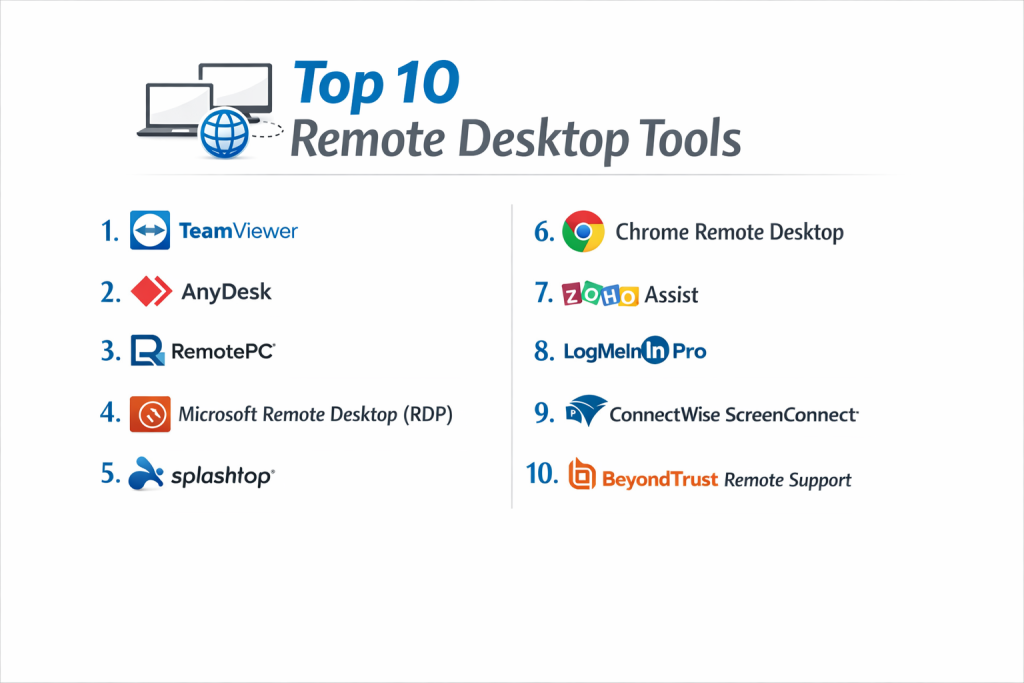
Top 10 Remote Desktop Tools
1 — TeamViewer
TeamViewer is an industry heavyweight known for its vast feature set and its ability to connect to almost any device, from PCs to industrial IoT hardware.
- Key Features:
- Cross-Platform Access: Connect from PC to PC, mobile to PC, and even PC to mobile.
- Unattended Access: Manage servers or home computers without a person at the remote end.
- Wake-on-LAN: Remotely power on computers that are in sleep or powered-off modes.
- Remote Printing: Print documents from the remote machine directly to your local printer.
- Augmented Reality (AR) Support: Technical assistance using camera sharing and 3D markers.
- Bulk Deployment: Easily push software to thousands of devices simultaneously.
- Pros:
- Exceptionally easy to set up for first-time users via simple ID and password.
- Highly reliable performance over varying network conditions.
- Cons:
- The commercial licensing is among the most expensive in the market.
- Personal users frequently report aggressive “commercial use detected” flags.
- Security & compliance: 256-bit AES encryption, two-factor authentication (2FA), SOC 2, HIPAA, and GDPR compliance.
- Support & community: Extensive knowledge base, global phone support, and a massive community of IT professional users.
2 — AnyDesk
AnyDesk is built around the proprietary DeskRT codec, which is designed to provide near-instant responsiveness even on slow internet connections.
- Key Features:
- DeskRT Video Codec: Optimized for high frame rates and low latency.
- On-Premises Option: Allows enterprises to host the network entirely within their own infrastructure.
- Custom Client: Organizations can brand the software and customize feature sets.
- Address Book: Simplifies management of hundreds of frequent remote connections.
- Permission Profiles: Granular control over what the remote user can see or do.
- File Manager: Dedicated dual-pane interface for moving data between devices.
- Pros:
- Lightweight application with a very small installation footprint.
- One of the smoothest user experiences for high-motion tasks like video editing.
- Cons:
- The administrative interface for large teams can be less intuitive than competitors.
- Some advanced security features are gated behind higher-tier plans.
- Security & compliance: RSA 2048 asymmetric key exchange, TLS 1.2, and GDPR readiness.
- Support & community: Solid technical documentation and a responsive ticket-based support system for paid users.
3 — RemotePC
RemotePC is a versatile, cost-effective solution that balances essential professional features with an interface that is accessible to non-technical users.
- Key Features:
- Always-on Access: Configure remote machines for permanent accessibility.
- One-Time Access: Generate temporary codes for quick, ad-hoc support sessions.
- Web-Based Access: Connect via a browser without installing a desktop client.
- Remote Whiteboard: Draw on the remote screen to guide users during support.
- Multi-Monitor Support: View multiple remote screens on a single local monitor or separate screens.
- Performance Scaling: Manually adjust quality to prioritize speed over visual clarity.
- Pros:
- Excellent value for money, frequently offering significant first-year discounts.
- Very straightforward installation process for non-technical employees.
- Cons:
- File transfer speeds can occasionally be slower than TeamViewer or AnyDesk.
- The mobile app interface is functional but lacks some of the polish of competitors.
- Security & compliance: TLS v1.2/AES-256 encryption, Personal Key options, and HIPAA/GDPR compliance.
- Support & community: 24/7 phone and chat support for business users; comprehensive FAQ and video guides.
4 — Microsoft Remote Desktop (RDP)
Built directly into Windows Pro and Enterprise editions, RDP is the native solution for Windows-centric environments, offering deep system-level integration.
- Key Features:
- Native Windows Protocol: No third-party software installation required on the host.
- RemoteFX: Enhances graphics performance for 3D applications and media.
- Smart Card Redirection: Use local security hardware on the remote machine.
- Printer and Drive Redirection: Seamlessly access local hardware within the remote session.
- Multi-Monitor Experience: Native support for full-screen, multi-display setups.
- Microsoft Gateway: Securely connect to internal network resources without a VPN.
- Pros:
- Completely free for users already owning Windows Pro/Enterprise licenses.
- Minimal latency since it is a native component of the operating system.
- Cons:
- Generally requires VPN or complex port forwarding for access over the public internet.
- Not available as a “Host” on Windows Home editions.
- Security & compliance: NLA (Network Level Authentication), AES encryption, and integrated Active Directory support.
- Support & community: Supported by Microsoft’s massive global ecosystem and documentation.
5 — Splashtop
Splashtop is favored by creative professionals and educational institutions for its high-performance video streaming and competitive pricing.
- Key Features:
- 4K Streaming: Supports high-resolution displays at 60 frames per second.
- Remote Microphone: Pass-through local mic input to the remote machine.
- Session Recording: Built-in tool for auditing or creating training videos.
- Scheduled Access: Grant remote access to specific machines during set hours only.
- Two-User Concurrency: Two technicians can connect to the same machine simultaneously.
- Active Directory Integration: Sync with existing company user management systems.
- Pros:
- Better price-to-performance ratio than TeamViewer for large deployments.
- Exceptional performance for resource-heavy apps like AutoCAD or Adobe Premiere.
- Cons:
- The pricing structure can be confusing due to the variety of specialized plans.
- Occasional “reconnection” prompts on some mobile networks.
- Security & compliance: 256-bit AES, TLS, SOC 2, HIPAA, GDPR, and PCI compliance.
- Support & community: Highly rated customer service with 24/7 technical support available.
6 — Chrome Remote Desktop
Chrome Remote Desktop is a free, web-based tool provided by Google that excels in simplicity and cross-platform accessibility via the browser.
- Key Features:
- Browser-Based: Runs as an extension within Google Chrome or any Chromium browser.
- PIN-Based Security: Simple authentication for “My Computers” access.
- Remote Support Mode: Generate one-time codes to assist friends or colleagues.
- Cloud-Synced: Your list of computers follows your Google Account.
- Minimalist UI: Focuses entirely on the screen view with few distractions.
- Mobile App: Simple “touch” or “trackpad” modes for phone-based control.
- Pros:
- Completely free for both personal and commercial use.
- Works on any OS that can run Chrome, including ChromeOS and Linux.
- Cons:
- Lacks professional features like remote printing, chat, or advanced file transfer.
- No multi-monitor view; you must manually toggle between screens.
- Security & compliance: Built on Google’s secure infrastructure; uses HTTPS. (Limited enterprise compliance reporting).
- Support & community: Community-based support forums and standard Google help documentation.
7 — Zoho Assist
Zoho Assist is a cloud-based remote support and access software designed for help desks, outsourced IT, and customer service teams.
- Key Features:
- On-Demand Support: Connect to customers without any prior software installation.
- Unattended Access: Manage PCs, Macs, and servers that are not currently in use.
- Voice and Video Chat: Integrated communication tools within the session.
- Service Desk Integration: Works seamlessly with Zoho Desk and other CRMs.
- Custom Branding: Add your company logo and portal colors for a professional look.
- Bulk Deployment: Easily distribute agents across large networks.
- Pros:
- Excellent browser-based technician console that requires no local installation.
- Very competitive pricing for small to medium-sized support teams.
- Cons:
- The interface can be slightly slower than dedicated desktop clients.
- Advanced session reporting requires the more expensive professional tiers.
- Security & compliance: 256-bit AES encryption, SSL/TLS, GDPR, HIPAA, and SOC 2.
- Support & community: 24/5 or 24/7 support depending on the plan, plus a large library of webinars.
8 — LogMeIn Pro
LogMeIn Pro is a high-end solution focused on business productivity, offering more than just remote access through bundled secondary tools.
- Key Features:
- File Storage: Includes 1TB of cloud storage for sharing and backup.
- LastPass Premium: Often bundled for secure password management across the team.
- Multi-Monitor Display: View all remote monitors locally at once.
- Remote Deployment: Push installers to multiple machines via a link or installer package.
- Desktop Shortcuts: Create icons on your local desktop to launch remote sessions instantly.
- Detailed Reports: Monitor user activity and session history for auditing.
- Pros:
- Extremely high reliability and uptime for enterprise users.
- The bundled storage and password management offer a complete remote-work suite.
- Cons:
- One of the most expensive options, with a history of significant price increases.
- Lacks a free version for personal users.
- Security & compliance: SSL/TLS, AES-256 encryption, SOC 2 Type II, and HIPAA compliance.
- Support & community: 24/7 phone support and a mature network of enterprise consultants.
9 — ConnectWise ScreenConnect
ScreenConnect (formerly Control) is a fast, highly customizable tool that is widely favored by Managed Service Providers (MSPs).
- Key Features:
- Backstage Mode: Perform administrative tasks in a terminal window without disturbing the user.
- Extension Marketplace: Add community-built tools for extra functionality.
- Granular Permissions: Define exactly what technicians can see and do.
- Toolbox: A shared folder of scripts and executables available in every session.
- Meeting Mode: Collaborative screen sharing for up to 10 participants.
- Integration Engine: Connects with RMM, PSA, and ticketing systems.
- Pros:
- Remarkably fast connection speeds and low-latency interaction.
- Highly customizable; you can modify the UI and functionality via CSS and extensions.
- Cons:
- The administrative console has a steep learning curve for beginners.
- Licensing is primarily designed for tech companies rather than individual users.
- Security & compliance: SSO, 2FA, AES-256 encryption, and extensive audit logging.
- Support & community: Vibrant developer community and deep technical documentation.
10 — BeyondTrust Remote Support
BeyondTrust (formerly Bomgar) is the gold standard for high-security environments, focusing on the concept of “privileged access.”
- Key Features:
- Credential Injection: Technicians can log in to remote systems without ever seeing the password.
- Hardened Appliance: Available as a physical or virtual appliance for maximum security.
- Full Audit Trail: Video and text logs of every single action taken during a session.
- Mobile Device Support: Full remote control of Android and view-only for iOS.
- Smart Card Support: Allows for secure authentication in government environments.
- Jump Clients: Highly stable connections for permanent remote management.
- Pros:
- The most secure and compliant tool on the market for regulated industries.
- Centralized management that is second to none for large corporate help desks.
- Cons:
- Very high cost of entry; strictly an enterprise solution.
- Can be overly complex for organizations with simple remote-access needs.
- Security & compliance: FIPS 140-2, HIPAA, GDPR, ISO 27001, and SOC 2.
- Support & community: Dedicated enterprise support teams and specialized training certifications.
Comparison Table
| Tool Name | Best For | Platform(s) Supported | Standout Feature | Rating (Gartner/True) |
| TeamViewer | General Use/IoT | All Platforms | Augmented Reality (AR) | 4.6 / 5 |
| AnyDesk | Performance | All Platforms | DeskRT Codec | 4.5 / 5 |
| RemotePC | Small Business | Win, Mac, Mobile | Price-to-Feature Ratio | 4.3 / 5 |
| MS RDP | Windows-Only | Windows, (Client) All | Native Integration | 4.4 / 5 |
| Splashtop | Creative Pros | All Platforms | 4K @ 60 FPS | 4.7 / 5 |
| Chrome RD | Casual Users | Browser-Based | 100% Free | 4.1 / 5 |
| Zoho Assist | Help Desks | Win, Mac, Linux | CRM Integration | 4.4 / 5 |
| LogMeIn Pro | Productivity | Win, Mac | 1TB Cloud Storage | 4.0 / 5 |
| ScreenConnect | MSPs | All Platforms | Backstage Mode | 4.7 / 5 |
| BeyondTrust | High Security | All Platforms | Credential Injection | 4.8 / 5 |
Evaluation & Scoring of Remote Desktop Tools
This evaluation uses a weighted rubric to score tools based on the requirements of modern digital environments.
| Category | Weight | Evaluation Criteria |
| Core Features | 25% | Multi-monitor support, file transfer, and unattended access. |
| Ease of Use | 15% | Intuitiveness for both the technician and the end-user. |
| Integrations | 15% | Connectivity with ticketing systems, CRMs, and RMM tools. |
| Security & Compliance | 10% | Encryption standards, MFA, and industry certifications. |
| Performance | 10% | Latency, frame rate, and bandwidth efficiency. |
| Support & Community | 10% | Quality of documentation and availability of technical help. |
| Price / Value | 15% | Affordability and transparency of the licensing model. |
Which Remote Desktop Tools Tool Is Right for You?
Solo Users vs SMB vs Mid-Market vs Enterprise
- Solo Users: If you are a freelancer or hobbyist, Chrome Remote Desktop is the easiest $0 option. If you need more power, the free tier of AnyDesk is superior to TeamViewer’s restrictive free version.
- Small Businesses (SMBs): RemotePC offers the most professional features for the lowest annual cost, making it ideal for teams with tight budgets.
- Mid-Market: Splashtop and Zoho Assist scale well, offering centralized management without the extreme price tag of enterprise suites.
- Enterprise: TeamViewer Tensor or BeyondTrust are essential for organizations that need to manage thousands of devices with strict audit requirements.
Budget-Conscious vs Premium Solutions
For those watching the bottom line, Chrome Remote Desktop (Free) and RemotePC (Budget-Paid) are the winners. If your business depends on zero downtime and specific integrations, premium solutions like LogMeIn or BeyondTrust justify their cost through reliability and support.
Feature Depth vs Ease of Use
If you want a tool that “just works” for non-technical users, AnyDesk or RemotePC are excellent. However, if you are a power user who needs to run scripts behind the scenes without the user knowing, the feature depth of ConnectWise ScreenConnect is unmatched.
Integration and Scalability Needs
If you already use the Zoho or Microsoft ecosystems, sticking with Zoho Assist or MS RDP will provide the best integration. For Managed Service Providers who need to connect remote access to their billing and ticketing systems, ScreenConnect is the industry standard.
Frequently Asked Questions (FAQs)
1. Is remote desktop software safe for my data?
Yes, provided you use professional tools with End-to-End Encryption and Two-Factor Authentication (2FA). Never give your access ID to anyone you don’t know, as remote desktop scams are a common way for attackers to gain entry.
2. Can I use these tools if I have slow internet?
Yes. Tools like AnyDesk and Splashtop allow you to lower the visual quality (e.g., turning off the desktop wallpaper) to ensure the mouse movement remains smooth even on low-bandwidth connections.
3. Do I need to be in front of the computer to accept the connection?
Only if you use “on-demand” support. For your own computers, you can set up unattended access, which uses a fixed password or account login to let you in anytime without someone clicking “Accept.”
4. Can I access a PC from a Mac or a phone?
Absolutely. Most modern tools have “clients” for iOS, Android, and macOS. While the screen is smaller on a phone, you can use touch gestures or a virtual mouse to navigate a full desktop.
5. What is the difference between RDP and third-party tools?
RDP (Remote Desktop Protocol) is built into Windows and is very fast, but usually requires a VPN for security over the internet. Third-party tools like TeamViewer use their own servers to “broker” the connection, making them easier to use through firewalls.
6. Will the remote computer turn off if I disconnect?
No. Your session simply ends, but the remote computer stays in whatever state you left it (unless you manually click “Shut Down” or “Restart” within the remote session).
7. Can I hear audio from the remote computer?
Yes, most professional tools support audio redirection, meaning any music, system alerts, or video sound from the remote PC will play through your local speakers.
8. Can I transfer files between the two computers?
Most paid tools have a dedicated file transfer window or allow you to simply “copy” on the remote machine and “paste” on your local machine.
9. Why does my screen look blurry when I connect?
This is usually the software’s way of dealing with a slow connection. It compresses the video to prevent “lag.” You can usually go into the settings and change the quality to “Optimize for Quality” instead of “Speed.”
10. Can two people use the remote computer at the same time?
In most “Remote Desktop” scenarios, whoever moves the mouse has control. However, tools like Splashtop and BeyondTrust allow two technicians to view and control the screen together for collaboration.
Conclusion
The evolution of Remote Desktop Tools has effectively erased geographic boundaries for the modern workforce. Whether you are a technician saving the day for a frustrated customer or a remote employee accessing your office powerhouse from a beach, the technology has reached a level of maturity where the experience is nearly indistinguishable from being there in person.
Choosing the “best” tool ultimately comes down to your specific use case. If you need pure speed and responsiveness, AnyDesk and Splashtop are hard to beat. If your priority is enterprise-grade security and auditing, BeyondTrust is the winner. For the casual user or the budget-conscious business, Chrome Remote Desktop and RemotePC provide everything necessary for basic remote productivity. By focusing on your core needs—security, performance, or price—you can find a tool that makes the distance disappear.