Introduction
Outbound Dialer Software is a specialized technology designed to automate the process of making outgoing phone calls. In a traditional setting, a salesperson would manually dial a number, wait for a ring, and likely hit a voicemail—repeating this hundreds of times a day. An outbound dialer removes this “dead time” by dialing numbers automatically from a list and connecting agents only when a live human answers. Modern dialers use sophisticated algorithms to predict when an agent will be free, ensuring that team productivity is maximized.
This software is critical for any business that relies on high-volume phone outreach. It significantly increases “talk time”—the actual minutes spent speaking to prospects—and reduces the fatigue associated with manual dialing. By automating the workflow, businesses can scale their sales operations, improve lead conversion rates, and maintain a consistent follow-up schedule.
Key real-world use cases include:
- Inside Sales: Helping SDRs (Sales Development Representatives) reach more leads per hour to book more meetings.
- Debt Collection: Automating outreach to accounts with outstanding balances to improve recovery rates.
- Political Campaigning: Reaching thousands of voters in a short window for polling or get-out-the-vote efforts.
- Market Research: Conducting large-scale phone surveys efficiently across diverse demographics.
When choosing a tool in this category, users should evaluate dialing modes (preview, power, and predictive), CRM integration (to keep data synced), compliance features (to avoid legal issues like TCPA violations), and answering machine detection accuracy.
Best for: High-growth sales teams, mid-to-large call centers, telemarketing firms, and debt collection agencies that need to make hundreds or thousands of calls daily.
Not ideal for: Solopreneurs or businesses that prioritize deep, long-form relationship building where they only make 5–10 highly researched calls per day. In these cases, a simple VoIP phone is usually sufficient.
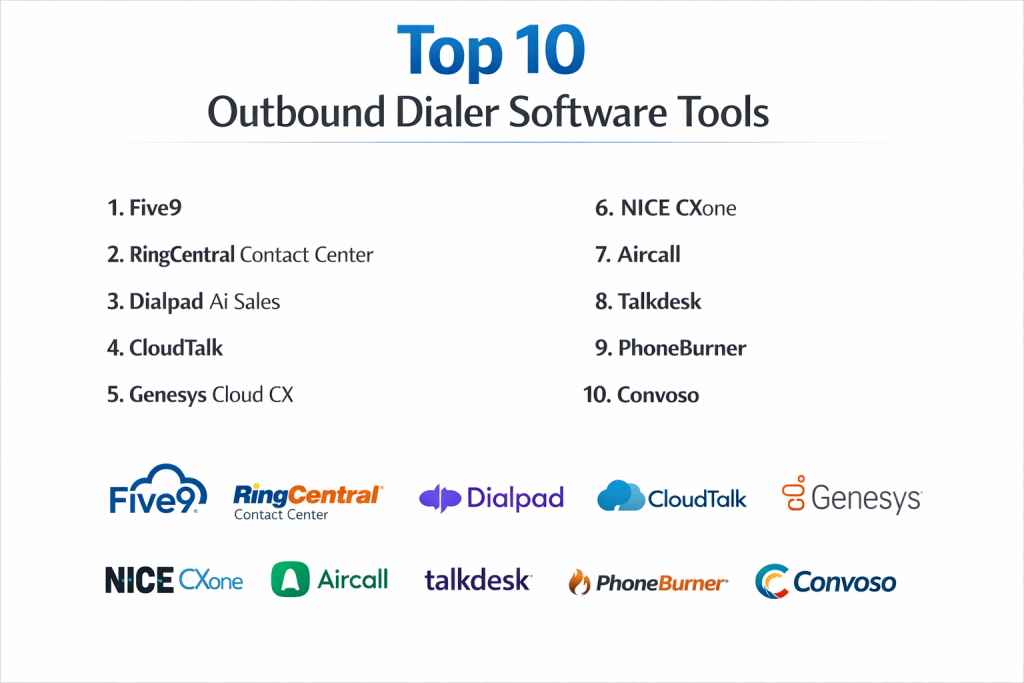
Top 10 Outbound Dialer Software Tools
1 — Five9
Five9 is a heavyweight in the cloud contact center space, known for its robust outbound dialing capabilities that cater specifically to large-scale enterprises and high-velocity sales environments.
- Key Features:
- Predictive Dialer: Uses math-based algorithms to dial multiple lines per agent to minimize idle time.
- Power Dialer: Dials exactly one number per available agent, perfect for smaller, high-quality lists.
- Progressive Dialer: Only dials a number when an agent is actually available to take the call.
- TCPA Manual Connection: A specific mode designed to help businesses stay compliant with federal regulations.
- Answering Machine Detection: High-accuracy filters that prevent agents from hearing “Please leave a message.”
- CRM Integration: Deep, native syncing with Salesforce, Microsoft Dynamics, and ServiceNow.
- Pros:
- One of the most powerful predictive algorithms in the industry, significantly boosting talk time.
- Extremely scalable, making it the “go-to” for centers with hundreds of agents.
- Cons:
- The setup process is complex and usually requires a professional implementation specialist.
- The user interface can feel dated and overwhelming for new users.
- Security & compliance: SOC 2 Type II, HIPAA, GDPR, PCI DSS Level 1, and ISO 27001.
- Support & community: 24/7 technical support, a dedicated Customer Success Manager for large accounts, and an extensive online “Five9 University.”
2 — RingCentral Contact Center
RingCentral is a leader in unified communications, and their contact center product offers a world-class outbound dialer that focuses on reliability and omnichannel integration.
- Key Features:
- Smart Dialing: Automatically adjusts dialing rates based on real-time agent availability.
- Campaign Management: Easily segment lists and schedule specific outreach times.
- Integrated Scripting: Displays custom sales scripts to agents the moment a call connects.
- Omnichannel Reach: Seamlessly switch between phone, SMS, and email within the same campaign.
- Real-time Analytics: Track agent performance, conversion rates, and drop rates on the fly.
- Global Reach: Local presence dialing to show a local caller ID to prospects in different regions.
- Pros:
- Incredible uptime reliability (99.999%), which is vital for revenue-generating teams.
- Excellent mobile app support, allowing managers to monitor campaigns on the go.
- Cons:
- Can be quite expensive if you only need the dialer and not the full suite of tools.
- The reporting engine has a steep learning curve for custom reports.
- Security & compliance: HITRUST, SOC 2, HIPAA, GDPR, and PCI-DSS.
- Support & community: 24/7 phone support, a massive global partner network, and a very active user community forum.
3 — Dialpad Ai Sales
Dialpad distinguishes itself by placing Artificial Intelligence at the core of the calling experience, providing real-time coaching and automated note-taking.
- Key Features:
- Ai Recaps: Automatically summarizes calls and lists action items without agent input.
- Real-time Assist: AI-powered pop-ups that give agents answers to common objections instantly.
- Power Dialer: Built directly into the desktop app for rapid, sequential calling.
- Sentiment Analysis: Analyzes the caller’s tone to see if the conversation is going well or poorly.
- Live Coaching: Managers can see “live” transcripts and jump in to help if an agent is struggling.
- Local Presence: Automatically displays a local area code to increase pick-up rates.
- Pros:
- The AI transcriptions are remarkably accurate and save agents hours of data entry.
- Extremely modern and “friendly” interface that requires almost zero training.
- Cons:
- The predictive dialing features are not as aggressive as legacy systems like Five9.
- Heavily dependent on a very high-quality internet connection for the AI features to work.
- Security & compliance: SOC 2 Type II, HIPAA, GDPR, and ISO 27001.
- Support & community: Great online help documentation and 24/7 live support for Pro and Enterprise users.
4 — CloudTalk
CloudTalk is a modern, cloud-based phone system that has become a favorite for European and North American SMBs due to its simplicity and excellent international calling rates.
- Key Features:
- Power Dialer: Automatically moves through a list of contacts one by one.
- Smart Dialer: Automatically compiles a list of numbers from any website or CRM view.
- International Numbers: Quickly buy local numbers in over 160 countries.
- Call Flow Designer: A visual tool to map out exactly what happens when a call is placed.
- Wallboards: Real-time visual displays for the office to track team competition.
- SMS Campaigning: Send follow-up texts automatically after a call.
- Pros:
- Very competitive pricing for small teams that need advanced features.
- Excellent integration with modern CRMs like HubSpot, Pipedrive, and Copper.
- Cons:
- Does not offer a “Predictive” dialer mode, which may limit very large call centers.
- The mobile app can occasionally be less stable than the desktop version.
- Security & compliance: GDPR, ISO 27001, and SOC 2 compliant.
- Support & community: Fast email and phone support with a reputation for being very helpful to startups.
5 — Genesys Cloud CX
Genesys is a top-tier enterprise platform that specializes in “experience orchestration,” ensuring that outbound calls feel like a natural part of the customer journey.
- Key Features:
- Blended AI: Seamlessly combines bot interactions with human agent hand-offs.
- Predictive Engagement: Identifies the best time to call a lead based on their website behavior.
- Workforce Management: Built-in tools to predict how many agents you need for a campaign.
- Custom Scripting: Drag-and-drop builder for complex, branch-based sales scripts.
- Unified Agent Desktop: All customer history across chat, email, and phone in one screen.
- Compliance Suite: Advanced tools for managing “Do Not Call” (DNC) lists globally.
- Pros:
- Highly flexible and customizable for complex business workflows.
- Superior analytics that connect outbound call data to overall customer satisfaction.
- Cons:
- The administrative side is very technical and usually requires an IT specialist.
- The price point is significantly higher than SMB-focused tools.
- Security & compliance: FedRAMP, HIPAA, GDPR, SOC 2, and ISO 27001.
- Support & community: Enterprise-grade global support and a massive developer community (Genesys AppFoundry).
6 — Nice CXone
Nice CXone (formerly inContact) is a giant in the industry, offering some of the most advanced workforce optimization and outbound dialing tools available today.
- Key Features:
- Personal Connection Dialer: A patented technology that eliminates the “telemarketer pause” (the silence when you pick up).
- Proactive Outreach: Automates messages across voice, SMS, and email.
- Enlighten AI: Scores every agent interaction automatically to improve coaching.
- DNC Management: Real-time scrubbing against national and local “Do Not Call” lists.
- Campaign Visualization: See exactly how your call lists are performing through graphical maps.
- Virtual Agent: AI-driven voice bots that can qualify leads before passing them to humans.
- Pros:
- The “No-Pause” technology drastically improves the customer’s first impression.
- Unrivaled workforce management features for optimizing large teams.
- Cons:
- The platform can feel massive and “corporate,” which may slow down smaller teams.
- Billing and contract terms are often more rigid than newer SaaS players.
- Security & compliance: SOC 2, HIPAA, GDPR, PCI DSS, and HITRUST.
- Support & community: 24/7/365 global support and a very deep library of technical whitepapers.
7 — Aircall
Aircall is designed for teams that prioritize simplicity and a “clean” tech stack. It is famously easy to set up and integrates perfectly with the tools sales teams already use.
- Key Features:
- Power Dialer: Instantly detects phone numbers on any webpage and adds them to a queue.
- Call Tagging: Agents can quickly categorize calls for better reporting.
- Insight Cards: Shows full context from your CRM the moment a call is placed.
- After-Call Work: Gives agents a set amount of time to finish notes before the next call.
- Live Monitoring: Allows managers to “whisper” to agents during live outbound calls.
- Shared Inbox: Teams can see all outbound activity and voicemails in a collaborative view.
- Pros:
- One of the most user-friendly interfaces in the world of business phones.
- The “set up in minutes” promise is actually true for most teams.
- Cons:
- Lacks a true predictive dialer, making it less ideal for massive 100+ agent outbound centers.
- Call recording storage can be limited on lower-priced plans.
- Security & compliance: SOC 2 Type II, GDPR, and HIPAA-ready.
- Support & community: Excellent onboarding specialists and a very modern help center.
8 — Talkdesk
Talkdesk is a “cloud-native” platform that focuses on high-speed innovation, frequently releasing new AI and automation features for outbound sales teams.
- Key Features:
- Talkdesk AI Trainer: Allows businesses to “teach” the AI to understand specific industry terms.
- Outbound Engagement: A specific module designed to increase pick-up rates via smart ID.
- Automated Workflows: Send a calendar invite or an email follow-up the second a call hangs up.
- Visual IVR: Helps prospects route themselves to the right salesperson if they call back.
- Talkdesk Guardian: Uses AI to monitor for security risks or compliance slips during calls.
- Agent Assist: Provides live “next best action” advice during sales conversations.
- Pros:
- Very fast deployment times for such a powerful enterprise tool.
- Consistently rated high for user experience and agent satisfaction.
- Cons:
- Heavily usage-based pricing can make monthly costs unpredictable.
- The platform can occasionally experience “growing pains” with new feature releases.
- Security & compliance: ISO 27001, SOC 2 Type II, HIPAA, and GDPR.
- Support & community: 24/7 global support and a very strong “Talkdesk Academy” for certifications.
9 — PhoneBurner
PhoneBurner is a specialized power dialer that focuses purely on increasing sales productivity without the technical headaches of a full contact center suite.
- Key Features:
- Power Dialer: Dials up to 80 contacts per hour without any “telemarketer delay.”
- Lead Distribution: Automatically routes new leads to specific agents based on rules.
- Email Tracking: See when a prospect opens an email you sent through the platform.
- Branded Caller ID: Shows your company name on the prospect’s phone screen.
- Voicemail Drop: Leave a pre-recorded, professional voicemail with a single click.
- Smart Sender: Sends personalized follow-up emails based on the call outcome.
- Pros:
- The “No Delay” connection is industry-leading, making it feel like a manual call.
- Extremely simple for sales reps to manage their own lead lists.
- Cons:
- Does not offer a predictive dialer (sequential dialing only).
- Reporting is less robust than the massive enterprise platforms.
- Security & compliance: SOC 2 Type II and GDPR compliant.
- Support & community: US-based phone support and a very friendly, responsive team.
10 — Convoso
Convoso is a highly specialized outbound dialer built for one purpose: helping lead-generation companies increase their contact rates in a world of “Scam Likely” filters.
- Key Features:
- ClearView Analytics: Shows you which of your numbers are being flagged as “Scam” or “Spam.”
- Dynamic Scripting: The script changes on the fly based on the prospect’s answers.
- Predictive Dialing: One of the most aggressive algorithms for high-volume centers.
- Omnichannel SMS: Send a text to “pre-warm” a lead before the call is placed.
- Real-time Revenue Tracking: See exactly how much money each agent is generating.
- Answering Machine Detection: Powered by AI to ensure agents never waste time on machines.
- Pros:
- Unrivaled at managing caller ID reputation to ensure your calls actually ring.
- Built-in tools specifically for the highly regulated lead-gen industry.
- Cons:
- The software is quite expensive and intended for companies with high lead spends.
- The user interface is very “data-heavy” and can take time for agents to master.
- Security & compliance: PCI, HIPAA, and SOC 2.
- Support & community: High-touch customer success and technical support for large-scale operations.
Comparison Table
| Tool Name | Best For | Platform(s) Supported | Standout Feature | Rating (Gartner) |
| Five9 | Enterprise Sales | Web, Win, Mac | Robust Predictive Algorithm | 4.4 / 5 |
| RingCentral | Reliability/Global | Web, iOS, Android | 99.999% Uptime SLA | 4.3 / 5 |
| Dialpad Ai | Modern Sales/SMB | Web, Win, Mac, iOS | Real-time AI Coaching | 4.4 / 5 |
| CloudTalk | International SMB | Web, Win, Mac, iOS | Smart Dialer Extension | 4.5 / 5 |
| Genesys Cloud | Complex Workflows | Web, Win, Mac | Journey Orchestration | 4.4 / 5 |
| Nice CXone | workforce Management | Web, Win, Mac | No-Pause Connection | 4.5 / 5 |
| Aircall | CRM Integration | Web, Win, Mac, iOS | One-Click CRM Setup | 4.3 / 5 |
| Talkdesk | Fast Growth/AI | Web, Win, Mac | AI Agent Trainer | 4.6 / 5 |
| PhoneBurner | Individual Reps | Web, iOS | No Telemarketer Delay | 4.8 / 5 |
| Convoso | Lead Generation | Web | Caller ID Reputation Mgmt | N/A |
Evaluation & Scoring of Outbound Dialer Software
To provide an objective look at these tools, we have scored them based on seven critical factors. This rubric reflects what a modern sales or support leader needs from their technology.
| Category | Weight | Evaluation Criteria |
| Core Features | 25% | Includes Dialing modes (Power vs Predictive), Answering Machine Detection, and Scripting. |
| Ease of Use | 15% | Agent interface simplicity and the learning curve for new hires. |
| Integrations | 15% | Native connectivity with Salesforce, HubSpot, and other major CRM players. |
| Security & Compliance | 10% | TCPA tools, DNC list management, and data encryption standards. |
| Performance | 10% | Voice quality, latency, and system uptime reliability. |
| Support & Community | 10% | Speed of technical support and quality of training materials. |
| Price / Value | 15% | Comparing the monthly cost against the revenue-generating potential. |
Which Outbound Dialer Software Tool Is Right for You?
Solo Users vs. SMB vs. Mid-Market vs. Enterprise
- Solo/Micro Teams: If you are a team of 1–3 people, look at PhoneBurner. It doesn’t require complex IT setup and focuses on helping individuals sell more.
- SMB (10–50 agents): CloudTalk or Aircall are the strongest contenders. They integrate beautifully with “startup” CRMs like HubSpot and Pipedrive and are easy to manage.
- Mid-Market to Enterprise (50+ agents): You need the industrial-strength algorithms of Five9, Nice CXone, or Genesys. These tools can handle the complex “blended” environments where agents handle both inbound and outbound traffic.
Budget-Conscious vs. Premium Solutions
- Budget: CloudTalk often provides the best “feature-per-dollar” ratio for growing teams.
- Premium: Convoso and Talkdesk are premium investments. They are expensive, but for high-volume lead generators, the increase in contact rates often pays for the software many times over.
Feature Depth vs. Ease of Use
If you want a tool that “just works” and looks like a modern smartphone app, Dialpad and Aircall are the winners. If you need a tool where you can customize every single tiny detail of the call flow and agent experience, Genesys is the better path.
Frequently Asked Questions (FAQs)
1. What is the difference between a Power Dialer and a Predictive Dialer?
A Power Dialer dials one number at a time for an agent who is already on the line. A Predictive Dialer dials multiple numbers at once before an agent is even free, using math to guess when the next agent will be available.
2. How do outbound dialers help with TCPA compliance?
TCPA (Telephone Consumer Protection Act) is a major US law. Good dialers include “Manual Dial” modes, “Do Not Call” list scrubbing, and tools to ensure you don’t call people outside of legal hours.
3. What is “Local Presence” and why does it matter?
Local Presence shows a caller ID with the same area code as the person you are calling. Statistics show people are significantly more likely to answer a call from a “local” number than a toll-free or long-distance one.
4. Will my business number be flagged as “Scam Likely”?
It is a risk in high-volume dialing. Some tools, like Convoso, specialize in “reputation management,” helping you rotate numbers or register them with carriers so they aren’t incorrectly flagged as spam.
5. How long does it take to implement a new dialer?
For a simple tool like Aircall, it takes about 15 minutes. For a complex enterprise tool like Five9, expect a 4-to-8 week rollout including training and data migration.
6. Can I use these tools on my personal cell phone?
Most (like Dialpad or CloudTalk) have excellent mobile apps. However, for high-volume “predictive” dialing, a desktop computer with a wired headset is almost always recommended for stability.
7. Does the software record my calls?
Yes, almost all dialers include call recording. This is vital for training new agents and for legal protection in case of a dispute about what was said on a call.
8. Do I need a special internet connection?
You don’t need a “special” one, but you need a “fast and stable” one. VoIP (Voice over IP) is sensitive to “jitter” and “latency.” A wired ethernet connection is always better than Wi-Fi for calling.
9. What is “Voicemail Drop”?
This allows an agent to click a single button when they hit a voicemail. The software then “plays” a pre-recorded message while the agent immediately moves on to the next live call.
10. What is a typical mistake to avoid when buying?
The most common mistake is buying a “Predictive” dialer for a small list. If your list is small, a predictive dialer will burn through it too fast and result in too many “dropped calls” (where someone answers but no agent is free).
Conclusion
Selecting an Outbound Dialer Software is one of the most impactful decisions a sales or support leader can make. The “best” tool is the one that aligns with your specific volume and team size. If you are focused on high-volume lead generation where every second counts, an aggressive predictive dialer like Convoso or Five9 is essential. If you are a modern sales team that values AI-insights and clean CRM data, Dialpad or Aircall will likely serve you better.
What matters most is maintaining a balance between agent productivity and the customer experience. The technology should enable your team to reach more people without sacrificing the quality of the conversation. Start with a clear understanding of your call volume and your compliance requirements, and then use the trials offered by these top 10 providers to find the perfect fit for your workflow.