Introduction
Interview Intelligence Tools are software platforms that join live video or audio interviews to record the session, provide real-time transcriptions, and apply Artificial Intelligence to extract actionable insights. These tools do more than just record; they analyze speaker ratios (how much the recruiter talks vs. the candidate), track the use of specific keywords, and provide “highlight reels” that can be shared with hiring managers who couldn’t attend the live session.
The importance of this technology lies in its ability to eliminate hiring bias and improve candidate experience. By having a perfect record of the conversation, interviewers can focus entirely on the candidate rather than frantic note-taking. Real-world use cases include a scaling tech company using these tools to train new managers on how to conduct legal and effective interviews, or a global enterprise using them to ensure consistent evaluation across different time zones. When evaluating these tools, users should look for transcription accuracy, native ATS integrations, collaboration features, and AI-driven coaching insights.
Best for: Talent Acquisition teams, HR Leaders, and hiring managers in high-growth startups, mid-market firms, and large enterprises. They are particularly valuable for decentralized teams and industries like Tech, Finance, and Healthcare where hiring quality is a top-tier business priority.
Not ideal for: Solopreneurs or very small businesses making one hire a year. It may also be inappropriate for highly confidential executive search firms where the mere presence of a recording bot could stifle the sensitive nature of the conversation.
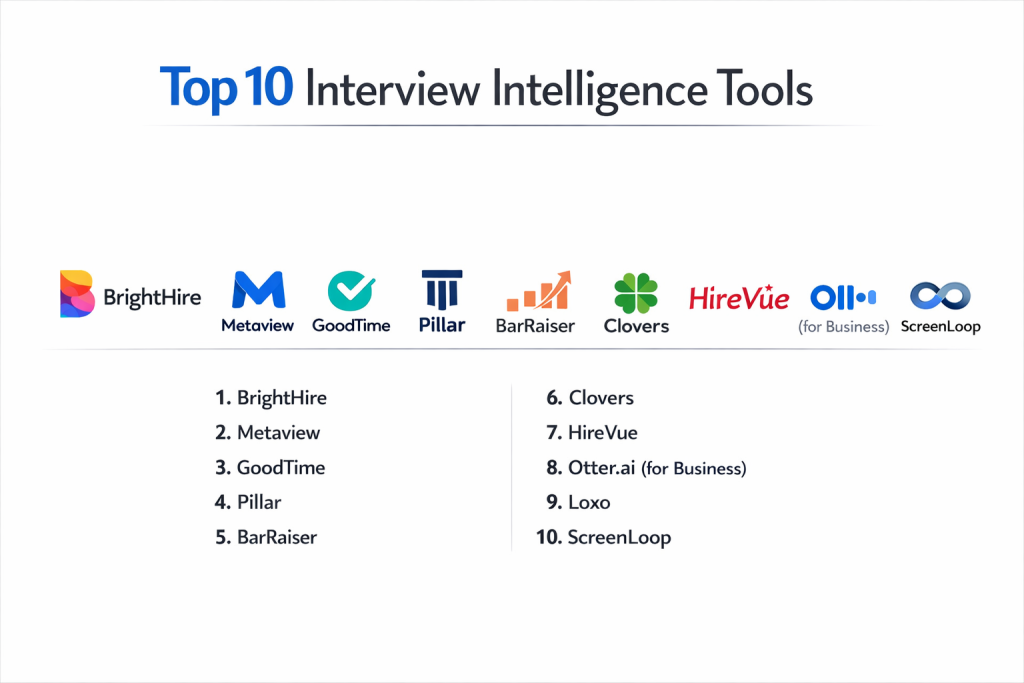
Top 10 Interview Intelligence Tools
1 — BrightHire
BrightHire is widely regarded as the leader in the Interview Intelligence space, designed to integrate seamlessly into the recruiter’s existing workflow to provide a high-quality “co-pilot” experience.
- Key features:
- AI-Powered Notes: Automatically generates structured summaries based on the interview.
- Live Guidance: Real-time prompts and questions appear on the interviewer’s screen.
- Interview Playlists: Curated snippets of the best candidate responses for hiring managers.
- Bias Mitigation: Dashboards that flag inconsistent questioning or interruptions.
- Deep ATS Integration: Syncs recordings and notes directly to Greenhouse, Lever, and others.
- Collaboration Tools: Ability to @mention teammates on specific parts of the transcript.
- Pros:
- Exceptionally high transcription accuracy across various accents.
- The most “invisible” workflow; it doesn’t distract the interviewer or candidate.
- Cons:
- Positioned as a premium enterprise tool with pricing to match.
- Requires a significant initial setup to align with specific hiring rubrics.
- Security & compliance: SOC 2 Type II, GDPR, and HIPAA compliant. Offers SSO and end-to-end encryption.
- Support & community: High-touch onboarding, dedicated customer success managers, and a robust library of hiring best practices.
2 — Metaview
Metaview is built for speed and automation. It is designed to be a “zero-effort” tool that removes the administrative burden of post-interview write-ups for busy hiring teams.
- Key features:
- Automatic Summaries: AI-generated “first drafts” of candidate feedback.
- Multi-Platform Recording: Works with Zoom, Google Meet, Microsoft Teams, and phone calls.
- Recruiter Coaching: Analyzes talk time, question types, and sentiment.
- Keyword Tracking: Monitor how often specific skills or values are discussed.
- Team Search: Search through the history of all interviews conducted across the company.
- Instant Feedback: Managers receive a summary in their inbox minutes after the call ends.
- Pros:
- The AI summary feature is among the most concise and accurate in the market.
- Very easy for individual recruiters to set up and start using immediately.
- Cons:
- The coaching insights are great but can feel overwhelming if not filtered.
- Mobile functionality for on-the-go review is still evolving.
- Security & compliance: SOC 2 Type II and GDPR compliant. Data encryption at rest and in transit.
- Support & community: Responsive digital support and a growing community of modern talent acquisition professionals.
3 — GoodTime
GoodTime started as an interview scheduling powerhouse and expanded into “Hire Intelligence,” focusing on the entire candidate journey from the first invite to the final offer.
- Key features:
- Automated Scheduling: Sophisticated logic to find the best interviewers for a specific candidate.
- Interviewer Training: Shadowing and reverse-shadowing tools for new managers.
- Candidate Experience Analytics: Measures candidate sentiment throughout the funnel.
- Customizable Rubrics: Ensures every interviewer asks the right questions at the right time.
- Data-Driven Insights: Reports on pipeline velocity and interviewer performance.
- Diversity Tracking: Ensures diverse panels are automatically scheduled.
- Pros:
- Unrivaled for companies that struggle with complex scheduling and panel management.
- Provides a very holistic view of why candidates drop out of the funnel.
- Cons:
- The “Intelligence” side is deeply tied to the “Scheduling” side, which may be overkill for some.
- Can have a steeper learning curve for non-technical HR users.
- Security & compliance: ISO 27001, SOC 2 Type II, GDPR, and Privacy Shield compliant.
- Support & community: Robust enterprise support, white-glove onboarding, and annual user conferences.
4 — Pillar
Pillar focuses on “Hiring Integrity,” using AI to help teams move beyond the resume and identify the true potential and cultural alignment of candidates through better conversations.
- Key features:
- Video Highlight Clips: Easily share the most relevant 30 seconds of an interview.
- In-Interview Coaching: Real-time tips for interviewers to improve their technique.
- Candidate Comparison: Watch responses to the same question side-by-side from different applicants.
- Skill-Based Evaluation: Tags specific moments where a candidate demonstrates a key competency.
- Calendar Integration: Effortless bot entry into scheduled meetings.
- Feedback Loop: Connects interview performance to long-term employee success data.
- Pros:
- The side-by-side comparison feature is a game-changer for final decision-making.
- Strong focus on reducing unconscious bias through standardized evaluation.
- Cons:
- Smaller integration ecosystem compared to legacy players like BrightHire.
- The real-time coaching can be distracting for some interviewers.
- Security & compliance: SOC 2 Type II and GDPR compliant. Supports SSO and audit logs.
- Support & community: Personal customer success model and proactive training sessions.
5 — BarRaiser
BarRaiser is unique in that it offers a “Structured Interview-as-a-Service” model alongside its intelligence platform, often providing external experts to help conduct technical rounds.
- Key features:
- Interviewer Network: Access to 2,000+ global experts to conduct technical interviews.
- Standardized Question Bank: A library of thousands of validated interview questions.
- B-Score: A proprietary metric that quantifies a candidate’s fit for a role.
- Interview Recording & Transcription: AI-powered logs for every session.
- Quality Control: AI flags when an interviewer asks a leading or biased question.
- Customizable Workflows: Tailor the hiring bar for different seniority levels.
- Pros:
- Best-in-class for companies that don’t have enough internal bandwidth to conduct technical screens.
- Provides an objective “Bar” that prevents hiring managers from “lowering the standard” under pressure.
- Cons:
- The outsourced model is not a fit for every company culture.
- Transcription is solid but can struggle with niche industry jargon.
- Security & compliance: GDPR and ISO 27001 compliant. Detailed audit logs for enterprise security.
- Support & community: 24/7 technical support and a massive community of expert interviewers.
6 — Clovers
Clovers is an intelligent interviewing platform that helps teams discover, connect with, and hire the best talent through a focus on “Collaborative Hiring.”
- Key features:
- Question Playbooks: Pre-made sets of questions for various roles (Sales, Engineering, etc.).
- Highlight Reels: Automated clipping of key interview moments.
- Post-Interview Collaboration: Threaded comments directly on the transcript.
- Searchable Archive: Find that one time a candidate mentioned a specific tool six months ago.
- Bias Alerts: Flags interruptions and excessive talk time by the interviewer.
- Integration with Slack/Teams: Notifications and highlights sent directly to your chat app.
- Pros:
- Very affordable entry point for smaller teams or single departments.
- The integration with Slack makes review feel like a natural part of the day.
- Cons:
- Lacks some of the deep “Strategic Planning” features found in GoodTime.
- Transcription engine is optimized for English; international support is still growing.
- Security & compliance: SOC 2 Type II and GDPR compliant. Data is encrypted at rest.
- Support & community: Strong digital documentation and email-based customer support.
7 — HireVue
As a pioneer in the video interviewing space, HireVue’s Intelligence suite is designed for massive scale, combining asynchronous video with AI-driven insights.
- Key features:
- Asynchronous Interviews: Candidates record responses to prompts on their own time.
- AI Evaluation: Analyzes language patterns to predict job performance (where permitted).
- Game-Based Assessments: Cognitive challenges integrated into the interview flow.
- Automated Scheduling: Handles the logistics of moving thousands of candidates.
- Structured Interview Builder: Ensures every candidate gets the exact same experience.
- Global Reach: Supports dozens of languages and regional compliance rules.
- Pros:
- Unbeatable for high-volume hiring (Retail, Hospitality, Banking).
- Massive data sets allow for very accurate predictive modeling.
- Cons:
- The “AI-first” approach can sometimes feel impersonal to candidates.
- Has faced regulatory scrutiny regarding AI ethics (though they are highly compliant).
- Security & compliance: FedRAMP, SOC 2, ISO 27001, GDPR, and HIPAA compliant.
- Support & community: Global enterprise support, implementation consulting, and an annual user conference.
8 — Otter.ai (for Business)
While not a dedicated “HR” tool, Otter.ai is frequently used by recruiters as a lightweight, cost-effective alternative for transcription and note-taking.
- Key features:
- Real-time Transcription: One of the fastest and most accurate transcription engines.
- Otter Assistant: Joins meetings automatically even if you are late.
- Keyword Summaries: Automatically generates a “word cloud” of the conversation.
- Searchable Audio: Click any word in the transcript to hear that exact moment in the recording.
- Group Folders: Organize transcripts by role or department.
- Collaborative Highlighting: Multiple people can highlight the transcript in real-time.
- Pros:
- Extremely cost-effective; often 1/10th the price of dedicated HR intelligence tools.
- The mobile app is superior to almost any other tool on this list for in-person interviews.
- Cons:
- Lacks “Recruiting Intelligence” (no bias tracking, no ATS sync, no rubrics).
- Does not have the same level of candidate privacy controls as dedicated HR platforms.
- Security & compliance: SOC 2 Type II and GDPR compliant.
- Support & community: Standard SaaS support and a massive global user community.
9 — Loxo
Loxo is an “All-in-One” Talent Intelligence platform. It includes a CRM, ATS, and outbound sourcing tool, with its interview intelligence features baked into the core product.
- Key features:
- Unified Workflow: No need to sync with an external ATS—it is the ATS.
- AI Sourcing: Finds candidates and then helps you interview them.
- Interview Recording: Native recording within the Loxo ecosystem.
- Candidate Mapping: Tracks the entire journey from “cold lead” to “hired.”
- Automated Outreach: Integrated email and SMS for scheduling and follow-ups.
- Sentiment Analysis: Analyzes the tone of the conversation for both parties.
- Pros:
- Best for recruiting agencies or lean startups that want one tool for everything.
- Eliminates the “Data Silo” problem where interview notes aren’t connected to the candidate profile.
- Cons:
- If you already have a preferred ATS (like Greenhouse), Loxo’s features are redundant.
- The interview intelligence module is not as deep as specialized tools like Metaview.
- Security & compliance: SOC 2 Type II, GDPR, and HIPAA compliant.
- Support & community: Very active “Loxo Academy” and a dedicated customer success model.
10 — ScreenLoop
ScreenLoop is a comprehensive post-offer intelligence platform that focuses on “Hiring Success,” helping companies understand the “Why” behind their hiring decisions.
- Key features:
- Interview Training: A dedicated module to coach hiring managers.
- Candidate Feedback Surveys: Automatically asks candidates for feedback after the call.
- AI Transcriptions: Multi-language support for global teams.
- Interviewer Benchmarking: Compare which managers are the most effective “closers.”
- Success Tracking: Connects interview scores to the employee’s 6-month performance.
- Competency Mapping: Tags interview moments against a specific “Success Profile.”
- Pros:
- Excellent for long-term strategic HR; it helps you figure out if your interviewers are actually good at their jobs.
- The candidate feedback loop provides a clear roadmap for improving employer brand.
- Cons:
- May be too data-heavy for small teams that just need simple recording.
- UI can feel complex due to the sheer amount of analytics provided.
- Security & compliance: GDPR and SOC 2 compliant. Uses high-level AWS encryption.
- Support & community: High-quality onboarding and proactive data-review sessions with consultants.
Comparison Table
| Tool Name | Best For | Platform(s) Supported | Standout Feature | Rating (Gartner) |
| BrightHire | Strategic Enterprise | Web, Zoom, Google Meet | Interview Playlists | 4.8 / 5 |
| Metaview | Busy Hiring Managers | Web, Mobile, All Video | Zero-effort Summaries | 4.7 / 5 |
| GoodTime | Complex Scheduling | Web, All Video | Diverse Panel Logic | 4.5 / 5 |
| Pillar | Bias Reduction | Web, Zoom, Teams | Side-by-Side Compare | 4.6 / 5 |
| BarRaiser | Technical Expertise | Web, All Video | B-Score Analytics | 4.4 / 5 |
| Clovers | Collaborative Teams | Web, Zoom, Teams | Slack Integration | 4.2 / 5 |
| HireVue | High-Volume Hiring | Web, iOS, Android | Asynchronous AI | 4.3 / 5 |
| Otter.ai | Budget Conscious | Web, iOS, Android | Live Transcription | 4.8 / 5 |
| Loxo | Recruiting Agencies | Web, Desktop | All-in-One CRM/ATS | 4.6 / 5 |
| ScreenLoop | Interviewer Coaching | Web, All Video | 360 Hiring Analytics | 4.5 / 5 |
Evaluation & Scoring of Interview Intelligence Tools
Choosing an Interview Intelligence platform is an investment in your company’s culture. We evaluate these tools using a weighted rubric to ensure they meet the needs of modern organizations:
| Category | Weight | Evaluation Criteria |
| Core Features | 25% | Quality of transcription, AI summary accuracy, and highlight reels. |
| Ease of Use | 15% | Frictionless entry into meetings and intuitive dashboards. |
| Integrations | 15% | Depth of sync with major ATS and video conferencing software. |
| Security & Compliance | 10% | SOC 2 status, GDPR compliance, and privacy controls. |
| Performance | 10% | Reliability of the “Bot” joining meetings and processing speed. |
| Support & Community | 10% | Onboarding quality and speed of technical support. |
| Price / Value | 15% | ROI in terms of hours saved and hiring quality improvement. |
Which Interview Intelligence Tool Is Right for You?
Solo Users vs. SMB vs. Mid-market vs. Enterprise
Solo users or micro-businesses should stick to Otter.ai; it provides the core benefits of transcription without the enterprise price tag. SMBs looking to level up their hiring will find Metaview or Clovers to be the best balance of power and simplicity. Mid-market companies scaling rapidly should look at BrightHire or Pillar. Global Enterprises with thousands of hires must consider the robust infrastructure of HireVue or GoodTime.
Budget-conscious vs. Premium Solutions
If budget is your primary driver, Otter.ai is the clear winner, followed by the entry-level tiers of Metaview. If you are a premium buyer who views talent as your #1 competitive advantage, BrightHire and GoodTime offer the deepest insights and the most sophisticated bias-reduction tools available today.
Feature Depth vs. Ease of Use
For Ease of Use, Metaview is arguably the champion because of its “set it and forget it” approach. For Feature Depth, where you want to coach every manager and track the long-term success of every hire, ScreenLoop and BrightHire offer the most granular data sets.
Integration and Scalability Needs
If you use Greenhouse or Lever, look for tools like BrightHire or GoodTime that have “native” sync, meaning your notes appear in your ATS automatically. For scalability, ensuring the platform can handle “Panel Interviews” with multiple internal stakeholders is vital—Pillar and BrightHire excel here.
Frequently Asked Questions (FAQs)
1. Is it legal to record job interviews?
Yes, but you must follow “consent” laws. Most tools handle this by sending an email notice or playing a disclaimer when the “bot” joins. Always ensure your legal team reviews your privacy policy regarding recorded data.
2. Does the presence of a recording bot make candidates nervous?
Initially, it might. However, data shows that once the interviewer explains that the bot is there so they can “focus 100% on the candidate instead of taking notes,” most applicants find it professional and respectful of their time.
3. How accurate are the AI-generated transcripts?
Most modern tools (using engines like Whisper or proprietary models) achieve 90-95% accuracy. They may struggle with very heavy accents or highly technical acronyms, but they are more than sufficient for hiring notes.
4. Can these tools detect if a candidate is lying?
No. While some tools analyze sentiment or “stress” levels, there is no scientifically reliable “lie detector” for interviewing. These tools are meant to facilitate better human judgment, not replace it.
5. Do I need an ATS to use Interview Intelligence?
Not necessarily, but it helps. Most tools can function standalone, but the true value comes when the recordings and notes are linked to the candidate’s application in your ATS.
6. How much do these tools cost?
Pricing is typically based on the number of recruiters or the total number of employees in the company. It can range from $30/month for basic transcription to $50,000+/year for enterprise intelligence suites.
7. How long is the data stored?
Most platforms allow you to set “Retention Policies” (e.g., delete recordings after six months) to comply with GDPR or your own internal data privacy rules.
8. Can these tools help with technical coding interviews?
Yes. Tools like BarRaiser or BrightHire can record the screen share as a candidate codes, allowing you to review their thought process later.
9. What is “Interviewer Shadowing”?
It is a training method where a new manager watches a recording of an expert interviewer. These tools make this infinitely easier by providing a library of “Great Interviews” for new hires to study.
10. What is the biggest mistake companies make when buying these tools?
Buying for features rather than adoption. If your hiring managers find the bot annoying or the summaries unhelpful, they will stop using it. Choose the tool that fits into your existing meeting habits.
Conclusion
The “best” Interview Intelligence Tool is the one that transforms your hiring managers from “gut-feeling” skeptics into data-driven talent magnets. If you are a growth-stage startup that needs to move fast, Metaview is an incredible asset. If you are an enterprise that needs to prove fair hiring practices at scale, BrightHire and HireVue are the benchmarks.
By opening the “black box” of the interview, you aren’t just making hiring more efficient—you are making it more human. When interviewers don’t have to worry about capturing every word, they can focus on what actually matters: building a connection with the person on the other side of the screen.