Introduction
Human Capital Management (HCM) Suites are integrated software solutions that provide a wide range of functions to manage an organization’s most valuable asset: its employees. Unlike basic HR software that might only handle payroll or employee records, an HCM suite covers the entire “hire-to-retire” lifecycle. This includes recruitment, onboarding, core HR (records and benefits), payroll, time and attendance, performance management, learning and development, and advanced workforce analytics.
The importance of an HCM suite lies in its ability to centralize data. When your payroll system “talks” to your performance management system, you gain insights into how compensation affects productivity. Real-world use cases include a multinational corporation automating localized tax compliance across 20 countries, or a healthcare provider using AI-driven scheduling to ensure nursing ratios meet legal safety standards. When evaluating these tools, users should look for data unity, mobile accessibility, regulatory compliance automation, and predictive analytics capabilities.
Best for: HR Directors, Chief People Officers, and operational leaders in mid-market to enterprise-level organizations. They are essential for companies with complex compliance needs, high-volume hiring, or global workforces across industries like finance, tech, healthcare, and manufacturing.
Not ideal for: Solopreneurs or very small businesses (under 25 employees) that only need basic payroll. For these users, a lightweight payroll provider or a simple “Point Solution” (a single-purpose tool) is more cost-effective and less overwhelming than a full-scale HCM suite.
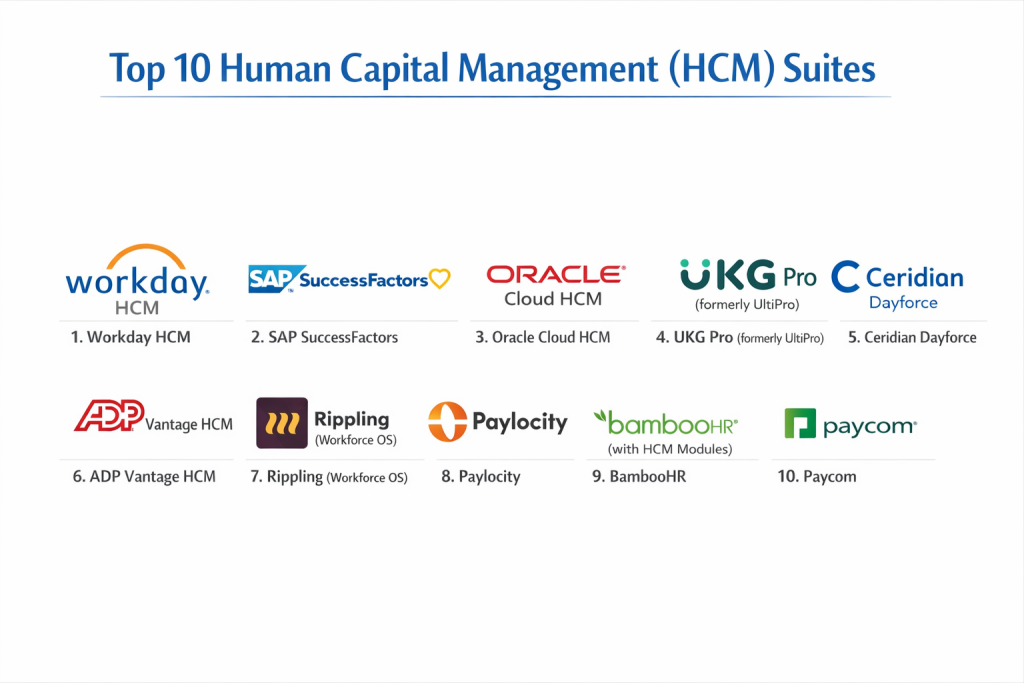
Top 10 Human Capital Management (HCM) Suites
1 — Workday HCM
Workday is widely considered the pioneer of cloud-native HCM. Built specifically for the cloud from day one, it is designed for large-scale global enterprises that require deep analytical power and a unified data core.
- Key features:
- Unified Data Core: Finance and HR live in the same system for perfect data alignment.
- Skills Cloud: Uses AI to identify and track employee skills across the whole organization.
- Adaptive Planning: Advanced workforce modeling for future hiring and budgeting.
- Employee Voice: Integrated pulse surveys to measure sentiment in real-time.
- Global Compliance: Automated updates for labor laws in over 100 countries.
- Workday Journeys: Personalized digital experiences to guide employees through milestones (like promotions).
- Pros:
- Exceptional reporting and “what-if” scenario modeling for executive leadership.
- A very high standard of security and reliability that satisfies Fortune 500 requirements.
- Cons:
- The implementation is notoriously long and expensive, often requiring specialized third-party consultants.
- The user interface, while powerful, can feel complex for casual users or frontline staff.
- Security & compliance: SOC 2, ISO 27001, GDPR, HIPAA, and FedRAMP compliant.
- Support & community: High-tier enterprise support, “Workday Community” forums, and an extensive global partner network.
2 — ADP Workforce Now
ADP is a global giant in the payroll space, and Workforce Now is their comprehensive HCM platform tailored for mid-market to large companies looking for “all-in-one” stability.
- Key features:
- Deep Payroll Integration: Leverages ADP’s decades of tax and compliance expertise.
- Benchmarking Data: Compare your turnover and pay rates against industry averages using ADP’s massive data set.
- Self-Service App: Highly-rated mobile app for employees to manage paystubs, benefits, and time.
- Benefits Administration: Comprehensive tools for open enrollment and ACA compliance.
- ADP Marketplace: One of the largest ecosystems for third-party HR app integrations.
- Recruiting & Onboarding: Streamlined pipelines for high-volume hiring.
- Pros:
- Unmatched compliance security; they have “boots on the ground” in almost every legal jurisdiction.
- Highly scalable—it works as well for a 100-person firm as it does for a 5,000-person one.
- Cons:
- Pricing can be opaque and often involves many “add-on” modules that increase the cost.
- Customer service can be inconsistent due to the sheer size of the company.
- Security & compliance: ISO 27001, SOC 2, HIPAA, and GDPR compliant.
- Support & community: 24/7 global support, dedicated account managers for larger tiers, and local user groups.
3 — Oracle Cloud HCM
Oracle Cloud HCM is a massive, AI-driven suite designed for the most complex global organizations. It is built on Oracle’s powerful database technology, offering high levels of customization.
- Key features:
- Oracle ME: An employee experience platform designed to boost engagement and retention.
- Strategic Workforce Planning: Deep integration with Oracle ERP for financial alignment.
- AI Recruiting: Intelligent candidate matching to reduce time-to-hire.
- Digital Assistant: A chatbot that helps employees with HR tasks via voice or text.
- Learning & Development: A Netflix-style interface for corporate training and certifications.
- Health & Safety: Tools for tracking workplace incidents and safety compliance.
- Pros:
- Exceptional at handling “matrixed” global organizations with complex reporting lines.
- Very high degree of customizability for unique business processes.
- Cons:
- Significant learning curve; it usually requires a dedicated internal admin to manage.
- The UI has improved but can still feel “database-heavy” in certain modules.
- Security & compliance: SOC 1/2/3, ISO 27001, HIPAA, GDPR, and FedRAMP.
- Support & community: Extensive enterprise support, global training centers, and a massive developer ecosystem.
4 — UKG Pro (formerly Kronos & Ultimate Software)
UKG Pro is a leader in managing “frontline” workforces. It blends deep workforce management (scheduling/time) with traditional HR and payroll capabilities.
- Key features:
- Life-Work Technology: Focuses on employee well-being and flexible scheduling.
- AI Forecasting: Predicts labor needs based on historical sales and traffic data.
- UKG Talk: Built-in communication platform for deskless and frontline workers.
- Global Payroll: Unified processing across multiple currencies and tax zones.
- Predictive Analytics: Identifies “flight risks” before employees decide to quit.
- Performance & Compensation: Integrated cycles for reviews and merit increases.
- Pros:
- The best-in-class choice for industries with complex shift work (retail, manufacturing, healthcare).
- Strong cultural focus on “purpose-driven” work and employee engagement.
- Cons:
- Implementation of the “Workforce Management” side can be very technically demanding.
- Merging two legacy platforms (Kronos and Ultimate) has created some UI inconsistencies.
- Security & compliance: SOC 2, ISO 27001, GDPR, and HIPAA compliant.
- Support & community: “UKG Insiders” community, dedicated executive relationship managers, and 24/7 support.
5 — SAP SuccessFactors
SuccessFactors is SAP’s answer to cloud HCM, offering a modular approach that is particularly popular in Europe and among companies already using the SAP ERP ecosystem.
- Key features:
- Employee Central: The core HR “system of record” with global localization.
- Opportunity Marketplace: Internal “gig” board for employees to find new projects.
- Global Benefits Management: Centralized control for diverse benefit plans.
- Succession & Development: Advanced tools for mapping the future leadership pipeline.
- Cross-Boarding: Tools specifically for managing internal transfers and promotions.
- Compensation Planning: Budget-aware merit and bonus management.
- Pros:
- Unrivaled for multinational companies that need extreme “localization” (languages, local laws).
- Modular design allows you to buy only what you need today and scale later.
- Cons:
- Can feel rigid; it follows “The SAP Way,” which may not fit every company’s culture.
- Requires significant technical investment to integrate with non-SAP systems.
- Security & compliance: ISO 27001, SOC 2, GDPR, and HIPAA.
- Support & community: SAP Enterprise Support, global training certifications, and an massive annual conference (SuccessConnect).
6 — Rippling
Rippling is the “disruptor” in the HCM space. It treats HR and IT as a single system, automating the technical side of employee management (like shipping laptops and setting up software access).
- Key features:
- Unified Stack: Manage payroll, expenses, IT, and benefits in one dashboard.
- 90-Second Payroll: Deeply automated sync with hours and deductions.
- Global EOR: Hire and pay employees in 100+ countries without a local entity.
- Device Management: Order, ship, and secure company laptops through the HR portal.
- App Provisioning: Automatically grant/revoke access to tools like Slack and Zoom.
- Workflow Automator: Create “If-This-Then-That” rules for any HR process.
- Pros:
- The most modern, fast, and “SaaS-native” interface on this list.
- Automates the “IT/HR gap” better than any other platform in existence.
- Cons:
- The scheduling and time-tracking features are not yet as deep as UKG or ADP.
- Fast growth has led to some reports of customer support being spread thin.
- Security & compliance: SOC 2 Type II, GDPR, HIPAA, and ISO 27001.
- Support & community: Responsive chat/email support, but lacks the “on-site consultant” model of larger firms.
7 — Ceridian Dayforce
Dayforce is an enterprise-scale suite famous for its “Continuous Calculation” engine, which calculates payroll in real-time as hours are worked.
- Key features:
- Real-Time Payroll: Managers see the exact cost of labor (including taxes) at any moment.
- On-Demand Pay: Allows employees to access their earned wages before payday.
- Unified Time & Pay: No “batch” processing; time data and pay data are the same record.
- Global WFM: Advanced scheduling for complex international workforces.
- Benefit Administration: Real-time eligibility tracking based on hours worked.
- Talent Intelligence: AI-driven insights into hiring and retention trends.
- Pros:
- Eliminates the “stress of payroll week” because pay is always being calculated.
- Exceptional at managing “Earned Wage Access,” a major perk for modern workers.
- Cons:
- High cost of entry; it is firmly positioned for mid-to-large enterprises.
- Configuration is complex and requires significant initial planning.
- Security & compliance: ISO 27001, SOC 2, HIPAA, and GDPR.
- Support & community: Enterprise customer success model, annual “Dayforce Insights” conference, and global support.
8 — Paycom
Paycom is a comprehensive, single-database HCM solution that focuses on a “Self-Service” model where employees own their own data accuracy.
- Key features:
- Beti: A tool that allows employees to review and approve their own payroll for accuracy.
- Direct Data Exchange: Tracks how much employees are actually using the HR system.
- Manager on-the-go: Mobile-first tools for managers to handle approvals and scheduling.
- Position Management: Real-time visibility into vacancies and headcount budgets.
- Compensation Management: Simplified merit and bonus cycles.
- Learning Management: Native training platform for compliance and skill building.
- Pros:
- The “Beti” feature dramatically reduces payroll errors by putting the check in the employee’s hands.
- No integrations to break because every module is built on one single database.
- Cons:
- The sales process is known to be very aggressive.
- The platform is a “closed garden”—integrating with external software can be difficult.
- Security & compliance: ISO 27001, SOC 2, HIPAA, and GDPR.
- Support & community: Dedicated service model (one point of contact for the life of the account).
9 — BambooHR
BambooHR is the “people-first” HCM designed for small-to-medium businesses. It focuses on the culture and employee experience rather than complex enterprise compliance.
- Key features:
- Friendly UI: The most approachable and easy-to-use interface in the category.
- Applicant Tracking (ATS): Built-in hiring and onboarding workflows.
- Employee Satisfaction: Native NPS (Net Promoter Score) surveys for staff.
- Performance Management: Short, frequent check-ins rather than annual reviews.
- BambooHR Marketplace: Connects easily to payroll and time tools.
- Time-Off Tracking: Simple, visual calendar for managing leave.
- Pros:
- Extremely high user adoption; employees actually like using it.
- Fast implementation (weeks instead of months).
- Cons:
- Lacks the deep global compliance and workforce forecasting of Oracle or UKG.
- Payroll and Time-tracking often require separate (though integrated) modules.
- Security & compliance: SOC 2, GDPR, and HIPAA compliant.
- Support & community: Award-winning customer support and a massive library of HR educational resources.
10 — HiBob (Bob)
HiBob is a “modern HCM” designed for high-growth global companies. It prioritizes the “social” side of work and is popular with modern tech and creative firms.
- Key features:
- Culture-First Design: Features like “Clubs” and “Shout-outs” to build community.
- Agile Performance: Flexible review cycles that match modern work rhythms.
- Compensation Benchmarking: Real-time market data to ensure fair pay.
- Workforce Planning: Visual “Org Chart” modeling for rapid scaling.
- Onboarding Experiences: Tailored digital journeys for new hires.
- Survey Module: Deep analytics on employee engagement and DEI metrics.
- Pros:
- Perfect for “Remote-First” or “Hybrid” cultures that need to build connection.
- Very flexible; it adapts easily as a startup grows into a mid-market firm.
- Cons:
- Not designed for traditional heavy industries with complex shift/union rules.
- Reporting is good but not as “CFO-ready” as Workday or SAP.
- Security & compliance: ISO 27001, SOC 2, and GDPR compliant.
- Support & community: Highly responsive digital support and a modern, engaged user base.
Comparison Table
| Tool Name | Best For | Platform(s) Supported | Standout Feature | Rating (Gartner) |
| Workday | Global Enterprises | Web, iOS, Android | Skills Cloud AI | 4.3 / 5 |
| ADP WFN | Mid-Market Stability | Web, iOS, Android | Compliance Confidence | 4.1 / 5 |
| Oracle HCM | Data-Heavy Global | Web, iOS, Android | Strategic HR/ERP Sync | 4.3 / 5 |
| UKG Pro | Frontline/Manufacturing | Web, iOS, Android | Life-Work Tech | 4.3 / 5 |
| SuccessFactors | SAP Ecosystem Users | Web, iOS, Android | Opportunity Marketplace | 4.2 / 5 |
| Rippling | Tech-Heavy SMB/Mid | Web, Desktop | IT & HR Unification | 4.8 / 5 |
| Dayforce | Real-Time Payroll | Web, iOS, Android | Continuous Calculation | 4.2 / 5 |
| Paycom | Automated Payroll | Web, iOS, Android | Beti (Employee Payroll) | 4.2 / 5 |
| BambooHR | Culture-Focused SMB | Web, iOS, Android | Ease of Use | 4.4 / 5 |
| HiBob | High-Growth Modern | Web, iOS, Android | Culture-First Design | 4.5 / 5 |
Evaluation & Scoring of HCM Suites
Selecting an HCM suite is a multi-million dollar decision for large firms and a critical operational choice for SMBs. We evaluate these tools using the following weighted scoring rubric:
| Category | Weight | Evaluation Focus |
| Core Features | 25% | Breadth of the hire-to-retire lifecycle modules. |
| Ease of Use | 15% | Employee adoption rate and manager dashboard clarity. |
| Integrations | 15% | Native connectivity to ERP, Slack, and IT stacks. |
| Security & Compliance | 10% | Enterprise-grade certifications and labor law automation. |
| Performance | 10% | Speed of reporting and mobile app reliability. |
| Support & Community | 10% | Quality of onboarding and depth of user network. |
| Price / Value | 15% | ROI in terms of hours saved and risk reduction. |
Which HCM Suite Tool Is Right for You?
Solo Users vs. SMB vs. Mid-market vs. Enterprise
Solo users and micro-teams should avoid HCM suites; a simple payroll provider is enough. SMBs (50-250 employees) will thrive with BambooHR or Rippling because they prioritize speed and ease. Mid-market companies (250-1,000) should look at ADP or HiBob. Global Enterprises (1,000+) are the primary audience for Workday, Oracle, and SAP SuccessFactors.
Budget-conscious vs. Premium Solutions
If budget is the driver, BambooHR and OnPay (honorable mention) offer the best value. If you are a premium buyer who needs to solve complex global compliance and workforce planning issues, Workday and Oracle justify their high price tags through risk reduction and massive efficiency gains at scale.
Feature Depth vs. Ease of Use
For Ease of Use, BambooHR and HiBob are the winners. If you need Feature Depth—specifically for manufacturing or healthcare with 24/7 shifts and complex union rules—UKG Pro and Dayforce are the specialized leaders.
Integration and Scalability Needs
If you use SAP or Oracle for your finance and accounting, sticking to their native HCM suites offers the best data flow. If you are a scaling tech company that hires people in multiple countries and wants to automate laptop shipping and Slack access, Rippling is currently the only tool that truly masters that integration.
Frequently Asked Questions (FAQs)
1. What is the difference between HRIS and HCM?
HRIS (Human Resource Information System) focuses on core data like records and payroll. HCM (Human Capital Management) is a broader term that includes HRIS plus strategic features like talent management, analytics, and workforce planning.
2. Is an HCM suite better than using multiple separate tools?
A suite provides a “single source of truth,” meaning you don’t have to enter an employee’s name three times in three different systems. It reduces errors and provides better analytics, though some “niche” tools may have better specific features.
3. How long does it take to implement an HCM?
For an SMB tool like BambooHR, it might take 4-6 weeks. For a global enterprise suite like Workday or SAP, implementation usually takes 6-12 months and involves significant data migration.
4. Can HCM software help with DEI (Diversity, Equity, and Inclusion)?
Yes. Most modern suites (like HiBob and Workday) have specific modules to track diversity metrics, gender pay gaps, and equitable promotion paths across the organization.
5. Do I need an HCM if I have a PEO?
A PEO (Professional Employer Organization) often provides its own software. However, as you grow and move to an “In-house” model, you will need your own HCM suite to manage your employees directly.
6. What is “EOR” and can HCM suites do it?
Employer of Record (EOR) allows you to hire people in countries where you don’t have a legal entity. Platforms like Rippling and Deel integrate this directly into their HCM suite.
7. How much do HCM suites cost?
Pricing is usually based on a per-user, per-month fee. It ranges from $6 to $30+ per employee, often with a significant one-time implementation fee and annual base platform costs.
8. Can I manage freelance contractors in an HCM?
Most modern HCM suites (especially Rippling and Workday) allow you to track and pay contractors alongside W-2 employees, though the compliance rules applied to them are different.
9. Are HCM suites secure enough for healthcare data?
Yes, but you must ensure the vendor is HIPAA compliant. Tools like UKG and ADP have specific configurations for the healthcare industry to ensure patient and employee data privacy.
10. What is the biggest mistake companies make when buying an HCM?
Underestimating the “People” side of implementation. You can buy the best software in the world, but if you don’t have a plan for training your managers and cleaning your data first, the project will fail.
Conclusion
Choosing a Human Capital Management (HCM) Suite is a defining moment for any HR department. It is the transition from “Administrative HR” (fixing paychecks) to “Strategic HR” (building a workforce). If you are a small business focused on culture, BambooHR is a perfect starting point. If you are a scaling tech firm, Rippling offers unrivaled automation. For the global titans, Workday and Oracle provide the analytical “armor” needed to navigate a complex world.
The “best” tool isn’t the one with the most features—it’s the one that your employees will actually use and your managers will actually trust. Data is the new currency of HR, and a robust HCM suite is the vault that keeps it safe.