Introduction
An HRIS Platform is a digital solution that integrates software, hardware, and various processes to manage an organization’s HR functions. At its core, it serves as a central database for employee records, but modern systems have evolved to handle everything from recruitment and onboarding to benefits administration, time tracking, and performance reviews. By digitizing these touchpoints, an HRIS ensures that data flows seamlessly throughout the employee lifecycle.
The importance of an HRIS cannot be overstated. It mitigates the risk of human error in payroll, ensures compliance with ever-changing labor laws, and provides leadership with actionable analytics regarding turnover, diversity, and labor costs. Real-world use cases include a mid-sized tech company automating the onboarding of a distributed remote team, or a manufacturing firm using “Self-Service” portals to let workers update their tax information without manual HR intervention. When evaluating these platforms, users should prioritize data security, user adoption rates, payroll reliability, and integration depth with existing business tools like Slack or ERP systems.
Best for: HR managers, People Operations directors, and business owners in growing small-to-medium businesses (SMBs) and large enterprises. It is essential for organizations with more than 20–25 employees where manual tracking is no longer feasible.
Not ideal for: Solopreneurs or very small teams (under 10 people) where the cost and complexity of a full system outweigh the benefits. In these cases, simple payroll software or specialized time-tracking apps are usually more effective.
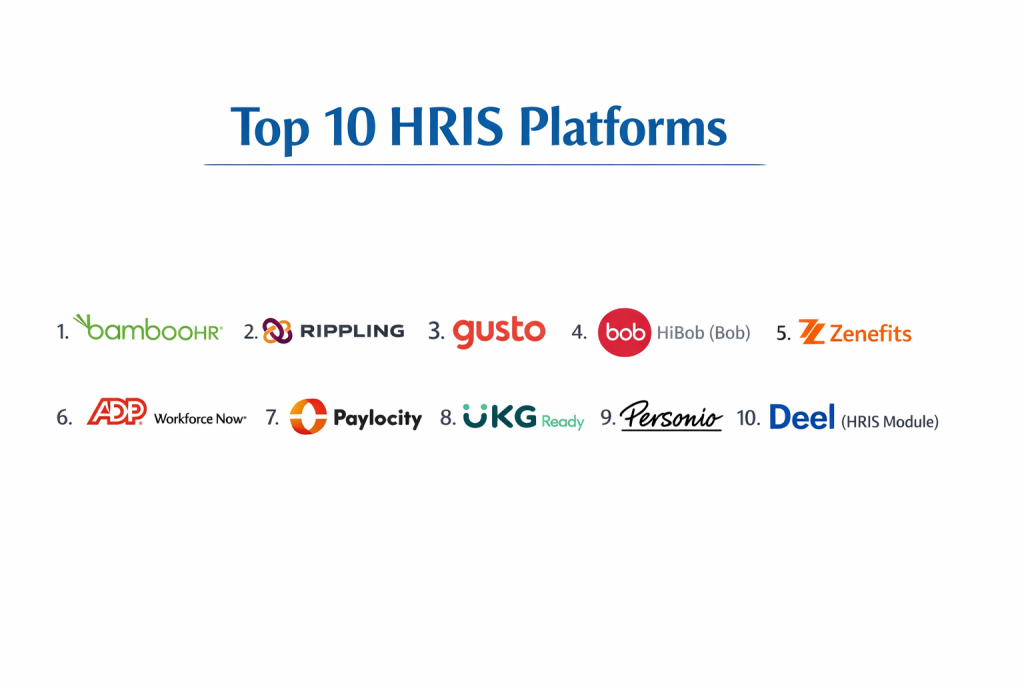
Top 10 HRIS Platforms
1 — BambooHR
BambooHR is widely recognized as the “people-first” HRIS, specifically designed for small to medium-sized businesses that want to focus on company culture rather than just database management.
- Key features:
- Centralized Employee Records: A clean, easy-to-navigate database for all personnel info.
- Applicant Tracking System (ATS): Built-in tools to manage the hiring pipeline from job post to offer.
- Onboarding & Offboarding: Automated checklists to ensure a consistent experience for new hires.
- Employee Satisfaction (eNPS): Native pulse surveys to measure team morale.
- Time-Off Management: Visual calendars and automated approval workflows for leave requests.
- Performance Management: Modern, collaborative review cycles that replace the “annual dreaded review.”
- Pros:
- The most intuitive user interface on the market; employees actually enjoy using the mobile app.
- Excellent for building a professional HR department from scratch without needing a technical background.
- Cons:
- Payroll and Time Tracking are separate add-on modules that increase the base cost.
- Not designed for massive global enterprises with complex union or multi-country legal requirements.
- Security & compliance: SOC 2 Type II, GDPR, and HIPAA compliant. Uses 256-bit encryption for all data.
- Support & community: High-quality documentation, a helpful HR blog, and responsive email/phone support.
2 — Rippling
Rippling is a revolutionary HRIS that treats employee management as a part of the IT stack. It is the gold standard for companies that want to automate the technical side of HR.
- Key features:
- Unified System: Syncs HR, IT, and Finance data into one single employee record.
- Automated Provisioning: Automatically sets up Slack, Zoom, and Gmail accounts for new hires in seconds.
- Device Management: Allows you to buy, ship, and manage company laptops directly through the HR portal.
- Global Payroll: Native capability to pay employees and contractors in 100+ countries.
- Workflow Automator: Create “If-Then” logic (e.g., “If an employee is promoted, increase their laptop security level”).
- App Management: Manage hundreds of third-party app permissions from a single dashboard.
- Pros:
- Unmatched automation; it can save hours of manual work during the onboarding process.
- The most modern “tech-native” feel of any HRIS currently available.
- Cons:
- Can be expensive if you don’t utilize the IT and Finance modules.
- Rapid feature expansion sometimes leads to “feature bloat” for users who just want simple HR.
- Security & compliance: SOC 2, GDPR, HIPAA, and ISO 27001 compliant. Advanced SSO and MFA integrations.
- Support & community: Fast chat-based support and a robust technical knowledge base.
3 — Gusto
Originally a payroll specialist, Gusto has evolved into a full-service HRIS for SMBs, focusing on ease of use and automated tax compliance.
- Key features:
- Full-Service Payroll: Automatic tax filing and payments for federal, state, and local levels.
- Benefits Administration: Integrated health insurance, 401(k), and HSA/FSA management.
- Gusto Wallet: An employee-facing app for managing paychecks and emergency savings.
- Automated Onboarding: Digital signature collection for W-4s, I-9s, and offer letters.
- Lifetime Access: Employees keep their portal access even after they leave the company.
- Hiring Tools: Includes basic job posting and applicant management.
- Pros:
- Extremely friendly and approachable design that makes complex taxes feel simple.
- The “Auto-Pilot” payroll feature is a massive time-saver for salaried teams.
- Cons:
- Reporting capabilities are basic compared to mid-market tools like ADP.
- Health insurance brokerage is not available in all 50 states yet.
- Security & compliance: SOC 2 Type II, GDPR, and uses multi-layered encryption.
- Support & community: Extensive help center, phone support for higher tiers, and a community of small business advocates.
4 — ADP Workforce Now
ADP is the most established name in the industry. Workforce Now is their “all-in-one” platform designed for mid-market and enterprise companies that need deep compliance data.
- Key features:
- Massive Data Analytics: Benchmark your company’s pay and turnover against industry averages.
- Advanced Compliance: Built-in legal expertise for every state and many international regions.
- Benefits Premium: Advanced tools for managing complex open enrollment cycles.
- Executive Reporting: Highly customizable dashboards for C-suite decision-making.
- Marketplace Integrations: Access to hundreds of pre-built app connectors.
- Talent Management: Deep modules for succession planning and career development.
- Pros:
- Unrivaled for companies with complex, multi-state labor requirements and large workforces.
- One of the most secure and reliable platforms globally, backed by decades of experience.
- Cons:
- Pricing is opaque and often involves many “add-on” modules that increase the cost.
- The user interface can feel corporate and “clunky” compared to newer SaaS startups.
- Security & compliance: ISO 27001, SOC 2, HIPAA, and GDPR. High-level cybersecurity monitoring.
- Support & community: Dedicated account managers for enterprise clients and 24/7 global support.
5 — HiBob (Bob)
HiBob is a modern HRIS designed for high-growth, global companies. It prioritizes the “social” and “culture” side of HR, making it very popular in the tech and creative sectors.
- Key features:
- Culture-First UI: Includes “Shoutouts,” “Clubs,” and social-media-style profiles for employees.
- Global Agility: Easily manage employees in different countries with local holidays and currencies.
- Compensation Benchmarking: Real-time data to ensure your pay scales are competitive.
- Visual Org Charts: Dynamic charts that help employees understand company structure during rapid growth.
- People Analytics: Advanced data visualization on DEI (Diversity, Equity, and Inclusion) metrics.
- Performance 360: Peer reviews and upward feedback integrated into the workflow.
- Pros:
- Excellent for “Remote-First” cultures that need to build community and connection.
- Highly flexible; the platform adapts easily to the unique workflows of a scaling startup.
- Cons:
- Not built for traditional industries with heavy shift-work or complex union rules.
- Some of the “social” features can feel like clutter for more conservative organizations.
- Security & compliance: ISO 27001, SOC 2, and GDPR compliant.
- Support & community: Highly responsive digital support and a modern, engaged user community.
6 — Paycom
Paycom is a comprehensive HRIS known for its “Single Database” architecture, meaning all features are built in-house rather than through acquisitions or integrations.
- Key features:
- Beti: An industry-first tool that lets employees do their own payroll to ensure accuracy.
- Direct Data Exchange: Tracks the ROI of your HR activities in real-time.
- Position Management: Sophisticated tools for managing headcount budgets and vacancies.
- Manager on-the-Go: Mobile-first tools for managers to handle approvals and scheduling.
- Learning Management (LMS): Integrated training and certification tracking.
- Document Audit: Ensures all required employee compliance documents are signed and up-to-date.
- Pros:
- The “Beti” system significantly reduces payroll errors by having employees verify their data before it’s sent.
- Because it’s a single database, you never have to worry about data “syncing” between modules.
- Cons:
- The sales and implementation process is known to be very aggressive and high-touch.
- It is a “closed” system—it does not integrate as easily with external 3rd party apps.
- Security & compliance: ISO 27001, SOC 2, HIPAA, and GDPR.
- Support & community: One-to-one service model where you have a dedicated specialist for your account.
7 — Zenefits (by TriNet)
Zenefits is a “Benefits-First” HRIS that is particularly strong for companies that want to offer enterprise-level health and wellness plans to a smaller team.
- Key features:
- Benefit Sync: Deductions for health, dental, and vision are updated automatically in payroll.
- Mobile Onboarding: New hires can pick their benefits and sign documents on their phone.
- Compliance Assistant: Automated alerts for ACA (Affordable Care Act) requirements.
- Well-being Module: Tools for tracking employee mental and physical wellness.
- Time & Attendance: Simple clock-in tools with GPS location tracking.
- Performance Management: Goal tracking and one-on-one meeting templates.
- Pros:
- Best-in-class for managing complex employee benefits without a dedicated HR team.
- Very clean and modern interface that makes the “boring” parts of HR feel fast.
- Cons:
- Payroll is technically an “add-on” and isn’t quite as robust as Gusto’s.
- Customer support has seen mixed reviews since being acquired by TriNet.
- Security & compliance: SOC 2 Type II, HIPAA, and GDPR compliant.
- Support & community: Extensive library of compliance resources and a digital help desk.
8 — UKG Ready (formerly Kronos)
UKG Ready is the mid-market solution from UKG, specializing in workforce management for industries with complex scheduling needs like healthcare and manufacturing.
- Key features:
- Advanced Scheduling: Manage shifts, rotations, and on-call schedules with ease.
- Labor Forecasting: Predict how many staff you will need based on historical demand.
- Fatigue Management: Alerts for managers when employees are working too many consecutive hours.
- Compliance Guard: Automatically applies local labor laws for breaks and overtime.
- Mobile Punch-In: Mobile time clock with geofencing to ensure staff are on-site.
- Integrated Payroll: Handles complex pay rules for different shifts and locations.
- Pros:
- The best choice for organizations with “frontline” or “deskless” workers.
- Unrivaled for managing complex overtime and shift-differential pay rules.
- Cons:
- The setup process is very technical and often requires professional services.
- The interface is functional but lacks the “beauty” of platforms like BambooHR or HiBob.
- Security & compliance: SOC 2, ISO 27001, GDPR, and HIPAA.
- Support & community: Enterprise-grade support and an active user community (UKG Insiders).
9 — Workday HCM
Workday is the “Ferrari” of HRIS platforms, designed for the Fortune 500 and large global enterprises that require massive scale and AI-driven insights.
- Key features:
- Unified Data Core: Finance, HR, and Planning all live in the same enterprise system.
- Skills Cloud: Uses AI to identify and track employee skills across the entire global organization.
- Adaptive Planning: Advanced workforce modeling for future hiring and budgeting.
- Journeys: Personalized digital experiences to guide employees through life events (like a promotion).
- Global Compliance: Handles localized tax and labor rules for over 100 countries.
- PRISM Analytics: Allows you to bring in external data for massive-scale business intelligence.
- Pros:
- Unmatched strategic power; it’s a tool for CFOs and CEOs as much as it is for HR.
- High standard of data integrity and security that satisfies the most regulated industries.
- Cons:
- Prohibitively expensive for anyone outside of the enterprise market.
- Implementation takes 6–12 months and requires a team of dedicated consultants.
- Security & compliance: SOC 1/2/3, ISO 27001, HIPAA, GDPR, and FedRAMP (for gov use).
- Support & community: High-tier enterprise support and an elite community of “Workday” professionals.
10 — Personio
Personio is the leading HRIS for European-based SMBs, specializing in the specific regulatory and data privacy needs of the EU/UK market.
- Key features:
- GDPR Compliance Hub: Built specifically for European data privacy standards.
- Recruiting & Posting: Automated job posting to hundreds of local European boards.
- Employee Lifecycle: Digital files, onboarding, and electronic signatures.
- Absence Management: Handles complex European holiday and sick leave rules.
- Payroll Preparatory: Prepares “ready-to-go” data for external payroll providers or internal teams.
- Workflow Automation: Streamlines repetitive tasks across different office locations.
- Pros:
- The clear choice for European businesses that need to navigate local labor laws and GDPR.
- Clean, modern interface that is very easy for multi-national European teams to use.
- Cons:
- Not as well-supported for North American-based tax and labor rules.
- Smaller integration marketplace compared to US-centric giants like ADP.
- Security & compliance: ISO 27001, SOC 2, and strictly GDPR compliant. Data is hosted in the EU.
- Support & community: Excellent localized support in multiple European languages.
Comparison Table
| Tool Name | Best For | Platform(s) Supported | Standout Feature | Rating (Gartner) |
| BambooHR | SMB Culture | Web, iOS, Android | Ease of Use / eNPS | 4.4 / 5 |
| Rippling | Tech/Remote Teams | Web, Desktop | IT & App Automation | 4.8 / 5 |
| Gusto | Payroll-First SMB | Web, Mobile | Automated Tax/Payroll | 4.6 / 5 |
| ADP WFN | Mid-Market Compliance | Web, iOS, Android | Data Benchmarking | 4.1 / 5 |
| HiBob | High-Growth Modern | Web, iOS, Android | Culture-First Design | 4.5 / 5 |
| Paycom | Automated Accuracy | Web, iOS, Android | Beti (Employee Payroll) | 4.2 / 5 |
| Zenefits | Benefits-Heavy SMB | Web, iOS, Android | Benefit Administration | 4.0 / 5 |
| UKG Ready | Frontline/Healthcare | Web, iOS, Android | Workforce Scheduling | 4.1 / 5 |
| Workday | Global Enterprise | Web, iOS, Android | Skills Cloud AI | 4.3 / 5 |
| Personio | European SMBs | Web, iOS, Android | GDPR/EU Compliance | 4.3 / 5 |
Evaluation & Scoring of HRIS Platforms
Choosing an HRIS is a significant investment. We evaluate these tools based on a weighted scoring rubric that reflects the real-world priorities of HR leaders:
| Category | Weight | Evaluation Criteria |
| Core Features | 25% | Recruitment, onboarding, payroll, benefits, and performance management. |
| Ease of Use | 15% | Intuitiveness of the manager dashboard and employee self-service app. |
| Integrations | 15% | Native connectivity to Slack, Zoom, Accounting, and ERP systems. |
| Security & Compliance | 10% | SOC 2 status, GDPR/HIPAA compliance, and labor law automation. |
| Performance | 10% | Speed of reporting and mobile app stability. |
| Support & Community | 10% | Quality of documentation, forums, and customer success speed. |
| Price / Value | 15% | Transparency of pricing vs. the total feature set provided. |
Which HRIS Platform Tool Is Right for You?
Solo Users vs. SMB vs. Mid-market vs. Enterprise
Solo users hiring their first team member should start with Gusto—it’s the easiest transition from “owner” to “employer.” Small Businesses (SMB) looking to build a culture will find the most value in BambooHR. Mid-market companies scaling rapidly should look at Rippling or HiBob for their automation and culture tools. Enterprises with 1,000+ employees require the strategic power of Workday or ADP Workforce Now.
Budget-conscious vs. Premium Solutions
If budget is your primary driver, Gusto and Personio offer the best value-to-feature ratios for their respective markets. If you are a premium buyer who wants to eliminate administrative work entirely through automation, Rippling is currently the most innovative investment you can make.
Feature Depth vs. Ease of Use
If you need feature depth (e.g., managing 24/7 nursing shifts in a hospital), you must sacrifice some ease of use for UKG Ready. If you want Ease of Use so that your employees actually update their own data, BambooHR remains the industry champion.
Integration and Scalability Needs
For teams that live in their digital tools, Rippling’s app management is a game-changer. For companies that plan to grow from 50 to 5,000 employees without ever switching platforms, ADP offers the most reliable “forever” home due to its massive scalability.
Frequently Asked Questions (FAQs)
1. What is the difference between HRIS, HRMS, and HCM?
HRIS (Information System) focuses on data and records. HRMS (Management System) includes HRIS plus IT/technical workflows. HCM (Human Capital Management) is the broadest term, including strategic talent and skills tracking. Today, the terms are often used interchangeably.
2. How long does implementation take?
For an SMB tool like BambooHR or Gusto, you can be up and running in 2–4 weeks. For mid-market tools like Rippling or HiBob, expect 6–10 weeks. Enterprise tools like Workday can take 6–12 months.
3. Is my data safe in an HRIS?
Yes, if you choose a reputable provider. Look for SOC 2 Type II and ISO 27001 certifications as the “gold standard” for data security. These platforms use the same level of encryption as major banks.
4. Can an HRIS help with remote hiring?
Absolutely. Modern platforms like Rippling and Deel allow you to hire and pay employees internationally while ensuring you are compliant with local laws and tax requirements.
5. Do I need an HRIS if I have a PEO?
A PEO (Professional Employer Organization) like TriNet or Justworks often provides its own software. However, as you grow and want more control, moving to your own HRIS is a common step toward independence.
6. How much does an HRIS cost?
Most charge a “Per Employee Per Month” (PEPM) fee. This ranges from $6 to $25 per employee. Many also charge a base platform fee of $50–$200 per month and a one-time implementation fee.
7. Can an HRIS eliminate the need for an HR manager?
No. It eliminates the “clerical” work (data entry, filing), allowing your HR manager to focus on high-value tasks like employee coaching, culture building, and conflict resolution.
8. What is “Self-Service,” and why is it important?
Self-service allows employees to log in and change their own bank details, download pay stubs, or request time off. This saves HR hours of manual data entry and empowers employees.
9. Can I track diversity and inclusion (DEI) metrics?
Yes, high-growth tools like HiBob and Workday have specific dashboards that visualize your company’s diversity data, helping you hit equity goals.
10. What is the biggest mistake companies make when buying an HRIS?
Buying for features they don’t need yet. A complex enterprise system will fail in a small company because it is too hard for the average employee to use. Choose a tool that fits your current size and 2-year growth plan.
Conclusion
The “best” HRIS Platform is the one that your team will actually use. If you are a small business focused on people, BambooHR is a perfect starting point. If you are a tech-heavy organization that wants to automate IT and HR together, Rippling is a clear winner. For the global enterprise, Workday and ADP remain the reliable giants.
An HRIS is more than just a database; it is an investment in your company’s scalability. By removing the friction of administrative tasks, you free up your most important capital—your people—to focus on the work that actually grows your business.