Introduction
GraphQL Tooling refers to the collection of IDEs, client libraries, gateways, and monitoring platforms that support the GraphQL lifecycle. Unlike traditional REST APIs, GraphQL requires specialized tools to handle its unique schema-based nature, such as graph explorers for visualizing data relationships and schema registries for managing changes. This tooling is important because it ensures type safety, improves developer productivity through auto-completion, and provides much-needed observability into query performance and “n+1” issues.
In the real world, GraphQL tools are used by front-end teams to mock APIs for faster development, by DevOps engineers to manage “supergraphs” in microservices architectures, and by security teams to prevent malicious deep-nested queries. When choosing a tool, users should evaluate the depth of schema integration, performance overhead, community support, and compatibility with existing backend languages. A robust toolset should offer a seamless transition from local development to global distribution.
Best for: Full-stack developers, API architects, and front-end engineers working in data-intensive environments. It is essential for mid-market to enterprise companies building complex dashboards, mobile apps, or interconnected microservices where data efficiency is a top priority.
Not ideal for: Simple CRUD applications where a standard REST API is faster to implement, or for hobbyist projects with very flat data structures that do not benefit from the graph-based query model.
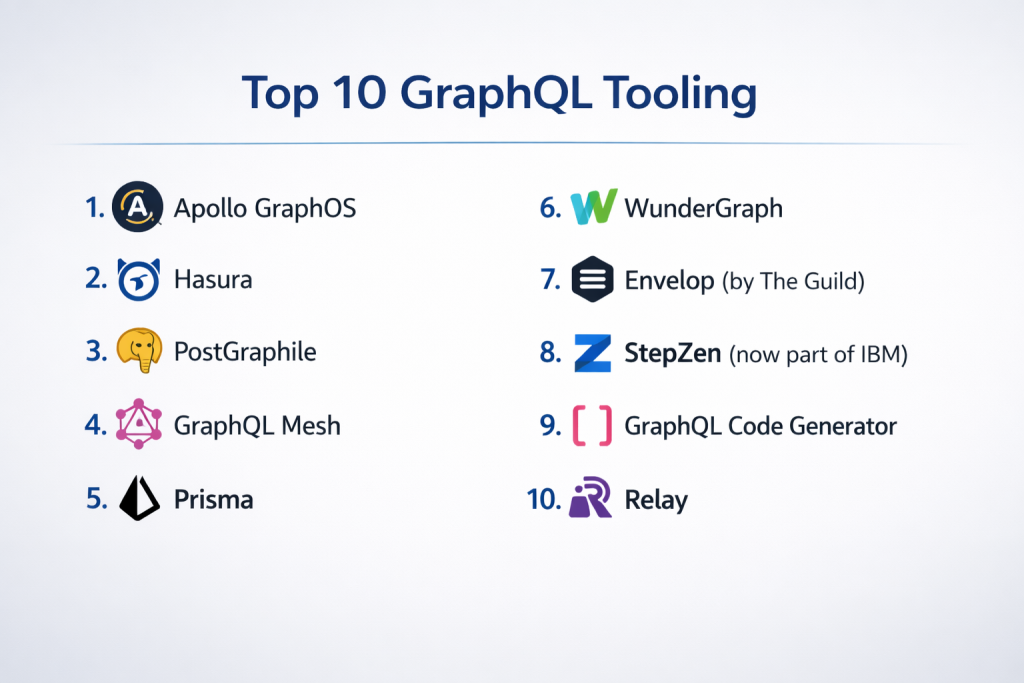
Top 10 GraphQL Tooling Tools
1 — Apollo GraphOS
Apollo is the industry leader in GraphQL implementation, offering a complete platform for building, querying, and managing a “supergraph.” It is designed for teams that need high-level orchestration and enterprise governance.
- Key features:
- Apollo Federation: Connect multiple GraphQL services into a single, unified graph.
- Schema Registry: Track schema changes over time and prevent breaking changes with automated checks.
- Apollo Explorer: A powerful, cloud-based IDE for testing queries and visualizing schemas.
- Query Caching: Advanced server-side and client-side caching mechanisms to boost performance.
- Usage Reporting: Real-time metrics on which fields are being used and by whom.
- Client Libraries: Robust SDKs for React, iOS, Android, and more.
- Pros:
- The most mature ecosystem with extensive documentation and industry-standard best practices.
- Federation allows massive teams to work on different parts of the graph independently.
- Cons:
- The enterprise pricing tiers can be significantly expensive for smaller companies.
- Some users find the “managed” nature of the platform results in a bit of vendor lock-in.
- Security & compliance: SOC 2 Type II compliant; supports SSO, role-based access control (RBAC), and enterprise-grade encryption.
- Support & community: Unrivaled community support, a massive library of tutorials, and dedicated enterprise support for paid tiers.
2 — Hasura
Hasura is a high-performance engine that gives you instant GraphQL APIs over your existing databases. It is designed for developers who want to move fast without writing boilerplate resolver code.
- Key features:
- Auto-generated Schema: Instantly generates a GraphQL schema based on your SQL tables and relationships.
- Real-time Subscriptions: Built-in support for live data updates via WebSockets.
- Remote Schemas: Stitch together external GraphQL APIs alongside your local database.
- Fine-grained Authorization: Define security rules directly at the row and column level.
- Event Triggers: Trigger serverless functions or webhooks based on database changes.
- Action/Rest Connectors: Easily turn existing REST endpoints into GraphQL fields.
- Pros:
- Dramatic reduction in backend development time; you get a production-ready API in minutes.
- High performance, written in Haskell, capable of handling high concurrency with low latency.
- Cons:
- Can feel restrictive if you need highly custom, complex business logic that doesn’t map directly to a database.
- Heavily focused on the data layer, requiring external tools for full frontend management.
- Security & compliance: HIPAA and SOC 2 compliant options; supports JWT and webhook-based authentication.
- Support & community: Large Discord community, excellent documentation, and professional support for Cloud and Enterprise users.
3 — GraphQL Yoga
GraphQL Yoga is a fully-featured, high-performance GraphQL server library that focuses on ease of use and developer experience. It is part of the “The Guild” ecosystem.
- Key features:
- Platform Agnostic: Runs on Node.js, Bun, Cloudflare Workers, or Deno.
- Envelop Integration: A plugin-based system to extend server functionality easily.
- File Uploads: Native support for multipart request file uploads.
- Server-Sent Events (SSE): Support for subscriptions without the complexity of WebSockets.
- GraphiQL Integration: Built-in interactive IDE for testing queries out of the box.
- TypeScript First: Excellent type safety and auto-completion for modern developers.
- Pros:
- Extremely lightweight and fast, with no “fluff” or unnecessary dependencies.
- High flexibility; you are not forced into a specific deployment model or cloud provider.
- Cons:
- Lacks the high-level “management” features (like registries) found in Apollo GraphOS.
- Requires more manual configuration for complex enterprise features like federation.
- Security & compliance: Varies (depends on implementation); supports standard auth middleware and CORS.
- Support & community: Backed by The Guild, known for excellent open-source maintenance and community-driven development.
4 — PostGraphile
PostGraphile is a specialized tool that creates a GraphQL API directly from a PostgreSQL schema. It leverages the power of Postgres to provide a highly efficient data layer.
- Key features:
- Reflection Engine: Scans your Postgres database and generates a schema automatically.
- Graphile Worker: Support for job queues and background tasks.
- Plugin System: Extend the generated schema with custom logic using JavaScript plugins.
- Smart Comments: Use Postgres comments to hide fields or rename types in the GraphQL API.
- Row-Level Security (RLS): Directly utilizes Postgres RLS for API authorization.
- Batching: Optimized SQL generation to avoid the “n+1” query problem.
- Pros:
- If you are a “Postgres Power User,” this is the most efficient way to build an API.
- Performance is exceptional because it compiles GraphQL queries into a single SQL statement.
- Cons:
- Requires deep knowledge of PostgreSQL to utilize effectively.
- The documentation can be quite technical and intimidating for beginners.
- Security & compliance: Relies on PostgreSQL’s robust security model; supports JWT and RLS.
- Support & community: Strong niche community on Discord and GitHub; professional support available through “Graphile Pro.”
5 — Relay
Relay is a production-ready GraphQL client for React, developed by Meta (Facebook). It is designed for performance and data consistency in very large applications.
- Key features:
- Declarative Data Fetching: Co-locate data requirements with the components that use them.
- Compiler: A build-time step that optimizes queries and ensures type safety.
- Automatic Normalization: Keeps the client-side cache consistent across different views.
- Pagination: Standardized support for cursor-based pagination.
- Fragment Composition: Allows building complex data requirements through reusable fragments.
- Strict Type Safety: Integrates deeply with Flow or TypeScript.
- Pros:
- Provides the best possible performance for React apps at massive scale.
- Prevents data inconsistencies that often plague simpler client libraries.
- Cons:
- Very high learning curve; it introduces concepts that can be confusing for juniors.
- Requires a significant amount of boilerplate and a specific build process.
- Security & compliance: N/A (Client-side library); security depends on the backend.
- Support & community: Maintained by Meta; widely used in the professional React ecosystem but has a smaller community than Apollo Client.
6 — GraphQL Mesh
GraphQL Mesh is a unique tool that allows you to use GraphQL to query sources that aren’t GraphQL, such as REST, gRPC, SOAP, and SQL.
- Key features:
- Source Handlers: Connectors for OpenAPI, Swagger, gRPC, SQL, and even JSON schemas.
- Unified Schema: Merges all disparate sources into one cohesive GraphQL API.
- Custom Transforms: Rename fields, wrap types, or alter the schema structure visually.
- Caching: Global caching layer that works across all your different data sources.
- CLI-Driven: Generate a ready-to-use SDK or server directly from the command line.
- Edge Deployment: Small enough to run on edge functions like Vercel or Netlify.
- Pros:
- The best tool for organizations migrating from REST to GraphQL without rewriting everything.
- Allows frontend developers to enjoy GraphQL even if the backend team isn’t ready to switch.
- Cons:
- Adding a “mesh” layer can introduce slight latency compared to direct database access.
- Troubleshooting data issues across multiple underlying sources can be complex.
- Security & compliance: Varies; acts as a proxy, so it inherits the security of the sources it connects to.
- Support & community: Another high-quality open-source project from The Guild with strong community backing.
7 — StepZen (by IBM)
StepZen is a declarative GraphQL platform that allows developers to build APIs using a simple “configuration over code” approach.
- Key features:
- Directives-based Design: Build your graph using
@rest,@dbquery, and@graphqldirectives. - Cloud-Native: A fully managed service that handles scaling and infrastructure.
- SaaS Connectors: Pre-built templates for connecting to tools like Airtable, Stripe, and Salesforce.
- StepZen CLI: Fast development workflow for deploying and testing your graph.
- Performance Optimization: Automatically handles request batching and caching.
- Enterprise Governance: Built-in tools for managing API keys and usage.
- Directives-based Design: Build your graph using
- Pros:
- Extremely fast to set up for integrating multiple SaaS products.
- No infrastructure to manage; perfect for “Frontend-Heavy” teams.
- Cons:
- Less flexibility for complex, bespoke backend logic compared to GraphQL Yoga.
- Now part of IBM, which may lead to a more enterprise-focused (and potentially slower) roadmap.
- Security & compliance: ISO and SOC 2 compliant via IBM’s cloud infrastructure.
- Support & community: Professional IBM support available; growing community and documentation.
8 — Insomnia (with GraphQL support)
Insomnia is a popular API design and testing desktop client that offers some of the best built-in support for GraphQL debugging.
- Key features:
- Schema Introspection: Automatically fetches your schema to provide auto-completion.
- Variable Management: Handle GraphQL variables in a clean, separate editor.
- Plugin System: Extend the client with custom headers or authentication flows.
- Environment Switching: Easily move between local, staging, and production graphs.
- Documentation Browser: A built-in sidebar to explore types, queries, and mutations.
- Code Generation: Generate client-side code snippets for your queries in various languages.
- Pros:
- Much cleaner and more focused than Postman for GraphQL tasks.
- Excellent for “Visual Thinkers” who need to explore relationships in the data.
- Cons:
- It is a testing tool, not a development framework; it won’t help you build the API.
- Limited collaboration features in the free version.
- Security & compliance: Standard desktop security; supports OAuth2, AWS IAM, and custom headers.
- Support & community: Large user base; maintained by Kong; extensive community plugins available.
9 — WunderGraph
WunderGraph is a “GraphQL-to-TypeScript” framework that focuses on making GraphQL more secure and efficient by turning it into standard JSON-over-HTTP at runtime.
- Key features:
- Generated SDK: Automatically creates a fully typed TypeScript client based on your queries.
- Persisted Queries: Only allows pre-defined queries to run, preventing injection attacks.
- S3 Integration: First-class support for handling file uploads directly in the API.
- Authentication Integration: Native support for OpenID Connect (OIDC) and NextAuth.
- Data Joins: Join data across different APIs (e.g., join Stripe data with Postgres data).
- Serverless Ready: Optimized for deployment on serverless platforms like Vercel.
- Pros:
- Solves the security issues of “Open GraphQL” by using persisted operations by default.
- The developer experience for TypeScript users is arguably the best in the market.
- Cons:
- It requires a specific architectural pattern that might not fit all existing projects.
- Newer to the market compared to Apollo, so the ecosystem is smaller.
- Security & compliance: Inherently secure design; SOC 2 and GDPR ready for enterprise plans.
- Support & community: Very active GitHub and Discord; the founders are highly involved with users.
10 — Prisma
Prisma is an Object-Relational Mapper (ORM) that is frequently used alongside GraphQL to provide a type-safe database client.
- Key features:
- Prisma Schema: A human-readable modeling language for your database.
- Prisma Client: Auto-generated, type-safe database client for Node.js and TypeScript.
- Migrations: Declarative database migration system.
- Prisma Studio: A visual GUI to explore and edit your database data.
- Introspection: Can generate a Prisma schema from an existing database.
- Middleware: Support for adding custom logic during database operations.
- Pros:
- Makes writing GraphQL resolvers incredibly easy and type-safe.
- Effectively eliminates the risk of “n+1” queries when used with the right patterns.
- Cons:
- It is a database tool, not a GraphQL tool per se; you still need a server like Yoga or Apollo.
- The abstraction layer can sometimes make very complex SQL queries harder to write.
- Security & compliance: Standard database-level security; supports encryption and audit logs.
- Support & community: Massive community, excellent documentation, and one of the most loved tools in the JavaScript ecosystem.
Comparison Table
| Tool Name | Best For | Platform(s) Supported | Standout Feature | Rating (Gartner/Other) |
| Apollo GraphOS | Enterprise Supergraphs | Node, Java, C#, Cloud | Schema Federation | 4.8 / 5 |
| Hasura | Instant Data API | SQL, NoSQL, Cloud | Auto-generated Resolvers | 4.7 / 5 |
| GraphQL Yoga | Lightweight Servers | Node, Bun, Workers | Plugin-based Extensibility | N/A |
| PostGraphile | Postgres Power Users | Node, PostgreSQL | SQL Compilation | 4.6 / 5 |
| Relay | High-perf React Apps | Web (React) | Build-time Optimization | N/A |
| GraphQL Mesh | REST-to-GraphQL | Node, SaaS APIs | Disparate Source Stitching | N/A |
| StepZen | SaaS Integrations | Managed Cloud | Directives-based Config | 4.4 / 5 |
| Insomnia | Testing & Debugging | Desktop (Mac, Win) | Schema Exploration UI | 4.7 / 5 |
| WunderGraph | Secure TS Apps | Node, Serverless | Persisted Operations | N/A |
| Prisma | DB Type Safety | Node, TypeScript | Type-safe ORM Client | 4.9 / 5 |
Evaluation & Scoring of GraphQL Tooling
To provide an objective overview, we have scored the general “GraphQL Tooling” category based on the following weighted rubric:
| Category | Weight | Description |
| Core Features | 25% | Schema management, query execution, and introspection capabilities. |
| Ease of Use | 15% | Onboarding speed, quality of IDE/UI, and boilerplate requirements. |
| Integrations | 15% | Compatibility with major databases, clouds, and frontend frameworks. |
| Security & Compliance | 10% | Handling of deep nesting, auth, and enterprise certifications. |
| Performance | 10% | Latency overhead, batching efficiency, and “n+1” mitigation. |
| Support & Community | 10% | Vibrancy of the ecosystem, forums, and documentation. |
| Price / Value | 15% | Free-tier generosity and scalability of paid plans. |
Which GraphQL Tooling Tool Is Right for You?
Selecting the right tool depends on your technical stack and the scale of your organization.
Solo Users vs SMB vs Mid-market vs Enterprise
Solo users and small startups should prioritize speed and low overhead; Hasura or GraphQL Yoga with Prisma are excellent choices for building quickly. Mid-market companies often benefit from the organizational power of GraphQL Mesh or WunderGraph to manage growing service counts. Enterprises with hundreds of developers almost always land on Apollo GraphOS because of its robust federation and governance capabilities.
Budget-conscious vs Premium Solutions
If you are on a strict budget, the open-source offerings from The Guild (Yoga, Mesh) and the community version of PostGraphile provide enterprise-grade power for free. For companies that value “Peace of Mind” and managed infrastructure, StepZen or Apollo’s managed plans are worth the premium for the reduced DevOps burden.
Feature Depth vs Ease of Use
If you need Ease of Use, Hasura is the clear winner; you can create a working API without writing a single line of backend code. However, if you need Feature Depth and the ability to customize every single part of the query lifecycle, GraphQL Yoga and Relay offer the highest degree of granular control.
Integration and Scalability Needs
For those heavily invested in the PostgreSQL ecosystem, PostGraphile offers the most efficient integration. If you are operating at a Global Scale with multiple microservices in different languages, Apollo Federation is the industry standard for scalability and team decoupling.
Security and Compliance Requirements
If your project is in a highly regulated industry (Fintech/Healthcare), WunderGraph is a strong contender because its “persisted operations” model prevents many common GraphQL security vulnerabilities by default. For general enterprise compliance, Apollo and IBM StepZen provide the most mature SOC 2 and HIPAA-ready environments.
Frequently Asked Questions (FAQs)
1. Is GraphQL Tooling necessary for every project?
No. For very simple projects, you can use basic libraries. However, as soon as you have more than five relationships or need to secure your API, specialized tooling saves hundreds of hours of manual work.
2. Can I use Apollo and Hasura together?
Yes! Many teams use Hasura as a “subgraph” for their database and then use Apollo Federation to connect it with other custom-coded GraphQL servers.
3. What is the “n+1” problem in GraphQL?
It occurs when a query for a list of items results in one database call for the list, plus one call for each item’s related data. Tools like Prisma and PostGraphile solve this automatically through batching.
4. Do I need a specific tool for GraphQL security?
While general web security applies, tools like Apollo or WunderGraph offer specific features like “Query Depth Limiting” to prevent attackers from crashing your server with recursive queries.
5. Is Relay better than Apollo Client?
Relay is more performant and consistent for very large apps but is much harder to learn. Apollo Client is more beginner-friendly and has a larger community.
6. Can I use GraphQL to query a REST API?
Yes, GraphQL Mesh is specifically designed for this. It takes a REST (OpenAPI) definition and generates a GraphQL schema automatically.
7. Does GraphQL replace the need for an ORM?
No. GraphQL is an API layer. You still need a way to talk to your database. Tools like Prisma act as the bridge between your database and your GraphQL resolvers.
8. What is a “Supergraph”?
A supergraph is a term coined by Apollo to describe a single, unified GraphQL schema that is composed of many smaller “subgraphs” (microservices).
9. Can I test GraphQL APIs with Postman?
Yes, Postman has GraphQL support, but tools like Insomnia or the Apollo Explorer are often preferred by specialists for their better schema introspection and documentation browsers.
10. Is GraphQL faster than REST?
GraphQL is often “faster” in terms of network efficiency (less data sent over the wire), but it can be “slower” in terms of server CPU usage due to the overhead of parsing and validating queries. Proper tooling mitigates this.
Conclusion
The GraphQL ecosystem has matured to the point where there is a specialized tool for every stage of the development journey. Choosing the right tooling is not just about the technical features; it’s about finding the balance between developer productivity and system performance.
If you want to launch a product tomorrow with an existing database, Hasura is your best ally. If you are building a mission-critical enterprise platform that needs to scale across dozens of teams, Apollo GraphOS remains the gold standard. For those who prioritize type safety and the modern TypeScript stack, the combination of WunderGraph or GraphQL Yoga with Prisma offers a formidable, future-proof foundation. The “best” tool is the one that allows your data to flow most naturally to your users.