Introduction
An API Management Platform is a comprehensive solution that acts as a proxy between API providers and consumers. It typically includes a gateway to handle traffic, a developer portal for onboarding, and an analytics engine to track performance. These tools are vital because they provide essential layers of security (like rate limiting and authentication) and observability that prevent system outages and data breaches. Without centralized management, APIs often become “shadow IT”—unmonitored entry points that pose significant security risks.
Real-world use cases are diverse, ranging from banking institutions opening “Open Banking” endpoints to retail giants managing inventory across mobile apps and third-party delivery partners. When evaluating these platforms, decision-makers should look for low-latency performance, robust security certifications, multi-cloud support, and a developer-friendly portal. The goal is to reduce the friction of integration while maintaining absolute control over who accesses what data.
Best for: Enterprise architects, DevOps engineers, and digital product managers in large-scale organizations. It is indispensable for industries like Fintech, Healthcare, E-commerce, and SaaS providers who need to scale their digital services securely.
Not ideal for: Solo developers building a single side project or very small startups with only one or two internal endpoints. In these cases, simple cloud functions or direct connections are often more cost-effective and less complex than a full management suite.
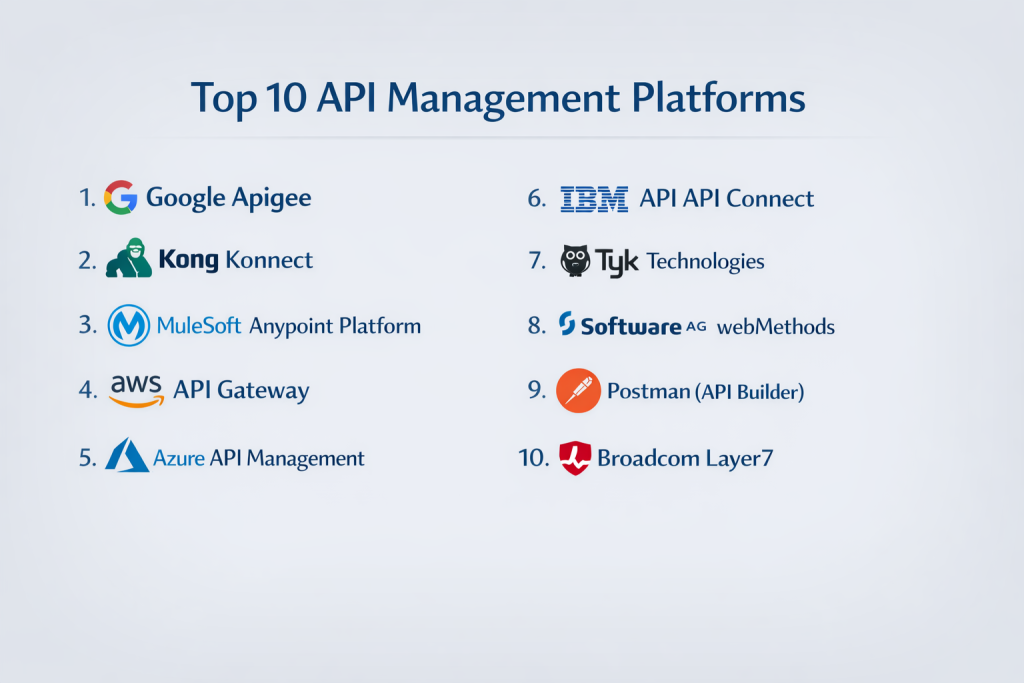
Top 10 API Management Platforms Tools
1 — Google Cloud Apigee
Apigee is a premier enterprise-level platform that Google acquired to provide high-end API management. It is designed for large organizations that need sophisticated traffic management and monetization capabilities.
- Key features:
- AI-Powered Analytics: Uses machine learning to detect anomalies and predict traffic patterns.
- Multi-Cloud Deployment: Can be deployed on-premises, on Google Cloud, or in hybrid environments.
- Developer Portal: A customizable storefront for developers to discover and test APIs.
- Advanced Security: Built-in protection against SQL injection and DDoS attacks.
- API Monetization: Comprehensive tools to package, price, and sell API access.
- Policy Management: Visual editor for setting rate limits, quotas, and transformations.
- Pros:
- Exceptionally robust feature set that covers every possible enterprise requirement.
- Industry-leading analytics that provide deep insights into API health and business value.
- Cons:
- Extremely high price point that can be prohibitive for mid-sized companies.
- Significant complexity requires specialized training to master the interface.
- Security & compliance: SOC 1/2/3, ISO 27001, HIPAA, GDPR, and PCI DSS compliant.
- Support & community: Enterprise-grade 24/7 support, extensive Google Cloud documentation, and a massive global user community.
2 — Kong Konnect
Kong is built on the high-performance NGINX proxy and is widely recognized for its speed and extensibility. It is a favorite among DevOps teams who prefer an “API-first” approach.
- Key features:
- Cloud-Native Architecture: Designed to run seamlessly on Kubernetes and Docker.
- Plugin Marketplace: Over 100 plugins for authentication, logging, and traffic control.
- Lightweight Gateway: Extremely low latency, making it ideal for microservices.
- Service Mesh Integration: Connects directly with Kong Mesh for internal service communication.
- Declarative Configuration: Allows “Infrastructure as Code” management of API settings.
- Multi-Protocol Support: Handles REST, gRPC, and GraphQL efficiently.
- Pros:
- Incredible performance with minimal overhead compared to older legacy platforms.
- Highly flexible; you can start with the open-source version and upgrade to enterprise as you grow.
- Cons:
- The visual management interface (GUI) is not as intuitive as some competitors.
- Advanced enterprise features require a significantly more expensive license.
- Security & compliance: FIPS 140-2, SOC 2 Type II, GDPR, and Common Criteria compliant.
- Support & community: Strong open-source roots with a massive GitHub presence and professional 24/7 support for Konnect users.
3 — MuleSoft Anypoint Platform (Salesforce)
MuleSoft is often viewed as the “heavy lifter” of the integration world. Now owned by Salesforce, it focuses on “API-led connectivity” to bridge the gap between legacy systems and modern apps.
- Key features:
- Anypoint Exchange: A library of pre-built connectors and templates for fast integration.
- DataWeave: A powerful data transformation engine for complex mapping.
- API Designer: Visual tool for designing API specifications using RAML or OAS.
- Hybrid Deployment: Manage APIs across on-premises servers and multiple clouds.
- Visualizer: Real-time mapping of how all your services are interconnected.
- Governance: Centralized dashboard for enforcing security standards across the company.
- Pros:
- The best choice for organizations that need to connect old mainframe data to new mobile apps.
- Seamless integration with the Salesforce ecosystem makes it a no-brainer for Salesforce-heavy shops.
- Cons:
- It is often considered the most expensive solution in the market.
- Can feel “bloated” for teams that only need a simple API gateway.
- Security & compliance: ISO 27001, SOC 1/2, HIPAA, PCI DSS, and FedRAMP compliant.
- Support & community: Extensive “MuleSoft Training” certifications and a dedicated global ecosystem of consultants.
4 — AWS API Gateway
For organizations already living in the Amazon Web Services ecosystem, this is the most logical and integrated choice for managing serverless and containerized APIs.
- Key features:
- Serverless Integration: Native “one-click” connectivity to AWS Lambda.
- Websocket Support: Real-time, two-way communication features for chat and live apps.
- Canary Deployments: Safely roll out new API versions to a small percentage of users.
- VPC Integration: Securely connect to private backends within the AWS network.
- Throttling & Caching: Built-in tools to reduce backend load and improve speed.
- CloudWatch Monitoring: Automated logging and alerting for every API call.
- Pros:
- Pay-as-you-go pricing makes it highly accessible for startups and scaling businesses.
- Eliminates the need to manage servers or infrastructure manually.
- Cons:
- Significant “vendor lock-in”; it is difficult to move these configurations to another cloud provider.
- Customizing the developer portal is much harder than with Apigee or Kong.
- Security & compliance: SOC 1/2/3, ISO 27001, HIPAA, GDPR, and PCI DSS compliant.
- Support & community: Standard AWS support tiers and an endless supply of community tutorials and forum posts.
5 — Azure API Management
Microsoft’s entry into the field is designed to help Azure customers secure and scale their services, with a strong emphasis on developer experience and enterprise governance.
- Key features:
- Self-Hosted Gateway: Deploy the gateway component near your backend, even if it’s on-premises.
- Visual Policy Editor: Logic-based rules for transforming XML to JSON on the fly.
- Developer Portal: A CMS-based portal that is easy to brand and customize.
- Active Directory Integration: Native SSO and identity management using Microsoft Entra.
- Git Integration: Manage API configurations using standard version control workflows.
- VNET Support: Advanced networking for isolation and security.
- Pros:
- The best-in-class integration for companies using .NET, C#, and Azure Functions.
- Highly competitive pricing tiers, including a “Consumption” tier for serverless apps.
- Cons:
- The management console can be overwhelming for those not used to the Azure portal layout.
- Some advanced features are locked behind the expensive “Premium” tier.
- Security & compliance: ISO 27001, SOC 1/2/3, HIPAA, FedRAMP, and GDPR compliant.
- Support & community: Professional Microsoft support and deep integration with the Microsoft Developer Network (MSDN).
6 — IBM API Connect
IBM’s solution is built for the high-stakes world of banking and highly regulated industries. It focuses on the full API lifecycle with an emphasis on hybrid-cloud flexibility.
- Key features:
- LoopBack Framework: An open-source Node.js framework to create APIs quickly.
- Micro-Gateway: A high-speed, local gateway for distributed environments.
- Automated Testing: Built-in tools to verify API behavior before deployment.
- Multi-Tenant Support: Manage different business units under one umbrella.
- Strong Governance: Highly granular role-based access control (RBAC).
- Unified Management: Manage REST, SOAP, and GraphQL in a single pane.
- Pros:
- Excellent for large, older companies migrating from SOAP to RESTful services.
- The platform is highly stable and designed for “mission-critical” uptime.
- Cons:
- The user interface is often described as clunky and dated compared to Kong or Tyk.
- Licensing and setup can be long and complex.
- Security & compliance: ISO 27001, SOC 2, HIPAA, and GDPR compliant.
- Support & community: IBM Global Services provides extensive on-site and remote support for enterprise clients.
7 — Tyk Technologies
Tyk is a modern, open-source API gateway and management platform that has gained popularity for its developer-centric approach and “batteries-included” philosophy.
- Key features:
- Zero Dependencies: Does not require a complex Java stack or large database to run.
- Visual API Designer: Easy-to-use GUI for building and testing endpoints.
- Universal Data Graph: A unique feature to combine multiple APIs into a single GraphQL endpoint.
- Multi-Data Center Support: Sync configurations across various global locations.
- Developer Portal: Includes documentation, key management, and usage tracking.
- Pluggable Architecture: Write custom middleware in Go, Python, or JavaScript.
- Pros:
- Very lightweight and fast; it can run on a Raspberry Pi or a massive Kubernetes cluster.
- The community version is very generous, allowing for significant testing before buying.
- Cons:
- The brand is smaller than Google or IBM, leading to fewer third-party consultants.
- Documentation can sometimes lag behind the rapid pace of new feature releases.
- Security & compliance: SOC 2 Type II, GDPR, and HIPAA compliant.
- Support & community: Very active community forum and direct access to engineers for enterprise customers.
8 — Axway API Management
Axway (formerly Vordel) is a veteran in the space, offering a platform called “Amplify” that specializes in “Multi-Gateway” management.
- Key features:
- Universal Directory: Discover and manage APIs from other vendors (AWS, Azure) in one place.
- MBaaS: Built-in mobile backend-as-a-service capabilities.
- Visual Policy Studio: Flow-chart style editor for complex traffic routing.
- Pre-built Compliance: Specialized accelerators for Open Banking (OBIE, Berlin Group).
- Advanced Monitoring: Dashboards for both technical health and business KPIs.
- Amplify Central: A central plane for governing a fragmented API landscape.
- Pros:
- The best choice for companies that have “API sprawl” across multiple different cloud providers.
- Strongest solution for specific regulatory compliance in the financial sector.
- Cons:
- The platform can feel fragmented because it is made of several different legacy modules.
- Higher learning curve for the visual policy studio.
- Security & compliance: FIPS 140-2, SOC 2, HIPAA, and GDPR compliant.
- Support & community: Professional enterprise support with a focus on large-scale digital transformation.
9 — Software AG webMethods
webMethods is a powerhouse in the integration space, offering an API management suite that is deeply integrated with its “Enterprise Service Bus” (ESB) heritage.
- Key features:
- API Portal: A social-enabled portal where developers can rate and review APIs.
- Microgateway: A small footprint gateway for edge computing and microservices.
- Threat Protection: Built-in rules for anti-virus and content-level security.
- Usage Analytics: Tracks not just uptime, but the business value of API calls.
- Legacy Connectivity: Specialized adapters for mainframes and ERP systems like SAP.
- Automated Mocking: Create mock APIs so front-end teams can work before the backend is ready.
- Pros:
- Incredible depth for complex B2B integrations and legacy modernization.
- High availability and clustering are built into the core architecture.
- Cons:
- Can be very “heavy” and requires significant server resources.
- Pricing is complex and generally targets only the largest enterprises.
- Security & compliance: ISO 27001, SOC 2, HIPAA, and GDPR compliant.
- Support & community: Strong global presence with a focus on long-term enterprise partnerships.
10 — Postman (API Platform)
Originally known as a testing tool, Postman has evolved into a complete API platform that covers the design, documentation, and collaborative development phases of the lifecycle.
- Key features:
- API Builder: Design APIs using OpenAPI (Swagger), RAML, or GraphQL.
- Automated Mock Servers: Simulate endpoints with one click for rapid prototyping.
- Workspaces: Collaborative environments for teams to share collections and environments.
- Monitors: Run periodic tests from global locations to ensure uptime and performance.
- Documentation: Automatically generates beautiful, interactive documentation from collections.
- Governance: Set organizational rules for API design and security standards.
- Pros:
- Every developer already knows how to use Postman; the onboarding time is zero.
- Best-in-class tools for the “Design” phase and collaboration between teams.
- Cons:
- It is not a runtime “Gateway” in the same way Kong or Apigee are; it must be used alongside one.
- Enterprise features can get expensive as the team size grows.
- Security & compliance: SOC 2 Type II, GDPR, and ISO 27001 compliant.
- Support & community: Unrivaled community size; millions of developers use Postman, and the documentation is stellar.
Comparison Table
| Tool Name | Best For | Platform(s) Supported | Standout Feature | Rating (Gartner) |
| Google Apigee | Large Enterprises | Multi-Cloud, Hybrid | AI Traffic Analytics | 4.8 / 5 |
| Kong Konnect | Cloud-Native / DevOps | Kubernetes, Docker | High-Speed Performance | 4.5 / 5 |
| MuleSoft | Legacy Integration | Any Cloud, On-Prem | DataWeave Engine | 4.6 / 5 |
| AWS Gateway | AWS Ecosystem | AWS Cloud | Serverless Integration | 4.4 / 5 |
| Azure API M | Microsoft Shops | Azure Cloud | Self-Hosted Gateways | 4.3 / 5 |
| IBM API Connect | Banking / Regulated | Hybrid Cloud | Lifecycle Automation | 4.2 / 5 |
| Tyk Technologies | Developer-Centric | Multi-Cloud, Edge | Universal Data Graph | 4.6 / 5 |
| Axway Amplify | Multi-Gateway Mgmt | Multi-Cloud | Universal Directory | 4.1 / 5 |
| webMethods | B2B / Industrial | Hybrid Cloud | Social Dev Portal | 4.4 / 5 |
| Postman | Collaborative Design | SaaS, Desktop | Team Workspaces | 4.7 / 5 |
Evaluation & Scoring of API Management Platforms
We have evaluated these platforms based on a weighted rubric to help you identify which one excels in the areas most important to your specific project.
| Category | Weight | Evaluation Criteria |
| Core Features | 25% | Quality of gateway, portal, designer, and monetization tools. |
| Ease of Use | 15% | Intuitiveness of the GUI and time to go from design to deployment. |
| Integrations | 15% | Breadth of pre-built connectors and cloud-native compatibility. |
| Security & Compliance | 10% | Encryption, SSO, DDoS protection, and regulatory certifications. |
| Performance | 10% | Latency overhead and ability to handle high-traffic spikes. |
| Support & Community | 10% | Quality of documentation, forums, and 24/7 enterprise support. |
| Price / Value | 15% | Licensing transparency and cost-effectiveness for various scales. |
Which API Management Platforms Tool Is Right for You?
Choosing the right platform is a strategic decision that affects your developers’ productivity and your systems’ security. Use the following guide to match your needs to the right tool.
Solo Users vs SMB vs Mid-market vs Enterprise
Solo users and small startups should look at AWS API Gateway or the open-source version of Tyk; they are inexpensive and scale only as you do. Mid-market companies will find a great balance of features and price in Azure API Management or Kong. Enterprises with legacy systems and huge budgets should focus on Apigee or MuleSoft to handle the heavy architectural lift.
Budget-conscious vs Premium Solutions
If you are on a strict budget, Tyk and Kong offer excellent open-source foundations. Postman is affordable for design and collaboration. If you require a premium, all-in-one solution where cost is secondary to feature depth, Google Apigee is the market leader for a reason.
Feature Depth vs Ease of Use
If you need Ease of Use, Postman is the most intuitive for design, and Azure is very easy for Windows-aligned teams. If you need Feature Depth—specifically for monetization and complex AI analytics—Apigee provides the most advanced toolkit, despite its steeper learning curve.
Integration and Scalability Needs
If your primary concern is Scalability for microservices, Kong is the fastest and most efficient. If your concern is Integration with 30-year-old mainframe systems, MuleSoft or webMethods are the specialists in “making everything talk to everything else.”
Security and Compliance Requirements
For Fintech and Healthcare, where security is the #1 priority, IBM API Connect and Axway provide the most pre-built compliance templates for things like Open Banking and HIPAA data protection.
Frequently Asked Questions (FAQs)
1. What is an API Gateway?
An API Gateway is a component of the platform that handles the actual traffic. It takes incoming requests and routes them to the correct backend service while checking for security and rate limits.
2. Why can’t I just build my own management layer?
While you can code basic security, a management platform provides a “Developer Portal,” analytics, and lifecycle tools that would take years to build manually, allowing your team to focus on business features instead.
3. Is there a difference between Low-Code and No-Code API management?
Most platforms are “Low-Code,” meaning you use a GUI to set policies but might need to write a little script (like JavaScript or Go) for complex data transformations.
4. How does pricing usually work?
Pricing is typically based on the number of “API calls” per month, the number of developers, or a flat annual license fee for enterprise tiers.
5. What is a Developer Portal?
It is a “storefront” where external or internal developers can sign up, read your API documentation, and get their own API keys to start using your service without talking to a human.
6. Can I manage APIs across different clouds (AWS and Azure)?
Yes, platforms like Kong, Apigee, and Axway are “Cloud-Agnostic,” meaning they can sit in the middle and manage services across any cloud provider.
7. Is security included automatically?
While the platforms provide the tools (SSO, OAuth, rate limiting), you must still configure them correctly. They act as a powerful lock, but you still have to turn the key.
8. What is API Monetization?
It is the process of charging users for access to your API—for example, charging $0.01 per weather request or a $100 monthly subscription for financial data.
9. How does “Shadow IT” relate to APIs?
Shadow IT happens when developers spin up endpoints without telling the security team. A management platform helps “discover” these hidden APIs and brings them under central control.
10. What is the most common mistake when choosing a platform?
Over-buying. Many companies pay for MuleSoft when they only need a simple gateway. Always start with a “Proof of Concept” (PoC) to see if you actually use the advanced features you are paying for.
Conclusion
Managing the modern API lifecycle is a balancing act between developer speed and organizational security. The “best” platform is rarely the one with the most features, but rather the one that integrates most smoothly with your existing technical stack.
If you are a cloud-native startup, the speed and flexibility of Kong or Tyk will likely be your biggest asset. If you are a global bank trying to modernize, the governance and legacy support of MuleSoft or Apigee will be worth every penny. Ultimately, choose a platform that your developers actually enjoy using—because an API management tool is only effective if your team actually adopts it.