Introduction
An Affiliate Marketing Tool is a piece of software that creates special links for partners to use. When a customer clicks one of those links and buys something, the tool “remembers” which partner sent them there. These tools are very important because they help businesses grow without spending money on ads first. Instead of paying for a billboard and hoping someone sees it, a business only pays a small fee after a sale is actually made. This is a much safer way for a business to spend its money.
In the real world, these tools are used for many things. A sports shop might use one to pay a famous runner for recommending their shoes. A software company might use one to give a small reward to a blogger who writes a review of their app. When you are looking for a tool like this, you should check if it is easy to learn, if it works with your current online shop, and if it can stop people from trying to cheat the system with fake clicks.
Best for: This is best for online store owners, people who sell digital courses, and marketing managers at companies of all sizes. It is especially helpful for industries like fashion, health, and software where recommendations are very important.
Not ideal for: This is not needed for a very small shop that only sells things in person or a business that only has one or two partners. If you are just working with your best friend, you can just use a simple list and pay them by hand.
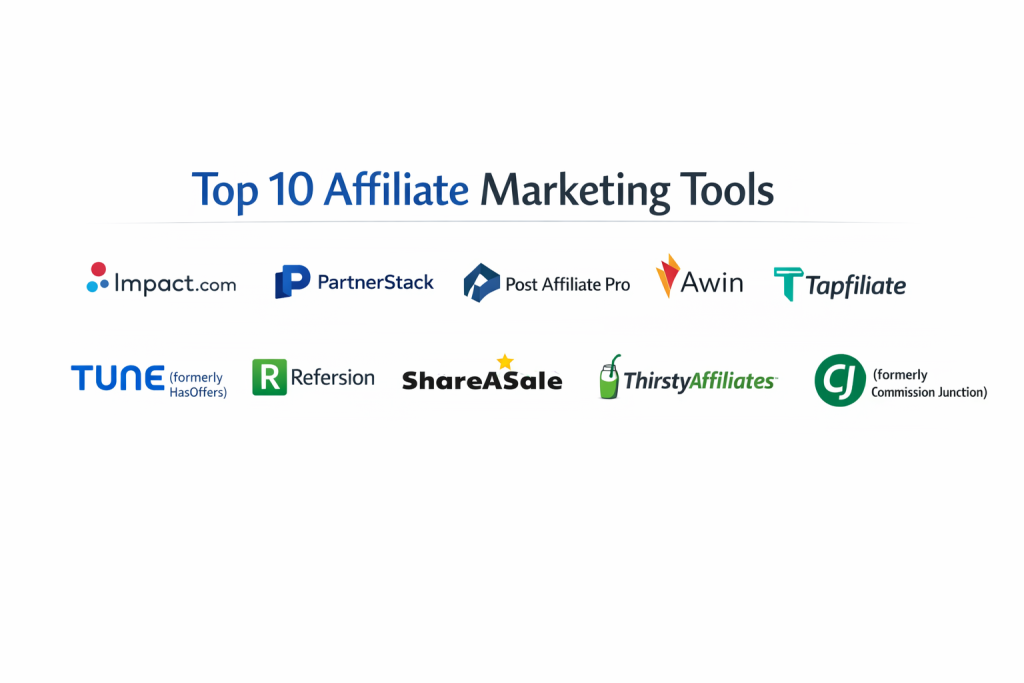
Top 10 Affiliate Marketing Tools
1 — Impact.com
Impact is a very large and powerful system used by some of the biggest brands in the world. It is made for companies that want to manage everything from famous influencers to small coupon websites in one single dashboard.
- Key features:
- A huge “marketplace” where you can find new partners to work with.
- Very smart tracking that works on phones, computers, and even inside apps.
- It can detect if someone is using fake clicks to try and get unearned money.
- It handles contracts and legal papers automatically for every new partner.
- You can set up different payment rules, like paying more for new customers.
- It creates very detailed reports that show exactly where your money is going.
- It automates the process of sending emails to your thousands of partners.
- Pros:
- It is extremely strong and can handle a massive amount of data without slowing down.
- The tools to stop “fraud” (cheating) are some of the best in the industry.
- Cons:
- It is very expensive and is usually too much for a small business to handle.
- The website has so many buttons and settings that it takes a long time to learn.
- Security & compliance: It follows the highest rules for safety, including SOC 2, ISO 27001, and GDPR privacy laws.
- Support & community: They have an online school to teach you and a professional team to help big companies get started.
2 — Post Affiliate Pro
This tool is famous for being very reliable and for working with almost any type of website. It is a great choice for medium-sized businesses that want a lot of features without the “enterprise” price tag.
- Key features:
- It can track sales using many different methods (like cookies or IP addresses).
- You can change the way the dashboard looks so it matches your company’s colors.
- It allows you to set up “multi-tier” marketing, where partners get a small fee for finding other partners.
- It works in many different languages and uses many different types of money.
- It has a mobile app so your partners can check their earnings on their phones.
- It handles the sending of “banners” and ads for your partners to use.
- Pros:
- It is very fair with its pricing and doesn’t charge you extra for every single sale.
- It connects to over 200 different online store types and payment tools.
- Cons:
- The design of the website looks a bit old-fashioned and gray.
- It can take a bit of work to set up the first time compared to simpler tools.
- Security & compliance: Uses 256-bit encryption and is fully GDPR compliant to keep data safe.
- Support & community: They are well-known for their fast chat support and helpful setup guides.
3 — PartnerStack
PartnerStack is built specifically for companies that sell software (SaaS). It is designed to help those companies grow by working with other businesses and experts who recommend their software.
- Key features:
- A dedicated marketplace where software-focused partners look for new products.
- It automatically pays your partners, so you don’t have to send 500 individual checks.
- It has a very clean “portal” where partners can log in and see their links.
- You can create “learning paths” to teach your partners how to sell your product.
- It tracks when a lead turns into a real sale over a long period of time.
- It integrates deeply with sales tools like Salesforce and HubSpot.
- Pros:
- It is the best tool for software companies because it understands how they work.
- The partner dashboard is very modern and easy for people to use.
- Cons:
- It is not a good fit for shops selling physical items like clothes or food.
- The cost is higher than some of the basic tools on this list.
- Security & compliance: SOC 2 Type II compliant and follows GDPR and CCPA privacy rules.
- Support & community: They offer a dedicated manager for your account and have a very active group of users.
4 — Tapfiliate
Tapfiliate is a very popular choice for small-to-medium businesses because it is beautiful and simple. It is made for people who want to start their own partner program in just a few minutes.
- Key features:
- A very simple setup process that doesn’t require you to be a computer expert.
- It lets you create custom “Invite” pages that look like your own brand.
- You can reward partners with money or with store discounts and “points.”
- It has a tool to help you turn your actual customers into partners.
- It works perfectly with Shopify, WooCommerce, and Squarespace.
- It allows you to share social media posts directly with your partners.
- Pros:
- It is very easy on the eyes and simple to navigate.
- It is very affordable for a business that is just starting out.
- Cons:
- It doesn’t have the very advanced “detective” tools to stop cheating that bigger tools have.
- Some of the automation features are a bit limited.
- Security & compliance: GDPR compliant and uses secure SSL encryption for all data.
- Support & community: They have a very good help center and answer emails quickly.
5 — Refersion
Refersion is built mainly for people who use Shopify to sell their goods. It is focused on helping online shops manage their relationships with influencers and fans.
- Key features:
- It connects to your Shopify store with just one click.
- A “Post-Purchase” pop-up that asks your customers to become partners after they buy.
- It handles all the tax forms (like 1099s in the US) for you automatically.
- You can track sales made with “coupon codes” even if there is no link clicked.
- It has a marketplace where you can find influencers who like your type of product.
- It shows you a simple dashboard of your top-performing partners.
- Pros:
- It makes the “tax and legal” side of paying people very easy.
- It is very focused on helping you find people who already love your brand.
- Cons:
- If you don’t use Shopify or a similar store, it is not as helpful.
- It can get expensive if you have a lot of partners.
- Security & compliance: GDPR and CCPA compliant; uses secure servers to store partner data.
- Support & community: They offer training webinars and have a solid support team.
6 — TUNE
TUNE is a very technical and powerful tool. It is used by large advertising agencies and companies that need to track millions of clicks every day with perfect accuracy.
- Key features:
- A “headless” system which means developers can build their own tools on top of it.
- Real-time data that shows you what is happening the very second a click occurs.
- Very advanced tools to stop people from sending fake traffic to your site.
- It can manage both mobile app downloads and website sales at the same time.
- A highly flexible way to set up different types of payments.
- It is built to work very fast, even when there is a huge amount of traffic.
- Pros:
- It is one of the most reliable and fastest tools in the world.
- You can customize almost every single part of it to fit your needs.
- Cons:
- It is much too complicated for a normal person or a small shop owner.
- You usually need to hire a technical expert to run it for you.
- Security & compliance: SOC 2 Type II and SOC 1 compliant; very high data safety standards.
- Support & community: They have an “Enterprise” support team that is available 24 hours a day.
7 — Rewardful
Rewardful is a simple and honest tool built specifically for companies that use “Stripe” to take payments. It is very popular with startups and small software teams.
- Key features:
- It links directly to your Stripe account in a few seconds.
- It automatically handles “refunds”—if a customer gets their money back, the partner’s fee is taken away.
- You can set up “recurring” payments, so a partner gets paid every month a customer stays.
- It has a very simple dashboard that is not confusing at all.
- It allows you to create private campaigns for special partners.
- Pros:
- It is one of the cheapest and simplest ways to start a partner program.
- Because it links to Stripe, the data is always 100% correct.
- Cons:
- It only works if you use Stripe to take payments.
- It doesn’t have a marketplace to help you find new partners.
- Security & compliance: GDPR compliant; it never sees your customers’ credit card numbers.
- Support & community: They have a very friendly small team that helps you via chat.
8 — Awin
Awin is a giant “network” more than just a tool. It is a place where thousands of shops and millions of partners meet. It is great for brands that want to be “found” by new partners easily.
- Key features:
- A massive directory of partners that you can search through.
- A “Browser Extension” that helps partners create links quickly.
- It uses “MasterTag” technology to track sales without needing complex code.
- It provides detailed charts comparing you to other shops in your industry.
- It handles all the global payments in many different languages.
- Pros:
- You get access to millions of potential partners the day you sign up.
- It is very well-known and trusted by people all over the world.
- Cons:
- You have to pay a fee just to join the network, even before you make a sale.
- You have less control over the “look” of your program compared to owning your own tool.
- Security & compliance: Fully GDPR compliant; uses high-level security to protect its global network.
- Support & community: They have offices in many countries and a huge help center.
9 — Circlewise
Circlewise is a tool that focuses on “transparency.” It is built to help shops talk directly to their partners without a “middle-man” taking extra money.
- Key features:
- A “marketplace” where you can invite partners directly.
- It shows you exactly how much every click and every sale is costing you.
- It has tools to manage “media buyers” (people who buy ads for you).
- It allows for very custom payment rules based on what was sold.
- A clean dashboard for partners to see their own performance.
- Pros:
- It helps you build a direct relationship with your partners.
- It is very clear about its costs and fees.
- Cons:
- It is not as famous as some of the other tools, so there are fewer partners in its list.
- The setup can be a little bit more manual than the “one-click” tools.
- Security & compliance: GDPR compliant and uses secure European data centers.
- Support & community: They offer personal help to help you set up your first campaigns.
10 — Affise
Affise is a “performance” tool. It is unique because they don’t charge you a percentage of your sales. Instead, they charge you for the number of “conversions” (sales or sign-ups) you track.
- Key features:
- An AI (smart computer) that helps you find the best way to grow your program.
- It can manage many different types of ads, from banners to videos.
- A very powerful tool to block “VPNs” and other things people use to cheat.
- It allows you to automate almost everything with a simple “if this happens, then do that” logic.
- It works in many different time zones and languages for global business.
- Pros:
- The pricing model can save you a lot of money if you have very big sales.
- The automation tools save you hours of work every week.
- Cons:
- It is a bit too technical for a small “Mom and Pop” shop.
- The dashboard can feel a bit crowded with data and charts.
- Security & compliance: SOC 2 Type II compliant and fully follows GDPR privacy laws.
- Support & community: They have a 24-hour support team and provide a personal manager for your account.
Comparison Table
| Tool Name | Best For | Platform(s) Supported | Standout Feature | Rating (Approx.) |
| Impact.com | Large Brands | Web, Mobile, App | Best Fraud Protection | 4.6 / 5 |
| Post Affiliate Pro | Medium Businesses | Web, Mobile | 200+ Connections | 4.5 / 5 |
| PartnerStack | Software (SaaS) | Web | Partner Learning Paths | 4.7 / 5 |
| Tapfiliate | SMBs / Startups | Web, Shopify | Very Easy to Use | 4.4 / 5 |
| Refersion | Shopify Stores | Web, Shopify | Post-Purchase Invites | 4.3 / 5 |
| TUNE | Ad Agencies | Web, Mobile, API | Unmatched Speed | 4.2 / 5 |
| Rewardful | Stripe Users | Web, Stripe | 1-Click Stripe Link | 4.8 / 5 |
| Awin | Finding Partners | Global Network | Millions of Partners | 4.0 / 5 |
| Circlewise | Direct Relationships | Web | No “Middle-Man” Fees | 4.1 / 5 |
| Affise | High-Volume Sales | Web, API | AI Automation Tools | 4.5 / 5 |
Evaluation & Scoring of Affiliate Marketing Tools
We look at these tools based on what a real business owner needs. Here is how we give them their “score”:
| Category | Weight | What it means |
| Core Features | 25% | Does it track links correctly and stop people from cheating? |
| Ease of Use | 15% | Is it easy for a normal person to set up and use every day? |
| Integrations | 15% | Does it work with Shopify, Stripe, and other important tools? |
| Security & Compliance | 10% | Is the data safe and does it follow the privacy laws? |
| Performance | 10% | Does the website work fast even when there are millions of clicks? |
| Support & Community | 10% | Can you get help quickly when you have a problem? |
| Price / Value | 15% | Is the cost fair compared to the money it helps you make? |
Which Affiliate Marketing Tool Is Right for You?
Choosing the right tool is about matching the program to your specific business type.
- Solo Users & Startups: If you are just one person or a very small team, you should look at Rewardful (if you use Stripe) or Tapfiliate. They are cheap, easy to look at, and won’t take up all of your time.
- Online Shops (SMBs): If you have a shop on Shopify, Refersion is usually the best choice because it was built just for you. If you want to find new partners easily, Awin is a great place to list your products.
- Software Companies: If you sell an app or a website service, PartnerStack is the winner. It knows how to handle “recurring” payments (where people pay every month).
- Large Enterprises & Agencies: If you are a massive company, you need Impact.com or TUNE. You need the deep “detective” tools to make sure you aren’t being cheated, and you need the high-level security they offer.
- Budget-Conscious: If you want a flat price and don’t want to pay a percentage of your hard-earned sales, look at Post Affiliate Pro or Affise. They are more honest about their costs as you grow.
Frequently Asked Questions (FAQs)
1. What is an affiliate marketing tool?
It is a computer program that tracks when a partner sends a customer to your shop and makes sure the partner gets paid their reward.
2. How do these tools track sales?
They use “cookies” (tiny files in a browser) or “coupon codes.” When a customer clicks a link, the tool remembers them for a certain number of days.
3. Is it hard to set up?
Some are very easy (one click), while others require you to add a small bit of code to your website. Most offer guides to help you.
4. How much do they cost?
Some start at $29 a month, while others cost thousands. Some also take a small “transaction fee” for every sale you make.
5. Can I stop people from cheating?
Yes. The better tools look at where clicks are coming from and block “bots” or people who try to claim sales that weren’t theirs.
6. Do I have to pay my partners myself?
Many tools (like PartnerStack or Impact) can send the money to your partners’ bank accounts for you, which saves a lot of time.
7. Can I use these tools for influencers?
Yes. These tools are perfect for tracking how many sales a famous person on Instagram or TikTok brings to your shop.
8. What is a “Post-Purchase” invite?
It is a feature where your actual customers are asked to become partners right after they buy something. It is a great way to find people who already like you.
9. Will these tools slow down my website?
Usually, no. They use very light code that doesn’t affect how fast your website loads for your customers.
10. Do I need a lawyer for the contracts?
Most of these tools have built-in “Terms and Conditions” that you can use, but it is always a good idea to have a professional look at them once.
Conclusion
Affiliate marketing is a wonderful way to grow a business because you only pay for actual results. However, trying to do it without a tool is like trying to build a house without a hammer—it is possible, but it will be very painful and messy.
The “best” tool for you is simply the one that fits your business. If you are a small shop, pick something simple like Tapfiliate. If you are a software giant, go with PartnerStack. The most important thing is to pick a tool that makes your partners feel trusted and paid on time, because they are the ones who will help your business reach new heights.