Introduction
An Influencer Marketing Platform is a specialized computer program designed to act as a bridge between a company and social media creators. Think of it like a massive, digital phone book that is also a post office and a bank. In the past, if a brand wanted to find someone to talk about their new shoes, they had to spend hours scrolling through Instagram or TikTok, writing down names in a notebook, and sending hundreds of “Direct Messages” (DMs) that often got ignored. These platforms replace that slow manual work with a search engine where you can find the perfect person in seconds.
The importance of these tools has grown because social media is now the main way people decide what to buy. We tend to trust a person’s recommendation more than a billboard or a TV commercial. However, for a business, working with 50 or 100 different people at once is a mess. You have to track who said yes, who received the product, when they are posting, and how much to pay them. An influencer marketing platform puts all of these moving parts into one single dashboard so nothing gets lost.
Key Real-World Use Cases:
- Finding the Right Fit: You can use filters to find “hidden gems”—influencers who might only have 10,000 followers but have a very high “engagement rate,” meaning their followers actually listen and comment on what they say.
- Managing the Mess: When you are running a campaign with 20 people, you don’t want to be checking your email, Instagram DMs, and WhatsApp all day. These tools keep all your chats and contracts in one place.
- Spotting Fake Fame: Some people buy fake followers (bots) to look important. These platforms have “truth-detecting” tools that look at the data to see if an influencer’s audience is made of real human beings or just computer programs.
- Tracking Every Cent: These tools can tell you exactly how many people clicked a link or used a discount code. This helps a business know if the money they spent on an influencer actually brought in more money in sales.
Best for: This software is a “must-have” for medium-sized brands, growing online shops (D2C), and marketing agencies that handle many clients. It is built for people whose job title is Marketing Manager or Social Media Coordinator and who need to show their boss clear results and charts.
Not ideal for: A tiny local business, like a single neighborhood coffee shop, probably doesn’t need to pay for this. If you only want to work with two or three local people a year, you can just use a simple spreadsheet and regular email for free.
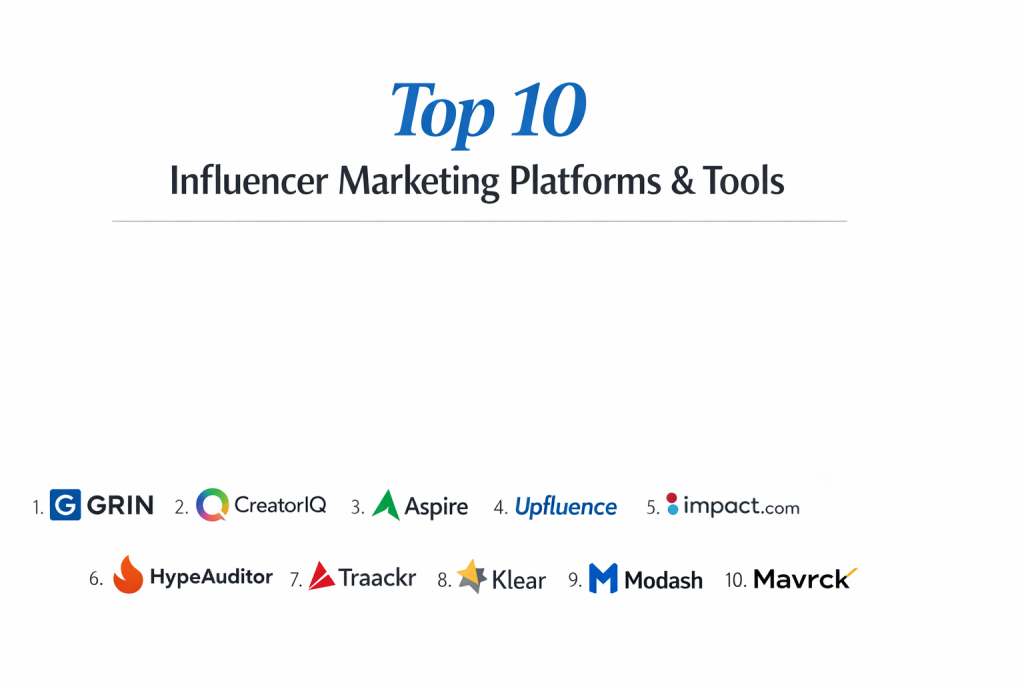
Top 10 Influencer Marketing Platforms
1 — GRIN
GRIN is widely loved by people who run online stores. It is famous because it focuses on the “relationship” part of marketing. It doesn’t feel like a cold database; it feels like a tool that helps you make friends with creators.
- Key Features:
- It connects directly to your online shop (like Shopify) so you can see sales in real-time.
- It automatically tracks when a package is mailed and when it arrives at the influencer’s house.
- It has a built-in email system so you can send “mass” emails that still look personal.
- It saves every photo and video the influencer makes so you can use them for your own ads later.
- It handles the payment and all the tax paperwork so the government stays happy.
- It has a “Chrome Extension” that lets you see an influencer’s stats while you are just browsing social media.
- It helps you find people who are “lookalikes” to your best-performing creators.
- Pros:
- It saves a massive amount of time on shipping and logistics.
- The reporting is very clear and shows exactly how much profit you made.
- Cons:
- The price is very high and usually requires you to pay for a whole year upfront.
- It is mainly for physical products, so it’s not as good for apps or services.
- Security & compliance: It is very safe and follows SOC 2 and GDPR rules, which are the industry standards for keeping your data and money private.
- Support & community: They give you a dedicated person to help you get started and have a big library of videos to teach you how to be a better marketer.
2 — CreatorIQ
CreatorIQ is the “heavy-duty” choice for very large, famous companies. If you are a brand that operates in 20 different countries and has 500 employees in the marketing department, this is the tool for you.
- Key Features:
- A very advanced “fraud detector” that finds fake followers with high accuracy.
- A way to manage multiple different brands or sub-companies under one big account.
- It has “legal folders” to store all your contracts and signed papers safely.
- A private website (portal) where your influencers can log in to see their tasks.
- It shows you what people are saying about your brand even when they don’t tag you.
- It creates deep data reports that look great in a boardroom meeting.
- It can suggest which influencers are most likely to bring in sales based on their past work.
- Pros:
- It is extremely organized and keeps everything “legal and clean” for big corporations.
- The data is very deep and detailed, going way beyond just “likes” and “comments.”
- Cons:
- It is very complicated to use and takes a few weeks of training to learn.
- It is way too big and expensive for a small business or a solo entrepreneur.
- Security & compliance: It has the highest level of security certificates (ISO 27001, SOC 2, HIPAA) to protect very sensitive company information.
- Support & community: You get a whole team of experts to help you, and they have 24/7 support for their big global clients.
3 — Aspire
Aspire is unique because it has a “Marketplace.” Instead of you hunting for people, you post an “ad” for your campaign, and influencers who actually like your brand can apply to work with you.
- Key Features:
- A search engine that helps you find people based on what their photos “look” like.
- A “Marketplace” where influencers come to find work and apply to your brand.
- A system that sends “drip” emails (emails that follow up automatically if the person doesn’t reply).
- An easy way to ask an influencer for the “rights” to use their video in your Facebook ads.
- It creates custom discount codes (like “SAVE20”) for every influencer automatically.
- It tracks the “health” of your relationship to see if an influencer is getting bored with your brand.
- Pros:
- You end up working with people who are already fans of your product, which leads to better content.
- The workflow for approving photos and videos before they go live is very smooth.
- Cons:
- Because it’s a marketplace, you sometimes get a lot of low-quality applications you have to decline.
- The price can go up quickly as you add more features.
- Security & compliance: It follows the standard GDPR rules for privacy and uses secure ways to send payments.
- Support & community: They have an “Aspire Academy” where you can take online classes to learn more about influencer marketing.
4 — Upfluence
Upfluence has a very clever feature that “listens” to your own website. It tells you if any of your actual customers are actually famous influencers who might want to work with you.
- Key Features:
- A “Live Capture” tool that identifies influencers when they visit your online shop.
- A huge search engine that covers almost every social media site in the world.
- A browser tool that lets you see an influencer’s “Engagement Rate” while you are scrolling Instagram.
- An automated system to send 100 emails at once that look like they were typed by hand.
- It allows you to pay influencers in their own local money, no matter what country they are in.
- It connects to Amazon and Shopify stores to track how many items were sold.
- Pros:
- It is one of the easiest tools to learn; most people can figure it out in a day.
- Working with your own customers is a very powerful way to get “real” reviews.
- Cons:
- The data is good, but the “look” of the website can feel a little bit messy compared to others.
- If you want the really advanced features, the price jumps up quite a bit.
- Security & compliance: Fully compliant with GDPR and CCPA privacy laws to keep customer data safe.
- Support & community: They have a help chat right inside the tool and a team that helps you get set up in the first month.
5 — Impact.com
Impact is a giant company in the world of “Affiliate Marketing.” Their influencer tool is built for brands that want to pay influencers based on the sales they make, rather than just a flat fee.
- Key Features:
- It uses very high-tech “links” to track every click and sale across phones and computers.
- You can set up rules like “I will pay you $10 for every person who buys these shoes.”
- It has a “Fraud Shield” that stops people from trying to fake clicks to get money.
- It generates legal contracts automatically so you don’t need a lawyer for every deal.
- It lets you manage traditional “coupon websites” and social influencers in the same place.
- Pros:
- It is the best tool for brands that are strictly focused on making a profit (ROI).
- It can handle a huge amount of people—thousands—without getting disorganized.
- Cons:
- The website looks very technical and “boring,” like a bank website.
- It takes a long time to learn how to set up the complex payment rules.
- Security & compliance: It is extremely secure and used by some of the biggest banks and stores in the world (SOC 2, ISO 27001).
- Support & community: They have an online school called “Impact PX” where you can become a certified expert.
6 — HypeAuditor
HypeAuditor is like a private investigator for the internet. Its main job is to tell you if an influencer is telling the truth about their followers and how popular they really are.
- Key Features:
- It gives every influencer a “Quality Score” from 1 to 100.
- It shows you a chart of an influencer’s follower growth over time (sudden jumps usually mean they bought fakes).
- It can tell you if the “comments” on a post are real thoughts or just bots saying “Great pic!”
- It lets you spy on your competitors to see which influencers they are paying.
- It shows you the age, gender, and even what country the influencer’s followers live in.
- Pros:
- It has the most accurate data in the industry for catching people who are “faking it.”
- The reports are very colorful and easy to understand at a glance.
- Cons:
- It is not very good at sending emails or managing campaigns; it is mostly for research.
- You have to buy “credits” for reports, which can be annoying if you need to check many people.
- Security & compliance: It follows all the standard GDPR privacy rules.
- Support & community: They have a great blog that releases free reports on what is trending on social media.
7 — Traackr
Traackr is a pioneer in this industry. It is built for brands that want to manage “relationships” over several years, not just pay for one single post and leave.
- Key Features:
- It keeps a full “diary” of every time you have talked to an influencer, even if it was years ago.
- A “Vitality Score” that shows how much people are talking about your brand compared to your rivals.
- It helps you keep track of your budget so you don’t overspend your marketing money.
- It can find influencers based on what they believe in (like sustainability or veganism).
- It automatically checks to see if influencers are following the law (like using #ad in their posts).
- Pros:
- Perfect for “premium” brands like luxury makeup or high-end fashion.
- It helps you see the “big picture” of how your brand’s reputation is growing.
- Cons:
- The design of the tool is a bit old-fashioned and takes time to get used to.
- It doesn’t always have the newest features for fast-moving apps like TikTok.
- Security & compliance: Very high enterprise security with SOC 2 and SSO (Single Sign-On).
- Support & community: They offer “professional services” where their experts can actually help you run your campaigns.
8 — Klear
Klear is part of a larger social media company called Meltwater. It is a great choice if you also need to track the news and what people are saying about you in general.
- Key Features:
- It shows you an influencer’s “Social Footprint” (all their different accounts in one view).
- It “listens” to the internet and tells you when someone mentions your brand name.
- It uses Artificial Intelligence to find new influencers who are talking about topics you like.
- It makes very simple, clean reports that you can turn into a PDF for your team.
- Pros:
- It is fantastic if you already use Meltwater for your PR and news tracking.
- The “Klear Score” is a very fast way to see if an influencer is worth your time.
- Cons:
- If you only want influencer tools, it might be too expensive because it comes with “extras” you might not need.
- The database of people is not always as huge as some of the other tools.
- Security & compliance: It follows the strictest global security rules (ISO 27001 and SOC 2).
- Support & community: They have offices all over the world, so you can usually talk to someone in your own time zone.
9 — Modash
Modash is built to be fast and simple. It is basically a giant search engine that has almost every creator in the world in its list.
- Key Features:
- A massive search engine with 250 million people from Instagram, TikTok, and YouTube.
- Very simple filters—you can search by city, number of followers, or keywords.
- A “Vetting Tool” that gives you a quick summary of an influencer’s audience quality.
- A monitoring system that “watches” your influencers and tells you when they post about you.
- It lets you export your lists into a CSV (Excel) file very easily.
- Pros:
- It is much more affordable than the big “enterprise” tools.
- You don’t have to wait for influencers to “sign up” to see them; they are already in the system.
- Cons:
- It does not help you with the “banking” part (paying influencers).
- It doesn’t have a place to store contracts or sign papers.
- Security & compliance: It follows the standard GDPR rules to keep data private.
- Support & community: They have a very helpful blog that gives real tips on how to write outreach emails.
10 — Mavrck
Mavrck is a tool for brands that want to turn their own customers into a “fan club.” It is built for handling thousands of small influencers at once.
- Key Features:
- A “White-Label” portal—this means you can have a website that looks like yours where fans sign up.
- It sends out surveys to your customers to see who would be a good influencer for you.
- It automatically takes the reviews and photos from influencers and puts them on your website.
- It can handle “loyalty programs” where you give fans points for posting about you.
- Pros:
- It is the best tool for brands that want a “massive” strategy with thousands of micro-influencers.
- It builds a very deep connection with your actual customers.
- Cons:
- It is very complex to set up at the start.
- It is not the right tool if you just want to find one or two big celebrities.
- Security & compliance: Follows standard privacy laws like GDPR and CCPA.
- Support & community: They have a dedicated success manager who helps you build your “ambassador program.”
Comparison Table
| Tool Name | Best For | Platform(s) Supported | Standout Feature | Rating |
| GRIN | Online Shops | IG, TT, YT, FB | Store Integration | 4.6 / 5 |
| CreatorIQ | Big Global Brands | All Social Media | High Security | 4.5 / 5 |
| Aspire | Getting Applicants | IG, TT, YT, Pin | Brand Marketplace | 4.4 / 5 |
| Upfluence | Finding your Fans | IG, TT, YT, Twitch | Site Visitor Tool | 4.2 / 5 |
| Impact.com | Paying for Sales | All Social Media | Sales Tracking | 4.5 / 5 |
| HypeAuditor | Checking Fakes | IG, TT, YT, X | Fake Follower Check | 4.4 / 5 |
| Traackr | Luxury Brands | All Social Media | Relationship History | 4.3 / 5 |
| Klear | PR & News Teams | IG, TT, YT, X | All-in-one PR | 4.1 / 5 |
| Modash | Fast Searching | IG, TT, YT | 250M+ Database | 4.7 / 5 |
| Mavrck | Customer Clubs | All Social Media | Fan Portals | 4.6 / 5 |
Evaluation & Scoring of Influencer Marketing Platforms
When we test these platforms, we don’t just look at the buttons. we look at how much they actually help a business grow. We use this scoring system to decide who is the winner:
| What we look at | How important is it? | Detailed Explanation |
| Core Features | 25% | This is the basics: finding people, seeing their stats, and managing the campaign. |
| Ease of Use | 15% | Can a new employee learn it in a day, or does it require a 100-page manual? |
| Integrations | 15% | Does it connect to your store (Shopify), your email (Gmail), and your chat (Slack)? |
| Security & Compliance | 10% | Is your money and data safe? Does it follow the privacy laws of the country? |
| Performance | 10% | Does the website work fast? Is the influencer data fresh or is it old? |
| Support | 10% | When something breaks on a Friday night, will someone help you? |
| Price / Value | 15% | Is the tool worth what you pay? Does it save you enough time to be worth it? |
Which Influencer Marketing Platform Tool Is Right for You?
Choosing the right tool is a big decision. Here is a simple guide to help you choose:
- The “One-Man-Show” or Startup: If you are a small team with a small budget, go for Modash. It is the most “bang for your buck” and helps you find influencers without a lot of complicated extra stuff you won’t use.
- The Fast-Growing Store: If you have an online store and are shipping hundreds of boxes a day, you need GRIN. It will save you from the nightmare of tracking packages and checking discount codes by hand.
- The Huge Corporation: If you are a brand like Nike or Disney, you need CreatorIQ. You need the high security and the ability for 100 people in different offices to see the same data at once.
- The ROI Focused Team: If your boss says “I only care about sales,” use Impact.com. It is built like a precision tool for tracking money and making sure every dollar spent brings in more than a dollar back.
- The Relationship Focused Brand: If you are a luxury brand and want to work with the same 50 people for the next five years, Traackr is the best choice for keeping that history organized.
Frequently Asked Questions (FAQs)
1. What is an Influencer Marketing Platform?
It is a computer program that helps businesses find, contact, and pay social media influencers who promote their products.
2. Are these tools only for Instagram?
No. Most of them now work with TikTok, YouTube, and some even work with Pinterest, Twitch, and Twitter (X).
3. How do these tools find fake followers?
They look at the “math” behind an account. If someone has a million followers but only 10 likes per photo, the software flags them as likely having fake followers.
4. Can I see what an influencer’s audience looks like?
Yes. You can see the percentage of men vs women, what age they are, what cities they live in, and even what other things they are interested in.
5. Do I have to pay the influencers through the tool?
You don’t have to, but most tools like GRIN and Aspire have a “Pay” button that makes it much faster and handles the tax forms for you.
6. Are these platforms expensive?
Some are. “Enterprise” tools can cost $50,000 a year. But simple search tools like Modash can be as low as $100 per month.
7. Can I track my competitors?
Yes, tools like HypeAuditor and Traackr allow you to type in a competitor’s name to see which influencers are talking about them and how much “buzz” they are getting.
8. Is my brand’s data safe?
The top tools use very high-level encryption (like a bank) and follow “GDPR” rules, which are the strictest laws for keeping personal data private.
9. Do I still need to send the emails myself?
The tools provide a “portal” to send emails. You write a template, and the tool fills in the influencer’s name and sends it from your own email address automatically.
10. What is a “Micro-influencer”?
This is an influencer with a smaller audience (usually 10,000 to 50,000) who has a very close relationship with their fans. They are often the best people to work with for sales.
Conclusion
At the end of the day, an influencer marketing platform is a tool to help you be more “human” at a large scale. By taking away the boring work like spreadsheets, tracking packages, and checking bank accounts, these tools allow you to spend your time on what matters: finding great people and telling a story together.
The “best” tool is simply the one that fits your budget and solves your biggest headache. Whether you are a small startup looking for your first 10 fans or a global giant managing a community of thousands, there is a platform on this list that can help you grow. Take your time, try a few “demos,” and pick the one that feels easiest for your team to use every day.