Introduction
Recommendation engines are AI-powered software systems that analyze user data, behavior, preferences, and contextual information to suggest relevant items, content, or actions. These engines use algorithms like collaborative filtering, content-based filtering, hybrid models, and deep learning to predict what users might like, often in real-time. They process vast datasets from interactions, purchases, or views to deliver personalized suggestions, enhancing user engagement across platforms.
The importance of recommendation engines cannot be overstated in today’s data-driven digital economy. They drive user satisfaction, increase retention, boost conversions by up to 30% according to industry reports, and generate significant revenue—think how Netflix attributes 75% of views to recommendations. With privacy regulations and cookie deprecation, modern engines emphasize first-party data and ethical AI to maintain trust while personalizing experiences. They enable businesses to stand out in crowded markets by anticipating needs, reducing choice overload, and fostering loyalty through relevant interactions. Key real-world use cases include e-commerce platforms suggesting products based on browsing history, streaming services curating playlists or shows, news apps recommending articles by reading patterns, social media feeds prioritizing posts from similar interests, and B2B tools proposing resources based on user roles or company data.
When choosing a recommendation engine, users should prioritize algorithmic flexibility (collaborative vs. content-based), data integration capabilities (CDPs, CRMs, analytics), real-time processing for dynamic suggestions, scalability for user volume, A/B testing for model validation, privacy compliance features, customization for domain-specific needs, and analytics for performance measurement. Also evaluate ease of deployment (cloud vs. on-premise), API accessibility for developers, and cost models based on usage or users.
Best for: E-commerce managers, product owners, data scientists, marketers, content curators, and CX specialists benefit most from recommendation engines. They suit SMBs personalizing basic e-stores, mid-market companies scaling user engagement, and enterprises in retail, media, streaming, and SaaS requiring advanced, AI-driven suggestions at massive scale.
Not ideal for: Small sites with low user data—basic plugins suffice. Organizations without sufficient interaction data might see poor results. Those prioritizing manual curation over AI could use simple lists instead.
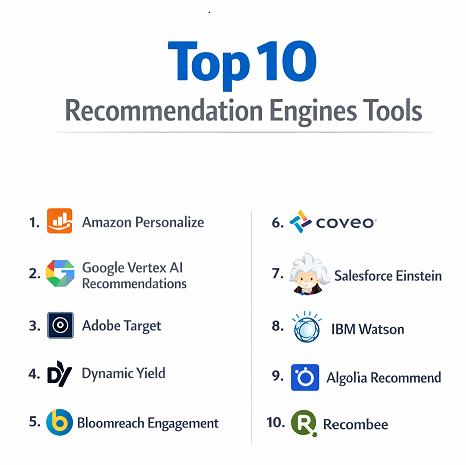
Top 10 Recommendation Engines Tools
1 — Amazon Personalize
Amazon Personalize is a fully managed ML service that creates real-time personalized recommendations using the same technology as Amazon.com. It’s designed for developers and businesses building scalable recommendation systems without ML expertise. Amazon Personalize handles data processing, model training, and deployment automatically, making it ideal for e-commerce, media, and content platforms needing hyper-personalized user experiences.
Key features:
- Real-time and batch recommendation modes.
- Automatic model training and optimization.
- Support for user-item interactions and contextual data.
- Integration with AWS services like S3, Lambda.
- A/B testing and metrics monitoring.
- Scalable to billions of interactions.
- Privacy-focused with data controls.
Pros:
- Proven technology from Amazon’s ecosystem.
- No ML knowledge required for setup.
- Highly scalable for large datasets.
Cons:
- Tied to AWS infrastructure.
- Higher costs at scale.
- Limited customization of algorithms.
Security & compliance: Encryption, audit logs; SOC 2, GDPR, HIPAA compliant.
Support & community: AWS docs, forums, enterprise support.
2 — Google Vertex AI Recommendations
Google Vertex AI Recommendations is a managed service for building recommendation systems using Google’s ML infrastructure. It’s aimed at developers integrating personalized experiences into apps and sites. Vertex AI handles data ingestion, model selection, and deployment, ideal for e-commerce and content platforms leveraging Google Cloud.
Key features:
- Pre-built models for common use cases.
- AutoML for custom training.
- Real-time inference.
- Integration with BigQuery, Analytics.
- A/B testing support.
- Scalable serving.
- Explainable recommendations.
Pros:
- Fast deployment with pre-trained models.
- Strong integration with Google ecosystem.
- Good for large-scale data.
Cons:
- Google Cloud dependent.
- Learning curve for advanced use.
- Pricing based on usage.
Security & compliance: Encryption; GDPR, SOC 2 compliant.
Support & community: Google docs, enterprise.
3 — Adobe Target
Adobe Target is an AI personalization engine with recommendation capabilities within Experience Cloud. It’s for enterprises delivering tailored content and offers. Adobe Target uses Sensei AI for automated recommendations, ideal for marketing teams in retail and media.
Key features:
- AI auto-targeting.
- Content/product recommendations.
- Multivariate testing.
- Integration with Analytics, Experience Manager.
- Omnichannel support.
- Audience discovery.
- Reporting dashboards.
Pros:
- Powerful AI integration.
- Enterprise-scale.
- Comprehensive suite.
Cons:
- High cost.
- Complex setup.
- Adobe ecosystem heavy.
Security & compliance: SSO, encryption, audit logs; SOC 2, GDPR, HIPAA.
Support & community: Enterprise, resources.
4 — Dynamic Yield
Dynamic Yield is a personalization engine for e-commerce with advanced recommendation algorithms. It’s for retailers optimizing user journeys. Dynamic Yield combines recommendations with testing, suited for online stores boosting conversions.
Key features:
- Behavioral recommendations.
- Customizable algorithms.
- Real-time personalization.
- A/B testing.
- Integration with CMS/CRMs.
- Merchandising tools.
- Analytics.
Pros:
- Strong e-commerce focus.
- Flexible customization.
- Quick value.
Cons:
- Acquired integration ongoing.
- Premium pricing.
- Less for non-retail.
Security & compliance: Encryption; GDPR, SOC 2.
Support & community: Dedicated.
5 — Bloomreach Engagement
Bloomreach Engagement is an omnichannel personalization platform with recommendation engine for marketing automation. Bloomreach uses AI for product/content suggestions, ideal for retail brands.
Key features:
- AI recommendations.
- Customer 360 CDP.
- Multi-channel delivery.
- A/B testing.
- Automation flows.
- Analytics.
- Integrations.
Pros:
- Unified CDP/personalization.
- Strong retail results.
- Scalable.
Cons:
- Complex for small teams.
- Pricing enterprise.
- Setup time.
Security & compliance: Encryption; GDPR, SOC 2.
Support & community: Enterprise.
6 — Coveo
Coveo is an AI recommendation and search engine for e-commerce and service. Coveo provides relevant product suggestions, suited for sites enhancing discovery.
Key features:
- AI recommendations.
- Search personalization.
- Merchandising.
- A/B testing.
- Integrations.
- Analytics.
- Omnichannel.
Pros:
- Excellent discovery.
- Flexible.
- Good support.
Cons:
- Technical setup.
- Costly.
- Focus search/rec.
Security & compliance: Encryption; SOC 2, GDPR.
Support & community: Resources.
7 — Salesforce Einstein
Salesforce Einstein is an AI layer with recommendation capabilities for commerce and service. Einstein predicts next-best products/actions, ideal for Salesforce users.
Key features:
- Predictive recommendations.
- Commerce integration.
- AI models.
- Personalization.
- A/B testing.
- Analytics.
- Multi-channel.
Pros:
- Seamless Salesforce.
- Powerful AI.
- Enterprise ready.
Cons:
- Salesforce dependent.
- High cost.
- Complex.
Security & compliance: SSO, encryption; SOC 2, GDPR.
Support & community: Salesforce.
8 — IBM Watson
IBM Watson Recommendation Service uses AI for personalized suggestions in commerce and content. Watson analyzes data for recommendations, suited for enterprises with big data.
Key features:
- ML models.
- Real-time.
- Integration with IBM cloud.
- Custom training.
- Analytics.
- A/B testing.
- Scalable.
Pros:
- Robust AI.
- Enterprise scale.
- Flexible.
Cons:
- IBM ecosystem.
- Setup effort.
- Pricing.
Security & compliance: Encryption; GDPR, HIPAA.
Support & community: IBM.
9 — Algolia Recommend
Algolia Recommend is an AI recommendation engine integrated with search for e-commerce. Algolia delivers fast, relevant suggestions, ideal for sites needing instant personalization.
Key features:
- AI models (frequently bought, related).
- Customizable.
- Integration with search.
- A/B testing.
- Analytics.
- API-first.
- Real-time.
Pros:
- Lightning fast.
- Easy integrate.
- Good value.
Cons:
- Less advanced ML.
- Usage pricing.
- Focus e-commerce.
Security & compliance: Encryption; GDPR.
Support & community: Docs.
10 — Recombee
Recombee is a recommendation API for personalized content/products. Recombee uses collaborative filtering, suited for media/e-commerce with custom models.
Key features:
- Multiple algorithms.
- Real-time.
- A/B testing.
- Custom logic.
- Integrations.
- Analytics.
- Scalable.
Pros:
- Flexible models.
- Affordable.
- Easy API.
Cons:
- Dev required.
- Less UI.
- Smaller community.
Security & compliance: Encryption; GDPR.
Support & community: Docs, support.
Comparison Table
| Tool Name | Best For | Platform(s) Supported | Standout Feature | Rating |
|---|---|---|---|---|
| Amazon Personalize | Scalable e-commerce | Cloud | Auto ML | N/A |
| Google Vertex AI | Cloud-native apps | Cloud | Pre-built models | N/A |
| Adobe Target | Enterprise marketing | Cloud | Sensei AI | N/A |
| Dynamic Yield | Retail journeys | Cloud | Behavioral recs | N/A |
| Bloomreach | Omnichannel retail | Cloud | Customer 360 | N/A |
| Coveo | Search + recs | Cloud | AI discovery | N/A |
| Salesforce Einstein | CRM personalization | Cloud | Predictive models | N/A |
| IBM Watson | Big data enterprises | Cloud | Custom ML | N/A |
| Algolia Recommend | Fast e-commerce | Cloud | Instant suggestions | N/A |
| Recombee | Custom content | Cloud | Multiple algorithms | N/A |
Evaluation & Scoring of Recommendation Engines
| Tool Name | Core Features (25%) | Ease of Use (15%) | Integrations & Ecosystem (15%) | Security & Compliance (10%) | Performance & Reliability (10%) | Support & Community (10%) | Price / Value (15%) | Total Score |
|---|---|---|---|---|---|---|---|---|
| Amazon Personalize | 9.5 (2.375) | 8 (1.2) | 9 (1.35) | 9 (0.9) | 9.5 (0.95) | 9 (0.9) | 8.5 (1.275) | 8.95 |
| Google Vertex AI | 9 (2.25) | 8 (1.2) | 9.5 (1.425) | 9 (0.9) | 9 (0.9) | 8.5 (0.85) | 8.5 (1.275) | 8.8 |
| Adobe Target | 10 (2.5) | 7.5 (1.125) | 9.5 (1.425) | 9.5 (0.95) | 9 (0.9) | 9 (0.9) | 7.5 (1.125) | 8.93 |
| Dynamic Yield | 9 (2.25) | 8.5 (1.275) | 8.5 (1.275) | 8.5 (0.85) | 9 (0.9) | 8 (0.8) | 8 (1.2) | 8.55 |
| Bloomreach | 9 (2.25) | 8 (1.2) | 8.5 (1.275) | 8.5 (0.85) | 9 (0.9) | 8 (0.8) | 8 (1.2) | 8.48 |
| Coveo | 9 (2.25) | 8 (1.2) | 8 (1.2) | 9 (0.9) | 9 (0.9) | 8 (0.8) | 8 (1.2) | 8.45 |
| Salesforce Einstein | 9.5 (2.375) | 7.5 (1.125) | 9.5 (1.425) | 9 (0.9) | 9 (0.9) | 9 (0.9) | 7 (1.05) | 8.68 |
| IBM Watson | 9 (2.25) | 7 (1.05) | 9 (1.35) | 9 (0.9) | 9 (0.9) | 8.5 (0.85) | 7.5 (1.125) | 8.28 |
| Algolia Recommend | 8.5 (2.125) | 9 (1.35) | 8 (1.2) | 8 (0.8) | 9.5 (0.95) | 8 (0.8) | 8.5 (1.275) | 8.5 |
| Recombee | 8 (2.0) | 8.5 (1.275) | 8 (1.2) | 8 (0.8) | 8.5 (0.85) | 7.5 (0.75) | 9 (1.35) | 8.18 |
Which Recommendation Engines Tool Is Right for You?
Selecting the right recommendation engine depends on your business scale, technical resources, and specific use cases.
Solo users or small creators might start with simpler tools like Recombee or Algolia Recommend, which offer easy APIs for basic product/content suggestions without heavy infrastructure.
SMBs benefit from Dynamic Yield or Bloomreach, providing out-of-the-box e-commerce personalization with affordable plans and quick integrations to boost sales fast.
Mid-market companies often choose Google Vertex AI or Salesforce Einstein for scalable AI models and integrations with existing clouds or CRMs, balancing cost and performance for growing user bases.
Enterprises favor Amazon Personalize or Adobe Target for advanced, custom ML at massive scale, with robust compliance and enterprise support for data-intensive environments.
If you’re budget-conscious, opt for Recombee or Algolia’s pay-as-you-go models, delivering high value with flexible pricing based on usage rather than flat fees.
Premium solutions like Adobe Target or IBM Watson justify higher costs with sophisticated predictive AI and comprehensive analytics for ROI-focused teams.
Balance feature depth (Amazon/IBM for custom algorithms) vs. ease of use (Dynamic Yield/Recombee for no-ML needed)—depth suits data scientists, ease marketers.
For integration and scalability, Amazon/Google excel in cloud ecosystems, while Salesforce ties seamlessly with CRM for B2B.
Security and compliance requirements are vital in regulated fields—tools like Adobe (HIPAA) or Amazon (broad certifications) ensure data protection.
Assess your data quality, channels (web/app), and goals—trial with sample data to validate accuracy.
Frequently Asked Questions (FAQs)
What is a recommendation engine? It’s AI software analyzing data to suggest relevant items/content, using algorithms like collaborative filtering for personalized experiences.
Why important for e-commerce? Increases sales 15-30% by reducing choice overload, boosting engagement through tailored suggestions.
Pricing models? Usage-based (Amazon per inference); subscription $1k-10k/month mid-tier; enterprise custom.
Implementation time? Weeks for basic (Recombee API); months for custom (IBM) with data training/testing.
Common concern: Data requirements? Need quality interaction data; poor data leads inaccurate recs—clean/integrate sources first.
Typical mistake? Ignoring A/B testing—assumes perfect. Best: Test recs, monitor metrics.
Scalability for large users? Cloud tools like Amazon handle billions; check latency, costs at volume.
Alternatives to full engines? Basic plugins for CMS; for simple, rule-based lists.
AI vs traditional engines? AI adapts dynamically; traditional static—AI better for complex preferences.
For non-e-commerce? Yes—content (Netflix-like) or B2B (Salesforce) use cases.
Conclusion
This guide to top recommendation engines highlights a vibrant market, with cloud giants like Amazon Personalize and Google Vertex AI leading in scalability, enterprise solutions like Adobe Target and Salesforce Einstein for integrated ecosystems, and specialized tools like Dynamic Yield and Bloomreach for e-commerce prowess. Key insights include the fusion of AI/ML for predictive accuracy, emphasis on real-time processing, and growing focus on privacy-compliant data handling amid regulations. These engines have matured to not only suggest items but anticipate needs, driving measurable uplifts in engagement and revenue across industries.
What matters most is aligning the tool with your data maturity, integration needs, and personalization goals—scalability for high-volume, ease for quick wins. Emphasize that the “best” tool depends on specific needs rather than one universal winner; what powers Amazon’s recs may overwhelm a startup. Audit your data, define success metrics, and pilot options to ensure the engine enhances user satisfaction while scaling with your business. The right recommendation engine transforms passive browsing into personalized discovery, fostering loyalty in a crowded digital world.