Introduction
Enterprise search platforms are advanced software solutions that index, retrieve, and deliver relevant information from vast internal data sources across an organization, including documents, emails, databases, intranets, and connected applications. These platforms use AI, machine learning, and natural language processing to understand user intent, provide contextual results, and often include features like personalization, analytics, and secure access controls.
Enterprise search platforms are essential for modern organizations dealing with information overload and distributed teams. They reduce time wasted on searching (often 20-30% of employee hours), improve decision-making with accurate insights, enhance productivity through self-service, ensure compliance with permission-based results, and drive innovation by surfacing hidden knowledge. With AI advancements, they now offer generative answers, content summarization, and proactive recommendations. Key real-world use cases include R&D teams accessing research data quickly in pharma, support agents finding solutions across tickets in SaaS, finance professionals retrieving contracts/compliance docs, HR locating policies during onboarding, and sales accessing customer history for better deals.
When evaluating enterprise search platforms, prioritize connector depth for data sources, AI relevance and natural language understanding, permission syncing for security, analytics on search gaps/usage, customization for branding/workflows, scalability for data volume, and deployment flexibility (cloud/hybrid/on-premise).
Best for: IT administrators, knowledge managers, support teams, R&D professionals, compliance officers, and executives benefit most from enterprise search platforms. They suit mid-market companies unifying tools, and enterprises in tech, finance, healthcare, manufacturing, and government requiring secure, AI-powered access to petabyte-scale data.
Not ideal for: Small teams with basic file search—cloud storage suffices. Organizations with minimal internal data could use consumer tools. Highly specialized external search might prefer dedicated engines.
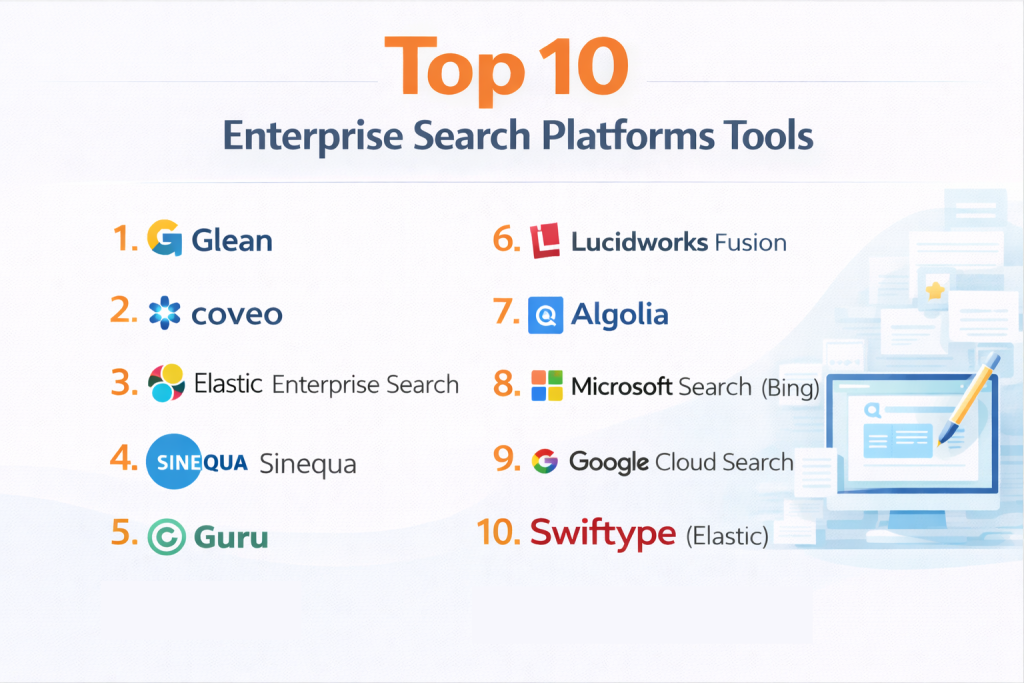
Top 10 Enterprise Search Platforms Tools
1 — Glean
Glean is an AI-powered work platform that connects and understands enterprise knowledge, delivering generative answers and insights across company data. It focuses on secure, permission-aware search with deep integrations, making it ideal for large organizations adopting AI for productivity.
Glean uses advanced LLMs to provide natural language answers grounded in internal data, suited for knowledge workers needing fast, trustworthy information without switching apps.
Key features:
- Generative AI for answers and summarization.
- 100+ connectors to apps/databases.
- Permission syncing and access controls.
- Personalized results based on role/history.
- Actionable insights and workflows.
- Content recommendations.
- Admin analytics dashboard.
Pros:
- Excellent relevance and answer quality.
- Strong adoption through ease.
- Measurable productivity gains.
Cons:
- Premium pricing for scale.
- Dependent on connector coverage.
- Newer player with evolving features.
Security & compliance: SSO, encryption, audit logs; SOC 2, GDPR compliant.
Support & community: Dedicated support, docs, enterprise onboarding.
2 — Coveo
Coveo is an AI-powered relevance platform for enterprise search, customer service, and e-commerce personalization. It leverages machine learning for contextual results across internal and external sources.
Coveo excels in relevance tuning and omnichannel experiences, ideal for organizations needing unified search for employees and customers.
Key features:
- ML relevance models.
- 360-degree indexing.
- Query suggestions/pipelines.
- Analytics and A/B testing.
- Integrations with Salesforce, ServiceNow.
- Generative answering.
- Security trimming.
Pros:
- Superior relevance customization.
- Strong for customer/employee.
- Mature platform.
Cons:
- Complex setup.
- Higher cost.
- Interface dated.
Security & compliance: SSO, encryption; SOC 2, GDPR, HIPAA.
Support & community: Partners, docs, enterprise.
3 — Elastic Enterprise Search
Elastic Enterprise Search is built on Elasticsearch for scalable, customizable search across apps and data.
Elastic provides developer-friendly tools for relevance and analytics, suited for tech teams building tailored experiences.
Key features:
- Vector/semantic search.
- App search/workplace.
- Relevance tuning.
- Crawlers/connectors.
- Kibana dashboards.
- Hybrid deployment.
- AI integrations.
Pros:
- Highly scalable/customizable.
- Open-source core.
- Strong performance.
Cons:
- Requires dev expertise.
- Setup complexity.
- Support paid.
Security & compliance: Role-based, encryption; compliance packs.
Support & community: Forums, paid support.
4 — Sinequa
Sinequa is an AI-powered insight platform for complex enterprise data in regulated industries.
Sinequa offers NLP and generative AI for insights, ideal for pharma/finance needing deep understanding.
Key features:
- 360 search with NLP.
- Generative AI answers.
- Entity extraction.
- Connectors 200+.
- Governance/compliance.
- Analytics.
- Workflow.
Pros:
- Excellent for unstructured.
- Strong compliance.
- Insight depth.
Cons:
- Expensive.
- Implementation long.
- UI traditional.
Security & compliance: SSO, audit; SOC 2, GDPR, HIPAA.
Support & community: Enterprise.
5 — Guru
Guru is an AI search and knowledge platform surfacing information in workflows.
Guru captures/verifies knowledge with Slack overlay, suited for sales/support needing contextual access.
Key features:
- AI search/answers.
- Capture extension.
- Verification.
- Collections.
- Slack/Teams bot.
- Analytics.
- Integrations.
Pros:
- In-context delivery.
- Easy capture.
- Adoption high.
Cons:
- Less public KB.
- User pricing.
- Search tuning.
Security & compliance: SSO, encryption; SOC 2, GDPR.
Support & community: Chat, resources.
6 — Lucidworks Fusion
Lucidworks Fusion is an AI search platform for personalized experiences.
Fusion offers signals and ML for relevance, ideal for e-commerce/internal needing tuning.
Key features:
- Signals boosting.
- App studio.
- Connectors.
- AI features.
- Analytics.
- Headless.
- Security.
Pros:
- Relevance expertise.
- Flexible.
- Good support.
Cons:
- Complex.
- Costly.
- Dev needed.
Security & compliance: Enterprise.
Support & community: Professional.
7 — Algolia
Algolia is a search-as-a-service API for fast, relevant results.
Algolia provides instant search with typo tolerance, suited for sites/apps needing UX focus.
Key features:
- Instant/typo-tolerant.
- Personalization.
- A/B testing.
- Analytics.
- Merchandising.
- Neural search.
- Dashboard.
Pros:
- Speed/relevance.
- Easy implement.
- Developer friendly.
Cons:
- Query pricing.
- Less internal KB.
- Add-ons cost.
Security & compliance: Encryption; GDPR.
Support & community: Docs, enterprise.
8 — Microsoft Search (Bing)
Microsoft Search is enterprise search in Microsoft 365.
It unifies search across Office/SharePoint, ideal for Microsoft ecosystems.
Key features:
- Graph connectors.
- AI Copilot integration.
- Personalization.
- Security trimming.
- Acronyms.
- Bookmarks.
- Analytics.
Pros:
- Included in M365.
- Easy for users.
- Secure.
Cons:
- Microsoft limited.
- Customization moderate.
- External connectors extra.
Security & compliance: Microsoft standards.
Support & community: Microsoft.
9 — Google Cloud Search
Google Cloud Search is for G Suite/Workspaces knowledge retrieval. It provides natural language across Google apps, suited for Google-centric orgs.
Key features:
- Third-party connectors.
- AI relevance.
- People/cards.
- Security.
- Admin controls.
- Analytics.
- Mobile.
Pros:
- Familiar Google UI.
- Strong search.
- Included Workspace.
Cons:
- Google ecosystem.
- Connectors limited.
- Customization less.
Security & compliance: Google enterprise.
Support & community: Google.
10 — Swiftype (Elastic)
Swiftype is site search with enterprise features from Elastic . It offers customizable relevance for websites/intranets.
Key features:
- Crawling/indexing.
- Relevance tuning.
- Analytics.
- Synonyms.
- Integrations.
- Security.
- AI options.
Pros:
- Easy site search.
- Good customization.
- Reliable.
Cons:
- Overlap Elastic.
- Limited internal.
- Pricing.
Security & compliance: Elastic.
Support & community: Elastic.
Comparison Table
| Tool Name | Best For | Platform(s) Supported | Standout Feature | Rating |
|---|---|---|---|---|
| Glean | AI answers & insights | Cloud | Generative AI grounding | N/A |
| Coveo | Relevance & personalization | Cloud/Hybrid | ML tuning | N/A |
| Elastic | Custom/scalable search | Cloud/On-premise | Vector/semantic | N/A |
| Sinequa | Regulated industries | Cloud/On-premise | NLP insights | N/A |
| Guru | In-context knowledge | Cloud | Overlay capture | N/A |
| Lucidworks | Personalized experiences | Cloud | Signals boosting | N/A |
| Algolia | Fast site/app search | Cloud | Instant typo-tolerant | N/A |
| Microsoft Search | Microsoft 365 users | Cloud | Graph connectors | N/A |
| Google Cloud Search | Google Workspace | Cloud | Natural language | N/A |
| Swiftype | Site/intranet search | Cloud | Relevance dashboard | N/A |
Evaluation & Scoring of Enterprise Search Platforms
| Tool Name | Core Features (25%) | Ease of Use (15%) | Integrations & Ecosystem (15%) | Security & Compliance (10%) | Performance & Reliability (10%) | Support & Community (10%) | Price / Value (15%) | Total Score |
|---|---|---|---|---|---|---|---|---|
| Glean | 9.5 (2.375) | 9 (1.35) | 9 (1.35) | 9 (0.9) | 9 (0.9) | 8.5 (0.85) | 8 (1.2) | 8.93 |
| Coveo | 9.5 (2.375) | 8 (1.2) | 9.5 (1.425) | 9 (0.9) | 9 (0.9) | 9 (0.9) | 8 (1.2) | 8.9 |
| Elastic | 10 (2.5) | 7.5 (1.125) | 9.5 (1.425) | 9 (0.9) | 9.5 (0.95) | 9 (0.9) | 9 (1.35) | 9.15 |
| Sinequa | 9.5 (2.375) | 7 (1.05) | 9 (1.35) | 9.5 (0.95) | 9 (0.9) | 8.5 (0.85) | 7.5 (1.125) | 8.6 |
| Guru | 9 (2.25) | 9 (1.35) | 9 (1.35) | 8.5 (0.85) | 9 (0.9) | 8 (0.8) | 8.5 (1.275) | 8.78 |
| Lucidworks | 9 (2.25) | 8 (1.2) | 9 (1.35) | 8.5 (0.85) | 9 (0.9) | 8 (0.8) | 8 (1.2) | 8.55 |
| Algolia | 9 (2.25) | 9 (1.35) | 8.5 (1.275) | 8 (0.8) | 9.5 (0.95) | 8.5 (0.85) | 8.5 (1.275) | 8.7 |
| Microsoft Search | 8.5 (2.125) | 9 (1.35) | 9.5 (1.425) | 10 (1.0) | 9 (0.9) | 9 (0.9) | 9 (1.35) | 9.05 |
| Google Cloud Search | 8.5 (2.125) | 9 (1.35) | 9 (1.35) | 9 (0.9) | 9 (0.9) | 9 (0.9) | 9 (1.35) | 8.88 |
| Swiftype | 8 (2.0) | 8.5 (1.275) | 8 (1.2) | 8 (0.8) | 9 (0.9) | 8 (0.8) | 8.5 (1.275) | 8.25 |
Which Enterprise Search Platforms Tool Is Right for You?
Solo users: Rare—basic search enough.
SMBs: Guru or Slab-like for ease.
Mid-market: Glean or Coveo for AI.
Enterprise: Elastic or Sinequa for custom/compliance.
Budget-conscious: Open-source Elastic core.
Premium solutions: Glean or Coveo for AI depth.
Feature depth vs. ease of use: Elastic depth; Guru ease.
Integration and scalability: Coveo broad; Microsoft ecosystem.
Security and compliance: All strong enterprise; check HIPAA etc.
Assess data sources—developer-heavy Elastic; AI-focused Glean.
Frequently Asked Questions (FAQs)
What is enterprise search? Unified search across internal data with security/relevance.
Why important? Reduces search time, surfaces insights, compliance.
Pricing? $10k+ annual; user/query based.
AI role? Intent understanding, answers, personalization.
Implementation? Months—connectors, tuning, adoption.
Common mistake? Poor connectors—gaps. Best: Pilot, feedback.
Scalability? Leaders handle billions docs.
Alternatives? Basic Google; full for enterprise.
On-premise vs cloud? Cloud dominant; hybrid compliance.
Measure success? Reduced tickets, adoption metrics.
Conclusion
Enterprise search platforms like Glean, Coveo, Elastic, and Sinequa lead with AI relevance, integrations, and security. Trends: generative answers, permission-aware AI, analytics for gaps.
Prioritize connectors, relevance, compliance. The “best” fits data volume, users, regulations. Evaluate ROI, trial, align stakeholders. Effective platform turns data chaos into actionable intelligence, driving productivity and innovation.