Introduction
A physics engine is a sophisticated software framework that simulates physical systems within a digital environment. Its primary role is to approximate the laws of physics—such as gravity, friction, collisions, and the dynamics of rigid and soft bodies—so that objects in games, simulations, and visualizations move and interact in a convincing and consistent manner. By handling the complex mathematics behind these interactions, physics engines free developers from manually scripting every bounce, fall, and crash, allowing them to focus on creative and gameplay elements.
The importance of physics engines cannot be overstated. They are the cornerstone of realism and immersion, directly shaping the user’s experience and perception of a digital world. In video games, a good physics engine determines whether movement feels weighty, collisions appear fair, and environments seem alive. Beyond entertainment, these engines are critical tools in engineering, robotics, and scientific research, enabling accurate, cost-effective simulations that reduce the need for expensive real-world prototyping and testing.
Real-world applications are diverse and growing:
- Video Game Development: From AAA blockbusters to mobile puzzles, for both 2D and 3D environments.
- Film & Animation: Creating realistic visual effects (VFX), destruction, and character motion for movies and virtual production.
- Robotics & AI Research: Training robotic systems and reinforcement learning algorithms in accurate virtual sandboxes.
- Engineering & Manufacturing: Simulating crash tests, fluid dynamics, structural stress, and digital twins for product validation.
- Architecture & Automotive: Running immersive simulations for design reviews, training, and configurators.
When choosing a physics engine, key evaluation criteria include the required dimensionality (2D vs. 3D), the level of accuracy or realism needed, target platforms (mobile, desktop, console, web), ease of integration with your primary game engine or framework, performance and scalability, and the licensing model and cost.
Best for:
Physics engines are essential for game developers (indie to AAA), simulation engineers, robotics researchers, visual effects artists, and R&D teams across sectors like automotive, aerospace, and healthcare. They benefit organizations of all sizes that build interactive, simulation-driven products where believable physical interaction is a core requirement.
Not ideal for:
A full-featured physics engine is often unnecessary for simple applications with minimal or scripted interactions, such as basic 2D UI animations, static data dashboards, or narrative-driven games with no dynamic physics. In these cases, lightweight animation libraries or custom simple logic are more efficient and appropriate.
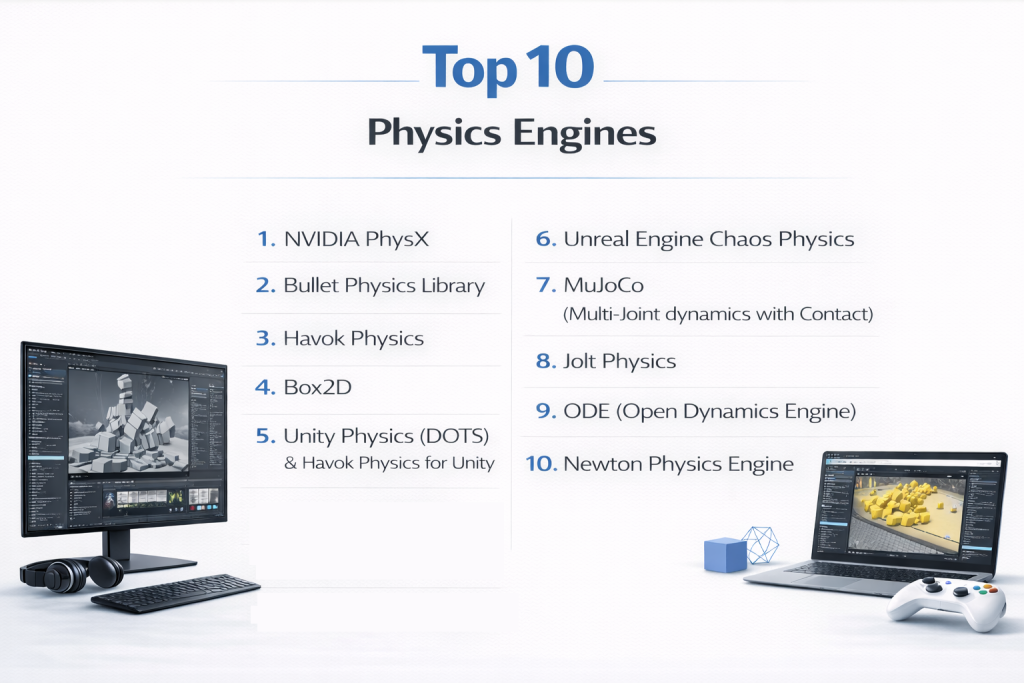
Top 10 Physics Engines Tools
1 — NVIDIA PhysX
Short description: A powerhouse in the gaming and real-time simulation industry, NVIDIA PhysX is renowned for its performance, stability, and advanced features. It’s the default physics engine for Unity and widely used in Unreal Engine for complex rigid body dynamics, with optional GPU acceleration.
Key features:
- Advanced rigid body dynamics and high-performance collision detection.
- GPU-accelerated physics processing for massively parallel simulations.
- Support for cloth, particle, fluid, and soft body dynamics.
- Deterministic simulation options for consistent results across platforms.
- Deep integration with major game engines like Unity and Unreal.
- Scalable architecture suitable for large, complex scenes.
Pros:
- Proven, battle-tested reliability in thousands of shipped AAA and indie titles.
- Excellent performance, especially on NVIDIA hardware where GPU acceleration is leveraged.
- Strong industry adoption means a large talent pool and extensive resources.
Cons:
- Its full GPU acceleration is optimized primarily for NVIDIA hardware.
- Can have a steeper learning curve for accessing and tuning its most advanced features.
Security & compliance: Varies / N/A. As a simulation library integrated into end-user applications, security is typically the responsibility of the developer.
Support & community: Backed by extensive official NVIDIA documentation. It has a massive, global developer community due to its integration with Unity and Unreal, providing abundant tutorials and forums.
2 — Bullet Physics Library
Short description: Bullet is a highly respected, open-source physics engine celebrated for its robustness and flexibility. It’s used not only in games but also extensively in film pre-visualization, virtual reality, and academic research for robotics.
Key features:
- Comprehensive rigid body and soft body dynamics.
- Advanced collision detection with support for continuous collision (preventing tunneling).
- Constraint-based physics system for joints and vehicles.
- Cross-platform compatibility and source code availability for deep customization.
- Support for robotics and motion planning applications.
Pros:
- Completely free and open-source under the permissive zlib license, with no royalties.
- Extremely versatile, proven in both commercial game development and scientific research.
- Highly customizable due to accessible source code.
Cons:
- Requires more manual integration and setup compared to engines tightly bundled with game editors.
- Out-of-the-box tooling and visual debugging can be less polished than commercial alternatives.
Security & compliance: Varies / N/A.
Support & community: An active, knowledgeable open-source community drives development. Support relies on community forums, GitHub discussions, and shared knowledge.
3 — Havok Physics
Short description: Havok is a premier commercial physics suite synonymous with high-end, AAA game development. Known for its exceptional stability at scale, it provides a complete solution for physics, animation, and destruction.
Key features:
- Industry-leading rigid body simulation optimized for multi-core processors.
- High-fidelity collision detection and deterministic simulation.
- Deep integration with animation systems for responsive character physics.
- Advanced toolchain for authoring and debugging complex physics scenes.
- Proven performance in massive open-world and densely interactive games.
Pros:
- Unmatched stability and performance in large, complex production environments.
- Comprehensive professional tooling and world-class technical support.
- Industry-standard choice for console and PC AAA titles.
Cons:
- Commercial licensing costs are significant and can be prohibitive for indie developers or small studios.
- Primarily a closed ecosystem, offering less customization flexibility than open-source engines.
Security & compliance: Enterprise-grade security practices are part of its commercial licensing agreements.
Support & community: Offers professional, direct enterprise support from Havok (owned by Microsoft) and detailed technical documentation.
4 — Box2D
Short description: Box2D is the de facto standard for 2D physics simulation. This lightweight, efficient, and incredibly stable engine is purpose-built for 2D games and is integrated into many game frameworks.
Key features:
- Fast and reliable 2D rigid body dynamics.
- Continuous collision detection to prevent fast-moving objects from passing through each other.
- Comprehensive joint and constraint system (revolute, prismatic, pulley, etc.).
- Minimal performance overhead, ideal for web and mobile games.
- Simple, clean API that is easy to learn and integrate.
Pros:
- Perfectly suited for 2D platformers, puzzles, arcade, and mobile games.
- Very easy to integrate and get started with due to its focused design.
- Extremely stable and performance-predictable.
Cons:
Security & compliance: Varies / N/A.
Support & community: Exceptionally well-documented with a vast user base in the 2D game development community, ensuring easy-to-find help and resources.
5 — Unity Physics (DOTS) & Havok Physics for Unity
Short description: This represents Unity’s modern, high-performance physics solutions. The Data-Oriented Technology Stack (DOTS) based “Unity Physics” is built for scalability, while “Havok Physics for Unity” brings the AAA Havok engine into the Unity workflow.
Key features:
- Unity Physics: Multithreaded, deterministic simulation designed for the Entity Component System (ECS), ideal for thousands of simultaneous objects.
- Havok for Unity: Full-featured Havok engine with seamless Unity Editor integration.
- Both offer tight workflow integration with Unity’s GameObject or DOTS paradigms.
- Optimized for large-scale battles, crowds, and particle-based physics.
Pros:
- Native integration within Unity provides a smooth, familiar workflow.
- DOTS-based physics offers breakthrough performance for entity-heavy simulations.
- Choice between a scalable in-house solution and a proven AAA engine.
Cons:
- DOTS/Unity Physics requires learning the ECS architectural pattern, which is a shift from traditional Unity scripting.
- Primarily beneficial only within the Unity ecosystem.
Security & compliance: Varies / N/A.
Support & community: Supported by the immense global Unity community, official Unity documentation, and learning platforms.
6 — Unreal Engine Chaos Physics
Short description: Chaos is Unreal Engine 5’s next-generation physics and destruction system. It is fully integrated into Unreal, replacing its older PhysX integration, and is built for high-fidelity visual realism, particularly for destruction and cinematic effects.
Key features:
- State-of-the-art real-time destruction and fracture simulation.
- Integrated rigid body, cloth, and vehicle physics.
- Built from the ground up for tight integration with Unreal’s Niagara VFX and rendering systems.
- Scalable for large open worlds.
- Extensive in-editor tools for authoring and visualizing physics.
Pros:
- Delivers stunning visual realism for destruction and dynamic scenes.
- Seamless, native workflow within Unreal Engine 5.
- Continually updated and supported by Epic Games as a core UE5 technology.
Cons:
- Tightly coupled to Unreal Engine; cannot be used with other game engines.
- Can be resource-intensive, making it overkill for simple projects.
Security & compliance: Varies / N/A.
Support & community: Backed by the extensive Unreal Engine community, official Epic documentation, and dedicated enterprise support options.
7 — MuJoCo (Multi-Joint dynamics with Contact)
Short description: MuJoCo is a precision physics engine designed for robotics, biomechanics, and reinforcement learning research. It prioritizes simulation accuracy, speed, and differentiability over “game feel”.
Key features:
- Extremely accurate contact dynamics and constraint solving.
- Fast numerical solvers optimized for complex articulated systems (like robots).
- Native support for differentiable physics, enabling gradient-based learning and control.
- Detailed modeling of actuators, sensors, and tendons.
Pros:
- Industry-leading accuracy for robotics and biomechanics simulation.
- Exceptional performance for complex, constrained systems.
- The engine of choice for a large segment of the AI and robotics research community.
Cons:
- Not designed with game development features or workflows in mind.
- Requires significant technical expertise in physics modeling.
- Limited built-in visual tooling compared to game engines.
Security & compliance: Varies / N/A.
Support & community: Strong within academic and research circles, with detailed technical documentation. Since being open-sourced by DeepMind, its community has grown.
8 — Jolt Physics
Short description: Jolt is a modern, high-performance open-source physics engine written in C++. It has gained attention for its clean design, reliability, and performance, often compared favorably to established engines like PhysX and Bullet.
Key features:
- Modern, multithreaded architecture designed for performance.
- High-quality collision detection and stable rigid body simulation.
- Deterministic simulation results.
- Written with clean, readable C++ code.
- Suitable for large-scale game worlds.
Pros:
- Offers excellent performance and stability, challenging older, established engines.
- Clean and modern codebase makes it easier to understand, modify, and debug.
- Completely free and open-source.
Cons:
- A newer project with a smaller ecosystem and less industry adoption than giants like PhysX or Bullet.
- Fewer pre-built integrations with major game engines.
Security & compliance: Varies / N/A.
Support & community: A growing and enthusiastic developer community. Documentation and resources are expanding as adoption increases.
9 — ODE (Open Dynamics Engine)
Short description: ODE is an older, established open-source library for simulating rigid body dynamics. It has historically been used in games, robotics, and research, though its development pace has slowed compared to newer alternatives.
Key features:
- Stable rigid body dynamics and constraint solver.
- Simple, lightweight core architecture.
- Trical collision detection primitives.
- Cross-platform support.
Pros:
- Simple and reliable for basic to moderate simulation needs.
- Completely free and open-source.
- Good for educational purposes and legacy projects.
Cons:
- Lacks many modern features and optimizations found in newer engines.
- Smaller, less active community and slower development pace.
Security & compliance: Varies / N/A.
Support & community: Basic documentation exists, supported by a niche but knowledgeable long-term user base.
10 — Newton Physics Engine
Short description: Recently introduced by NVIDIA, Google DeepMind, and Disney, Newton is a modern, open-source physics engine built for the future of robotics learning and development. It leverages NVIDIA Warp and is designed from the ground up for GPU acceleration and differentiability.
Key features:
- Built on NVIDIA Warp for high-performance, GPU-accelerated simulations.
- Fully differentiable, accelerating robot training, design optimization, and system identification.
- Extensible architecture with pluggable custom solvers for multi-physics simulation.
- Built on OpenUSD for robust description of robots and complex environments.
- Seamless compatibility with robot learning frameworks like NVIDIA Isaac Lab and MuJoCo Playground.
Pros:
- Cutting-edge performance by leveraging GPU computation, reducing simulation time from days to minutes.
- Designed specifically for the demanding needs of modern AI and robotics research.
- Open-source design managed by the Linux Foundation, encouraging broad collaboration.
Cons:
- Very new and specialized, with a primary focus on robotics, not game development.
- Requires familiarity with specific frameworks like Isaac Lab and Warp.
Security & compliance: Varies / N/A. As an open-source project focused on simulation, security considerations are application-specific.
Support & community: Emerging community backed by major players (NVIDIA, DeepMind). Documentation and resources are growing alongside the project.
Comparison Table
| Tool Name | Best For (Target User or Scenario) | Platform(s) Supported | Standout Feature | Rating |
|---|---|---|---|---|
| NVIDIA PhysX | AAA games, high-performance real-time simulation | Cross-platform (Integrated in Unity/Unreal) | GPU Acceleration & Industry Standard Reliability | N/A |
| Bullet Physics | Cross-platform games, robotics research, open-source projects | Cross-platform | Open-Source Flexibility & Robust Feature Set | N/A |
| Havok Physics | AAA game studios requiring maximum stability at scale | PC, Console | Proven Performance in Large, Complex Productions | N/A |
| Box2D | 2D game development (mobile, web, desktop) | Cross-platform | Lightweight, Efficient, and Perfect for 2D | N/A |
| Unity Physics / Havok | Unity developers needing scalable or AAA physics | Within Unity ecosystem | Deep Unity Integration & Choice of Tech Stack | N/A |
| Unreal Chaos | Unreal Engine 5 projects focused on high-fidelity visuals/destruction | Within Unreal Engine ecosystem | Cinematic-Quality Destruction & Visual Effects | N/A |
| MuJoCo | Robotics, biomechanics, and reinforcement learning research | Desktop (Linux, Windows, macOS) | Simulation Accuracy & Differentiable Physics | N/A |
| Jolt Physics | Developers seeking a modern, high-performance open-source alternative | Cross-platform | Clean Modern Architecture & High Performance | N/A |
| ODE | Legacy projects, education, simple simulations | Cross-platform | Simplicity & Proven History | N/A |
| Newton Physics | Next-generation robotics simulation and AI training | Cross-platform (GPU-focused) | GPU-Accelerated & Differentiable Physics | N/A |
Evaluation & Scoring of Physics Engines
Which Physics Engine Tool Is Right for You?
Choosing the right physics engine is a strategic decision. Here’s a guide based on common scenarios:
- Solo Developers & Indie Studios: Prioritize cost (free is best), ease of use, and strong communities. Box2D is perfect for 2D projects. For 3D, Bullet Physics offers immense power for zero cost. If you work in Unity or Unreal, their built-in physics (PhysX/Chaos) provide the smoothest start.
- Small to Medium-Sized Businesses (SMBs): Balance capability, budget, and future scalability. Jolt Physics is an excellent modern, free 3D option. Bullet remains a top choice for its versatility. For studios committed to a specific engine, deepening expertise in Unity Physics (DOTS) or Unreal Chaos offers great returns.
- Mid-Market & AAA Game Studios: Focus on ultimate performance, stability at scale, and professional support. Havok Physics is the industry benchmark for large-scale AAA titles. The deeply integrated Unreal Chaos system is the definitive choice for teams using UE5.
- Enterprise & Research (Non-Gaming): Your needs are specialized. For robotics and AI research, MuJoCo is the established leader, while the new Newton Physics engine represents the cutting edge of GPU-accelerated, differentiable simulation. For engineering and digital twins, high-precision modes of Bullet or licensed solutions from vendors like NVIDIA are common.
Additional Decision Drivers:
- Budget vs. Premium: Open-source engines (Bullet, Jolt, Box2D, Newton) provide incredible value and freedom. Premium solutions like Havok justify their cost with unparalleled support, tools, and optimization for high-stakes commercial projects.
- Feature Depth vs. Ease of Use: Engines like PhysX (via Unity/Unreal) and Box2D offer a gentle start. Maximum feature depth in Havok or Chaos comes with greater complexity.
- Integration and Scalability Needs: Your primary game engine is the biggest factor. Unity/Unreal’s native solutions ensure the easiest path. For a custom engine or unique needs, Bullet or Jolt offer more independence.
- Security and Compliance Requirements: For most game development, this is not a primary concern for the physics engine itself. For enterprise simulations in regulated industries, a commercial partnership with a provider like Havok or NVIDIA is the typical route to meet specific requirements.
Frequently Asked Questions (FAQs)
1. What is the difference between a 2D and a 3D physics engine?
A 2D engine, like Box2D, simulates physics on a two-dimensional plane (X and Y axes), perfect for side-scrollers and top-down games. A 3D engine, like PhysX or Bullet, simulates the full three-dimensional world (X, Y, and Z), required for realistic depth, volume, and complex spatial interactions.
2. Why shouldn’t I just code my own physics from scratch?
Building a robust, stable, and performant physics system is an extremely complex task involving advanced mathematics (solvers, continuous collision detection, constraint resolution). Mature engines represent years, often decades, of optimization and bug-fixing. Using one saves immense time and risk.
3. Which physics engine is best for Unity?
For most traditional Unity projects, the built-in PhysX integration is the default and a great choice. For projects with thousands of physics entities, the Unity Physics (DOTS) package offers revolutionary scalability. Havok Physics for Unity is available for teams needing AAA-level features within the Unity editor.
4. Which physics engine is best for Unreal Engine?
For Unreal Engine 5, Chaos Physics is the default and recommended system. It is fully integrated, provides stunning visual results (especially for destruction), and is actively developed by Epic. Older UE4 projects may still use PhysX.
5. Are physics engines accurate enough for scientific or engineering work?
Some are. Engines like MuJoCo and Newton are designed specifically for high accuracy in robotics. Bullet Physics is also used in scientific contexts. However, “accuracy” depends heavily on correct modeling, tuning, and validation against real-world data.
6. What common mistakes do developers make with physics engines?
Common pitfalls include: using variable timesteps (causing unpredictable behavior), improperly scaling object masses/forces, mixing kinematic and dynamic bodies incorrectly, and expecting perfect stability from complex jointed systems without adequate tuning.
7. Can I switch physics engines mid-project?
It is possible but can be very expensive and disruptive. It often requires re-authoring colliders, re-tuning all physical interactions, and potentially changing gameplay code. It’s crucial to choose an engine aligned with your long-term vision early on.
8. How important is a physics engine for mobile game development?
Crucial, but efficiency is key. Box2D is ideal for 2D mobile games. For 3D, lightweight use of PhysX (in Unity) or a well-optimized custom solution is common. The focus is on achieving the desired “feel” with minimal CPU/GPU impact.
9. What does “deterministic simulation” mean?
A deterministic engine will produce the exact same simulation outcome every time it is run from the same initial state. This is vital for features like network synchronization in multiplayer games, replay systems, and consistent AI behavior.
10. What is a “differentiable” physics engine, like Newton or MuJoCo?
Differentiable physics allows the engine to calculate not just the outcome of a simulation, but also how that outcome would change if the inputs were tweaked. This is a powerful tool for AI/robotics, as it enables algorithms to learn and optimize physical behaviors much more efficiently through gradient-based methods.
Conclusion
The landscape of physics engines in 2026 is rich and specialized, offering powerful tools for every conceivable application. From the universal adoption of NVIDIA PhysX and the open-source versatility of Bullet, to the AAA precision of Havok, the specialized research focus of MuJoCo and Newton, and the engine-integrated power of Unreal Chaos and Unity Physics, there has never been a better array of choices.
The critical takeaway is that the “best” physics engine does not exist in a vacuum. It is entirely dependent on your project’s specific needs, your team’s expertise, your target platform, and your budget. The most powerful engine is a poor choice if it’s impossible to integrate or too complex for your team to wield effectively.
Ultimately, the right physics engine is the one that becomes an invisible, reliable foundation—empowering you to build interactive worlds that feel authentic, engaging, and alive, whether for play, research, or innovation. Invest time in aligning the engine’s strengths with your project’s core requirements; this decision will pay dividends throughout your entire development journey.