Introduction
IC Design & Verification Tools are specialized software platforms used to design, simulate, verify, and validate integrated circuits (ICs) before fabrication. These tools cover the complete semiconductor design lifecycle—from register-transfer level (RTL) coding and logic synthesis to functional verification, timing analysis, physical design, and signoff. Given the complexity of modern chips, manual verification is impossible; automation through these tools is essential.
The importance of IC design and verification tools has grown significantly with the rise of advanced nodes, system-on-chip (SoC) designs, artificial intelligence accelerators, automotive electronics, and low-power mobile devices. A single design flaw can cost millions in respins and delayed market entry. These tools help ensure correctness, performance, power efficiency, and manufacturability before tape-out.
When choosing IC design and verification tools, users should evaluate functional coverage, simulation speed, scalability, ease of integration with existing flows, support for advanced nodes, debugging capabilities, security, and licensing flexibility. Strong vendor support and ecosystem compatibility are equally critical for long-term success.
Best for:
RTL designers, verification engineers, physical design engineers, SoC architects, semiconductor startups, fabless companies, IP vendors, and large semiconductor enterprises working on complex digital, analog, or mixed-signal chips.
Not ideal for:
Users working only on basic electronics, simple PCB-level designs, or educational logic exercises. For such use cases, lightweight simulators or academic tools may be sufficient.
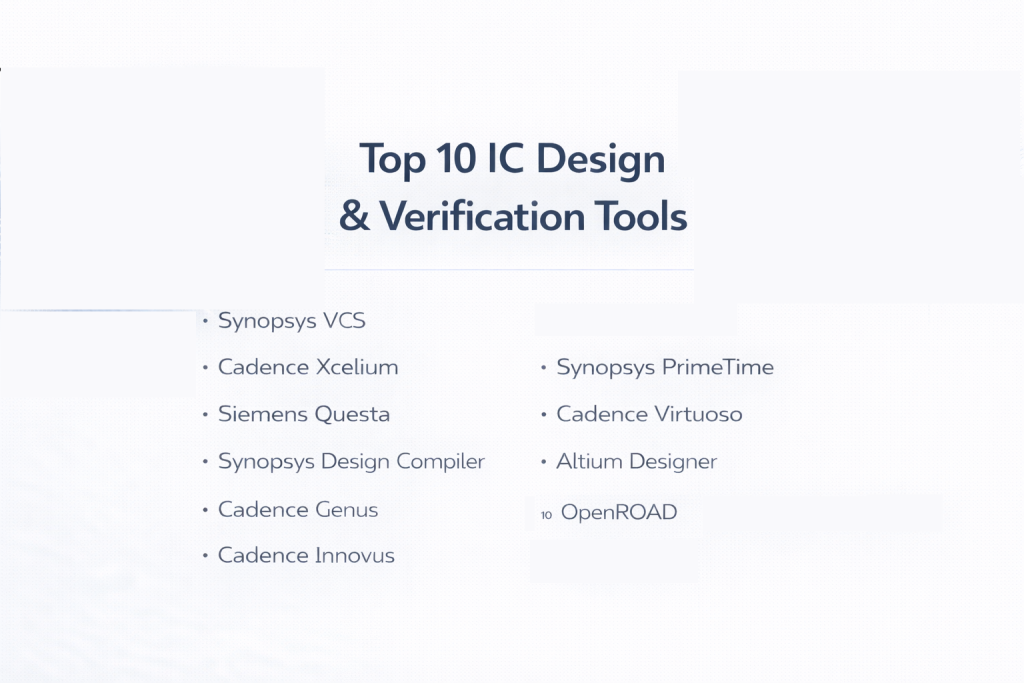
Top 10 IC Design & Verification Tools
1 — Synopsys VCS
Short description:
Synopsys VCS is a high-performance RTL simulation and verification tool widely used for large-scale digital and SoC designs.
Key features:
- High-speed SystemVerilog simulation
- Advanced debug and waveform analysis
- UVM-based verification support
- Mixed-language simulation
- Scalable parallel simulation
- Integration with formal and coverage tools
Pros:
- Industry-leading simulation performance
- Excellent scalability for large designs
- Strong ecosystem integration
Cons:
- Premium pricing
- Requires experienced verification engineers
Security & compliance:
Enterprise-grade access controls, audit support, ISO-aligned processes
Support & community:
Extensive documentation, enterprise support, large professional user base.
2 — Cadence Xcelium
Short description:
Cadence Xcelium is a unified simulation platform designed for functional verification of complex digital and mixed-signal ICs.
Key features:
- Unified kernel simulation
- Advanced low-power verification
- Coverage-driven verification
- SystemVerilog and UVM support
- High-capacity simulation
- Fast incremental compilation
Pros:
- Efficient verification convergence
- Strong low-power analysis
- Stable and predictable performance
Cons:
- Steep learning curve
- High licensing cost
Security & compliance:
Enterprise security standards, ISO-aligned compliance
Support & community:
Strong vendor support, comprehensive documentation, active professional community.
3 — Siemens Questa
Short description:
Questa is a comprehensive verification platform supporting simulation, formal verification, and coverage analysis.
Key features:
- Advanced RTL simulation
- Functional and code coverage
- Formal property checking
- UVM and assertion-based verification
- Mixed-signal simulation
- Debug and analysis tools
Pros:
- Strong verification completeness
- Excellent debug capabilities
- Flexible deployment options
Cons:
- Complex toolchain for beginners
- Performance tuning may be required
Security & compliance:
Enterprise-grade security, compliance varies by deployment
Support & community:
Professional support, detailed manuals, active verification community.
4 — Synopsys Design Compiler
Short description:
Design Compiler is a logic synthesis tool that translates RTL code into optimized gate-level netlists.
Key features:
- High-quality logic synthesis
- Power, performance, and area optimization
- Support for advanced process nodes
- Constraint-driven synthesis
- Timing-aware optimization
- Strong signoff correlation
Pros:
- Industry-proven synthesis quality
- Reliable timing closure
- Broad foundry support
Cons:
- Expensive licensing
- Requires deep synthesis expertise
Security & compliance:
Enterprise security controls, ISO-aligned processes
Support & community:
Extensive training, documentation, and enterprise support.
5 — Cadence Genus
Short description:
Cadence Genus is a modern synthesis solution focused on productivity and advanced node optimization.
Key features:
- Concurrent optimization engine
- Advanced low-power synthesis
- Fast turnaround time
- Tight integration with physical design
- Support for multi-mode constraints
- Scalable for large SoCs
Pros:
- Faster synthesis cycles
- Good correlation with physical design
- User-friendly compared to legacy tools
Cons:
- Premium cost
- Best suited for Cadence-centric flows
Security & compliance:
Enterprise-grade security, ISO-compliant workflows
Support & community:
Strong Cadence support ecosystem and professional user base.
6 — Cadence Innovus
Short description:
Innovus is a digital implementation tool used for place-and-route and physical optimization of IC designs.
Key features:
- Advanced place-and-route algorithms
- Power and clock optimization
- Multi-corner multi-mode analysis
- Signal integrity analysis
- Automated design closure
- Scalable for advanced nodes
Pros:
- Strong physical design automation
- High-quality timing closure
- Robust signoff correlation
Cons:
- High hardware requirements
- Long learning curve
Security & compliance:
Enterprise-grade security and audit capabilities
Support & community:
Comprehensive documentation and enterprise-level support.
7 — Synopsys PrimeTime
Short description:
PrimeTime is an industry-standard static timing analysis tool used for timing signoff.
Key features:
- Accurate static timing analysis
- Multi-corner multi-mode support
- Signal integrity and noise analysis
- Power-aware timing checks
- Foundry-qualified signoff accuracy
- Advanced ECO support
Pros:
- Trusted for final timing signoff
- Highly accurate results
- Widely accepted by foundries
Cons:
- Specialized focus
- Expensive standalone licensing
Security & compliance:
Enterprise security standards, ISO-aligned compliance
Support & community:
Strong professional support and widespread industry adoption.
8 — Cadence Virtuoso
Short description:
Virtuoso is a leading platform for analog and mixed-signal IC design and verification.
Key features:
- Analog schematic and layout design
- Mixed-signal simulation
- Parasitic extraction
- Custom layout automation
- Advanced visualization tools
- Foundry-certified flows
Pros:
- Industry standard for analog design
- Highly flexible environment
- Strong mixed-signal support
Cons:
- Very steep learning curve
- High licensing cost
Security & compliance:
Enterprise-grade security controls
Support & community:
Extensive training resources and professional support.
9 — Altium Designer (IC-focused workflows)
Short description:
Altium Designer supports chip-package-board co-design and early-stage IC integration workflows.
Key features:
- IC-package-PCB co-design
- Signal integrity analysis
- Design collaboration tools
- Unified design environment
- Visualization and documentation
- Early-stage verification support
Pros:
- Excellent system-level visibility
- Strong collaboration features
- Easier learning curve
Cons:
- Not a full IC verification suite
- Limited for advanced node design
Security & compliance:
Encryption, access controls, compliance varies
Support & community:
Strong documentation and active design community.
10 — OpenROAD
Short description:
OpenROAD is an open-source digital physical design toolchain focused on RTL-to-GDS automation.
Key features:
- Open-source RTL-to-GDS flow
- Automated place-and-route
- Timing-driven optimization
- Academic and research-friendly
- Scriptable workflows
- Community-driven development
Pros:
- No licensing cost
- Transparent and customizable
- Growing research adoption
Cons:
- Limited commercial support
- Less mature than enterprise tools
Security & compliance:
N/A (depends on deployment)
Support & community:
Active open-source community, research-focused documentation.
Comparison Table
| Tool Name | Best For | Platform(s) Supported | Standout Feature | Rating |
|---|---|---|---|---|
| Synopsys VCS | RTL verification | Linux | High-speed simulation | N/A |
| Cadence Xcelium | Functional verification | Linux | Unified simulation | N/A |
| Siemens Questa | Verification completeness | Linux, Windows | Formal + simulation | N/A |
| Design Compiler | Logic synthesis | Linux | Proven synthesis quality | N/A |
| Cadence Genus | Modern synthesis | Linux | Fast optimization | N/A |
| Cadence Innovus | Physical design | Linux | Advanced place-and-route | N/A |
| PrimeTime | Timing signoff | Linux | Industry-standard STA | N/A |
| Virtuoso | Analog & mixed-signal | Linux | Custom IC design | N/A |
| Altium Designer | System-level design | Windows | Co-design workflows | N/A |
| OpenROAD | Research & automation | Linux | Open-source RTL-to-GDS | N/A |
Evaluation & Scoring of IC Design & Verification Tools
| Evaluation Criteria | Weight | Overall Assessment |
|---|---|---|
| Core features | 25% | Excellent |
| Ease of use | 15% | Medium |
| Integrations & ecosystem | 15% | Excellent |
| Security & compliance | 10% | Medium |
| Performance & reliability | 10% | Excellent |
| Support & community | 10% | High |
| Price / value | 15% | Medium |
Which IC Design & Verification Tool Is Right for You?
Solo users and academic researchers may prefer open-source tools like OpenROAD due to cost efficiency and flexibility. SMBs and semiconductor startups often look for balanced solutions with strong verification and manageable licensing. Mid-market companies benefit from integrated flows such as Cadence or Siemens toolchains. Large enterprises and foundries require proven, signoff-qualified tools like Synopsys and Cadence for advanced nodes and high-volume production.
Budget-conscious teams should evaluate open-source or limited-scope licenses. Premium users needing signoff accuracy, scalability, and vendor accountability should invest in enterprise-grade solutions. Ease of use versus depth of control is a critical trade-off, especially for teams with varying experience levels. Integration and security requirements should align with internal IT and compliance standards.
Frequently Asked Questions (FAQs)
1. What are IC design and verification tools used for?
They are used to design, simulate, verify, and validate integrated circuits before manufacturing.
2. Why is verification so important in IC design?
Verification ensures functional correctness and prevents costly silicon respins.
3. Are open-source IC tools production-ready?
They are improving rapidly but often require additional validation.
4. What is UVM in verification?
UVM is a standardized methodology for building reusable verification environments.
5. Do small teams need enterprise tools?
Not always; tool choice depends on complexity and production goals.
6. How expensive are IC design tools?
Costs vary widely, from free open-source tools to premium enterprise licenses.
7. What is signoff in IC design?
Signoff confirms that a design meets timing, power, and manufacturing requirements.
8. Can these tools handle advanced process nodes?
Enterprise tools are designed specifically for advanced nodes.
9. What is the biggest mistake teams make?
Underestimating verification effort and tool integration needs.
10. Can one tool cover the entire IC flow?
No single tool does everything; integrated toolchains are typically used.
Conclusion
IC Design & Verification tools are foundational to modern semiconductor development. With increasing design complexity and shrinking margins for error, choosing the right tools is critical. Some excel in verification depth, others in synthesis or physical design automation. The best solution depends on project scale, technical requirements, budget, and team expertise. Rather than seeking a universal winner, teams should focus on aligning tool capabilities with their specific design and verification goals.