Introduction
Most large businesses today are drowning in information. Every customer click, payment transaction, supply chain update, and support ticket creates a digital footprint. Storing this information is cheap, but making sense of it is remarkably difficult.
Many organizations find their data scattered across different departments. The marketing team uses one software tool, the finance department uses another, and the customer service team relies on entirely separate spreadsheets. When leadership asks a simple question like, “Which customer segment is most profitable over a three-year period?”, it can take weeks to pull an accurate answer together.
This data chaos leads to missed opportunities, slow decision-making, and wasted spending on software licenses that nobody uses correctly. To bridge this gap, businesses turn to big data consulting. This guide explains what enterprise big data consulting is, why organizations need it, how the process works, and how to avoid the common traps that derail large data projects.
What Is Big Data Consulting?
Big data consulting is a professional service where external technology and data experts help organizations design, build, and optimize large-scale data systems.
- Simple Meaning: Hiring experienced data mechanics and strategists to fix your messy data pipes and build a modern engine for your business insights.
- Why It Matters: Internal IT teams are often overwhelmed with keeping daily systems running. Consultants bring dedicated focus, specialized tools, and cross-industry experience that internal teams may not have yet.
- Example: A large retail chain has ten years of sales data spread across fifty different regional databases. A big data consulting firm steps in to consolidate that data into a single cloud-based warehouse so executives can view real-time sales trends across every store instantly.
Why Do Enterprises Struggle with Big Data?
Before looking at how consultants help, it helps to understand why big data projects fail so often on their own.
The Volume and Velocity Trap
Data does not just sit still; it arrives continuously. When thousands of users interact with a platform every second, traditional databases freeze or crash. Managing this constant flood requires specialized streaming architectures.
The Silo Problem
Departments often operate as independent islands. The sales department does not share data cleanly with the product development team. Consultants break down these invisible walls so data can flow freely and safely across the entire enterprise.
Skill Shortages
Finding experienced data engineers, data architects, and machine learning specialists is expensive and time-consuming. Building an in-house team from scratch can take six to twelve months, delaying critical business initiatives.
Core Pillars of Enterprise Big Data Consulting
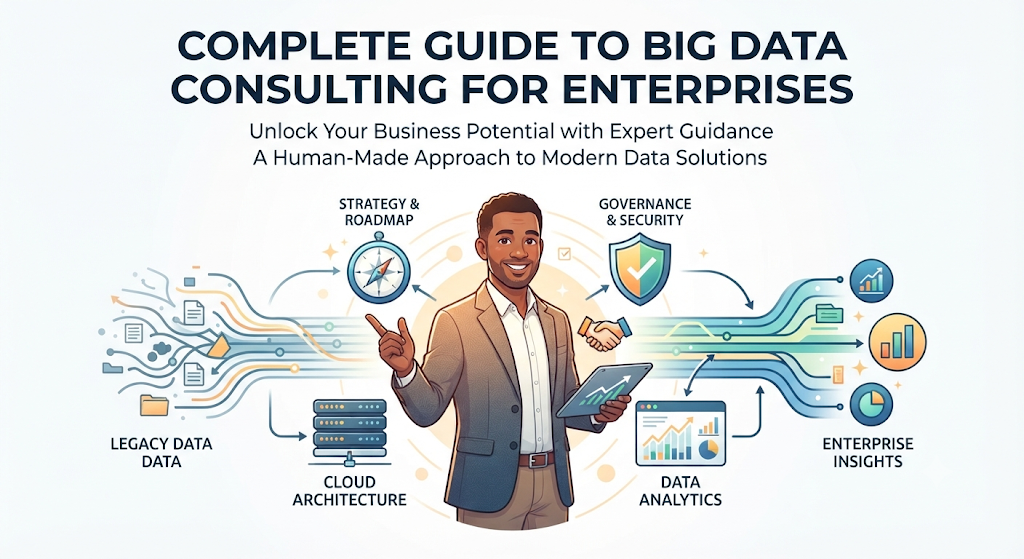
A comprehensive consulting engagement typically focuses on four foundational pillars: strategy, architecture, engineering, and governance.
1. Strategy and Roadmap
Consultants analyze the current business goals and map out what data capabilities are actually needed. They prevent companies from buying expensive software tools that do not solve their specific problems.
2. Modern Data Architecture
Enterprises often move away from rigid, on-premise servers toward flexible cloud environments. Consultants design modern data pipelines using tools like Apache Spark, Snowflake, Databricks, or cloud-native storage solutions.
3. Data Engineering and Migration
Moving petabytes of historical data from legacy systems to a modern cloud platform requires careful planning. Consultants write robust code to extract, transform, and load (ETL) data cleanly without disrupting daily business operations.
4. Governance, Compliance, and Security
Handling customer data means complying with strict regulations like GDPR and CCPA. Consultants implement role-based access controls, data encryption, and cataloging systems to ensure data is accurate, private, and auditable.
When Should an Enterprise Hire Big Data Consultants?
Consultants are not always necessary for routine software updates. However, certain milestones make external expertise vital:
- Major Digital Transformation: Moving core infrastructure from local servers to cloud platforms.
- Mergers and Acquisitions: Combining two large companies that use completely different customer databases and financial software.
- Scaling Bottlenecks: Existing analytics reports take hours to run, or database queries constantly time out during peak business hours.
- Advanced Analytics Initiatives: Launching machine learning models or real-time recommendation engines without prior in-house experience.
When Should an Enterprise NOT Hire Consultants?
External consulting is an expensive investment. Organizations should reconsider or delay hiring consultants if:
- Unclear Business Goals: Leadership cannot explain what specific business problem the data project is supposed to solve.
- Lack of Executive Sponsorship: No senior leader is willing to champion the project and enforce organizational changes.
- Day-to-Day Maintenance Only: The company only needs routine database maintenance or minor bug fixes that internal IT can handle.
Common Mistakes in Enterprise Data Projects
Organizations frequently stumble when approaching big data initiatives without proper guidance.
| Mistake | Why It Happens | Consequences | Corrective Action |
|---|---|---|---|
| Tool-First Approach | Buying trendy software before defining business needs. | Wasted budgets on unused features and complex maintenance. | Define business questions first; select tools that fit those exact needs. |
| Ignoring Data Quality | Rushing to build dashboards using messy, unverified source data. | “Garbage in, garbage out” leads to bad executive decisions. | Implement strict data validation and cleaning steps early in the pipeline. |
| Skipping Change Management | Assuming employees will automatically adopt new dashboards. | Low user adoption; staff continues using old spreadsheets. | Train business users thoroughly and tie data tools to daily workflows. |
| Neglecting Security | Treating data privacy as an afterthought during migration. | Regulatory fines, data leaks, and loss of customer trust. | Build security and compliance checks into every phase of the architecture. |
The Consulting Engagement Lifecycle
A successful big data consulting project follows a structured progression to ensure accountability and measurable results.
- Discovery and Assessment: Consultants interview stakeholders, review existing technical systems, and audit data quality.
- Architecture Design: The team creates blueprint designs for data lakes, warehouses, and pipelines, balancing cost and performance.
- Proof of Concept (PoC): A small, controlled pilot project tests the new architecture with real enterprise data.
- Full-Scale Implementation: The approved architecture is built, tested, and deployed across production environments.
- Knowledge Transfer: Consultants train internal engineers and business users so the company can maintain and scale the system independently.
Key Terms
- Data Lake: A massive storage repository that holds raw, unprocessed data in its native format until it is needed for analysis.
- Data Warehouse: A centralized, structured repository designed specifically for fast querying and business reporting.
- ETL (Extract, Transform, Load): The foundational process of pulling data from various sources, cleaning and formatting it, and loading it into a target database.
- Data Lineage: The audit trail that shows where data originated, how it was modified, and where it is currently used.
- Cloud Scalability: The ability of a cloud infrastructure to automatically expand storage and computing power as data volume grows.
- Metadata: Descriptive data that provides information about other data (e.g., table creation date, data owner, schema definitions).
- Latency: The time delay between data creation in the real world and its availability in an analytics dashboard.
- Master Data Management (MDM): A method used to define and manage critical enterprise data to provide a single, unified source of truth.
Frequently Asked Questions
What is the difference between a data analyst and a big data consultant?
A data analyst focuses on interpreting existing data to answer specific business questions and create reports. A big data consultant is a broader technologist and strategist who designs the underlying architecture, data pipelines, and storage systems that make large-scale analysis possible in the first place.
How long does an enterprise big data consulting project take?
Project duration varies based on scope. A preliminary architecture assessment may take 4 to 6 weeks, while a full-scale cloud migration and data platform build can take anywhere from 6 months to over a year.
How much do enterprise big data consulting services cost?
Costs depend heavily on the scale of the enterprise, the complexity of existing legacy systems, and whether the engagement requires strategy only or full technical implementation. Most engagements are structured around milestone deliverables or dedicated time-and-materials contracts.
Do consultants replace our internal IT team?
No. High-quality consultants work alongside internal IT and data teams. A core goal of any good consulting engagement is knowledge transfer—ensuring internal staff understand the new systems and can maintain them long after the consultants leave.
How do we measure the ROI of a big data consulting project?
Return on investment is measured through tangible operational improvements, such as reduced cloud storage costs, faster report generation times, increased revenue from targeted marketing campaigns, and hours saved by automated data reporting.
Is cloud storage mandatory for big data projects?
While local on-premise servers can handle some data, modern enterprise big data workloads require the elastic compute power and infinite storage scaling that cloud providers like AWS, Microsoft Azure, and Google Cloud offer.
Conclusion
Big data consulting is not about collecting as much information as possible; it is about building reliable systems that turn scattered noise into clear business direction. When enterprises approach data initiatives with a focus on clean architecture, strong security, and realistic business goals, they avoid costly missteps. By bringing in experienced external guidance when internal skills fall short, organizations can build a modern data foundation that supports confident decision-making for years to come.