Introduction
Most data teams know the sinking feeling of a broken dashboard on a Monday morning. A schema change in a upstream database quietly slips through, breaking a downstream data pipeline. By the time someone notices, executive reports are showing zero values, and stakeholders are asking questions.
When data engineering teams grow rapidly, technology choices multiply, but operational practices often lag behind. Teams spend hours manually fixing data quality issues, rewriting broken SQL queries, and rushing emergency hotfixes into production.
This operational friction is where DataOps comes in. By borrowing the best automation and collaboration practices from modern software development, DataOps changes how data teams build, test, and monitor their pipelines. However, adopting these practices requires more than just buying new tools. It requires dedicated DataOps training to shift team habits, align workflows, and turn stressed fire-fighters into confident engineers.
What Is DataOps Training?
Professional term: DataOps (Data Operations)
Simple meaning: A set of practices and cultural habits that combines data engineering, automated testing, and operations to manage data flows faster and more reliably.
Why it matters: It stops data pipelines from breaking silently and helps teams deliver trustworthy data with fewer manual steps.
Example: Instead of a data engineer manually running a script to check for missing rows every morning, a DataOps-trained team sets up automated tests that block bad data from reaching production automatically.
DataOps training is the educational process of teaching engineers, analysts, and data architects how to use these automated workflows. It covers version control for data, automated pipeline testing, continuous deployment, and collaborative monitoring.
Why Traditional Data Engineering Struggles Without DataOps
Traditional data engineering often mirrors how software was built two decades ago: in isolated silos.
A data engineer writes a complex extraction script, tests it locally on a small sample dataset, and pushes it to production. If the data volume changes, or if a source system changes a data type, the pipeline fails silently or produces corrupt data.
Common Operational Bottlenecks
- Manual Testing: Relying on human eyes to spot bad data in large data warehouses.
- The “Blame Game”: Endless debates between data engineers and business analysts over whose report is correct when numbers do not match.
- Slow Deployments: Waiting weeks for manual code reviews and QA sign-offs before pushing a simple SQL query update.
- Lack of Visibility: Finding out a pipeline is broken only after a customer or executive reports incorrect data.
How DataOps Training Transforms Engineering Workflows
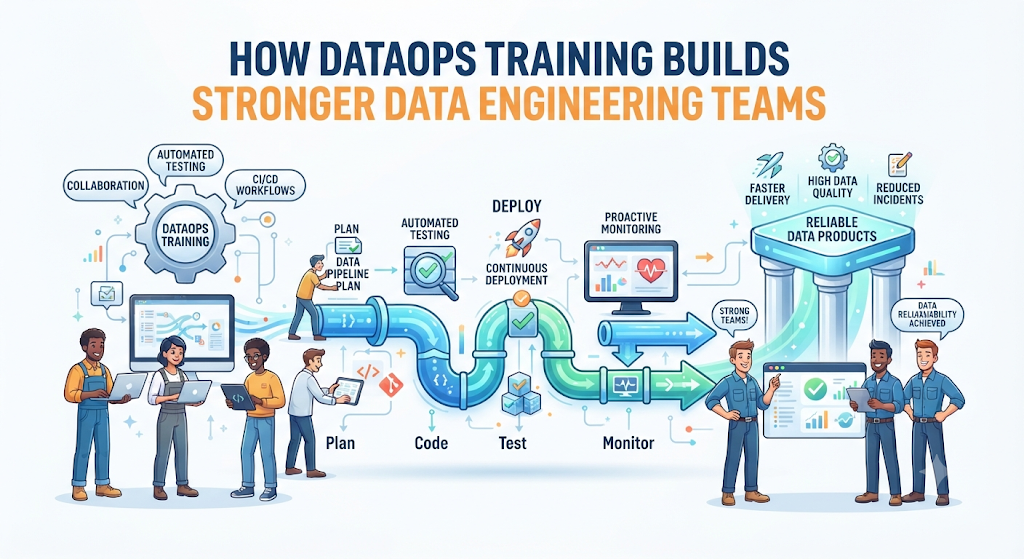
DataOps training replaces fragile manual habits with repeatable, automated processes. When an engineering team undergoes structured DataOps training, their daily workflow shifts across four key dimensions.
1. Version Control for Everything
Teams learn to treat SQL queries, data models, configuration files, and orchestration DAGs (Directed Acyclic Graphs) as code. Every change goes through Git pull requests, peer reviews, and automated checks before touching production environments.
2. Automated Data Testing
Training teaches engineers how to write assertions and data quality checks (such as checking for null values, unexpected duplicates, or out-of-range metrics) that run automatically every time a pipeline executes.
3. Continuous Integration and Continuous Deployment (CI/CD)
Instead of deploying code manually via copy-paste scripts, teams learn to use CI/CD pipelines to automatically build, test, and deploy data changes safely across development, staging, and production environments.
4. Observability and Proactive Monitoring
Engineers learn to set up monitoring tools that track pipeline performance, data freshness, and volume anomalies, alerting the team before business users spot an issue.
Key Benefits for Data Engineering Teams
Investing time in DataOps training yields measurable improvements in team morale, code quality, and delivery speed.
- Fewer Production Incidents: Automated tests catch schema changes and data corruptions before they reach executive dashboards.
- Faster Time-to-Insight: Automated deployments mean new data models reach business analysts in hours instead of weeks.
- Reduced Burnout: Engineers spend less time firefighting midnight pipeline crashes and more time building high-value data architecture.
- Clear Ownership: Standardized workflows make it easy for any team member to understand, troubleshoot, or update a pipeline built by a colleague.
Common Mistakes When Adopting DataOps
Organizations often rush into DataOps adoption without proper training, leading to predictable pitfalls.
| Mistake | Why It Happens | Consequence | What to Do Instead |
|---|---|---|---|
| Tool-First Approach | Buying expensive observability platforms without changing habits. | Tools sit unused while old manual habits persist. | Train the team on workflow principles before purchasing new tooling. |
| Ignoring Data Analysts | Treating DataOps as an internal concern for data engineers only. | Data quality issues are still caught too late by business users. | Include analytics engineers and data analysts in DataOps training sessions. |
| Over-Engineering Tests | Trying to test every single row and edge case immediately. | Pipelines slow to a crawl, and engineers disable frustrating tests. | Start with high-value assertions on core business metrics and expand gradually. |
A Practical Decision Framework for DataOps Training
Before rolling out a training program, engineering leaders should evaluate their readiness across three practical steps:
- Audit Current Bottlenecks: Identify where your team loses the most time. Is it manual deployments, debugging data quality issues, or waiting for code reviews?
- Assess Skill Gaps: Determine whether engineers are comfortable with Git workflows, automated testing frameworks, and infrastructure-as-code concepts.
- Pilot and Measure: Start training with a single pilot team on one critical data project. Measure the reduction in pipeline failures and deployment times over 90 days before scaling training organization-wide.
Key Terms
- CI/CD (Continuous Integration / Continuous Deployment): A practice where code changes are automatically tested and deployed to production safely.
- Pipeline Orchestration: Managing the order, schedule, and dependencies of data tasks using tools like Apache Airflow or Prefect.
- Data Observability: The ability to monitor, troubleshoot, and measure the health of data across your entire pipeline.
- Data Quality Assertions: Automated rules that check if incoming data meets specific standards before allowing it to proceed.
- Infrastructure as Code (IaC): Managing and provisioning cloud data infrastructure through human-readable configuration files rather than manual clicking in a console.
Frequently Asked Questions
What is the difference between DevOps and DataOps?
DevOps focuses on automating software application delivery, whereas DataOps focuses specifically on the unique challenges of data workflows, such as data quality, schema drift, long-running batch jobs, and reproducibility of analytical datasets.
Do data analysts need DataOps training, or is it just for engineers?
While engineers build the pipelines, data analysts benefit greatly from DataOps training because it teaches them version control, collaborative workflows, and how to write reliable SQL transformations that integrate smoothly into production systems.
How long does it take for a team to adopt DataOps practices?
Most teams see immediate improvements within the first month of targeted training and hands-on practice, though full cultural adoption and mature automation typically take three to six months.
Can small data teams benefit from DataOps training?
Yes. Small teams often suffer the most from pipeline failures because every minute spent firefighting pulls them away from strategic data modeling. DataOps automation acts like an extra team member.
What technical background should a team have before starting DataOps training?
Team members should have a working knowledge of SQL, basic Python or another scripting language, and familiarity with Git version control.
Conclusion
Data engineering is no longer just about writing scripts to move data from point A to point B. It is about building reliable, scalable data products that an entire organization can trust.
DataOps training bridges the gap between raw technical capability and robust operational discipline. By teaching teams how to automate testing, manage code versions, and monitor pipeline health proactively, organizations can transform stressed engineering groups into high-performing data powerhouses.