Introduction
Web3 Node Infrastructure is the essential hardware and software system that allows applications to talk to a blockchain. Think of a blockchain like a massive, decentralized library where information is stored across thousands of computers. To read a book or add a new one to the shelf, you need a way to enter that library. A “node” is your entry point. Managing these nodes is difficult and expensive, so most developers use node infrastructure providers. These companies run the complex servers for you, providing a simple “plug-in” connection (often called an API or RPC endpoint) so your application can check account balances, send transactions, or read smart contracts without you having to build the entire server room yourself.
This infrastructure is the backbone of the decentralized world. Without it, your favorite crypto wallet wouldn’t be able to show your balance, and decentralized exchanges wouldn’t be able to process trades. It is important because it offers reliability and speed. If you try to run your own node, it might crash or fall behind the rest of the network, but a professional provider ensures your app stays online 24/7. Key real-world use cases include powering Decentralized Finance (DeFi) platforms, managing NFT marketplaces, and supporting blockchain-based games. When choosing a provider, users should look for low latency (how fast the node responds), high uptime (is it always online?), the number of supported blockchains, and how easy the developer tools are to use.
- Best for: Software developers, blockchain engineers, and companies building decentralized applications (dApps). It is also vital for financial institutions moving into crypto, NFT creators, and any business that needs to read or write data to a blockchain reliably and at high speed.
- Not ideal for: People who are just learning the very basics of blockchain on their own computer and don’t have a live application yet. If you are just doing a small local test, you can often run a “local” blockchain on your own laptop for free without needing a professional infrastructure service.
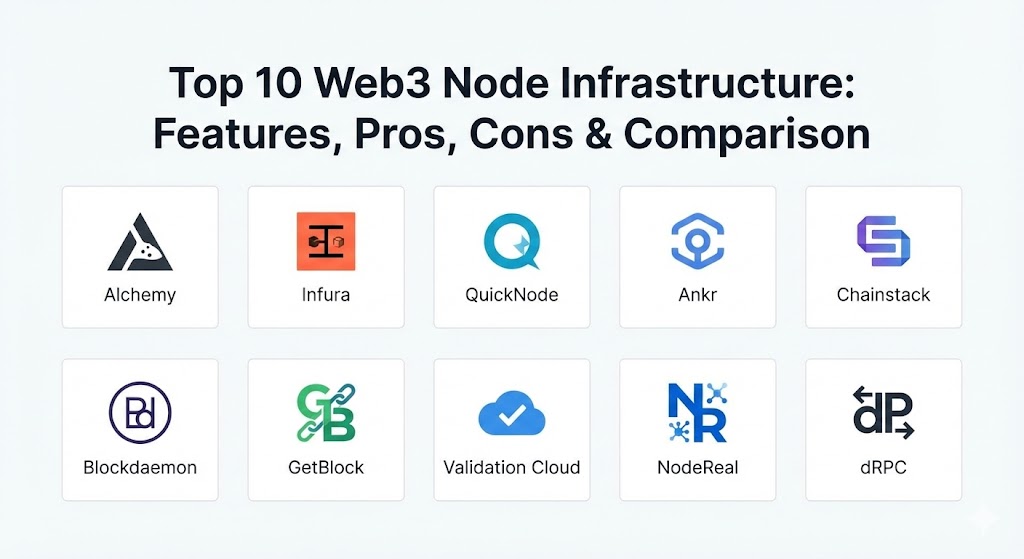
Top 10 Web3 Node Infrastructure Tools
1 — Alchemy
Alchemy is often called the “AWS of Web3” because it provides a massive suite of tools to help developers build and scale their apps. It uses a special technology called “Supernode” which ensures that data is always accurate and fast, even when the blockchain is very busy.
- Key Features:
- Supernode architecture for high reliability and data consistency.
- Enhanced APIs for NFTs, tokens, and transaction history.
- Alchemy Notify for real-time push notifications of on-chain events.
- Alchemy Build for debugging and monitoring transactions.
- Support for over 80 networks including Ethereum, Polygon, and Solana.
- Generous free tier with “Compute Units” to get started.
- Native rollup deployment tools for scaling.
- Pros:
- The developer tools are some of the most polished and helpful in the industry.
- Incredible reliability; it handles huge amounts of traffic without slowing down.
- Cons:
- The “Compute Unit” pricing model can be confusing to calculate at first.
- Higher-level features and priority support are reserved for expensive enterprise plans.
- Security & compliance: SOC 2 Type II; GDPR compliant; encryption in transit and at rest.
- Support & community: Active Discord, excellent documentation, and dedicated onboarding for large teams.
2 — Infura
Infura is one of the oldest and most trusted names in the space, managed by ConsenSys. It is the primary engine behind the famous MetaMask wallet, making it a “must-have” for many developers who want to ensure their app works perfectly for millions of users.
- Key Features:
- High-availability APIs for Ethereum and IPFS (decentralized storage).
- Deep integration with the ConsenSys ecosystem (MetaMask, Truffle).
- Support for major Layer 2 solutions like Arbitrum and Optimism.
- NFT API for easy minting and metadata retrieval.
- “Gas Station” features to help manage transaction fees.
- Reliable WebSockets for real-time data streaming.
- Pros:
- Because it is so widely used, most developer tools “just work” with Infura instantly.
- Very high trust level among enterprises and institutional projects.
- Cons:
- It is more centralized than some other options, which might bother some Web3 purists.
- The free tier limits have become stricter over the years compared to newer competitors.
- Security & compliance: SOC 2 Type II; GDPR; ISO 27001; Enterprise-grade security.
- Support & community: Massive community of users, professional enterprise support, and deep educational resources.
3 — QuickNode
QuickNode focuses on one main thing: speed. It is designed for high-performance applications that need the lowest possible latency. They offer “dedicated nodes” that are not shared with anyone else, giving you maximum power for your application.
- Key Features:
- Global network of nodes for ultra-fast response times.
- Support for over 70 different blockchain networks.
- Dedicated nodes for consistent, high-speed performance.
- QuickNode Marketplace for adding analytics and security tools.
- Advanced analytics dashboard to see exactly how your app is performing.
- Multi-region load balancing to prevent downtime.
- Pros:
- Benchmark tests often show it is significantly faster than other providers.
- The Marketplace makes it very easy to add “extra” features to your nodes.
- Cons:
- It does not offer a forever-free plan, only a limited trial for testing.
- The pricing can get very high once you start needing dedicated hardware.
- Security & compliance: SOC 2; GDPR compliant; secure HTTPS and WebSocket connections.
- Support & community: Great technical support, a helpful “Builders Guide,” and active social media presence.
4 — Ankr
Ankr takes a more decentralized approach to infrastructure. Instead of owning all the servers themselves, they work with a global network of node operators. This helps fulfill the original goal of Web3—not relying on a single company for everything.
- Key Features:
- Decentralized RPC network that routes traffic to the nearest healthy node.
- Support for dozens of blockchains, including many emerging networks.
- Liquid staking services integrated with node infrastructure.
- Enterprise-grade validator services for companies that want to earn rewards.
- Simple Pay-as-you-go pricing model using credits.
- Open-source SDKs to help developers get started quickly.
- Pros:
- Offers a very good balance between price and performance.
- Strong alignment with decentralized principles, which many in the crypto world prefer.
- Cons:
- Performance can sometimes vary depending on which operator is handling your request.
- The dashboard and analytics are a bit simpler than those of Alchemy or QuickNode.
- Security & compliance: Varies (Decentralized architecture); high-level encryption for API keys.
- Support & community: Very active community, direct support for enterprise clients, and clear documentation.
5 — Chainstack
Chainstack is built for flexibility and enterprise needs. It allows you to deploy nodes across different cloud providers like AWS, Google Cloud, or Microsoft Azure. It is known for its “Unlimited Node” option, which is great for projects with a huge number of requests.
- Key Features:
- Multi-cloud and hybrid deployment options.
- Support for over 70 blockchains, including both public and private ones.
- Transparent pricing with a “Request Unit” model that is easy to predict.
- Warp Transactions for faster transaction propagation on some chains.
- Managed hosting for validator nodes and staking.
- Enterprise-grade SLAs (Service Level Agreements) to guarantee uptime.
- Pros:
- The pricing is much more predictable and often cheaper for high-traffic apps.
- Great for businesses that have strict rules about which cloud provider they must use.
- Cons:
- The user interface can feel a bit technical and “industrial” for beginners.
- Setting up custom, multi-cloud clusters takes more time than a simple API key.
- Security & compliance: ISO 27001; SOC 2 Type II; GDPR; secure audit logs.
- Support & community: Professional 24/7 support for paid plans and a very responsive engineering team.
6 — Blockdaemon
Blockdaemon is the institutional choice for node infrastructure. They focus heavily on the “staking” and “validator” side of things, helping large funds and banks run the nodes that actually secure the blockchain networks.
- Key Features:
- Institutional-grade staking and validator node management.
- Ubiquity API for unified access to multiple blockchains.
- High-security key management and protection for digital assets.
- Support for over 60 blockchain protocols.
- 99.9% uptime guarantee with professional monitoring.
- Insurance options for certain types of node risks.
- Pros:
- Extremely safe and secure; it is built for companies that cannot afford any mistakes.
- The “Ubiquity” API makes it much easier to work across many different chains at once.
- Cons:
- It is much more expensive than the “developer-focused” tools.
- Not really intended for solo developers building a small hobby project.
- Security & compliance: SOC 2 Type II; ISO 27001; heavy focus on institutional compliance.
- Support & community: Top-tier account management and white-glove service for big clients.
7 — GetBlock
GetBlock is a straightforward and affordable provider that offers instant access to over 50 blockchains. It is a favorite for startups and developers who want a simple, no-nonsense way to get an API key and start coding.
- Key Features:
- Instant API access to full nodes and archive nodes.
- Shared nodes for low cost and dedicated nodes for high power.
- Support for a huge variety of smaller and newer blockchains.
- Simple dashboard with clear usage tracking.
- Competitive pricing tiers, including a free starter plan.
- Custom node configurations for specific project requirements.
- Pros:
- Very fast and easy to get started; you can have a working key in seconds.
- One of the best values for money if you need access to many different chains.
- Cons:
- The monitoring and debugging tools are not as advanced as Alchemy’s.
- Uptime and performance on shared nodes can be less consistent during peak times.
- Security & compliance: Standard HTTPS/WSS encryption; GDPR compliant.
- Support & community: Helpful support via chat and email, and a growing knowledge base.
8 — Validation Cloud
Validation Cloud is a high-performance provider that focuses on “enterprise-grade” speed and reliability. They are known for having a very “lean” and efficient system that minimizes the time it takes for data to travel.
- Key Features:
- Ultra-low latency global RPC network.
- Strong focus on scalability for high-throughput applications.
- Support for all major networks, including Ethereum and its many layers.
- Validator and staking services for institutions.
- SOC 2 compliance as a standard feature.
- Transparent and competitive pricing for high-volume users.
- Pros:
- Excellent for high-frequency trading or any app where every millisecond counts.
- The security certifications make it easy for corporate legal teams to approve.
- Cons:
- It is less of an “all-in-one” platform than Alchemy (fewer “extra” tools).
- The community size is smaller than the long-standing giants like Infura.
- Security & compliance: SOC 2 Type II; GDPR; high-security data centers.
- Support & community: Professional support with a focus on enterprise reliability.
9 — NodeReal
NodeReal is a fast-growing provider that is particularly strong in the BNB Chain and Ethereum ecosystems. They aim to provide the “ultimate” performance for high-speed Web3 applications like gaming and social media.
- Key Features:
- High-performance “MegaNode” architecture.
- Deep optimization for the BNB Smart Chain (BSC).
- Semita platform for launching custom application-specific chains (AppChains).
- Support for major EVM-compatible networks.
- Developer-friendly APIs for gaming and NFTs.
- Free tier with a generous amount of requests per month.
- Pros:
- If you are building on the BNB Chain, this is arguably the best provider available.
- Very fast response times and high request limits on paid plans.
- Cons:
- Less focus on non-EVM chains (like Solana or Bitcoin) compared to others.
- The documentation can sometimes be a bit thin on advanced topics.
- Security & compliance: ISO 27001; SOC 2; secure data management protocols.
- Support & community: Active presence in the BSC community and responsive tech support.
10 — dRPC
dRPC is a decentralized RPC aggregator. Instead of running its own nodes, it acts like a smart router that finds the fastest and most reliable node from a huge network of independent providers.
- Key Features:
- Decentralized routing that prevents single points of failure.
- Aggregated access to dozens of independent node operators.
- Latency-aware routing to ensure you always get the fastest connection.
- Pay-as-you-go pricing with no monthly subscription required.
- Support for over 50 blockchain networks.
- Analytics dashboard to track usage and operator performance.
- Pros:
- Very high uptime because if one provider goes down, the system instantly switches to another.
- Great pricing model for those who don’t want a flat monthly fee.
- Cons:
- Because it is an aggregator, you are adding one more “layer” to your connection.
- Lacks the proprietary “extra” APIs (like NFT metadata) that companies like Alchemy offer.
- Security & compliance: Distributed security model; encryption for all traffic.
- Support & community: Strong developer-led community and active support channels.
Comparison Table
| Tool Name | Best For | Platform(s) Supported | Standout Feature | Rating |
| Alchemy | Full-stack dApps | 80+ Networks | Supernode & Rich APIs | N/A |
| Infura | Ethereum & MetaMask | Ethereum, L2s, IPFS | ConsenSys Integration | N/A |
| QuickNode | Speed & Performance | 70+ Networks | Dedicated Nodes | N/A |
| Ankr | Decentralized focus | 70+ Networks | Liquid Staking integration | N/A |
| Chainstack | Enterprise Multi-cloud | 70+ Networks | Unlimited Node option | N/A |
| Blockdaemon | Institutions & Staking | 60+ Protocols | Institutional Compliance | N/A |
| GetBlock | Startups & Variety | 50+ Networks | Instant Node Setup | N/A |
| Validation Cloud | Enterprise Speed | All Major Networks | SOC 2 Compliance | N/A |
| NodeReal | BNB Chain projects | EVM Networks | MegaNode Speed | N/A |
| dRPC | Resilient uptime | 50+ Networks | Decentralized Aggregation | N/A |
Evaluation & Scoring of Web3 Node Infrastructure
To help you compare these options fairly, we have scored them based on a weighted rubric. This rubric looks at what truly matters for a production-ready application.
| Evaluation Category | Weight | Description |
| Core Features | 25% | Variety of chains, archive data, and special APIs (NFT, Trace, etc.). |
| Ease of Use | 15% | How quickly you can get an API key and how good the dashboard is. |
| Integrations | 15% | Compatibility with tools like Ethers.js, Hardhat, and cloud providers. |
| Security & Compliance | 10% | Presence of SOC 2, ISO 27001, and robust access controls. |
| Performance & Reliability | 10% | Latency benchmarks and guaranteed uptime SLAs. |
| Support & Community | 10% | Quality of documentation and availability of technical help. |
| Price / Value | 15% | Fairness of pricing and predictability of monthly costs. |
Which Web3 Node Infrastructure Tool Is Right for You?
The “best” provider depends heavily on the size of your team and the goals of your project.
Solo Users vs SMB vs Mid-market vs Enterprise
- Solo Users: If you are building alone, Alchemy or Ankr are fantastic. Their free tiers are very generous, and their documentation makes it easy to learn as you go.
- Small Businesses (SMB): GetBlock or dRPC are great choices because they offer low costs and high flexibility without requiring a long-term contract.
- Mid-market: QuickNode or Chainstack are the way to go here. They provide the extra power and analytics you need as your user base grows into the thousands.
- Enterprise: For large corporations, Infura, Blockdaemon, or Validation Cloud are the top picks. Their focus on legal compliance (like SOC 2) and institutional reliability is essential for big business.
Budget-conscious vs Premium Solutions
- If you are on a tight budget, look at dRPC or Ankr. Their pay-as-you-go models mean you only pay for exactly what you use.
- If you have a budget and want the “best of the best,” Alchemy and QuickNode offer premium tools that save your developers hours of work every week.
Feature Depth vs Ease of Use
- For Feature Depth (lots of extra tools for NFTs, alerts, and debugging), Alchemy is the clear winner.
- For Ease of Use (getting a connection working in 30 seconds), GetBlock and QuickNode are incredibly user-friendly.
Integration and Scalability Needs
If you plan to grow very fast, Chainstack is an excellent choice because its “Unlimited Node” and multi-cloud options prevent you from getting “stuck” with high costs as you scale.
Security and Compliance Requirements
If your project handles sensitive financial data or needs to pass an audit, you should prioritize Infura, Blockdaemon, or Validation Cloud. Their professional security certifications make the audit process much smoother.
Frequently Asked Questions (FAQs)
1. Do I really need a node provider? Can’t I run my own?
You can run your own node, but it is very difficult. It requires expensive hardware, constant maintenance, and high electricity costs. For most people, a provider is much cheaper and more reliable.
2. Is my data private when using a node provider?
Most providers see the transactions you send through them. If privacy is your main concern, you should look for “decentralized” providers or run a private node using a tool like Chainstack.
3. What is the difference between an RPC node and a full node?
An RPC (Remote Procedure Call) node is a server you talk to using code. A “full node” is the actual computer that stores the blockchain history. Providers run full nodes and give you an RPC endpoint to talk to them.
4. How important is latency in Web3?
Very important for some things, and less for others. If you are building a trading bot, low latency is everything. If you are building a simple app to show someone’s NFT collection, a few extra milliseconds won’t matter.
5. Are free tiers enough for a live app?
Usually no. Free tiers are great for building and testing, but once you have real users, you will likely hit the limits and need to upgrade to a paid plan.
6. What is an “Archive Node”?
A standard node only keeps recent data. An archive node keeps the entire history of the blockchain from day one. Some providers charge extra for archive data access.
7. Can I switch providers easily later?
Yes! Most providers use the same standard language (JSON-RPC). Switching is often as simple as changing one line of code (the API URL) in your application.
8. What does “Compute Unit” (CU) mean in pricing?
Instead of counting every request as “1,” some providers weigh them. A simple request (checking a balance) might cost 10 CUs, while a complex request (tracing a transaction) might cost 100 CUs.
9. Do node providers support all blockchains?
No. Most focus on “EVM” chains (like Ethereum and Polygon). If you need access to something like Solana, Bitcoin, or Near, you need to check the provider’s list specifically.
10. What happens if the provider goes down?
If your provider goes down, your app will stop working. This is why many professional apps use two different providers at once (like Infura and Alchemy) as a backup.
Conclusion
Finding the right Web3 Node Infrastructure is like choosing the foundation for a house. If your foundation is weak or slow, everything you build on top of it will struggle. There is no single “perfect” choice, but there is a right choice for your specific needs.
If you are a solo builder starting a new project, don’t overthink it—start with Alchemy or Ankr to get moving quickly. If you are an enterprise looking for security and reliability, Infura or Validation Cloud will give you the professional peace of mind you need. The most important thing is to pick a provider that scales with you, offers the chains you need, and fits your budget. As the Web3 world grows, these tools will only become more powerful, making it easier than ever to build the future of the decentralized web.