Introduction
Treasury Asset Liability Management (ALM) software is a specialized financial technology used by banks, credit unions, and large corporations to manage the risks arising from the mismatch between assets and liabilities. In simpler terms, it acts as a high-tech control center that monitors how a financial institution’s loans and investments (assets) balance against its deposits and debts (liabilities). The primary goal is to ensure that the institution remains profitable and stable even when interest rates fluctuate or market conditions shift unexpectedly.
The importance of ALM software lies in its ability to protect a bank’s net interest margin and ensure it has enough cash on hand to meet obligations. Without these tools, managing the complex “spread” between what a bank earns on loans and what it pays on deposits would be nearly impossible in a global economy. Key real-world use cases include simulating “what-if” scenarios for interest rate hikes, managing daily liquidity needs, and generating mandatory reports for government regulators to prove the institution is financially sound.
When choosing a tool in this category, users should look for high-quality data integration, as the software is only as good as the data it pulls from core banking systems. Additionally, advanced predictive modeling, ease of generating regulatory reports, and the ability to handle multi-currency portfolios are essential evaluation criteria. A tool that provides real-time insights rather than delayed batches is often preferred in today’s fast-moving markets.
Best for: Treasury ALM software is most beneficial for Chief Risk Officers (CROs), Treasurers, and Financial Controllers within retail banks, investment firms, and insurance companies. It is a critical requirement for mid-to-large scale financial institutions that must comply with strict regulatory frameworks and manage billions in diverse assets.
Not ideal for: Small local businesses or retail-focused startups without significant lending or complex debt structures generally do not need a full ALM suite. For these entities, a standard accounting package or a basic treasury management system (TMS) with a focus on simple cash positioning is often more cost-effective and sufficient.
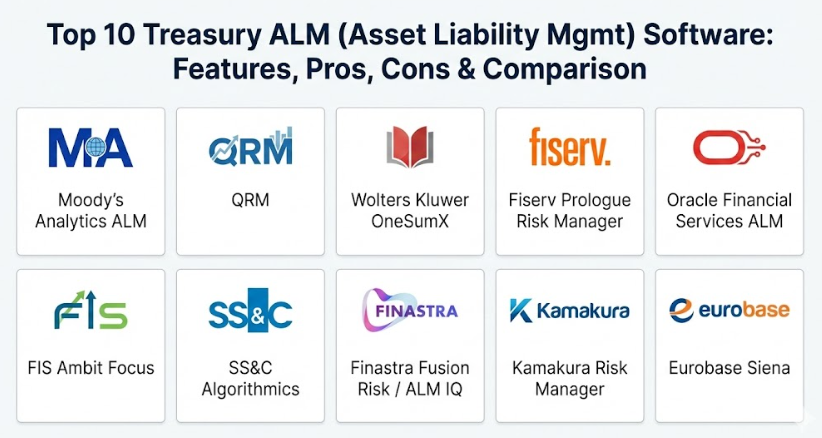
Top 10 Treasury Asset Liability Management Software Tools
1 — Moody’s Analytics ALM
Moody’s Analytics provides a globally recognized ALM solution designed to help institutions anticipate and mitigate risks across their entire balance sheet. It is built to bridge the gap between risk management and financial performance.
- Key features:
- Advanced interest rate risk (IRRBB) and liquidity risk modeling.
- Dynamic balance sheet forecasting and “what-if” scenario stress testing.
- Integrated modules for capital planning and impairment accounting.
- Behavioral modeling for non-maturing deposits and prepayments.
- Automated regulatory reporting templates for global standards.
- SaaS-based delivery for easier updates and scalability.
- Deep integration with credit risk and market risk analytics.
- Pros:
- Exceptional depth in modeling complex financial instruments and economic scenarios.
- Highly respected by regulators worldwide, making compliance audits smoother.
- Cons:
- The software is highly sophisticated and carries a very steep learning curve for new teams.
- It is generally priced at a premium, which may be prohibitive for smaller community banks.
- Security & compliance: SOC 2, GDPR, and ISO 27001 certified; includes robust encryption and detailed audit logs.
- Support & community: Offers professional consulting services, extensive technical documentation, and 24/7 global enterprise support.
2 — QRM (Quantitative Risk Management)
QRM is widely considered the industry benchmark for large-scale financial institutions. It focuses on a holistic approach to risk, integrating ALM with profitability and pricing strategies.
- Key features:
- Comprehensive balance sheet management using a single, unified data model.
- Market value and earnings-at-risk simulations across thousands of rate paths.
- Advanced funds transfer pricing (FTP) for accurate profitability measurement.
- Mortgage-backed security (MBS) and complex derivative valuation.
- Hedge effectiveness testing and accounting integration.
- Rigorous data validation and cleansing workflows.
- High-performance computing for rapid simulation of massive portfolios.
- Pros:
- Unmatched analytical power and accuracy for institutions with complex balance sheets.
- Excellent at aligning the risk department with the actual business goals of the bank.
- Cons:
- Implementation is notoriously long and requires a significant internal IT and risk team.
- The interface can feel more like a technical modeling environment than a user-friendly dashboard.
- Security & compliance: Enterprise-grade security with SSO, multi-factor authentication, and SOC 2 compliance.
- Support & community: Very strong user community with annual conferences and a dedicated client management model.
3 — Wolters Kluwer OneSumX
OneSumX is an integrated platform that combines ALM, liquidity risk, and regulatory reporting. It is designed to provide a “single source of truth” for finance and risk departments.
- Key features:
- Centralized data architecture that reduces data silos between departments.
- Contract-level modeling for high-precision cash flow generation.
- Support for multiple accounting standards (IFRS 9, CECL).
- Integrated funds transfer pricing (FTP) and cost allocation modules.
- Pre-built regulatory report templates for over 50 countries.
- Real-time monitoring of liquidity ratios (LCR, NSFR).
- Scalable architecture that grows with the institution’s asset size.
- Pros:
- Outstanding for international banks that need to manage different regulations in multiple countries.
- The integrated nature of the platform reduces the need for manual data reconciliation.
- Cons:
- Upgrading or customizing modules can be a slow and expensive process.
- System performance can lag during extremely large data processing runs.
- Security & compliance: HIPAA, GDPR, and SOC 2 compliant; features comprehensive audit trails.
- Support & community: Global presence with local support teams and extensive online training portals.
4 — Fiserv Prologue Risk Manager
Fiserv offers a solution tailored specifically for the needs of community and mid-sized banks. It focuses on making complex risk management accessible and actionable.
- Key features:
- Automated interest rate scenario builder for quick stress testing.
- Integration with core banking systems for seamless data uploads.
- Dynamic market value and duration analysis for investment portfolios.
- Forecasted funds transfer pricing (FTP) to evaluate product profitability.
- Liquidity analysis including forecasted ratios and contingency planning.
- User-defined reporting for board-level presentations.
- Support for multi-currency modeling and hedging.
- Pros:
- Much easier to implement and use compared to “heavyweight” global competitors.
- Excellent value for money for US-based community banks already using Fiserv core systems.
- Cons:
- Lacks the deep stochastic modeling capabilities required by the largest global banks.
- Reporting customization is somewhat limited compared to more open-ended platforms.
- Security & compliance: Complies with FFIEC standards, includes SSO, and regular security audits.
- Support & community: Strong US-based customer support and active user groups for community bankers.
5 — Oracle Financial Services ALM
Oracle’s solution is known for its massive scalability and its ability to handle billions of rows of transaction data. It is a preferred choice for the world’s largest retail banks.
- Key features:
- High-performance analytical engines for deterministic and stochastic simulations.
- Customer relationship level data model for granular insight.
- Integration with Oracle Business Intelligence for advanced data visualization.
- Over 200 pre-built financial measures for every balance sheet item.
- Separation of current position results from forecast assumptions for faster updates.
- Multi-currency valuation and exchange rate sensitivity analysis.
- Automated data quality control to ensure integrity before processing.
- Pros:
- Capable of processing the largest data sets in the industry without losing performance.
- Deeply customizable, allowing it to fit almost any unique banking business model.
- Cons:
- Requires a significant investment in Oracle database infrastructure and expertise.
- The setup cost and annual maintenance are among the highest in the market.
- Security & compliance: ISO 27001, SOC 1/2/3, and GDPR; inherits Oracle’s top-tier cloud security.
- Support & community: Massive global ecosystem of consultants and 24/7 enterprise-level support.
6 — FIS Ambit Focus
Ambit Focus by FIS is a modular ALM and liquidity risk solution designed to grow with a financial institution. It emphasizes speed to market and regulatory readiness.
- Key features:
- Unified engine for ALM, market risk, and liquidity risk.
- Automated regulatory reporting for templates like Basel III and IV.
- High-performance “Focus Engine” for rapid cash flow and NPV calculations.
- Integrated hedge accounting to track derivative effectiveness.
- Drill-down capabilities from board reports to individual transactions.
- Pre-configured setup to reduce implementation time.
- Advanced behavioral modeling for “sticky” deposit analysis.
- Pros:
- The modular approach allows banks to start small and add risk modules as they grow.
- Very efficient at handling the high-volume reporting requirements of European and Asian regulators.
- Cons:
- User interface can feel a bit dated compared to newer SaaS-native competitors.
- Integration with non-FIS core systems can be more complex than expected.
- Security & compliance: Fully compliant with Basel standards; includes strong encryption and access controls.
- Support & community: 24/7 support with global coverage and a well-established user base.
7 — SS&C Algorithmics
SS&C Algorithmics is a powerhouse in the world of financial modeling, offering deep expertise in both banking and insurance ALM. It is known for its “what-if” simulation power.
- Key features:
- Enterprise-wide risk analytics across market, credit, and liquidity risk.
- Scalable stochastic projections for the entire balance sheet.
- Advanced scenario generation for fat-tail events and non-linear risks.
- Portfolio construction and optimization tools for investment desks.
- Economic capital and Solvency II calculations for insurers.
- Real-time “what-if” analysis for immediate decision support.
- Available as on-premise, cloud-hosted, or a fully managed service.
- Pros:
- Exceptional at modeling the “worst-case” scenarios that other tools might miss.
- Great choice for institutions that manage both banking and insurance assets.
- Cons:
- Can be overly complex for institutions with a simple retail banking focus.
- Requires highly skilled quantitative staff to manage and interpret results.
- Security & compliance: SOC 2 Type II, GDPR, and ISO standards for data privacy.
- Support & community: Strong reputation for technical support and deep domain expertise in risk.
8 — Finastra Fusion Risk / ALM IQ
Finastra provides a cloud-native ALM solution through its ALM IQ platform, focusing on small and mid-sized banks that want a modern, easy-to-deploy system.
- Key features:
- SaaS-based platform that reduces the need for internal IT resources.
- Open-banking approach for easier integration with third-party apps.
- Intuitive dashboards designed for CEOs and Board members, not just risk analysts.
- Automated ingestion of core banking data, contracts, and market rates.
- Standardized reports that ensure compliance without heavy customization.
- Predictive modeling for interest rate and FX risk.
- Rapid deployment timelines, often much faster than traditional software.
- Pros:
- One of the most modern and user-friendly interfaces in the ALM space.
- Low total cost of ownership due to the cloud-first model.
- Cons:
- May lack the “deep-dive” customization that massive global banks require.
- Dependence on Finastra’s cloud infrastructure for updates and uptime.
- Security & compliance: SOC 2, HIPAA, and GDPR; utilizes advanced cloud security protocols.
- Support & community: Strong focus on customer success with modern digital support portals.
9 — Kamakura Risk Manager
Kamakura is known for its academic and research-driven approach to risk management. It is often the choice for institutions that want the most “theoretically sound” models.
- Key features:
- Fully integrated ALM, market risk, and credit risk on a single platform.
- Advanced default probability modeling using the Jarrow-Chava model.
- Total balance sheet simulation including pension and tax liabilities.
- Highly flexible scenario generation including historical and Monte Carlo paths.
- Bond performance and portfolio analytics for fixed-income desks.
- Comprehensive documentation of all underlying mathematical models.
- Available for on-premise installation to maintain maximum data control.
- Pros:
- Highly transparent models that are easy to explain to auditors and regulators.
- Incredible depth in credit risk integration, which is often a weak point in other ALM tools.
- Cons:
- The software can feel “academic” and less “operational” than some competitors.
- The user community is smaller, leading to fewer third-party experts for hire.
- Security & compliance: Varies by on-premise installation; supports all standard encryption and SSO.
- Support & community: High-quality email support and direct access to the firm’s quantitative researchers.
10 — Eurobase Siena
Eurobase Siena provides a specialized treasury and ALM solution that bridges the gap between the trading room and the risk department. It is ideal for banks with active trading desks.
- Key features:
- Real-time cash flow and liquidity gap management.
- Seamless connection between front-office trading and middle-office ALM.
- Advanced funds transfer pricing (FTP) with real-time rate updates.
- Comprehensive market risk and FX risk modeling.
- Highly customizable dashboards and management reporting.
- Support for multi-entity and multi-currency bank structures.
- Proven track record in emerging markets and specialized banking.
- Pros:
- Excellent for banks that want their ALM to reflect real-time market movements.
- The customer support and implementation success rate are highly rated by users.
- Cons:
- Less focus on the long-term “static” balance sheet than competitors like Moody’s.
- Might not be as well-known to US-based regulators as the major American brands.
- Security & compliance: ISO 27001 and GDPR compliant; robust user access controls.
- Support & community: Dedicated UK-based support team with a global reach and high-touch service.
Comparison Table
| Tool Name | Best For | Platform(s) Supported | Standout Feature | Rating |
| Moody’s ALM | Large Global Banks | SaaS / Cloud | World-class economic scenarios | N/A |
| QRM | Complex Institutions | On-Premise / Cloud | Unified risk & profitability model | N/A |
| OneSumX | Multi-National Regs | Cloud / Hybrid | Integrated Global Reporting | N/A |
| Fiserv Prologue | Community Banks | Cloud / On-Premise | Ease of use & core integration | N/A |
| Oracle FSALM | High-Volume Retail | On-Premise / Cloud | Massive data scalability | N/A |
| FIS Ambit Focus | Modular Growth | Hybrid / Cloud | Rapid cash flow engine | N/A |
| SS&C Algo | Banks & Insurers | Cloud / Managed | Advanced “what-if” simulations | N/A |
| Finastra ALM IQ | SMB & Mid-Market | SaaS-Native | Modern, intuitive UX | N/A |
| Kamakura | Quantitative Depth | On-Premise | Academic model transparency | N/A |
| Eurobase Siena | Trading-Active Banks | On-Premise / Cloud | Real-time front-to-back link | N/A |
Evaluation & Scoring of Treasury ALM Software
The following scoring reflects the general performance of the top-tier solutions in the ALM category. While individual tools may excel in specific areas, these weights represent the priorities of a typical bank selection committee.
| Evaluation Category | Weight | Score (1-10) | Explanation |
| Core Features | 25% | 9.0 | Top tools offer incredible depth in modeling and simulation. |
| Ease of Use | 15% | 6.5 | This category is traditionally complex and lacks “consumer-grade” UX. |
| Integrations | 15% | 8.0 | Strong links to core banking, though legacy data remains a challenge. |
| Security & Compliance | 10% | 10.0 | High standards are universal due to banking regulations. |
| Performance | 10% | 8.5 | Advanced engines handle large data sets well, but SaaS is leading here. |
| Support | 10% | 8.0 | Most vendors provide 24/7 enterprise-grade assistance. |
| Price / Value | 15% | 7.0 | High initial costs are offset by long-term risk reduction. |
Which Treasury ALM Software Tool Is Right for You?
Selecting the right ALM tool depends on the complexity of your balance sheet and your regulatory environment.
Solo Users vs SMB vs Mid-Market vs Enterprise
Small banks and credit unions (SMBs) should prioritize ease of implementation and a lower “footprint” on their IT staff. Tools like Finastra ALM IQ or Fiserv Prologue are designed for this market. Mid-market institutions need a balance of depth and usability, often finding a home with FIS Ambit Focus. Global Enterprises with trillions in assets will almost always require the raw power of QRM, Oracle, or Moody’s.
Budget-Conscious vs Premium Solutions
If budget is a primary constraint, SaaS solutions are generally more affordable because they eliminate the need for expensive on-site servers and maintenance teams. However, “premium” solutions like QRM often pay for themselves by identifying millions of dollars in potential profit through better Funds Transfer Pricing (FTP).
Feature Depth vs Ease of Use
If your risk team is small, a tool that is easy to navigate is more important than one with “Ph.D. level” modeling capabilities. Conversely, a large, sophisticated risk department will feel “handcuffed” by a simple tool and will prefer the mathematical transparency of Kamakura or Algorithmics.
Integration and Scalability Needs
Consider your long-term growth. If you plan to expand internationally, you need a tool like OneSumX that has pre-built reporting for different countries. If you are staying domestic but plan to grow assets quickly, ensure the database architecture (like Oracle) can scale with you.
Frequently Asked Questions (FAQs)
1. What is the difference between ALM and standard cash management?
Cash management focuses on daily liquidity and operational payments. ALM focuses on long-term structural risks, such as how a 20-year mortgage and a 1-year deposit react differently to interest rate changes.
2. Can these tools help with regulatory compliance?
Yes. Modern ALM tools are specifically built to generate reports for Basel III (LCR, NSFR), IRRBB, and local standards like CECL in the US or IFRS 9 globally.
3. How long does a typical implementation take?
For a small bank using a cloud solution, it can take 3 to 6 months. For a large global bank, an enterprise implementation can easily span 12 to 24 months.
4. Is cloud-based ALM software safe for sensitive banking data?
Yes. Most vendors use SOC 2 Type II certified data centers with end-to-end encryption. In many cases, these cloud environments are more secure than a mid-sized bank’s local server room.
5. Do these tools replace the need for a risk department?
No. The software is a powerful tool, but you still need skilled risk professionals to set the assumptions, interpret the data, and make strategic recommendations to the board.
6. What is Funds Transfer Pricing (FTP)?
FTP is a method used by ALM software to attribute profit and risk to specific departments. It helps the bank understand if a specific branch is actually making money after accounting for the “cost” of the funds they are using.
7. Can ALM software handle multi-currency portfolios?
Most top-tier tools (like Oracle and Eurobase) are designed specifically for this, allowing you to see your risk position in USD, EUR, JPY, and other currencies simultaneously.
8. What is a “Static” vs “Dynamic” balance sheet?
A static balance sheet looks at the risk of what you have today. A dynamic balance sheet includes “new business” assumptions, like how many new loans you plan to sell next year.
9. Why is data quality the biggest hurdle in ALM?
ALM models require thousands of data points. If the data from the core system is missing maturity dates or interest rate types, the entire risk calculation will be inaccurate.
10. Are there free alternatives to these tools?
While some banks use spreadsheets for very basic analysis, there are no “free” professional-grade ALM tools due to the extreme complexity and security requirements of the banking industry.
Conclusion
The right Treasury Asset Liability Management software is a foundational pillar for any stable financial institution. It moves risk management from a “defensive” posture to a strategic one, allowing leaders to see opportunities where others only see volatility. While the “best” tool depends on your bank’s size, complexity, and budget, the focus should always be on data integrity and the ability to turn complex simulations into actionable insights for the board.
Ultimately, choosing a tool like Moody’s for its global reputation, QRM for its analytical power, or Finastra for its modern cloud approach will depend on your specific journey. The key is to involve all stakeholders—from IT to the trading desk—to ensure the technology you choose today will support your institution’s growth for years to come.