Introduction
In an increasingly connected world, moving goods across borders is both a massive opportunity and a logistical minefield. Trade compliance software is a digital solution designed to help businesses navigate the complex web of international regulations, tariffs, and restricted party lists. These platforms automate the screening process, manage customs documentation, and ensure that every shipment follows the laws of both the exporting and importing countries. Without these tools, companies are forced to rely on manual checks, which are not only slow but also prone to human error that can lead to massive fines or seized shipments.
The importance of trade compliance software cannot be overstated. Government regulations change daily, and missing a single update on a denied party list or a new tariff can halt operations instantly. Real-world use cases include screening new customers against global sanctions lists, automatically classifying products with the correct Harmonized System (HS) codes, and managing Export Control Classification Numbers (ECCN). When choosing a tool, users should evaluate the accuracy of the regulatory data, the depth of automation features, and how well the software integrates with existing systems like an ERP or a Warehouse Management System.
Best for: Trade compliance software is most beneficial for compliance officers, logistics managers, and supply chain directors at mid-to-large enterprises. It is essential for industries with high regulatory scrutiny, such as aerospace, electronics, chemicals, and pharmaceuticals, where precision in documentation is a legal requirement.
Not ideal for: Companies that operate exclusively within domestic borders or those with a very low volume of international shipments may find these tools unnecessary. For occasional international shipping, a dedicated customs broker or simpler, manual documentation services might be more cost-effective than a full software suite.
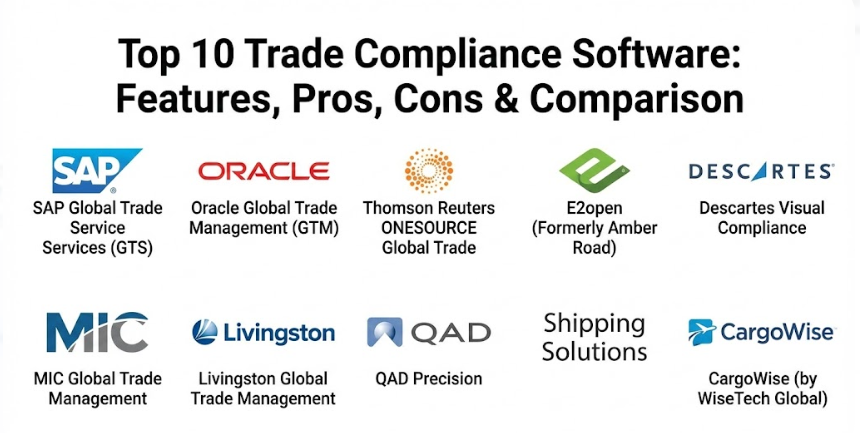
Top 10 Trade Compliance Software Tools
1 — SAP Global Trade Services (GTS)
SAP Global Trade Services is an enterprise-grade platform built to handle the most complex international trade requirements. It is designed for large corporations that already use the SAP ecosystem, providing a seamless flow of data between sales, procurement, and compliance. It focuses on automating the entire trade lifecycle, from restricted party screening to customs management.
Key Features:
- Restricted Party Screening: Checks customers and vendors against hundreds of global government lists in real-time.
- Export and Import Management: Automates the creation of customs declarations and ensures all licenses are in place.
- Electronic Customs Filing: Direct integration with government systems for faster clearance.
- Preference Management: Helps businesses take advantage of Free Trade Agreements (FTAs) to reduce duties.
- Bonded Warehouse Support: Manages specialized inventory movements for tax-deferral purposes.
- Sanctioned Party List Integration: Automatically updates lists to ensure data is always current.
Pros:
- Unmatched integration with SAP ERP systems, reducing the need for manual data entry.
- Highly scalable, capable of handling millions of transactions across dozens of countries.
Cons:
- Extremely complex to implement and usually requires specialized consultants.
- High total cost of ownership, making it less accessible for smaller businesses.
Security & compliance:
The platform offers robust security features including role-based access control, data encryption, and detailed audit logs. It is designed to comply with GDPR and various international trade laws.
Support & community:
SAP provides world-class enterprise support, a vast network of certified partners, and a massive user community with extensive documentation and forums.
2 — Oracle Global Trade Management (GTM)
Oracle Global Trade Management is a cloud-based solution that helps companies manage their global trade operations with a focus on visibility and efficiency. It is built on the same platform as Oracle Transportation Management, making it a powerful choice for companies that want to combine logistics and compliance into one view.
Key Features:
- Trade Master Data Management: Stores all product classifications and trade history in one place.
- Compliance Screening: Automated checks for denied parties and sanctioned regions.
- Duty and Tax Calculation: Provides estimated land costs to help with financial planning.
- Trade Document Management: Generates all necessary shipping documents automatically.
- Global Trade Intelligence: Advanced reporting tools to analyze compliance performance.
- ECCN and HS Classification: Automated tools to help assign the correct codes to products.
Pros:
- Cloud-native architecture means updates are handled automatically without downtime.
- Excellent visibility into the supply chain, allowing teams to spot compliance risks before they cause delays.
Cons:
- Users have noted that the interface can be technical and requires a learning curve.
- Integration with non-Oracle systems can sometimes require additional middleware.
Security & compliance:
Oracle GTM includes SOC 2 compliance, high-level encryption at rest and in transit, and comprehensive audit trails for regulatory reviews.
Support & community:
Oracle offers 24/7 global support, an extensive knowledge base, and a dedicated community for cloud supply chain users.
3 — Thomson Reuters ONESOURCE Global Trade
ONESOURCE Global Trade is known for its high-quality regulatory content. Thomson Reuters leverages its massive legal and tax database to provide users with the most accurate trade information available. It is a favorite for tax and compliance professionals who prioritize data accuracy over everything else.
Key Features:
- Comprehensive Regulatory Content: Access to trade laws and tariff schedules for over 200 countries.
- Automated Classification: Uses AI to help classify products quickly and accurately.
- Special Program Management: Manages FTAs and duty drawback programs to save money.
- Trade Alerts: Notifications when laws change in the countries where you do business.
- Customs Valuation: Ensures that goods are valued correctly for tax purposes.
- Import/Export Filing: Simplifies the submission of data to customs authorities.
Pros:
- The quality of the regulatory data is often considered the best in the industry.
- Modular design allows companies to buy only the specific tools they need.
Cons:
- The setup process for the automated classification engine can be time-consuming.
- Reporting features can be less flexible than some competitors.
Security & compliance:
Includes SSO support, data encryption, and ISO certification. It is built to handle sensitive financial and trade data securely.
Support & community:
Provides professional onboarding, dedicated account managers, and regular training webinars on changing trade laws.
4 — E2open (Formerly Amber Road)
E2open provides a comprehensive “Global Trade Management” suite that focuses on the end-to-end supply chain. It is designed for companies that need a “single source of truth” for all trade activities, including supplier management and logistics.
Key Features:
- Global Knowledge Base: A massive database of trade rules, duties, and taxes.
- Supplier Collaboration: Tools to ensure that your suppliers are also following compliance rules.
- Import/Export Automation: Streamlines the movement of goods through automated workflows.
- Duty Optimization: Actively looks for ways to reduce taxes through trade agreements.
- Restricted Party Screening: High-speed screening for large volumes of names and addresses.
- Visibility Dashboards: Real-time tracking of compliance status across the entire company.
Pros:
- Excellent for managing complex supplier networks and multi-tier supply chains.
- Very strong features for duty savings and free trade agreement management.
Cons:
- The software can be heavy and might be “more than needed” for simpler operations.
- Integration with legacy on-premise systems can be challenging.
Security & compliance:
Supports SOC 2, GDPR compliance, and enterprise-grade encryption. It is built for the high-security needs of global logistics.
Support & community:
E2open offers 24/7 support and a robust onboarding process for new enterprise clients.
5 — Descartes Visual Compliance
Descartes Visual Compliance is widely recognized for its “Restricted Party Screening” capabilities. It is a more focused tool than the massive ERP-integrated suites, making it an excellent choice for companies that need a quick, reliable, and user-friendly way to check for sanctions.
Key Features:
- Dynamic Screening: Automatically re-screens your database whenever a government list changes.
- Risk Management Dashboards: Visual representation of where your compliance risks are located.
- ECCN and HS Search: Simple tools for finding the right codes for your goods.
- Visitor Management: Screens visitors at your physical office against restricted lists.
- Export License Management: Tracks and manages the status of your export permits.
- Audit Documentation: Automatically saves every search and result for future audits.
Pros:
- Very easy to use; most employees can learn the system in a single afternoon.
- Extremely fast to implement, with most users getting up and running in days.
Cons:
- Lacks the deep “customs filing” features found in larger suites like SAP or Oracle.
- Not designed to handle complex warehouse or manufacturing logic.
Security & compliance:
Offers secure cloud hosting, encryption, and detailed audit trails. It is designed to help companies meet the “due diligence” standards of government agencies.
Support & community:
Known for having very responsive customer support and a straightforward documentation library.
6 — MIC Global Trade Management
MIC is a specialized provider that is particularly strong in the European and North American markets. It offers a modular system that allows companies to build their own compliance platform piece by piece. It is often used by automotive and industrial manufacturing companies.
Key Features:
- Customs Filing (NCTS): High-speed integration with European customs systems.
- Origin Calculation: Detailed tools for determining where a product was “made” for tariff purposes.
- Export Control: Manages complex licensing requirements for sensitive technologies.
- Centralized Data Hub: Combines trade data from multiple ERPs into one system.
- Automated HS Coding: Uses historical data and logic to suggest product codes.
- Audit Trail Management: Keeps a permanent record of all compliance decisions.
Pros:
- Very deep expertise in specific regional customs laws (like the EU and US).
- The modular approach makes it easy to scale the software as the company grows.
Cons:
- The interface can look a bit dated compared to modern cloud-native apps.
- Implementation requires a deep understanding of your own internal trade data.
Security & compliance:
Complies with ISO 27001 and provides high-level data security for industrial secrets and trade data.
Support & community:
Offers professional consulting services and dedicated project managers for the implementation phase.
7 — Livingston Global Trade Management
Livingston is a well-known name in the customs brokerage world, and their software is designed to complement their professional services. It is a great choice for companies that want a mix of automated software and expert human advice.
Key Features:
- Classification Services: A mix of software and human experts to ensure HS codes are correct.
- Document Visibility: A central portal to see all your customs documents in one place.
- Audit Readiness: Tools to help you prepare for a government customs audit.
- Trade Reporting: Clear dashboards showing your total duty spend and compliance rate.
- Import/Export Compliance Reviews: Software-driven checks for missing data or errors.
- Licensing Support: Tracks the usage and expiration of your import and export licenses.
Pros:
- Excellent for companies that want a “hybrid” approach of software and managed services.
- Very strong at helping companies navigate the specific complexities of US-Canada trade.
Cons:
- May not be the best fit for companies that want a 100% “hands-off” software experience.
- The software is often tied closely to Livingston’s own brokerage services.
Security & compliance:
Provides secure data storage and encryption. As a major customs broker, they follow strict regulatory security standards.
Support & community:
Excellent customer support, with the added benefit of having actual customs experts available to help with difficult questions.
8 — QAD Precision
QAD Precision focuses on “Global Trade and Parcel Execution.” It is a unique tool because it combines trade compliance with shipping software. This is perfect for high-volume shippers who need to print shipping labels and check for trade compliance at the same time.
Key Features:
- Multi-Carrier Shipping: Connects with hundreds of parcel and freight carriers.
- Export Trade Compliance: Automated screening during the label printing process.
- Packing and Manifesting: Tools for managing high-volume warehouse shipping.
- Desktop Shipping: Allows office workers to ship packages while following compliance rules.
- Trade Documentation: Automatically prints all international shipping forms.
- In-Transit Visibility: Tracks packages after they leave the warehouse.
Pros:
- The integration of compliance and shipping labels saves a massive amount of time for warehouse teams.
- Very strong for “e-commerce” and retail businesses with high international parcel volumes.
Cons:
- Less focused on deep “legal” compliance or tax optimization than other suites.
- Best used by companies that have a physical shipping operation.
Security & compliance:
Includes SSO, data encryption, and audit logs. It is built to operate securely in high-speed warehouse environments.
Support & community:
QAD offers enterprise-level support and a large user community focused on manufacturing and logistics.
9 — Shipping Solutions
Shipping Solutions is a great tool for small and medium-sized businesses (SMBs). It focuses on making the creation of export documents as easy as possible. It is a “no-frills” solution that is much more affordable than the enterprise suites.
Key Features:
- Export Document Generation: Creates commercial invoices, packing lists, and certificates of origin.
- ACE Filing: Direct integration with the US Automated Commercial Environment.
- Restricted Party Screening: Simple search tool for checking customers against lists.
- Export Compliance Module: Checks if your shipment requires a specific license.
- HS Code Lookup: A built-in database to help you find the right classification codes.
- Shipping History: Keeps a record of all your past international shipments.
Pros:
- Extremely affordable and easy to set up for smaller teams.
- Specifically designed for “The Everyday Exporter” who doesn’t want complex enterprise software.
Cons:
- Lacks the deep automation or “AI” features of larger platforms.
- Not built for massive corporations with thousands of daily shipments.
Security & compliance:
Provides secure desktop or cloud-based storage. It helps SMBs follow the basic “due diligence” rules for exporting.
Support & community:
Excellent documentation and very helpful phone support for small business owners.
10 — CargoWise (by WiseTech Global)
CargoWise is a massive, all-in-one platform for the logistics industry. While it is often used by freight forwarders, its trade compliance modules are very powerful. It is designed to be the single operating system for a global logistics business.
Key Features:
- Customs Clearance: Direct electronic links to customs in many countries.
- Enterprise-Level Workflow: Automates the movement of data between different offices.
- Tariff Management: Built-in databases for global tax and duty rates.
- Denied Party Screening: Integrated into the standard booking and shipping workflow.
- Document Management: Securely stores all digital records of international trades.
- Multi-Currency Accounting: Handles the complex financial side of global trade.
Pros:
- If you are a logistics provider, this is the most powerful “all-in-one” tool available.
- Incredibly deep features that cover almost every aspect of moving goods.
Cons:
- The software is very complex and takes a long time to fully learn.
- Implementation can be a massive project that requires dedicated internal staff.
Security & compliance:
High-level enterprise security including SSO, audit trails, and global data privacy compliance.
Support & community:
Offers a “CargoWise Certification” program for users and has a global network of specialized partners.
Comparison Table
| Tool Name | Best For | Platform(s) Supported | Standout Feature | Rating |
| SAP GTS | SAP-heavy enterprises | On-Premise / Cloud | Deepest ERP Integration | N/A |
| Oracle GTM | Global supply chain visibility | Cloud | Logistics & Trade combined | N/A |
| ONESOURCE | High-precision regulatory data | Cloud | Best Global Trade Content | N/A |
| E2open | Supplier network compliance | Cloud | Multi-tier supply chain focus | N/A |
| Visual Compliance | Fast & easy screening | Cloud | User-friendly interface | N/A |
| MIC GTM | EU and US regional expertise | On-Premise / Cloud | Modular Customs Filing | N/A |
| Livingston | Expert-led hybrid compliance | Cloud | Human & Software hybrid | N/A |
| QAD Precision | High-volume parcel shippers | Cloud / On-Premise | Integrated Label & Compliance | N/A |
| Shipping Solutions | Small & Mid-sized Exporters | Desktop / Cloud | Simple & Affordable | N/A |
| CargoWise | Logistics providers & forwarders | Cloud | All-in-one Logistics OS | N/A |
Evaluation & Scoring of Trade Compliance Software
Choosing the right software requires a balanced look at technical power and everyday usability. We have scored these tools based on a weighted rubric to show what really matters in a professional environment.
| Category | Weight | Evaluation Criteria |
| Core Features | 25% | Accuracy of screening, HS coding, and document generation. |
| Ease of Use | 15% | Training time and intuitiveness of the interface. |
| Integrations | 15% | How well it talks to ERPs, WMS, and carriers. |
| Security & Compliance | 10% | Encryption, SSO, audit trails, and data privacy. |
| Performance | 10% | Speed of screening and system uptime. |
| Support & Community | 10% | Quality of documentation and customer service. |
| Price / Value | 15% | Return on investment based on avoided fines and duty savings. |
Which Trade Compliance Software Tool Is Right for You?
Choosing the right tool is a balance between your shipment volume and the complexity of the products you sell.
Solo Users and SMBs
If you are a small business owner shipping a few times a week, you don’t need a complex system. Shipping Solutions is likely your best bet. It is affordable, doesn’t require an IT team, and helps you create the forms you need to keep customs happy. If you only need to screen names occasionally, Descartes Visual Compliance offers a great, low-cost entry point.
Mid-Market Companies
For companies with growing international sales, visibility becomes the biggest challenge. Descartes Visual Compliance or QAD Precision are excellent choices. They offer more automation than the small business tools but aren’t as difficult to set up as the giant ERP suites. They help you stay compliant without needing a massive team of experts.
Large Enterprise and Global Corporations
If your company is already running on a major platform, you should usually look there first. SAP GTS and Oracle GTM offer the most power for companies with thousands of employees and global footprints. These systems are an investment, but they provide the highest level of security and automation possible.
Budget-Conscious vs. Premium Solutions
- Budget: Shipping Solutions or basic screening subscriptions from Descartes.
- Premium: ONESOURCE Global Trade or E2open. These tools cost more because they provide the most accurate, real-time data and the most advanced automation for tax and duty savings.
Frequently Asked Questions (FAQs)
1. What is the most important feature of trade compliance software?
For most companies, “Denied Party Screening” is the most critical feature. This ensures you are not accidentally doing business with a person or company on a government sanctions list, which can lead to criminal charges.
2. Can I use this software if I don’t have an ERP?
Yes. Many tools like Shipping Solutions and Visual Compliance work perfectly as “standalone” systems. You simply type in the data or upload a spreadsheet of your shipments.
3. How often are the government lists updated?
The best software providers update their lists multiple times a day. Government agencies can add or remove people from sanctions lists at any time, so real-time updates are essential.
4. What is an HS code, and can software find it for me?
An HS code is a standard number used to classify products for taxes and duties. Good software uses AI and “keyword search” to suggest the correct code based on your product description.
5. Is my data safe in a cloud-based compliance tool?
Yes, most enterprise tools use very high-level encryption and are SOC 2 compliant. In fact, cloud tools are often more secure than local spreadsheets because they have better audit trails and access controls.
6. Does the software automatically pay my taxes and duties?
Generally, no. The software calculates the taxes and prepares the documents. The actual payment is usually handled through your customs broker or a direct link to the government’s financial portal.
7. How long does it take to implement these systems?
A simple screening tool can be ready in 24 hours. A massive enterprise integration with SAP or Oracle can take six months to a year of planning and testing.
8. Can the software help me save money on duties?
Yes. Advanced tools like ONESOURCE or E2open specifically look for Free Trade Agreements (FTAs) that your products might qualify for, which can reduce your taxes to zero in some cases.
9. What happens if the software makes a mistake?
Legally, the “exporter of record” (your company) is always responsible for compliance. The software is a tool to help you, but you should still have a human compliance officer review the most important decisions.
10. Do I still need a customs broker if I have this software?
Many companies still use a broker for the physical clearance of goods. However, having your own software gives you better control over your data and allows you to audit the broker’s work to ensure they aren’t making mistakes.
Conclusion
The “best” trade compliance software isn’t the one with the most features—it is the one that fits your company’s specific flow of goods. If you are an enterprise using SAP, the integration of SAP GTS is hard to beat. If you are a high-speed e-commerce business, the shipping focus of QAD Precision might be the winner. If you just need to ensure you aren’t shipping to a sanctioned person, Descartes Visual Compliance is the clear, simple choice.
Trade compliance is a journey, not a destination. As laws change and your company grows into new markets, your needs will evolve. By choosing a tool that is scalable and accurate, you protect your company’s reputation and its bottom line. In the world of international trade, being “compliant” isn’t just about following rules—it’s about building a foundation for global growth that won’t be interrupted by a surprise audit or a seized shipment.