Introduction
A Source-to-Pay (S2P) Suite is a unified software platform that integrates the entire procurement process. This includes finding and qualifying suppliers (sourcing), negotiating contracts, managing the actual purchase of goods (procure-to-pay), and finally handling the invoicing and payment. Unlike standalone tools that only handle one part of the job, an S2P suite ensures that data flows smoothly from the initial contract all the way to the final bank transfer.
Why It Is Important
In a global economy, supply chain visibility is everything. S2P suites are essential because they provide a “single source of truth.” They help companies control spending, ensure they are buying from compliant and ethical suppliers, and identify areas where they can negotiate better deals. By automating repetitive tasks like invoice matching, these suites reduce human error and allow procurement teams to focus on strategy rather than data entry.
Key Real-World Use Cases
- Strategic Sourcing: Running complex auctions and RFPs to find the best value for raw materials or services.
- Contract Compliance: Ensuring that when an employee buys a laptop, they are getting the price negotiated in the master agreement.
- Supplier Risk Management: Monitoring vendors for financial stability, legal compliance, or environmental impact.
- Spend Analysis: Visualizing where every cent goes to eliminate “maverick” spending that happens outside of official channels.
What to Look For
When evaluating S2P tools, look for deep integration capabilities with your existing ERP (Enterprise Resource Planning) system. User adoption is also critical; if the tool is too hard to use, employees will find ways to bypass it. Finally, consider the strength of the supplier network—a tool is only as good as the vendors who are willing to participate in its ecosystem.
Best for: Large enterprises, mid-market companies with complex supply chains, and procurement, finance, and supply chain managers in industries like manufacturing, retail, and healthcare.
Not ideal for: Very small startups or businesses with extremely low purchasing volume who may find the implementation costs and complexity far outweigh the benefits.
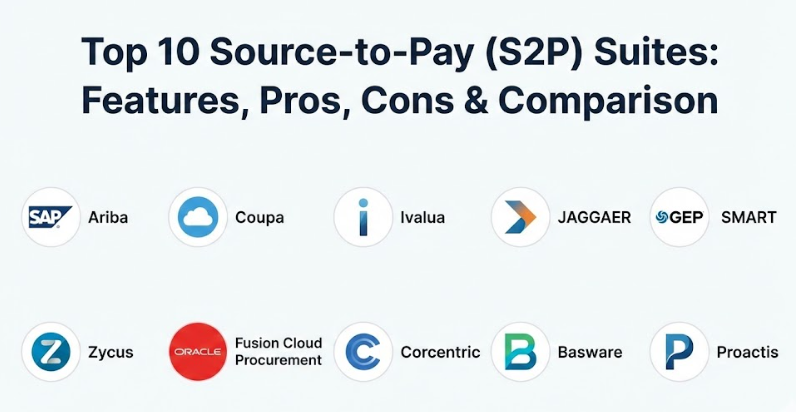
Top 10 Source-to-Pay (S2P) Suites Tools
1 — SAP Ariba
SAP Ariba is widely considered the giant of the procurement world. It operates the world’s largest business-to-business network, connecting millions of companies and providing a deep, end-to-end suite that covers everything from strategic sourcing to specialized financial supply chain management.
- Key features:
- Access to the Ariba Network for instant supplier discovery.
- Advanced guided buying to improve the user experience for employees.
- Direct materials sourcing tailored for complex manufacturing.
- Comprehensive contract lifecycle management (CLM).
- Dynamic discounting and supply chain finance options.
- Robust spend analysis with AI-driven insights.
- Pros:
- Unmatched scale and supplier connectivity.
- Seamless integration with other SAP ERP modules.
- Cons:
- Implementation can be long and very expensive.
- The user interface can feel complex and overwhelming for casual users.
- Security & compliance: ISO 27001, SOC 1/SOC 2, GDPR, and robust encryption protocols.
- Support & community: Massive global user community, extensive documentation, and premium enterprise support.
2 — Coupa
Coupa is the leader in “Business Spend Management” (BSM) and is famous for its focus on user experience. It aims to make business buying as easy as consumer shopping, which leads to incredibly high adoption rates across organizations.
- Key features:
- Unified platform for procurement, expenses, and accounts payable.
- “Community Intelligence” that uses anonymized data to suggest savings.
- High-adoption “Guided Buying” for all employees.
- Real-time visibility into cash flow and budget tracking.
- Integrated travel and expense management.
- Strategic sourcing with built-in risk scoring.
- Pros:
- Extremely modern and intuitive user interface.
- Quick implementation compared to other enterprise suites.
- Cons:
- Premium pricing that can be steep for some organizations.
- Some modules, like CLM, are not as deep as specialized standalone tools.
- Security & compliance: SOC 1 Type II, SOC 2 Type II, PCI DSS, and HIPAA compliance.
- Support & community: Strong “Coupa Community” and high-touch customer success programs.
3 — Ivalua
Ivalua is known for its incredible flexibility. While other suites force you to adapt your process to the software, Ivalua is designed to be highly configurable, making it a favorite for companies with very specific or unusual procurement workflows.
- Key features:
- Single code base for the entire S2P lifecycle.
- High configurability without needing custom coding.
- Deep supplier relationship management (SRM) features.
- Integrated project management for sourcing events.
- Advanced analytics for complex category management.
- Collaborative document editing for contract negotiations.
- Pros:
- Can be tailored to almost any industry-specific requirement.
- High data integrity due to the unified single-platform architecture.
- Cons:
- The high level of flexibility requires a clear internal strategy to avoid over-complicating.
- Smaller supplier network compared to SAP Ariba.
- Security & compliance: ISO 27001, SOC 1, SOC 2, and GDPR compliant.
- Support & community: Strong professional services and growing user documentation.
4 — JAGGAER
JAGGAER is a specialized powerhouse, particularly strong in sectors like higher education, government, and manufacturing. It offers deep functionality for both “indirect” spend (office supplies) and “direct” spend (materials for production).
- Key features:
- Specialized modules for Research & Development and labs.
- Strong “Direct” procurement features for manufacturing.
- Intelligent award optimization for sourcing.
- Digital capture of paper invoices with high accuracy.
- Collaborative supplier portals for better communication.
- Deep integration with campus ERPs like Ellucian or Oracle.
- Pros:
- Industry-specific expertise that general suites lack.
- Excellent at handling complex, multi-variable sourcing auctions.
- Cons:
- The interface across different modules can sometimes feel inconsistent.
- User community is more niche compared to Coupa or SAP.
- Security & compliance: SOC 2 Type II, ISO 27001, and FedRAMP authorized for government use.
- Support & community: Dedicated industry-specific support teams and regional user groups.
5 — GEP SMART
GEP SMART is a cloud-native platform that leverages AI and machine learning to drive procurement efficiency. It is often praised for its sleek design and the way it integrates sourcing and procurement with supply chain visibility.
- Key features:
- AI-powered spend classification and analysis.
- Mobile-first design for procurement on the go.
- Integrated “Procure-to-Pay” with “Source-to-Contract.”
- Digital “workspace” for managing supplier performance.
- High-end dashboarding and data visualization.
- Automated workflow engine for approvals.
- Pros:
- Very modern, “consumer-grade” look and feel.
- Excellent at turning raw data into actionable savings strategies.
- Cons:
- May require more support during the initial data cleanup phase.
- Some smaller suppliers may find the onboarding process detailed.
- Security & compliance: SOC 1/SOC 2, ISO 27001, and GDPR compliant.
- Support & community: Comprehensive GEP Academy for training and robust managed services.
6 — Zycus
Zycus focuses heavily on the “Source-to-Contract” side of the house, using its proprietary AI, Merlin, to automate mundane tasks like data extraction and contract risk analysis.
- Key features:
- Merlin AI suite for automation across the S2P cycle.
- Cognitive procurement for identifying “invisible” savings.
- Deep spend analysis with high categorization accuracy.
- Collaborative sourcing with internal stakeholders.
- Integrated financial risk monitoring for vendors.
- Seamless accounts payable automation.
- Pros:
- Industry leader in AI-driven procurement automation.
- Strong focus on customer-led innovation.
- Cons:
- Procure-to-pay (P2P) features were historically viewed as secondary to sourcing.
- Integration with legacy ERPs can sometimes be complex.
- Security & compliance: ISO 27001, SOC 2, and GDPR compliant.
- Support & community: Good documentation and an annual user conference (Horizon).
7 — Oracle Fusion Cloud Procurement
Oracle provides a massive, integrated suite that lives within the broader Oracle Cloud ERP ecosystem. It is the natural choice for organizations already running Oracle for their finance or HR operations.
- Key features:
- Built-in integration with Oracle Financials.
- AI-based lead-time and risk predictions.
- Collaborative supplier social network.
- Integrated “Procurement Contracts” with legal templates.
- Clean, modern interface within the Fusion platform.
- Robust self-service procurement for employees.
- Pros:
- Unrivaled financial integration for accounting.
- High scalability for global, multi-national organizations.
- Cons:
- Can feel “heavy” and rigid if not properly configured.
- Licensing and pricing structures can be complex.
- Security & compliance: Multi-layered security, SOC 1/2/3, ISO, and HIPAA ready.
- Support & community: Extensive Oracle University and global partner network.
8 — Corcentric
Corcentric is unique because it blends software with professional services. They don’t just give you the tool; they often provide the managed services to help you actually run your procurement office.
- Key features:
- Holistic view of procurement and accounts payable.
- Specialized fleet and asset management tools.
- Managed sourcing services for specific categories.
- Strategic advisory services included in the ecosystem.
- Automated payment solutions and virtual cards.
- Comprehensive supplier management portal.
- Pros:
- Great for companies that want to outsource parts of procurement.
- Very strong focus on cash flow and working capital.
- Cons:
- Not as “pure play” software-focused as Coupa or GEP.
- May not be the best fit for companies that want to do everything in-house.
- Security & compliance: SOC 1 Type II and SOC 2 Type II compliant.
- Support & community: High-touch account management and consulting support.
9 — Basware
Basware is the world leader in networked purchase-to-pay and e-invoicing. While they cover the whole S2P cycle, they are the “gold standard” for companies that struggle with complex global invoicing and tax compliance.
- Key features:
- 100% data capture of all invoices (paper, PDF, EDI).
- Global compliance for over 50 countries’ tax laws.
- Deep accounts payable automation and matching.
- Collaborative sourcing and contract management.
- Real-time spend visibility and predictive analytics.
- Open network for easy supplier connection.
- Pros:
- The best tool for complex, international accounts payable.
- High level of automation for “touchless” invoicing.
- Cons:
- The “Sourcing” side is not as feature-rich as SAP or Ivalua.
- Interface is professional but less “flashy” than some competitors.
- Security & compliance: ISO 27001, SOC 1/SOC 2, and GDPR compliant.
- Support & community: Extensive knowledge base and global customer support teams.
10 — Proactis
Proactis offers a modular S2P suite that is specifically designed for mid-to-large organizations that need to control spend without the enterprise price tag of the “Big 3” suites.
- Key features:
- Modular approach—buy only what you need.
- Strong emphasis on cost reduction and compliance.
- Specialized tools for public sector procurement.
- Integrated marketplace for employee purchasing.
- Supplier relationship management with performance tracking.
- Automated invoice processing and payment.
- Pros:
- Excellent value for money and transparent pricing.
- Fast deployment for specific modules.
- Cons:
- Lacks some of the high-end AI “bells and whistles” of GEP or Zycus.
- Smaller global presence compared to SAP or Oracle.
- Security & compliance: ISO 27001 and GDPR compliant.
- Support & community: Good regional support, especially in Europe and the US.
Comparison Table
| Tool Name | Best For | Platform(s) Supported | Standout Feature | Rating (Gartner/Other) |
| SAP Ariba | Global Enterprises | Cloud, Web, Mobile | Largest B2B Supplier Network | 4.3 / 5 |
| Coupa | Mid-to-Large Enterprise | Cloud, Web, Mobile | Community Intelligence & UX | 4.7 / 5 |
| Ivalua | Highly custom workflows | Cloud, Web | Unified single code base | 4.4 / 5 |
| JAGGAER | Higher Ed/Manufacturing | Cloud, Web | Specialized direct materials | 4.2 / 5 |
| GEP SMART | AI-focused teams | Cloud, Web, Mobile | Unified supply chain view | 4.5 / 5 |
| Zycus | Strategic Sourcing focus | Cloud, Web | Merlin AI automation | 4.1 / 5 |
| Oracle Fusion | Oracle ERP users | Cloud, Web, Mobile | Native finance integration | 4.0 / 5 |
| Corcentric | Managed Service seekers | Cloud, Web | Procurement + Consulting | 4.4 / 5 |
| Basware | Global E-Invoicing | Cloud, Web | 100% Invoice data capture | 4.2 / 5 |
| Proactis | Mid-market value | Cloud, Web | Modular deployment | 3.9 / 5 |
Evaluation & Scoring of S2P Suites
The following table provides a weighted evaluation of the S2P category as a whole, helping you understand where these tools typically shine and where they face challenges.
| Evaluation Category | Weight | Score (Avg) | Analysis |
| Core Features | 25% | 9 / 10 | Most tools have achieved high maturity in basic S2P tasks. |
| Ease of Use | 15% | 7 / 10 | A gap remains between consumer-grade and enterprise-grade UX. |
| Integrations | 15% | 8 / 10 | API-first strategies are making ERP connections much easier. |
| Security & Compliance | 10% | 10 / 10 | Industry standard is very high due to financial regulations. |
| Performance | 10% | 9 / 10 | Cloud reliability is now the norm for all top vendors. |
| Support | 10% | 7 / 10 | Enterprise support quality varies by region and vendor size. |
| Price / Value | 15% | 6 / 10 | High ROI exists, but initial “sticker shock” is common. |
Which S2P Suite Tool Is Right for You?
Selecting an S2P suite is a multi-year commitment. You need to look beyond the features and look at the “fit” for your organization.
Solo Users vs SMB vs Enterprise
Procurement suites are almost never for solo users. For SMBs, the modular approach of Proactis or the all-in-one simplicity of Coupa often works best. Enterprise users with global footprints and thousands of suppliers almost always require the heavy-duty power of SAP Ariba or Oracle.
Budget-Conscious vs Premium Solutions
If you are budget-conscious, look for vendors that offer a “pay-as-you-grow” model. Premium solutions like Coupa or GEP SMART may have a higher subscription fee, but their users often report much higher savings due to the “Community Intelligence” and ease of use that drives compliance.
Feature Depth vs Ease of Use
This is the classic trade-off. Ivalua offers immense feature depth but requires a dedicated team to manage it. If your primary goal is to stop employees from buying things they shouldn’t, prioritize Ease of Use with a tool like Coupa or GEP.
Integration and Scalability
Do not underestimate the importance of your ERP. If you are a “Blue” shop (IBM/SAP), SAP Ariba is the path of least resistance. If you are a “Red” shop (Oracle), Oracle Fusion is often the wisest choice for long-term scalability.
Frequently Asked Questions (FAQs)
1. What is the difference between S2P and P2P?
P2P (Procure-to-Pay) starts with the purchase and ends with payment. S2P (Source-to-Pay) includes everything in P2P plus the “upstream” parts like supplier searching and contract negotiation.
2. How long does a typical S2P suite implementation take?
For a large enterprise, it can take 6 to 12 months. Modular deployments for mid-market companies can be done in as little as 3 to 4 months.
3. Will an S2P suite replace our ERP?
No. It works with your ERP. The S2P suite handles the procurement workflows and supplier interaction, while the ERP remains the system of record for the company’s general ledger.
4. Can these tools help with ESG (Environmental, Social, and Governance) goals?
Yes. Most modern suites allow you to tag and track suppliers based on their diversity, carbon footprint, and ethical labor certifications.
5. How do S2P suites save money?
They save money through “spend consolidation” (buying more from fewer vendors at better prices), reducing manual labor, and eliminating duplicate payments and overcharges.
6. Do our suppliers have to pay to use these portals?
It depends on the vendor. Some networks (like SAP Ariba) may charge suppliers for high-volume accounts, while others (like Coupa or Basware) are generally free for suppliers.
7. Is AI in procurement just a buzzword?
Not anymore. AI is currently being used for “spend classification” (grouping thousands of items automatically) and identifying risks in contract language that a human might miss.
8. What is “Maverick Spending”?
This is when an employee buys something outside of the official company portal or negotiated contract, usually resulting in a higher price and zero visibility for the finance team.
9. Can S2P suites handle services as well as goods?
Yes, though some are better than others. Tools like Coupa and Ivalua have specialized modules for “Statement of Work” (SOW) based services.
10. What is the biggest mistake companies make when buying an S2P suite?
Underestimating the “Change Management” needed. You can buy the best software in the world, but if your employees and suppliers don’t want to use it, you won’t see a return on investment.
Conclusion
The transition from manual procurement to a modern Source-to-Pay (S2P) suite is one of the most impactful moves a finance or procurement department can make. By bringing sourcing, contracting, purchasing, and accounts payable into one unified digital ecosystem, organizations can finally gain the visibility they need to move from reactive buying to strategic planning.
As we have seen, the “best” tool is entirely dependent on your organization’s size, your existing tech stack, and your specific industry needs. Whether you choose the massive network of SAP Ariba, the user-friendly design of Coupa, or the flexible power of Ivalua, the key to success lies in choosing a partner that aligns with your long-term business goals rather than just a software provider.