Introduction
Semiconductor yield management software is a specialized digital tool used by chip manufacturers to track, analyze, and improve the number of working chips produced on every silicon wafer. In the world of microelectronics, not every chip that is designed actually ends up working once it is manufactured. Some might have tiny physical defects, while others might fail electrical tests due to microscopic variations in the production process. This software acts like a high-tech detective, gathering massive amounts of data from the factory floor to pinpoint exactly why certain chips are failing and how to fix the process to ensure more “good” chips are made in the future.
Semiconductor yield management software is essential because the cost of producing chips is incredibly high. A single silicon wafer can contain thousands of individual chips, and the manufacturing process involves hundreds of complex chemical and physical steps. If a company can improve its “yield”—the percentage of chips that work—by even one or two percent, it can result in millions of dollars in additional revenue. Without this software, engineers would be buried under mountains of raw data, making it nearly impossible to find the root cause of a failure in real-time.
Key real-world use cases include identifying “killer defects” during the early stages of production, comparing the performance of different manufacturing sites, and predicting which chips might fail early after they are sold to customers. When choosing a tool in this category, users should look for its ability to handle “big data” from different types of testing equipment, the speed of its analysis engines, and how well it integrates with both the design and manufacturing phases. Evaluation criteria often focus on data visualization, automated reporting, and the ability to use artificial intelligence to spot patterns that humans might miss.
Best for:
These tools benefit Yield Engineers, Fab Managers, and Product Engineers working at Integrated Device Manufacturers (IDMs) or large “fabless” companies that design chips but outsource the making of them. It is also critical for quality assurance teams who need to guarantee the reliability of chips used in cars or medical devices.
Not ideal for:
Very small startups in the early design-only phase may find these enterprise tools too expensive and complex. Research laboratories or hobbyist electronics makers usually do not produce enough volume to require a full-scale yield management suite and might be better off with basic statistical analysis tools.
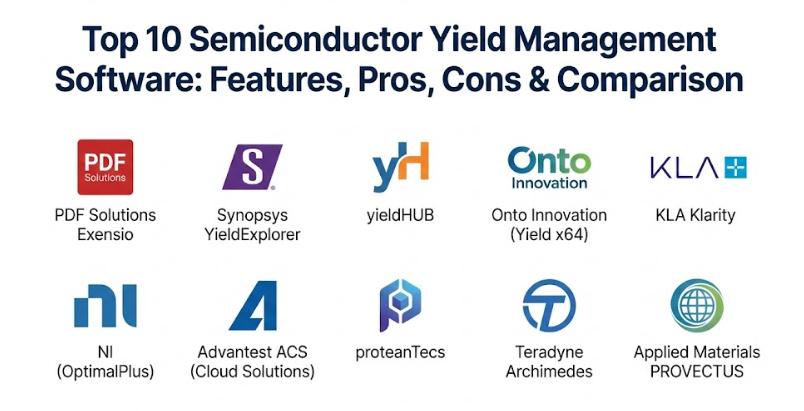
Top 10 Semiconductor Yield Management Software Tools
1 — PDF Solutions Exensio
Exensio is widely considered the industry standard for end-to-end data analytics in the semiconductor supply chain. It is designed to collect data from every stage—from the initial design and wafer fabrication to final assembly and testing—providing a “single source of truth” for the entire life of a chip.
- Unified Data Model: Connects data from diverse sources like testers, sensors, and design files into one database.
- Predictive Analytics: Uses machine learning to predict which wafers are likely to have issues before they finish the line.
- Design-to-Silicon Correlation: Links physical manufacturing results directly back to the original digital design.
- Fault Detection and Classification: Automatically identifies when a machine in the factory is drifting out of spec.
- Global Collaboration: Allows teams in different countries to look at the same data in real-time.
- Yield-Aware Testing: Adjusts testing protocols dynamically based on the health of the wafer.
Pros:
- Incredibly deep and powerful analytics that can handle the most complex chip designs in the world.
- It covers the entire lifecycle, meaning you don’t have to switch between different tools for different stages.
Cons:
- The software is very complex and usually requires significant training or dedicated experts to run it.
- Implementation can be a major project that takes several months to set up correctly.
Security & compliance: SOC 2 compliant; features advanced encryption, multi-factor authentication, and strict audit logs for data access.
Support & community: Professional enterprise support, on-site consulting services, and a well-established user community with regular global conferences.
2 — Synopsys YieldExplorer
YieldExplorer is a powerful analysis tool that focuses heavily on the link between chip design and manufacturing. It is designed for engineers who need to understand how the physical layout of a chip impacts its final yield.
- Physical Layout Integration: Allows users to overlay test data directly onto the visual map of the chip’s layers.
- In-line Defect Analysis: Combines inspection data with electrical test results to find “killer” defects.
- Volume Diagnosis: Analyzes thousands of test failures at once to find common patterns in the logic.
- Fast Search Engine: Uses specialized databases to search through terabytes of data in seconds.
- Custom Scripting: Allows advanced users to write their own analysis routines for unique problems.
- Automated Data Cleaning: Automatically removes “garbage” data that can skew yield reports.
Pros:
- Excellent at bridging the gap between what the designers intended and what the factory actually built.
- The visualization tools make it very easy to “see” where the problems are occurring on the wafer.
Cons:
- Best used by engineers who have a strong background in both design and manufacturing.
- Can be resource-heavy, requiring powerful servers to maintain top performance.
Security & compliance: ISO 27001; industry-standard encryption and secure user-based permission levels.
Support & community: High-quality documentation, professional technical support, and deep integration with the wider Synopsys ecosystem.
3 — yieldHUB
yieldHUB is a cloud-based platform that has gained popularity for being highly accessible and user-friendly. It is particularly well-suited for fabless companies that need to monitor production at distant manufacturing partners.
- Cloud-Native Platform: Accessible from any browser without needing to install heavy software on local computers.
- Automated Data Upload: Automatically pulls data from manufacturing partners (foundries) as soon as it is ready.
- Alerting System: Sends immediate notifications via email or app when yield drops below a certain level.
- Gage R&R Tools: Built-in features to ensure that testing equipment is accurate and consistent.
- Scalable Architecture: Can easily grow from a small project to a massive multi-product portfolio.
- Collaboration Dashboards: Simple, shareable views that help non-experts understand the current status.
Pros:
- Very fast to implement; you can often start seeing your data in a matter of days.
- The pricing model is often more flexible for mid-sized companies compared to the giant enterprise suites.
Cons:
- While powerful, it may lack some of the deepest design-level integrations found in tools like Synopsys.
- Some very traditional companies may still prefer on-premise solutions over cloud-based ones.
Security & compliance: GDPR compliant; uses secure AWS/Azure hosting with 256-bit encryption and regular security audits.
Support & community: Responsive customer support team and a very helpful onboarding process for new teams.
4 — Onto Innovation (Yield x64)
Onto Innovation provides a suite of tools focused on “total yield,” combining high-speed inspection data with traditional test data. Their software is built to help factories act fast when they spot a physical defect on a wafer.
- Automated Defect Classification: Uses AI to look at microscope images and decide what kind of defect is present.
- Spatial Pattern Recognition: Detects “signatures” like rings or scratches on a wafer that point to specific machine errors.
- Multi-Sensor Fusion: Combines data from physical measurement tools and electrical testers.
- Real-Time Dashboards: Displays live status of the production line on large screens in the factory.
- Historical Benchmarking: Compares current production against “golden” runs from the past.
- Root Cause Analysis: Suggests which step in the hundreds of manufacturing stages is likely causing the problem.
Pros:
- The visual defect recognition is top-tier, saving hours of manual microscope work.
- Highly effective at preventing “excursions” where a broken machine ruins multiple batches of wafers.
Cons:
- Primarily focused on the manufacturing floor; less focused on the design side of the house.
- It works best when paired with Onto’s own hardware, though it does support other sources.
Security & compliance: SOC 2 Type II; features robust data silos to keep different customer data separate.
Support & community: Global field application engineers provide hands-on help; strong presence in major chip-making regions like Asia.
5 — KLA Klarity
KLA is a giant in the inspection world, and their Klarity software is the primary tool many factories use to manage defect data. It is designed to turn images of tiny particles into a plan for improving yield.
- Defect Source Identification: Links specific particles or scratches to the exact machine that caused them.
- Wafer Map Management: Visualizes every defect on every wafer across an entire lot.
- Automated Reporting: Generates the daily “yield report” for management automatically.
- Sampling Optimization: Tells engineers exactly how many wafers they need to inspect to be safe, saving time.
- Integration with Reticle Data: Connects defect data with the “masks” used to print the chips.
Pros:
- The gold standard for defect management; if a factory uses KLA hardware, this software is almost mandatory.
- Very stable and reliable, having been refined over decades of use in the world’s top fabs.
Cons:
- Can feel a bit “old school” in its user interface compared to newer cloud startups.
- It is a premium product with a price tag to match.
Security & compliance: Meets strict international standards for intellectual property protection in the semiconductor industry.
Support & community: Extensive training programs and a massive network of users across the world’s largest foundries.
6 — NI (OptimalPlus)
Acquired by NI (formerly National Instruments), OptimalPlus focuses heavily on the big data produced during the “back-end” of the process—testing and assembly. It is a favorite for companies in the automotive and aerospace industries.
- Supply Chain Visibility: Tracks a single chip from the wafer in the fab to the final product in a car.
- Adaptive Testing: Skips certain tests on “healthy” chips to save time while testing “risky” chips more thoroughly.
- Outlier Detection: Finds chips that “pass” the test but behave slightly differently, which might mean they will fail later.
- Real-Time Edge Analytics: Processes data right at the testing machine for instant decision-making.
- Machine Learning Models: Learns what a “good” chip looks like over millions of examples.
Pros:
- Unbeatable for “traceability”—knowing the history of every single chip in your product.
- Reduces testing costs by making the process smarter rather than just longer.
Cons:
- The software can be heavy to manage and requires a good understanding of big data infrastructure.
- It is more focused on the test floor than on the chemical processing stages of the fab.
Security & compliance: ISO 27001 and GDPR; highly secure data handling for sensitive automotive and defense clients.
Support & community: Backed by the global reach of NI, with excellent technical support and documentation.
7 — Advantest ACS (Cloud Solutions)
Advantest is a leader in testing equipment, and their ACS platform is built to provide a modern, open data environment for test data. It aims to break down the walls between different pieces of equipment.
- Open Data Ecosystem: Allows different software tools to plug into the Advantest data stream.
- Workload Orchestration: Manages how data is processed across different servers to prevent bottlenecks.
- Edge-to-Cloud Connectivity: Moves data seamlessly from the test floor to the corporate office.
- Real-Time Monitoring: Watch tests as they happen from a remote location.
- Partner Solutions: Allows third-party apps to run directly on the testing platform.
Pros:
- Very flexible and “open,” making it easier for companies to build their own custom tools on top of it.
- Deep integration with Advantest testers, which are used by almost every major chip maker.
Cons:
- Because it is an “open” platform, it might require more effort from your internal IT team to customize.
- Still evolving compared to some of the more “packaged” yield suites.
Security & compliance: Uses secure data containers and modern encryption; ISO 21434 compliant.
Support & community: Strong developer support and a growing ecosystem of partner companies.
8 — proteanTecs
proteanTecs is a newer player that uses a “Deep Data” approach. Instead of just looking at the chip from the outside, they include tiny sensors inside the chip design itself to report on its health.
- On-Chip Telemetry: Small “Agents” built into the chip provide data during production and even while the chip is in use.
- Degradation Monitoring: Tracks how a chip ages over time to predict failure before it happens.
- High-Resolution Insights: Provides data points that external testers simply cannot see.
- Cloud Analytics: Aggregates data from “Agents” across millions of chips to find common issues.
- Predictive Maintenance for Chips: Tells you when a chip in a server or car needs to be replaced.
Pros:
- Offers a level of detail that is impossible with traditional “external” testing alone.
- Provides value even after the chip has been sold, which is a major differentiator.
Cons:
- Requires designers to include the “Agents” in their original chip design, which takes up a small amount of space.
- It is a newer technology, so it may take time for traditional teams to change their workflow.
Security & compliance: Advanced data protection; focus on supply chain security and anti-counterfeiting.
Support & community: High-touch engineering support to help integrate agents into new chip designs.
9 — Teradyne Archimedes
Teradyne is another giant in the testing space, and their Archimedes platform is built to bring AI and machine learning directly to the test floor. It focuses on making fast, smart decisions.
- Real-Time Data Streaming: Pushes test data to analytics engines with almost zero delay.
- Closed-Loop Feedback: Can automatically change the test program if it detects a problem.
- AI Model Deployment: Makes it easy to push new machine learning models to the testing machines.
- Security Silos: Ensures that data from one product doesn’t mix with another.
- Hardware Acceleration: Uses specialized chips to speed up the analysis of test data.
Pros:
- The “speed” of this platform is its biggest strength; it handles massive amounts of data in real-time.
- Built to be very secure, which is vital for high-end chip makers.
Cons:
- Most effective when using Teradyne testing hardware.
- The focus is primarily on the “test” portion of the yield journey.
Security & compliance: SOC 2 compliant; features robust “data bunkers” for extreme privacy.
Support & community: Global support network with specialized experts in AI and test engineering.
10 — Applied Materials PROVECTUS
Applied Materials makes the machines that actually build the chips, and PROVECTUS is their software layer that optimizes how those machines work together to maximize yield.
- Equipment Health Monitoring: Tracks the “pulse” of the manufacturing machines to ensure they are perfect.
- Virtual Metrology: Uses math to “guess” the thickness or quality of a layer without having to stop and measure it.
- Run-to-Run Control: Adjusts the settings for the next wafer based on the results of the last one.
- Sensor Fusion: Combines data from thousands of internal machine sensors.
- Process Optimization: Suggests changes to chemical recipes to improve the results.
Pros:
- Deepest possible knowledge of the “physics” of chip making; it knows the machines better than anyone.
- Can prevent problems before they even appear on a test wafer.
Cons:
- Primarily a tool for the “Fab” (the factory) rather than for design or final testing.
- Often requires using Applied Materials equipment to get the full benefit.
Security & compliance: High-level industrial security; designed for the most sensitive manufacturing environments.
Support & community: Professional service contracts with 24/7 support for high-volume factories.
Comparison Table
| Tool Name | Best For | Platform(s) Supported | Standout Feature | Rating |
| PDF Exensio | Full Supply Chain | Web / On-Premise | End-to-End Unified Data | N/A |
| YieldExplorer | Design-to-Yield | Web / Desktop | Visual Layout Correlation | N/A |
| yieldHUB | Fabless & SMBs | Cloud (SaaS) | Fast Implementation | N/A |
| Onto Yield x64 | Defect Inspection | Web / On-Premise | AI Defect Classification | N/A |
| KLA Klarity | Factory Defect Mgmt | On-Premise | Industry-Standard Defect Tracking | N/A |
| NI OptimalPlus | Traceability / Automotive | Web / On-Premise | Supply Chain Traceability | N/A |
| Advantest ACS | Open Test Ecosystem | Cloud / Edge | Open Data Architecture | N/A |
| proteanTecs | Deep On-Chip Data | Cloud | Internal Chip “Agents” | N/A |
| Teradyne Archimedes | Real-Time AI Testing | Edge / Local | High-Speed AI Feedback | N/A |
| Applied Materials | Fab Process Control | On-Premise | Virtual Metrology | N/A |
Evaluation & Scoring of Semiconductor Yield Management Software
The following rubric shows how these professional tools are typically judged by engineering teams before they make a purchase.
| Criteria | Weight | Evaluation Focus |
| Core Features | 25% | Analysis depth, AI capabilities, and data visualization. |
| Ease of Use | 15% | Training requirements and the clarity of the user interface. |
| Integrations | 15% | Ability to “talk” to different brands of testers and foundries. |
| Security | 10% | Encryption, IP protection, and compliance with SOC 2 or ISO. |
| Performance | 10% | Speed of processing terabytes of data and system uptime. |
| Support | 10% | Quality of technical documentation and availability of experts. |
| Price / Value | 15% | The ROI generated by improving yield vs. the cost of the seat. |
Which Semiconductor Yield Management Software Tool Is Right for You?
Selecting a tool in this high-stakes industry depends on where you sit in the supply chain and how much data you generate.
Solo Users vs. SMB vs. Mid-Market vs. Enterprise
If you are a mid-market fabless company with a small team, yieldHUB is often the best choice because it is cloud-based and easy to start. Large enterprises like Intel or TSMC will almost always require the massive power of PDF Exensio or Synopsys, as they have the staff and infrastructure to manage these complex systems.
Budget-Conscious vs. Premium Solutions
For those on a strict budget, looking for “pay-as-you-go” cloud models is best. yieldHUB and Advantest ACS offer more flexible entry points. Premium solutions like KLA Klarity or Applied Materials require a larger investment but are often considered “insurance” against much more expensive production failures.
Feature Depth vs. Ease of Use
If you need to find the root cause of a tiny chemical variation, you need the feature depth of Exensio. If you just need a dashboard to show your investors that your yield is improving month-over-month, a simpler, more visual tool is better.
Integration and Scalability Needs
If you work with many different foundries across the globe, you need a tool with an “Open” philosophy. Advantest ACS and yieldHUB are built to be very flexible. If you are a fully vertically integrated company that owns your own factory, “closed-loop” systems from Applied Materials or KLA can offer tighter control.
Security and Compliance Requirements
If you are making chips for the military or for medical devices, security is your number one priority. In these cases, look for tools that offer On-Premise versions and meet ISO 27001 or SOC 2 standards to ensure your chip designs never leave your network.
Frequently Asked Questions (FAQs)
1. What is “Yield” in the semiconductor industry?
Yield is the percentage of chips on a wafer that function correctly and pass all tests. Higher yield means more profit and less wasted material.
2. Can I use this software if I don’t own a factory?
Yes. “Fabless” companies use this software to analyze data sent to them by their manufacturing partners (foundries) to ensure they are getting what they paid for.
3. Does this software work with any testing machine?
Most leading tools are “tester-agnostic,” meaning they can read data from Advantest, Teradyne, or NI machines, but you should always verify the specific file formats they support.
4. How long does it take to implement these tools?
Cloud solutions can be ready in a few days, but full enterprise installations in a large factory can take six months or more to fully calibrate and integrate.
5. How much data do these tools handle?
A modern chip factory can generate several terabytes of data every single day. These tools are built specifically to search through that data without crashing.
6. Is my intellectual property (IP) safe in the cloud?
Yes, modern providers use extreme security measures, but if you have very sensitive government contracts, you may prefer an “On-Premise” version where the data stays on your own servers.
7. Can the software predict failures before they happen?
Yes, many of these tools use AI to spot “drifts” in machine performance, allowing engineers to fix a tool before it starts making bad chips.
8. What is the difference between “Front-end” and “Back-end” yield?
Front-end yield refers to the physical making of the wafer, while back-end yield refers to the testing, cutting, and packaging of the individual chips.
9. Do I need to be a data scientist to use these tools?
While data science skills help, most of these tools are designed for engineers and use “human” dashboards so you don’t have to write code to get answers.
10. What are the common reasons for low yield?
Dust particles, chemical variations, machine wear-and-tear, and even tiny changes in temperature or humidity in the factory can all lower yield.
Conclusion
In the semiconductor world, where the difference between success and failure is measured in nanometers, having the right yield management software is not optional—it is a survival requirement. The “best” tool for your team depends on your specific place in the industry. A factory manager needs the machine-level control of Applied Materials, while a product engineer needs the deep data visibility of Exensio or the innovative on-chip sensors of proteanTecs.
Ultimately, the goal of all these tools is to turn raw, overwhelming data into simple, actionable insights. By choosing a platform that fits your budget, security needs, and technical expertise, you can ensure that your manufacturing process stays efficient, your costs stay low, and your “good” chips continue to power the modern world.