Introduction
Relevance Evaluation Toolkits are specialized software frameworks designed to measure how well a system’s output matches a user’s intent. They provide the mathematical metrics—like Precision, Recall, nDCG, and MRR—and the workflow infrastructure needed to compare different algorithms, track improvements over time, and ensure that your “rankings” are statistically significant.
These toolkits are vital because “relevance” is subjective and prone to drift. Without a formal evaluation framework, developers often rely on “vibe checks” or anecdotal evidence, which leads to poor user experiences and wasted compute resources. Real-world use cases include e-commerce companies optimizing product search, legal firms evaluating document discovery tools, and AI researchers benchmarking new embedding models. When choosing a toolkit, you should look for support for diverse metrics, ease of integration with your data stack, the ability to handle human-in-the-loop labels, and scalability for large-scale “judgment” datasets.
Best for: Data scientists, search engineers, and AI researchers in mid-to-large enterprises, particularly those in e-commerce, legal tech, and academic research. It is also essential for teams building RAG-based applications who need to validate their retrieval quality.
Not ideal for: Small teams with very basic, out-of-the-box search implementations where the default ranking is sufficient. If you aren’t actively tuning an algorithm or comparing multiple models, the overhead of setting up a relevance evaluation framework may not be worth the effort.
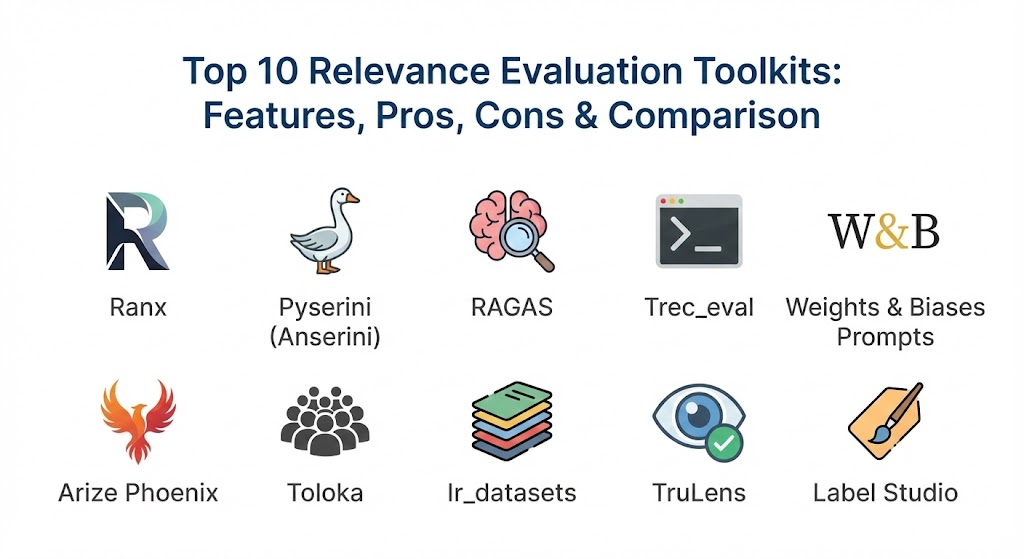
Top 10 Relevance Evaluation Toolkits
1 — Ranx
Ranx is a modern, high-performance Python library designed for ranking evaluation. It is built to handle massive datasets with ease and focuses on providing a fast, “scikit-learn-style” interface for researchers and practitioners.
- Key features:
- Support for over 30 standard IR metrics (NDCG, MAP, MRR, etc.).
- Blazing fast computation using Numba-accelerated functions.
- Integrated statistical tests (t-test, Wilcoxon, etc.) to ensure results are meaningful.
- Ability to aggregate results across multiple “qrels” (query-relevance labels).
- Seamless export of LaTeX tables for academic reporting.
- Support for “Fusion” techniques to combine results from different rankers.
- Pros:
- Exceptionally fast, making it ideal for large-scale benchmarks.
- The API is very clean and intuitive for anyone familiar with the Python data stack.
- Cons:
- It is a library, not a full GUI application, so it requires coding knowledge.
- Limited built-in tools for gathering human labels (it assumes you already have them).
- Security & compliance: N/A (Client-side library).
- Support & community: Active GitHub community, comprehensive Python documentation, and growing adoption in the research community.
2 — Pyserini (Anserini)
Pyserini is a Python toolkit that provides a bridge to Anserini, a widely used Lucene-based search toolkit. It is designed to make “reproducible” search research accessible, particularly for those working on “dense” and “sparse” retrieval.
- Key features:
- Built-in support for BM25 and newer neural (dense) retrieval models.
- Easy access to standard TREC collections and benchmarks.
- Tight integration with Hugging Face for transformer-based ranking.
- Multi-stage pipeline evaluation (retrieval + re-ranking).
- Extensive documentation on “Leaderboard” style reproducibility.
- Pros:
- The “gold standard” for academic search research and reproducibility.
- Excellent support for hybrid search models that combine keywords and vectors.
- Cons:
- Has a dependency on Java (via PyJNIus), which can make installation finicky.
- Focused more on research than production “real-time” monitoring.
- Security & compliance: Varies (Depends on underlying Lucene/Java configuration).
- Support & community: Massive academic backing, extensive wiki, and very active Slack and GitHub support.
3 — RAGAS (RAG Assessment)
RAGAS is a specialized framework designed for the specific needs of Retrieval-Augmented Generation. Instead of just looking at document ranks, it evaluates the “relevance” of the retrieved context in relation to the LLM’s final answer.
- Key features:
- “Faithfulness” and “Answer Relevance” metrics to detect hallucinations.
- “Context Precision” and “Context Recall” tailored for RAG pipelines.
- Ability to generate synthetic test datasets using your own documents.
- Integration with LangChain and LlamaIndex.
- Support for using LLMs as “judges” (LLM-assisted evaluation).
- Pros:
- The most popular tool for the specific challenges of modern AI and RAG.
- Helps bridge the gap between “search engineering” and “prompt engineering.”
- Cons:
- Relying on LLMs for evaluation can be expensive and introduce its own bias.
- Less focused on traditional keyword search (BM25) benchmarks.
- Security & compliance: GDPR compliant (as a library); security depends on the LLM provider (OpenAI, Anthropic, etc.) used.
- Support & community: High-growth community, frequent updates, and extensive blog-based tutorials.
4 — Trec_eval
Trec_eval is the classic, standard tool for evaluating search results in the TREC (Text REtrieval Conference) community. It is a C-based command-line tool that has been the industry benchmark for decades.
- Key features:
- The most rigorous implementation of standard IR metrics.
- Highly optimized for command-line pipe workflows.
- Extensive support for “trec_results” and “qrels” file formats.
- Ability to calculate metrics at specific “cutoffs” (e.g., P@10, NDCG@20).
- Statistical summaries that are widely accepted in peer-reviewed literature.
- Pros:
- If a tool claims to calculate NDCG, it is usually checked against Trec_eval.
- Extremely stable and lightweight; it will run on virtually any system.
- Cons:
- The output format is text-heavy and requires manual parsing or external scripts to visualize.
- No native support for modern vector-based or dense retrieval without conversion.
- Security & compliance: N/A (Standard local C binary).
- Support & community: Legacy support; widely documented in almost every search engineering textbook.
5 — Weights & Biases (W&B) Prompts
W&B Prompts is part of the broader Weights & Biases MLOps platform. It provides a visual interface to track and evaluate the relevance of outputs from search and generative AI models.
- Key features:
- Visual “Trace” view to see what was retrieved and what was generated.
- Comparison tables to side-by-side evaluate different model versions.
- Support for human annotation and “thumbs-up/down” feedback.
- Integration with automated evaluation metrics (ROUGE, BLEU, etc.).
- Centralized dashboard for team-wide experiment tracking.
- Pros:
- Exceptional UI/UX that makes it easy for teams to collaborate on relevance.
- Fits into a broader MLOps lifecycle, including model training and deployment.
- Cons:
- It is a commercial platform; the free tier has limitations for enterprise use.
- Can feel like “overkill” if you only need simple offline ranking metrics.
- Security & compliance: SOC 2 Type II, GDPR, HIPAA compliant, and ISO 27001.
- Support & community: Enterprise-grade support, massive user base, and active “W&B Academy.”
6 — Arize Phoenix
Arize Phoenix is an open-source observability library for LLMs and search. It specializes in “embedding analysis,” allowing you to visualize why certain documents were (or weren’t) considered relevant.
- Key features:
- UMAP/t-SNE visualization of document and query embeddings.
- Detection of “retrieval clusters” and gaps in your knowledge base.
- Automated evaluation of RAG relevance using heuristics and LLM-evals.
- Support for tracking “LLM spans” and latency alongside relevance.
- Exportable “eval sets” for regression testing.
- Pros:
- The visual embedding map is a game-changer for debugging “hard” queries.
- Open-source and easy to run locally in a Jupyter notebook.
- Cons:
- Focuses more on “observability” than traditional batch ranking benchmarks.
- Requires a good understanding of vector embeddings to be fully utilized.
- Security & compliance: GDPR compliant; self-hosted options provide high data privacy.
- Support & community: Strong Discord community and high-quality technical documentation.
7 — Toloka (Relevance Metrics)
Toloka is a data-labeling and evaluation platform. It goes beyond software to provide the “human” part of relevance—actual people who can judge if a result is relevant to a query.
- Key features:
- Access to a global crowd of “judges” for manual relevance labeling.
- Integrated templates for Side-by-Side (SBS) evaluation.
- Quality control mechanisms (honey pots, consensus) for labels.
- API-driven workflows to trigger human evaluation after model changes.
- Detailed analytics on inter-annotator agreement.
- Pros:
- The only way to get a “Ground Truth” that reflects real human nuance.
- Essential for building “Golden Datasets” that automated tools use.
- Cons:
- Can be expensive and slow compared to automated heuristics.
- Requires careful design of “human instructions” to get consistent results.
- Security & compliance: GDPR, ISO 27001, and SOC 2 Type II compliant.
- Support & community: Dedicated account managers for enterprise and a large knowledge base for “task design.”
8 — Ir_datasets
Ir_datasets is a Python library that provides a common interface to a vast number of ranking datasets. While not an “evaluator” itself, it is the standard toolkit for loading the data that relevance evaluations require.
- Key features:
- One-click access to hundreds of IR datasets (TREC, MS MARCO, BEIR).
- Standardized format for queries, documents, and relevance labels (qrels).
- Streaming support to handle datasets that are too large for local RAM.
- Integration with Ranx and Pyserini for end-to-end workflows.
- Automated download and verification of dataset integrity.
- Pros:
- Saves hours of manual data cleaning and formatting.
- Ensures that you are evaluating on the same data as the rest of the industry.
- Cons:
- It is a data-loading utility, so you still need another tool (like Ranx) to do the math.
- Requires significant disk space to store local copies of large datasets.
- Security & compliance: N/A (Data loading library).
- Support & community: Well-maintained GitHub and used as a foundation for many academic papers.
9 — TruLens
TruLens (by TruEra) is an evaluation toolkit for LLM applications. It introduced the concept of the “RAG Triad,” which specifically measures relevance across three distinct connections: Query-to-Context, Context-to-Answer, and Query-to-Answer.
- Key features:
- The “RAG Triad” evaluation framework for deep diagnostics.
- “Feedback Functions” that can be based on BERT, LLMs, or custom code.
- Dashboard for tracking relevance over different versions of your app.
- Low-latency evaluation that can be run as part of a live app.
- Support for “ground truth” comparison where available.
- Pros:
- Excellent at diagnosing where a relevance failure happened (retrieval vs. generation).
- Very visual and helpful for explaining AI quality to non-technical stakeholders.
- Cons:
- More focused on Generative AI than traditional e-commerce search.
- Some of the more advanced features are gated behind a commercial platform.
- Security & compliance: SOC 2 Type II, GDPR compliant, and private cloud deployment options.
- Support & community: Strong corporate backing, active Slack community, and frequent webinars.
10 — Label Studio (Search Eval)
Label Studio is a versatile open-source data labeling tool. It provides a highly customizable UI that can be configured specifically for search relevance and ranking evaluation tasks.
- Key features:
- Customizable ranking UIs (e.g., drag-and-drop to re-rank results).
- Support for multi-modal relevance (e.g., “Does this image match this text?”).
- Integration with machine learning models to provide “pre-labels.”
- Collaboration features for teams of internal subject matter experts.
- Flexible export formats for training search models (LTR – Learning to Rank).
- Pros:
- The most flexible UI for human evaluation on the market.
- Open-source and can be fully self-hosted for sensitive data.
- Cons:
- Requires significant “UI configuration” work to set up a search-specific task.
- Doesn’t calculate IR metrics natively; you must export data to a tool like Ranx.
- Security & compliance: GDPR compliant, SOC 2 for the Enterprise version, and SSO support.
- Support & community: Large open-source community, active Discord, and commercial support available.
Comparison Table
| Tool Name | Best For | Platform(s) Supported | Standout Feature | Rating |
| Ranx | Fast Python Metrics | Python (Library) | Speed & Statistical Tests | 4.8 |
| Pyserini | Search Research | Python / Java | TREC Collection Access | 4.7 |
| RAGAS | RAG Pipeline Eval | Python (Library) | LLM-based Heuristics | 4.6 |
| Trec_eval | Industry Benchmarking | C (CLI) | Legacy Precision | N/A |
| W&B Prompts | Team Collaboration | Cloud (SaaS) | Visual Experiment Traces | 4.5 |
| Arize Phoenix | Embedding Analysis | Python / Jupyter | UMAP Vector Visualization | 4.7 |
| Toloka | Human Ground Truth | Cloud (Platform) | Global Crowd Access | N/A |
| Ir_datasets | Loading Benchmarks | Python (Library) | Dataset Standardization | N/A |
| TruLens | RAG Diagnostics | Python (Library) | The RAG Triad Framework | 4.5 |
| Label Studio | Custom Annotation | Self-Hosted / SaaS | Multi-modal UI Flex | 4.4 |
Evaluation & Scoring of Relevance Evaluation Toolkits
Choosing the right toolkit depends on your technical stack and whether you are focusing on “Automatic” (math-based) or “Manual” (human-based) evaluation.
| Category | Weight | Description |
| Core Features | 25% | Number of metrics, support for RAG, and statistical testing. |
| Ease of Use | 15% | API quality, documentation, and UI/UX for non-coders. |
| Integrations | 15% | Connections to Elasticsearch, Pinecone, LangChain, etc. |
| Security & Compliance | 10% | SOC 2, GDPR, and ability to handle private data. |
| Performance | 10% | Computation speed and handling of millions of queries. |
| Support & Community | 10% | GitHub activity, Discord/Slack help, and commercial SLAs. |
| Price / Value | 15% | Open-source flexibility vs. commercial time-savings. |
Which Relevance Evaluation Toolkits Tool Is Right for You?
Solo Users vs SMB vs Mid-Market vs Enterprise
If you are a Solo User or developer working on a side project, Ranx or Arize Phoenix are your best bets; they are free, fast, and run on your laptop. SMBs looking to optimize a production search engine should look at RAGAS or TruLens to ensure their AI isn’t hallucinating. Enterprises with massive scale and strict compliance should consider Weights & Biases or the enterprise version of Label Studio, as they provide the audit logs and team collaboration tools needed for corporate environments.
Budget-Conscious vs Premium Solutions
If you are on a tight budget, stick to the open-source libraries: Ranx, Pyserini, and Trec_eval. These provide world-class math for $0. If you have a budget and need to move fast, Toloka or Weights & Biases will save you weeks of building internal tools for tracking and human evaluation.
Feature Depth vs Ease of Use
For Feature Depth and academic rigor, nothing beats Pyserini and Trec_eval. They are complicated but “correct.” For Ease of Use, Arize Phoenix and RAGAS offer the most modern, developer-friendly experience for the current “AI-first” era.
Integration and Scalability Needs
If you need to scale to millions of relevance judgments, Ranx is the only library optimized for that level of speed. If you are already deep in the Salesforce or AWS ecosystem, you might find that commercial MLOps tools integrate more cleanly with your existing security protocols.
Frequently Asked Questions (FAQs)
1. What is the difference between Precision and Recall?
Precision is the percentage of results you showed that were actually relevant. Recall is the percentage of all possible relevant results that you managed to show.
2. What is nDCG and why is it popular?
nDCG stands for normalized Discounted Cumulative Gain. It is popular because it doesn’t just check if a result is relevant; it checks if it is in the right order. Relevant results at the top are worth more than relevant results at the bottom.
3. Do I need human labels to evaluate relevance?
Ideally, yes. This is called “Ground Truth.” However, modern toolkits like RAGAS use LLMs to simulate human labels, which is faster and cheaper, though slightly less accurate.
4. How many queries do I need for a good evaluation?
For statistical significance, most researchers recommend at least 50 to 100 diverse queries. For a production system, you might evaluate on thousands of real user queries.
5. Can these tools help with “hallucinations”?
Yes. Toolkits like TruLens and RAGAS are specifically designed to catch when an AI generates a relevant-sounding answer that isn’t actually supported by the source documents.
6. What is “Inter-annotator agreement”?
This is a measure of how much two human judges agree on a relevance label. If they disagree often, your instructions are likely unclear.
7. Can I evaluate image or video search?
Yes, tools like Label Studio and Toloka allow you to set up multi-modal tasks where humans judge the relevance of images to text queries.
8. What is a “Golden Dataset”?
It is a small, perfectly labeled set of queries and results that you use as a benchmark to test every new version of your algorithm.
9. Is Trec_eval still relevant?
Absolutely. While it is old, it remains the industry standard for verifying that your mathematical implementation of metrics is accurate.
10. How much do these tools cost?
The libraries are free (Open Source). Commercial data labeling (Toloka) or MLOps platforms (W&B) can range from $500/month to six figures for large enterprises.
Conclusion
Building a search or AI system without a Relevance Evaluation Toolkit is like flying a plane without a dashboard. You might feel like you’re moving fast, but you have no idea if you’re heading in the right direction.
If you are working on modern RAG and LLM applications, RAGAS and Arize Phoenix are the current leaders in developer-friendly evaluation. If you are a traditional search engineer tuning a keyword engine, the speed of Ranx and the rigor of Pyserini are unbeatable.
The “best” tool is the one that fits your data and your team’s workflow. Start with a simple “Golden Dataset,” pick one of these toolkits to calculate your baseline NDCG, and stop guessing about your system’s quality.