Introduction
Regulatory Submission Management Tools are specialized software platforms that help healthcare and life sciences companies organize and send important documents to government agencies. When a company creates a new medicine or a medical device, they must prove to the government that it is safe and works well. These tools act like a high-tech filing cabinet and a mailing system combined. They help teams gather thousands of pages of research, format them correctly, and track them until the government gives its approval.
These tools are incredibly important because they prevent mistakes that could stop a life-saving product from reaching patients. In the past, people had to manage huge stacks of paper by hand. Today, these digital systems make sure every file is in the right spot and follows the strict rules set by health authorities. Using these tools helps companies work faster, stay organized, and avoid the risk of losing important data.
Key real-world use cases include preparing applications for new drugs, managing updates for products already on the market, and coordinating with teams across different countries to make sure everyone is using the latest version of a document. When looking for a tool, you should check if it is easy for your team to use, if it can handle rules from many different countries, and if it can automatically find errors before you hit the “send” button.
Best for: This software is best for pharmaceutical companies, biotech firms, and medical device makers of all sizes. It is especially helpful for regulatory affairs teams and quality managers who need to keep their data organized and compliant with global rules.
Not ideal for: These tools may not be necessary for very small research groups that are not yet ready to apply for product approvals. Companies that do not deal with highly regulated healthcare products, such as basic consumer goods, would likely find these systems too complex for their needs.
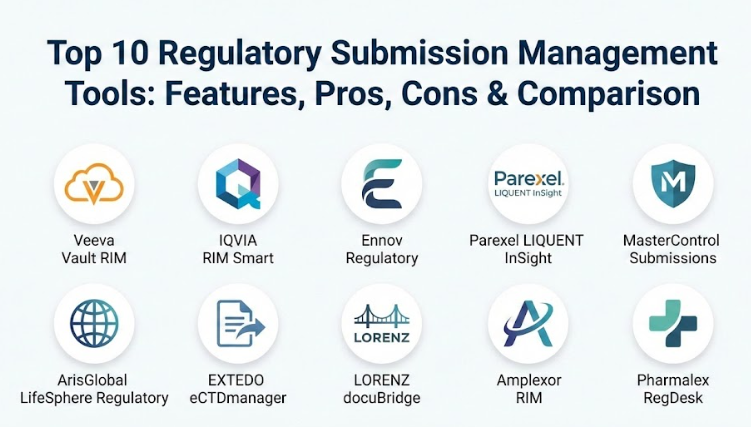
Top 10 Regulatory Submission Management Tools
1 — Veeva Vault RIM
Veeva Vault RIM is a modern, cloud-based platform that brings all your regulatory tasks into one single home. It is designed to help companies manage registrations, submissions, and documents without having to switch between different programs.
- Single system for everything so you don’t have to move files between different software.
- Automated publishing that creates the final submission files as you work.
- Global tracking to see the status of your products in every country at a glance.
- Smart dashboards that show your team’s progress and any upcoming deadlines.
- Real-time collaboration allowing multiple people to work on the same project at once.
- Seamless document links that make sure you are always using the most recent version of a file.
Pros:
- It is very fast and works through your web browser, so you can access it from anywhere.
- The system is built to grow with your company, whether you have one product or hundreds.
Cons:
- Because it has so many features, it can take some time for new users to learn everything.
- The cost can be higher than simpler tools, which might be a challenge for very small budgets.
Security & compliance: Uses high-level encryption and detailed audit logs to keep your data safe. It fully meets global standards like GDPR and 21 CFR Part 11.
Support & community: Provides excellent online help guides, a dedicated support team, and a large group of users who share tips and best practices.
2 — IQVIA RIM Smart
IQVIA RIM Smart uses advanced technology to help automate the boring and repetitive parts of regulatory work. It is built for teams that want to work smarter by using “intelligent” features to manage their global filings.
- Intelligent automation that helps fill out forms and organize data automatically.
- Built-in regulatory rules for many different countries so you don’t have to look them up manually.
- End-to-end planning that follows a product from the first idea to the final approval.
- Drag-and-drop filing which makes it very easy to move documents into the right folders.
- Centralized communication to track every meeting and letter sent to health agencies.
- Advanced reporting that creates clear charts to show management how things are going.
Pros:
- The automation features save a lot of time by doing the manual data entry for you.
- It is excellent at managing very large amounts of data without getting slow or confusing.
Cons:
- The screen can look a bit busy because it shows a lot of information at one time.
- It requires a good amount of setup at the beginning to make sure everything works perfectly for your specific needs.
Security & compliance: Features strong security measures including SSO (Single Sign-On) and constant monitoring to protect sensitive research.
Support & community: Offers 24-hour technical support and a library of training videos to help your team get up to speed.
3 — Ennov Regulatory
Ennov Regulatory is known for being very user-friendly and flexible. It is a great choice for companies that want a tool that is easy to understand but still powerful enough to handle complex global submissions.
- Unified platform that connects regulatory data with your document management system.
- Simple web interface that feels familiar and easy to navigate for any office worker.
- Configurable workflows so you can set up the tool to match the way your team already works.
- Fast publishing engine that turns your documents into ready-to-send files quickly.
- Commitment tracking to make sure you never miss a promise made to a health agency.
- Automated alerts that send emails to remind your team about important tasks.
Pros:
- It is one of the easiest tools to learn, which means your team can start using it right away.
- You can change many of the settings yourself without needing a computer expert to help you.
Cons:
- While it is very flexible, it might not have as many “out of the box” features for very specialized products.
- Some users might find that the mobile version of the tool is not as powerful as the desktop version.
Security & compliance: Fully compliant with industry security standards and provides a clear history of who changed what and when.
Support & community: Known for having a very helpful customer service team and clear, simple documentation.
4 — Parexel LIQUENT InSight
LIQUENT InSight is a very well-established name in the world of regulatory software. It is a solid and reliable choice that has been used by some of the biggest companies in the world for many years.
- Reliable publishing engine that is famous for creating perfect files every time.
- Global registration tracking that helps you manage products in many different languages.
- Historical archive so you can easily look back at everything you have ever submitted.
- Task management that allows managers to assign work and see who is finished.
- Deep integration with other research and development tools.
- Proven track record as it has been tested by almost every major health authority.
Pros:
- It is extremely stable and rarely has technical problems or “bugs.”
- The people who support this tool have a deep understanding of the pharmaceutical industry.
Cons:
- The software can feel a bit old-fashioned compared to some of the newer, more colorful tools.
- It can sometimes be slower to add new technology features compared to newer cloud companies.
Security & compliance: Adheres to all GxP standards and offers very high security for enterprise-level data.
Support & community: Offers professional training and a very reliable help desk for solving technical issues.
5 — MasterControl Submissions
MasterControl is a big name in quality management, and their submissions tool is designed to link your quality documents directly to your regulatory filings. This makes it a great choice if you already use their other products.
- Direct links to quality data so your submission always uses the most recent approved documents.
- Simple folder structure that makes it easy to organize thousands of files.
- Automated validation that checks your files against the rules of the FDA and other agencies.
- Collaborative reviewing where multiple people can leave comments on a document.
- Audit readiness so you are always prepared if a government inspector visits your office.
- Flexible deployment meaning you can use it in the cloud or on your own office servers.
Pros:
- If you already use MasterControl for quality, adding the submissions tool is very easy.
- It does a great job of making sure your documents follow the same rules from start to finish.
Cons:
- It is most powerful when used with the full MasterControl system, which might be more than you need.
- The setup process can be quite detailed and requires a lot of planning.
Security & compliance: Includes multi-layer security and is fully compliant with 21 CFR Part 11 and ISO standards.
Support & community: Provides a wealth of resources including webinars, a user community, and expert support.
6 — ArisGlobal LifeSphere Regulatory
LifeSphere is a modern platform that uses smart technology to help your team work faster. It focuses on bringing all parts of the drug lifecycle together, from safety to regulatory to quality.
- Smart automation that can read documents and help sort them into the right places.
- Unified data hub so you only have to enter information once for the whole company.
- Global authority rules that update automatically whenever a country changes its laws.
- Interactive tracking to see exactly where your application is in the approval process.
- Cloud-native design which means it is very fast and easy to access from a laptop.
- Team collaboration tools that make it easy for global teams to talk to each other.
Pros:
- The use of smart technology helps reduce the amount of manual typing your team has to do.
- It is very good for large companies that need to manage many different products at once.
Cons:
- The “smart” features can sometimes be a bit complex to set up correctly.
- Smaller companies might find it has more features than they actually need for their daily work.
Security & compliance: Built with top-tier cloud security and meets all major global privacy and data laws.
Support & community: Offers comprehensive enterprise support and a dedicated portal for training and help.
7 — EXTEDO eCTDmanager
EXTEDO is a specialist in the technical side of sending files to regulators. Their tool is widely used because it is very precise and is often the same software used by the government agencies themselves.
- Agency-standard validation which means if it passes in this tool, it will likely pass at the agency.
- Support for many formats including eCTD, NeeS, and even paper submissions.
- Simple document management that helps you keep track of every version of a file.
- User-friendly viewer so your team can see exactly what the regulator will see.
- Fast processing that can handle dossiers with hundreds of thousands of pages without slowing down.
- Regular updates to keep up with the latest technical rules from around the world.
Pros:
- It is very reliable and trusted by both companies and the government agencies that review the files.
- The tool focuses on being excellent at one specific task: making sure your submission is technically perfect.
Cons:
- It is a more technical tool, so it might not be as “pretty” as some other modern software.
- It doesn’t include as many features for the early planning stages of a product.
Security & compliance: Uses secure data handling and provides full audit trails for every action.
Support & community: Offers expert consulting and technical support from people who know the rules inside and out.
8 — LORENZ docuBridge
LORENZ docuBridge is a very flexible tool that can be used by a single person or a huge global corporation. It is known for being able to handle almost any type of regulatory filing.
- Scalable design that grows from a simple setup to a complex enterprise system.
- Document reuse so you can use the same file for many different countries without making copies.
- High-speed publishing that saves time when you are working against a tight deadline.
- Modular features so you only have to pay for the parts of the software you actually use.
- Cross-regional support that understands the unique rules for the US, Europe, and Asia.
- Easy-to-use templates that help you start your submission in the right format.
Pros:
- It is incredibly flexible and can be customized to fit almost any business size.
- The tool is very efficient at managing submissions that need to go to many different countries at once.
Cons:
- Some of the more advanced features can take a bit of extra effort to master.
- If you want all the extra modules, the total cost can start to add up.
Security & compliance: Highly secure with options for local hosting or cloud use, meeting all major global rules.
Support & community: Has a strong user community and provides regular training sessions for all skill levels.
9 — Amplexor RIM (myHealthCloud)
Amplexor focuses on making the whole process of managing product data easier and more visual. Their tool is designed to help you plan your global product rollouts with high accuracy.
- Visual planning tools that show your global timelines on a clear map or chart.
- Automated data collection from other systems like manufacturing or quality.
- Simplified registration that helps you track your product’s “license” in every country.
- Central document hub where all your approved research is kept safe and easy to find.
- Impact assessment that shows how a small change in a product affects your global filings.
- User-friendly dashboards for managers to track the status of the entire team.
Pros:
- The visual nature of the tool makes it very easy to understand your global status at a glance.
- It is great at linking different parts of the business so everyone is working with the same data.
Cons:
- It might not be as well-known as some of the other brands, so there is a smaller user community.
- Some of the advanced reporting might require a little bit of training to set up.
Security & compliance: Offers strong data protection and follows all the strict rules for healthcare data privacy.
Support & community: Provides personalized support and a range of training options for new teams.
10 — Pharmalex RegDesk
Pharmalex offers a tool that combines software with expert knowledge. It is a great choice if you want a system that comes with “regulatory intelligence” built right in.
- Built-in intelligence that tells you the rules for different countries as you work.
- Centralized tracking for all your interactions and meetings with health authorities.
- Simple project management to help you keep track of tasks and deadlines.
- Collaborative authoring so your experts can write and review documents together.
- Global compliance monitoring that alerts you if a country changes its submission rules.
- Easy-to-use search that helps you find old documents or data very quickly.
Pros:
- Having the regulatory rules built into the tool saves a lot of time on research.
- It is designed by people who are experts in regulatory affairs, so it works the way you expect.
Cons:
- It might not have as many high-tech “AI” features as some of the newest cloud competitors.
- It is very focused on regulatory tasks, so it may not link as deeply to manufacturing systems.
Security & compliance: Very secure and designed to meet the high standards of the global pharmaceutical industry.
Support & community: Offers excellent consulting and professional help along with the software.
Comparison Table
| Tool Name | Best For | Platform(s) Supported | Standout Feature | Rating |
| Veeva Vault RIM | Large Enterprises | Cloud / Web | All-in-one system | N/A |
| IQVIA RIM Smart | AI & Automation | Cloud / Web | Smart automation | N/A |
| Ennov Regulatory | Ease of Use | Web / Cloud | Very simple to learn | N/A |
| Parexel InSight | Reliability | Local / Cloud | Proven track record | N/A |
| MasterControl | Quality Integration | Cloud / Web | Links to quality data | N/A |
| ArisGlobal | Unified Platforms | Cloud / Web | Integrated drug lifecycle | N/A |
| EXTEDO | Technical Precision | Local / Cloud | Agency-grade validation | N/A |
| LORENZ | Scalability | Local / Cloud | Modular and flexible | N/A |
| Amplexor | Visual Planning | Cloud / Web | Global rollout maps | N/A |
| Pharmalex | Built-in Knowledge | Web / Cloud | Expert rules included | N/A |
Evaluation & Scoring of Regulatory Submission Management Tools
Choosing the right tool is a big decision. We have created a simple way to score these tools based on what matters most to businesses. Each area is given a “weight” to show how much it contributes to the final score.
| Scoring Category | Weight | What We Look For |
| Core Features | 25% | Can it handle eCTD files and track global registrations? |
| Ease of Use | 15% | Is it simple for a normal person to learn and use every day? |
| Integrations | 15% | Does it talk to your other software like email or document storage? |
| Security & Compliance | 10% | Does it follow the law and keep your secret research safe? |
| Performance | 10% | Is it fast and reliable when you are working on a deadline? |
| Support & Community | 10% | Can you get help quickly when you have a question? |
| Price / Value | 15% | Does the benefit you get match the price you pay? |
Which Regulatory Submission Management Tool Is Right for You?
Every company is different, so the “best” tool for one team might not be the right choice for another. Here is a practical guide to help you decide.
Solo Users and Small Businesses
If you are working alone or in a very small team, you need something that is easy to start and doesn’t cost too much. Tools like Ennov or the simpler versions of LORENZ are great because you can learn them quickly without needing a big IT department to help you.
Medium-Sized Companies
As your company grows and you have more products to manage, you might need more power. Tools like MasterControl or Pharmalex are good choices here. They offer more features for tracking tasks and keeping data organized without being as expensive as the giant enterprise systems.
Large Global Enterprises
For the biggest companies that sell products in many different countries, you need a system that can handle massive amounts of data. Veeva Vault RIM and IQVIA RIM Smart are the leaders here. They help thousands of people work together across the globe and keep everything in one central, safe place.
Budget vs. Depth
- If you have a small budget: Look for a tool that charges you based on how much you use it. This way, you don’t pay for features you don’t need.
- If you need advanced features: If your products are very complex, it is worth paying more for a tool with “smart” automation or built-in regulatory rules. This will save you more money in the long run by preventing mistakes.
Frequently Asked Questions (FAQs)
1. What exactly does a regulatory submission tool do?
It helps you collect, format, and send technical documents to the government. It makes sure your files follow the specific rules required for the approval of new medicines or medical devices.
2. Is it hard to move my old files into a new tool?
It takes some planning, but most software companies have a special team to help you. They will move your old documents and data into the new system so you don’t lose anything.
3. Do these tools work for medical devices too?
Yes, many of these tools have special sections designed just for medical devices. They help you follow the rules for things like implants, scanners, and diagnostic tests.
4. Can I use these tools on my phone?
Most modern tools are web-based, so you can log in from a tablet or a laptop. Some even have special mobile apps for managers to check the status of a project while on the go.
5. How much do these tools usually cost?
The price varies a lot. Some charge a monthly fee per user, while others charge a flat fee for the whole company. It is best to ask for a quote based on the size of your team.
6. Do I still need a regulatory expert if I use this software?
Yes. The software is a powerful tool, but you still need a human expert who understands the science and the laws to make sure the information is correct.
7. How long does it take to learn the software?
For simpler tools, you can learn the basics in a few days. For very complex enterprise systems, it might take a few weeks of training to become an expert.
8. What happens if the government changes its rules?
Good software companies update their tools automatically. This means the software will always follow the latest rules, so you don’t have to worry about your files being outdated.
9. Can I share documents with people outside my company?
Yes, most tools allow you to give “guest access” to partners or consultants so they can upload files or review your work securely.
10. What is the biggest mistake people make when buying these tools?
The biggest mistake is buying a tool that is too complex for what they need right now. It is often better to start with a simpler tool that can grow as your company grows.
Conclusion
Finding the right Regulatory Submission Management Tool is a journey that starts with understanding what your team really needs. These tools are the foundation of a successful regulatory strategy. They take the stress out of managing thousands of pages of research and help you focus on what matters most: getting safe and effective products to the people who need them.
Remember that there is no one-size-fits-all answer. A large company with dozens of products will need a very different tool than a small startup with just one idea. Think about how easy the tool is to use, how well it talks to your other systems, and whether the support team is ready to help you when you have a problem.
By picking a tool that fits your current size but has room for you to grow, you are setting your company up for long-term success. Take your time, watch the demos, and involve your whole team in the decision. With the right system in place, the path to government approval becomes much smoother and faster.